
News
TNA opposes demographic changes in East


TNA Trincomalee District MP R Sampanthan has, in a letter to President Ranil Wickremesinghe, said that demographic changes are to be implemented to convert the Eastern Province into a majority Sinhala Province and to disrupt linguistic contiguity between the Northern and Eastern Provinces.
Full text of the letter: I am informed that in recent times certain meetings have been held in Trincomalee wherein activities relating to the above two institutions Thirukoneshwaram – Dakshana Kailash and Trincomalee Harbour have been discussed and certain decisions are to be taken.
May I first deal with
1. Thirukoneshwaram – Dakshana Kailash the ancient temple was destroyed in 1623 by the Portuguese Viceroy Constantain De Saa. The temple is said to have had 1,000 pillars, three Rajagopurams, two abutting the sea on either side and one in the center.
Portuguese historians at the time of Rev Queroz stated that most of the Hindus in the world including those in India venerated this temple more than any other temple. This temple was regarded by them as the ‘Rome of the East”.
2. Sir Paul Peris the eminent Sri Lankan has in his historical works has stated that long before the arrival of Vijaya in Ceylon, there existed in Ceylon five Eashwarms of Lord Siva – Naguleshwaram and Thirukethesewaram in the North, Thirukoneshwaram in the East, Muneshwaram in the West and Thondeshwaram in the South. This temple is said to be on the decline while the other four temples are flourishing. These five Siva temples are said to have been constructed all around Ceylon in the North, East, West and South to protect the country. Vijaya was the precursor of the Sinhala Race.
3. Indian Prime Minister Charan Singh who went to Thirukoneshwaram to worship as he alighted from the Vehicle uttered the following words ‘I have come to Dakshana Kailash’. The antiquity and Sanctity of this temple needs to be preserved.
In recent days there have been some proposals which I wish to bring to your notice. Thirukoneshwaram is situated inside the Fort Fredric. One enters the area from the main gate on the front of the Fort. Some decades ago some Army personnel occupying part of the Fort Fredric constructed a statue of Lord Buddha on the part of the land occupied by them. People who wished to worship at Thirukoneshwaram and Lord Buddha entered the Fort through the main gate and worshipped. There was no other route to enter the Fort and worship Lord Buddha and Thirukoneshwaram.
In recent days a proposal has been made that a new route be opened to Lord Buddha’s Statue and from there to Thirukoneshwaram. This is not necessary and can result in persons encroaching on the route and occupying land which can only result in the sanctity and piety of Thirukoneshwaram Temple and Lord Buddha’s statue being diminished.
Some years ago some traders from Ratnapura were brought and installed on the route to koneshwaram by a former member of Parliament which resulted in the sanctity and Piety of this area being diminished. Meat and Fish were cooked in these temporary structures by these persons. A decision was taken that these persons be shifted from this area but not been implemented.
“I KINDLY REQUEST THAT THE OPENING OF THIS NEW ROUTE ON A SIDE UPTO LORD BUDDHA STATUE UNTIL KONESHWARAM BE STOPPED”
This will only result in evil being done. I am also informed that some persons claiming to be Archeological officials have visited this area and they could have their own plans. Former President proclaimed the Eastern Province as an area of Archeological investigation and appointed a Presidential Task Force consisting of persons all Sinhalese and Buddhist to perform the function inclusive of identification and allocation of state land to Buddhist temples which make such claim.
I sent the former president a letter copy of which I annex hereto subsequent to which as far as I am aware no further action have been taken. This proposal also may be activated.I am also informed that certain proposals have been discussed to change District Secretaries and Divisional Secretaries areas in such a way as to severely distort Historical Habitation of land for generations and centuries by Tamils.
Under the Indo Sri Lanka Agreement an International Treaty the Northern and Eastern provinces were accepted as areas of Historical Habitation of Tamil and Tamil speaking people.
I am now informed that in the Northern extremity of Trincomalee a larger chunk of land is said to be withdrawn from the Trincomalee District and replaced by a large piece of land from the Anuradhapura District in the North Central Province. Primary purpose of this is to rupture the Linguistic Contiguity of the Northern and Eastern Provinces. A similar proposal is to be implemented in the south of the Trincomalee District bringing into the Eastern Province a large portion of land from the Polanaruwa District whilst at the same time removing and attaching to the Polunaruwa District a large block of land from the Trincomalee District Eastern Province. This will result in the disruption of the maritime boundaries both to the North and South with the possibility of grave repercussions and grave consequences to the Trincomalee Harbour said to be the second best in the world. Neither the Tamil speaking residents living in these areas nor our neighbour or closest countries would approve of this step. The whole objective of this is to extinguish the linguistic contiguity between the North and eastern provinces on both North and South of Trincomalee District.
The conversion of Eastern Province into a majority Sinhala Province and the disruption of the Linguistic Contiguity between the Northern and Eastern Provinces have been a long term objective of the majoritarian Sinhala Governments.
I wish to record instances of such thinking.
1. In early 1975 large chunks of land in the Pulmoddai and Thenamaravadi Villages and other lands were transferred to Anuradhapura Divisional Secretary’s Division under whose jurisdiction land was alienated only to Sinhala not a single Tamil or Muslim was given land. The land continued to be under the control of the Divisional Secretary Anuradhapura until there was a change in government. This position was opposed by the Tamil people who insisted that land from Trincomalee District be brought back to Trincomalee District. The Tamils through these steps ensured the continuance of the Linguistic Contiguity even though the land which was barren land was taken over and occupied entirely by Sinhalese.
2. In late 1984 Tamils in Thenmaravadi Village were attacked some were killed many injured and houses were burnt and property looted. The Tamil people fled from Thenamaravadi village to Mullathevu only some of them have returned.
In seeking to resolve the issue pertaining to the unit of devolution a former government proposed the trifurcation of the Eastern Province said to be as follows.
1. Amparai Majority Muslim Area
2. Batticaloa Majority Tamil Area
3. Trincomalee Majority Sinhala Area
The new proposal to bring land on the North from Anuradhapura from the North Central Province and on the South from Polanaruwa in the North Central Province are all intended make the Sinhala people the majority in the Eastern Province particularly a majority in the Trincomalee District. All these efforts have been resisted and every one of the districts in the Northern and Eastern provinces is majority Tamil speaking, and not a single District is majority Sinhala.
This is in conformity with the position that Tamils / Tamil speaking people are a people with the North and East being their Historical Habitation entitled to internal self – determination within the frame work of a United and Undivided Sri Lanka. This is what the Tamils / Tamil speaking people are demanding a political solution. This position is affirmed by all democratic verdicts since 1956.
I strongly urge that the issue be resolved on this basis rather than steps being taken which will only prolong the problem.”


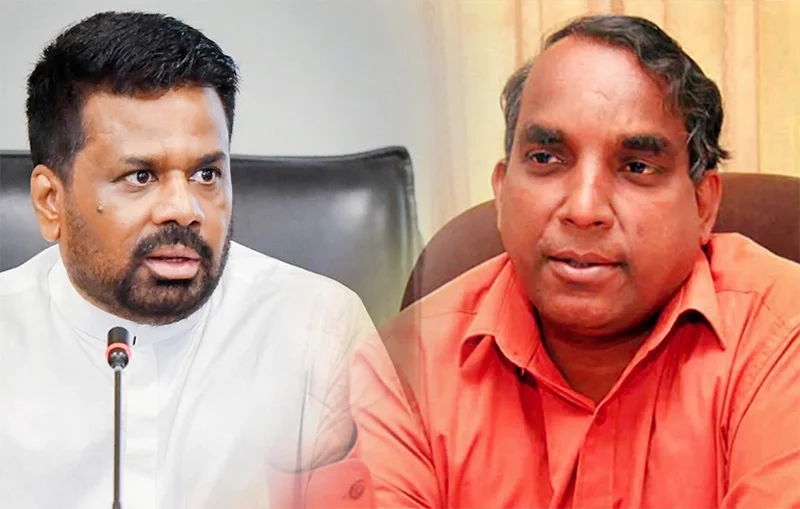
Executive Director of People’s Action for Free and Fair Elections (PAFFREL) Rohana Hettiarachchi yesterday (28) said that there were three major concerns regarding the Anti-Corruption (Amendment) Bill 2026. Acknowledging the recent Supreme Court determination, in respect of the above-mentioned Bill, that three of the provisions were not consistent with the Constitution, requiring a special majority in Parliament, with one clause requiring approval by the people at a Referendum, Hettiarachchi said nonetheless PAFFREL had decided to bring their concerns to the notice of President Anura Kumara Dissanayake.
Responding to The Island queries, Hettiarachchci said that PAFFREL sent a letter, dated 24 Sept., to President Dissanayake, regarding the issue at hand.
Petitions against the Bill was heard before a three-judge Bench of the Supreme Court, comprising Justices Shiran Gooneratne, Mahinda Samayawardena and Sampath Wijeratne.
PAFFREL and Transparency International Sri Lanka (TISL) were among the petitioners who challenged the proposed amendments to the Anti-Corruption Act No. 9 of 2023. “We did so in public interest,” Hettiarachchchi said, adding that three major concerns were (i) the breadth of the proposed redaction power and the proposed criminalisation of certain uses of publicly accessible redacted asset declarations, particularly in relation to freedom of expression, and the public’s right to meaningfully receive and impart information (ii) raising of the State or public-corporation shareholding threshold for certain asset declaration obligations from 25% to 50%, as this could exclude officers of State-linked entities in which the State holds less than 50%, in spite of such entities exercising public functions and managing public resources and (iii)role of the Director General Ranga Dissanayake.
Hettiarachchchi emphasised that though the PARREL appreciated the way CIABOC DG handled his responsibilities, centreing of power on one person was not acceptable.
Hettiarachchi urged President Dissanayake and the 159-member government parliamentary group to pay attention to concerns raised by those who moved court against the controversial Bill and address their concerns though the Parliament received the SC determination.
An International Monetary Fund mission that visited Colombo recently warned that the proposed amendments could weaken the country’s anti-corruption framework.
The mission, led by Evan Papageorgiou, was in the country from 10 to 23 September for discussions on the seventh review of the Extended Fund Facility and the 2026 Article IV consultation. (SF)
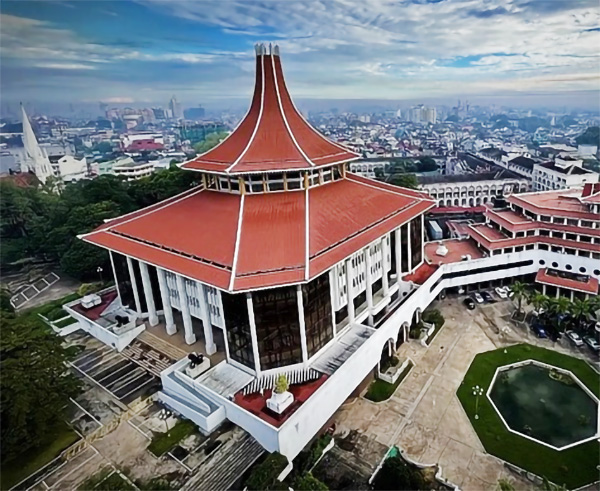
The Supreme Court yesterday (28) dismissed two petitions filed by retired Flight Lieutenant Shantha Jayathilake against Deputy Inspector General of Police of the Criminal Investigation Department (CID) Shani Abeysekara and Secretary to the Ministry of Public Security Ravi Seneviratne, and Rev. Father Cyril Gamini, alleging them of committing contempt of court.
They were the first cases dealt by the Supreme Court after the enactment of the 22nd Amendment to the Constitution.
The recipient of gallantry medal alleged that contempt of court had been committed through an affidavit previously submitted to the Supreme Court by Shani Abeysekara and Ravi Seneviratne.
The other petition alleged that contempt of court had been committed through the contents of a complaint submitted to the Criminal Investigation Department by Rev. Father Cyril Gamini.
The Supreme Court ordered that both petitions be dismissed without being taken up for hearing.
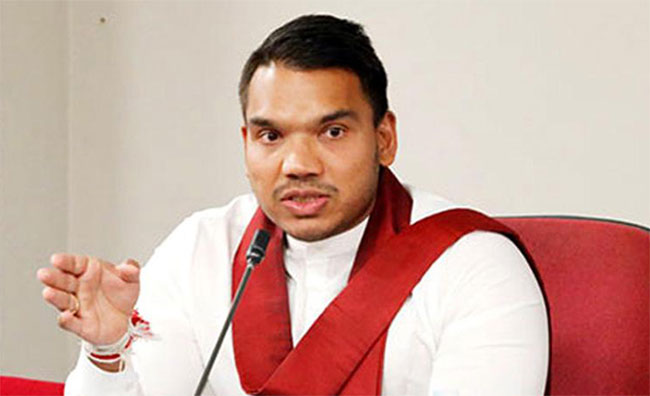
The Commission to Investigate Allegations of Bribery or Corruption (CIABOC) yesterday (28) named former Minister and leader of the SLPP parliamentary group Namal Rajapaksa as the fourth suspect in the Krrish case before the Colombo Chief Magistrate’s Court.
The MP was named as the fourth suspect in the wake of the arrest and remanding of former Executive Officer and Director of the Krrish Group, Janaki Siriwardena, regarding the payment of Rs. 70 mn to Namal Rajapaksa to facilitate the land transaction. Police arrested Ms. Siriwardena on 24 September and she was remanded till 6 Oct. pending investigations.
The investigation focuses on 4.3 acre land development in the Fort area that began in the 2013-2014 period. Investigations were launched in 2016 by the Yahapalana government, following a complaint lodged by Wasantha Samarasinghe, now a Minister in the current Cabinet.
The Indian company in this controversy is Krrish Transworks Colombo (Pvt.) Ltd .
The CIABOC named Namal Rajapaksa as a suspect in the Krrish case while he was remanded over two cases in respect of Airbus bribery probe. (SF)

Sri Lanka to face India in semi-finals after washout

Bangladesh to take on Pakistan in semis after another washout

OpenAI scraps rollout of new model over safety concerns

Iran’s Araghchi meets Qatari mediators as US calls for nuclear talks

Showers above 50 mm expected in Uva, Eastern and Central provinces and in Polonnaruwa and Mullaittivu districts after 2.00 p.m.

PAFFREL raises concerns over Anti-Corruption (Amendment) Bill

‘Dates have the highest sugar content to fight Coronavirus’

Sunday Island 27 December – Headlines

#SundayIsland 17th December – Headlines

Sunday Island – 28th March

Sunday Island Headlines – 21 March

Sunday Island – 21st February – Headlines
-
 News6 days ago
Mastermind Naufer Moulavi among 15 found guilty
-
 Midweek Review6 days ago
Thileepan’s fast unto death: An authentic narrative that many missed
-
 Latest News5 days ago
Showers above 100 mm are likely at some places in the Western, Sabaragamuwa, Central and North-western provinces and in Galle and Matara Districts
-

 Editorial6 days ago
Big Bad Bills
-
Editorial5 days ago
Crimes punished and unpunished
-

 Features4 days ago
Beyond traditional jobs: Why Sri Lanka needs to facilitate the gig economy
-

 News6 days ago
No referendum needed for passage of 22 A: SC
-
 Latest News6 days ago
Ms. P. M. Jayadeera (Engineer) appointed Director General of Irrigation