
News
TISL welcomes Anti-Corruption Bill, but flags two major concerns

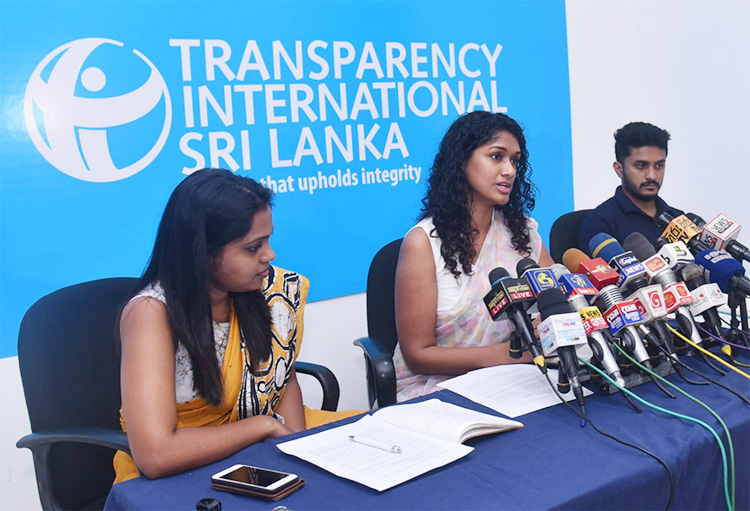
The proposed Anti-Corruption Bill contained several laudable provisions that seek to improve upon the existing anti-corruption legal framework in Sri Lanka, TISL, Deputy Executive Director Sankhitha Gunaratne said addressing a press conference held at its office in Nawala, Rajagiriya yesterday (11).
The proposed Anti-Corruption Bill, which seeks to replace the Bribery Act (Chapter 26), the Commission to Investigate Allegations of Bribery or Corruption Act No. 19 of 1994, and the Declaration of Assets and Liabilities law No. 1 of 1975, has been gazetted and is expected to be tabled in the Parliament soon. This Bill was open for observations from different stakeholders including TISL and other civil society organizations, activists, and the public.
“Specifically recognising sexual favours as a form of gratification, including private sector corruption, and corruption offences related to sporting events within its ambit, are important changes introduced in this Bill. The Bill also significantly increases fines that can be imposed for offences,” she highlighted.
She said: “Notably, some of the changes to the Declaration of Assets and Liabilities Law that anti-corruption activists including TISL have been advocating for a few years, have now been incorporated into this Bill. In the proposed asset declaration system, there will be a central authority (CIABOC – the Commission to Investigate Allegations of Bribery or Corruption) with which all the declarations of assets and liabilities will be filed. The asset declarations will be made publicly available through an electronic system, subject to the redaction of certain sensitive information. This electronic system will identify red flags regarding the illicit enrichment of the individuals to whom this law applies. The proposed law also requires the President to file their declaration of assets and liabilities, unlike the current law.
However, TISL notes two serious concerns in the proposed law. It seeks to override all other written law, which includes the Right to Information Act. The proposed law contains sections that require officials of the CIABOC to sign oaths of secrecy and therefore, the disclosure of information by CIABOC under the new law will only be possible with special permission from the Commission. As such, the proposed law promotes a culture of secrecy by making access to information from the CIABOC more difficult and thereby negates the objective to “enhance transparency in governance,” as stated in the Bill.
TISL also notes that Section 119 of the Bill, which refers to false allegations, appears to send a negative signal to citizens willing to come forward as informants and whistleblowers to report corruption. While the similar provision in the current law has not been misused targeting corruption fighters, this particular provision could become seriously counterproductive and dangerous in a context of a politically influenced public service, or in an adverse environment of stifled civic space, democratic deficits, weak governance or kleptocracy. As an organization that advocates for citizens’ freedom of expression, TISL believes that the proposed Bill should be more robust and progressive enough to encourage whistleblowers and citizens to come forward and report corruption without fear of repercussions, while discouraging the corrupt.
TISL further emphatically highlights that the law itself, on paper, cannot create solve the plague of systemic corruption in Sri Lanka since the effectiveness of the law will entirely depend on its enforcement. For instance, the Bill provides for joint investigations and international co-operation, which will have no impact unless this is practically implemented. Under this Bill, the CIABOC is granted immense police powers, which provides adequate space for CIABOC to carry out its functions. TISL reiterates that the successful implementation of those functions depends on the level of independence the Commission is given, starting with the appointment of the Commission and the Director-General, the creation of an enabling environment where the commission and law enforcement officials are able to act without undue influence and intimidation, availability of resources including human resources, financial independence, and knowledge capacity. The mere passage of this Bill, despite its progressive portions, will not be able to address the issue of corruption in Sri Lanka until there is the political will to lead the country by example, a system change that includes a cultural shift where the people resist corruption even at the petty level, and a context that is conducive to the whistleblowers.
Therefore, TISL calls upon the government, with the technical assistance of the International Monetary Fund (IMF) to rectify these concerns in the law forthwith, and further, to continue to engage with citizens, experts, and civil society, in order to adopt a holistic approach to achieve the envisaged goal of eradicating corruption in Sri Lanka.
TISL Advocacy and Research Manager Janithrika Jayasundara, TISL Legal Officer – Community Sector Piumi Madushani and TISL Programme Officer-Communication Rifdhi Nawas also addressed the press.












Approval has been granted at the Cabinet meeting held on 22.07.2024 to publish the draft bill of State Assets Management Act in the government gazette notification and thereby present it to the Parliament for its concurrence.
However, the draft bill couldn’t be passed in Parliament as a result of the Parliament being dissolved in the month of October 2024.
Thereafter, the draft bill was subject to further inspection by a
committee appointed which comprised of officials and authorities on the subject.
The said Committee has recognized the amendments to be made and a fundamental draft has been prepared including the proposed amendments.
Accordingly, the Cabinet of Ministers approved the resolution furnished by the President in his capacity as the Minister of Finance, Planning and Economic Development to suspend further activities regarding the draft bill of State Assets Management Act published in the extraordinary gazette of 02.08.2024, and to direct the Legal Draftsman to prepare a draft bill based on the fundamental draft prepared by the subject specialists’ committee.
Considering the compliance of the Cooperative Societies’ operations with the concurrent socio – economic circumstances as well as the changes in the common law, the requirement of amending the Cooperative Employees Commission Act No. 12 of 1972 has been recognized.
A fundamental draft including proposed amendments based on the experience gained by that Commission as well as the opinions and proposals of Cooperative societies, their director board members, cooperative employees and other interested parties has been prepared.
Accordingly, the Cabinet of Ministers granted approval to the resolution furnished by the Minister of Trade, Commerce, Food Security and Cooperative development to provide instructions to the Legal draftsman to prepare a draft bill to amend the Cooperative Employees Commission Act No. 12 0f 1972, based on the said fundamental draft.
Latest News
Dilki Wathsala Marambage appointed as Director General of the Department of Technical Education and Training

The Cabinet of Ministers granted approval to the proposal forwarded by the Prime Minister in her capacity as the Minister of Education, Higher Education and Vocational Education to appoint Mrs. Dilki Wathsala Marambage to the post of Director General of the Department of Technical Education and Training.

Cabinet approves redrafting of State Assets Management Act
Cooperative Employees Commission Act No. 12 of 1972 to be amended
Dilki Wathsala Marambage appointed as Director General of the Department of Technical Education and Training
Declaration of Naakolagane Sanctuary under the Fauna and Flora Protection Ordinance
Cabinet approves transfer and maintenance of selected roads presently under PC’s and Local Authorities to the RDA
Obtaining financial facilities for the Water Supply and Sanitation Improvement Program (Sub-program 2) from the ADB

‘Dates have the highest sugar content to fight Coronavirus’

Sunday Island 27 December – Headlines

#SundayIsland 17th December – Headlines

Sunday Island – 28th March

Sunday Island Headlines – 21 March

Sunday Island – 21st February – Headlines
-

 Features6 days ago
The Sri Lankan who made Scottish history
-

 Sports6 days ago
Nissanka absence opens door for Sri Lanka’s young guns
-

 News5 days ago
NDB fraud Rs 60mn more than reported
-

 News7 days ago
Gnansara Thera to be assigned to prison printing section: Officials
-

 News5 days ago
Removing monk’s robes matter for Sangha to decide: Mahanayake Theras
-
 News7 days ago
OIC of FCID summoned before Maligakanda Magistrate
-

 Features6 days ago
Future of Sri Lanka’s state university system: Should it be shut down and reopened?
-

 News6 days ago
Shiranthi R remanded until 13 Oct.