
News
SC allows TISL to intervene : X-Press Pearl case


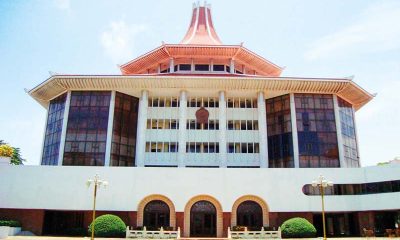
The Supreme Court, on Friday, granted permission for Transparency International Sri Lanka (TISL) to intervene in Case No. SC/FR 168/2021, which seeks fair compensation for the victims of the X-Press Pearl disaster.
The decision came after a heated legal battle that saw the Attorney General’s office strongly opposing the TISL’s involvement.
Earlier this year, TISL filed an intervention petition in the Supreme Court, aiming to shed light on several critical issues surrounding the X-Press Pearl disaster and the compensation claims. Senior Counsel Senany Dayaratne represented TISL in court, with a team of Attorneys-at-Law, including Lasanthika Hettiarachchi, Sankhitha Gunaratne, Nishadi Wickramasinghe, and Thiru Amirthalingam, under the guidance of Attorney-at-Law Thushari Jayawardena.
On Friday (06), the Supreme Court delivered its order, allowing TISL’s application for intervention. The decision was based on a careful consideration of the totality of the circumstances of the case and the submissions made by both parties. The Attorney General was represented by ASG Nerin Pulle, PC, and DSG Nayomi Kahawita.
Several key points were raised in TISL’s
intervention petition, highlighting the urgency and significance of its involvement in the case:
1. Allegations of Interference and Extraneous Pressure:
TISL expressed grave concerns about allegations of interference and extraneous pressure related to the compensation claim arising from the XPress Pearl disaster. These allegations cast doubt on the integrity of the compensation process and call for a transparent investigation.
2. Justice Minister’s Statement: TISL referenced the statement made by the Justice Minister in Parliament on April 25, 2023. In this statement, it was revealed that one Chamara Gunasekara, also known as Manjusiri Nissanka, had allegedly received a payment of USD 250 million into a private bank account in connection with the XPress Pearl disaster. TISL seeks clarity on the circumstances surrounding this payment.
3. Claims by Chinthaka Waragoda: TISL pointed to media statements made by Chinthaka Waragoda, who reportedly invented a machine to remove debris that washed ashore after the shipwreck. Waragoda alleged that he was offered payment to discontinue the use of his machine, purportedly to prevent the full extent of the damage caused by the disaster from becoming public knowledge. TISL aims to investigate these claims further.
4. Quantum of Compensation: Questions have been raised about the quantum of compensation due to Sri Lanka for the damages caused by the MV XPress Pearl. TISL intends to ensure that a fair and accurate assessment of the compensation owed to the country is conducted, taking into account the full extent of the environmental and economic impact of the disaster.









Latest News
Sun directly overhead Kokkuvil, Nallur, Kodikamam and Nagar Kovil at about 12.11 noon today (28)


The sun is going to be directly over the latitudes of Sri Lanka during 28th of August to 07th of September due to its apparent southward relative motion.
The nearest places of Sri Lanka over which the sun is overhead today (28) are Kokkuvil, Nallur, Kodikamam and Nagar Kovil about 12.11 noon.

Police to arrest and question four former ministers, others over links to Basik
By Norman Palihawadane
Police are investigating alleged links between suspected major drug trafficker Shiran Basik and a number of prominent politicians, with eight of them due to be arrested and questioned as investigators widen their probe into his financial dealings and network of associates, police headquarters, according to a senior police officer.
Among those set to face questioning include a sitting MP, four former ministers, and at least one of them is a female. Police are also investigating allegations that Basik provided large sums of money to politicians during election campaigns and extended other financial and material benefits to political figures.
Investigators are also looking into claims that two politicians were provided with facilities to construct houses and hotels, while efforts are under way to establish the extent of political support and assistance allegedly provided to Basik.
The Colombo Central Crime Investigation Bureau (CCIB) is expected to question the politicians based on information reportedly disclosed by Basik during interrogation. Two electoral organisers are also expected to be taken into custody as part of the ongoing investigation, according to police sources.
Meanwhile, statements are being recorded from managers and employees of several businesses allegedly linked to Basik, while investigators continue to examine information and records recovered from his mobile phone.
Basik, 48, was brought back to Sri Lanka on August 14 after being arrested in Dubai and deported. He was taken into custody by officers of the Criminal Investigation Department’s Airport Unit at Bandaranaike International Airport and subsequently handed over to the CCIB for further investigation.
Police initially obtained a 72-hour detention order to question Basik before securing approval to detain him for 90 days.
Basik, a resident of Dehiwala, is facing investigations over alleged large-scale drug trafficking as well as firearms, and unlawful assembly of weapons-related offences. Police are also examining whether he had any involvement in recent prison-related incidents and have said information has emerged linking him to the 2012 Welikada Prison riot.
The investigation has also expanded to Basik’s alleged assets and business interests in Sri Lanka and overseas.
Police have said information uncovered during questioning indicates that Basik had claimed ownership of five hotels along Colombo’s Marine Drive. Investigators have also identified two houses and two mobile phone shops in Boralesgamuwa allegedly linked to him.
A court has ordered a comprehensive examination of bank accounts linked to Basik, with the Financial Intelligence Unit of the Central Bank of Sri Lanka to conduct a review of his financial accounts. A separate investigation into his wealth and properties is being conducted by the Illegal Assets Investigation Division.
Investigators are also examining claims that Basik owns properties, including hotels and vehicles, in several European countries, as well as a high-value vehicle in Dubai. These claims remain subject to further investigation.
Basik had left Sri Lanka for Dubai in 2018, where police said he lived a lavish lifestyle while operating businesses. He was arrested by UAE authorities before being deported to Sri Lanka.
During initial questioning, Basik told investigators that Dubai police had stopped and searched him at a shopping mall and examined his mobile phone. He claimed that footage relating to Iranian missile and drone attacks was found on the device and that he was subsequently questioned over alleged links to Iran.
Police are continuing to examine the circumstances surrounding his arrest and deportation, as well as the information contained in his mobile phone and other evidence gathered during the investigation.
The ongoing probe is being conducted under the supervision of Senior DIG Ranmal Kodituwakku and SSP Kamal Ariyawansa.The allegations against Basik and the politicians named in connection with the investigation have not been established in court, and the investigations remain ongoing.

The Bar Association of Sri Lanka (BASL) has opposed the proposed “Twenty-Second Amendment to the Constitution”, saying it raises serious concerns over judicial independence and the rights and interests of the public.
In a statement signed by BASL President Rajeev Amarasuriya and Secretary Nalin De Silva, the association said it had challenged the constitutionality of the proposed amendment before the Supreme Court.
The BASL noted that the Chief Justice would be the first Supreme Court judge to benefit from the proposed amendment if it becomes law. It also referred to widespread speculation that the amendment was being expedited to facilitate an extension of the incumbent Chief Justice’s tenure, which is due to end on December 1, 2026.
Full text of the statement:
“The Bar Association of Sri Lanka (BASL) has taken a principled position opposing the Bill titled the “Twenty-Second Amendment to the Constitution” on the basis that it raises serious concerns regarding the independence of the Judiciary and the rights and interests of the people. Accordingly, the BASL has challenged the constitutionality of the proposed amendment before the Supreme Court.
“It is observed that it will be the Honourable Chief Justice who will be the first Judge of the Supreme Court who will benefit from the 22nd Amendment, if this Bill is enacted into Law.
There is widespread belief that this amendment is being rushed to facilitate the extension of the tenure of the Honourable Chief Justice which would otherwise complete on 1st December 2026. In this backdrop, in the recent past, we have witnessed allegations being made in Parliamentary Proceedings as well as on Social Media concerning the Judiciary including the incumbent Chief Justice.
“During this period, the BASL has also been subjected to unfounded attacks on social media and other platforms.
“The Judiciary, like every other institution exercising public power, must remain subject to legitimate scrutiny and accountability. Judgments, judicial conduct and the administration of justice may properly be subjected to fair, informed and responsible criticism. Where credible concerns or allegations arise regarding any member of the Judiciary, including the Chief Justice, they should be examined objectively and addressed through the appropriate constitutional and parliamentary processes which are in place, with due regard to fairness and due process.
“At the same time, everyone must exercise responsibility when making allegations concerning individual judges, lawyers and others. Personal attacks based upon unsubstantiated allegations can undermine public confidence in the administration of justice and affect the independence and integrity of the judicial process and the system of justice
“Judicial independence is not intended to shield any individual from legitimate scrutiny or accountability. It is a safeguard for the people, ensuring that disputes are determined impartially and that individual rights, the Rule of Law and the constitutional order are protected.
“The BASL therefore calls upon all organs of the State, all parties concerned and the media to respect the role of the Judiciary and the system of administration of justice, while ensuring that any genuine concerns are addressed fairly, responsibly and through the procedures established by the Constitution and the law.”

Sun directly overhead Kokkuvil, Nallur, Kodikamam and Nagar Kovil at about 12.11 noon today (28)

Showers above 75 mm are likely at some places in the Western and Sabaragamuwa provinces and in Kandy, Nuwara-Eliya, Galle and Matara districts

Eight politicians in drug kingpin probe

CJ first SC judge to benefit from 22A, if enacted: BASL

Over 84,000 people adversely affected by prevailing El Niño dry weather

Rooftop solar systems over 300kW to be temporarily switched off

‘Dates have the highest sugar content to fight Coronavirus’

Sunday Island 27 December – Headlines

#SundayIsland 17th December – Headlines

Sunday Island – 28th March

Sunday Island Headlines – 21 March

Sunday Island – 21st February – Headlines
-

 Business6 days ago
SriLankan Airlines makes ShakthiSAT Mission possible for talented Sri Lankan student
-

 Latest News7 days ago
Imran Khan moved to private hospital amid deteriorating health
-

 Latest News7 days ago
Government has declared 21, 22 and 23 August 2026 as national days of mourning
-
 Features5 days ago
My secondary schooling after Royal Primary
-
 Features5 days ago
From the First to the 22nd: A short history of Amendment Politics and Reform Frustrations
-

 Latest News6 days ago
Tharanga edges out Chopra in 88m javelin battle
-

 News3 days ago
Missing doctor’s body found in Mahiyanganaya
-
 Features5 days ago
How Shelton Kodikara became first Professor of International Relations