
Features
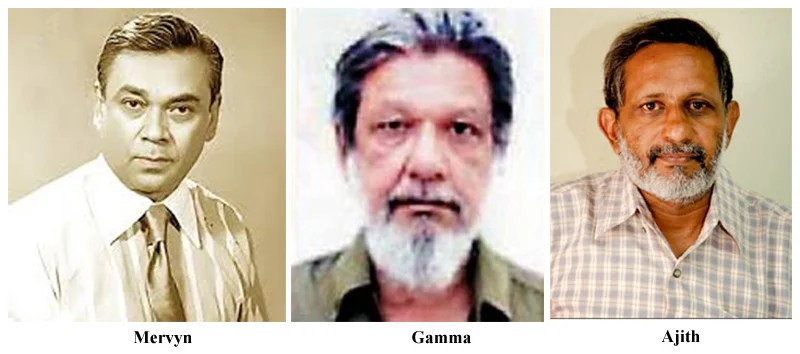
Three Great Editors: Mervyn, Gamma and Ajith

Journalism Awards for Excellence – 25th Anniversary
by Dayan Jayatilleka, PhD
(Reproduced from the souvenir for 25th Journalism Awards for Excellence ceremony to be held today.)
MERVYN
Mervyn de Silva
has been described as “the greatest journalist that Sri Lanka ever produced” (Radhika Coomaraswamy, 2001). Furthermore, “… [Mervyn’s] literary critical writing…and his affirmative humanism that grew from it enriched the world of journalism in Sri Lanka as no one else has done.” (Godfrey Gunatilleke, 2005).
Mervyn began as a free-lancer, joined the profession as a cub-reporter, became Deputy Editor, Observer, and reached the top as Editor Daily News and Editor-in-Chief. Choosing to remain in Sri Lanka declining lucrative job offers in journalism overseas, he made his mark in the elite international media as Colombo’s correspondent for the BBC, The Economist (London), the Financial Times (London), Times of India and India Today.
An unmatched achievement in Sri Lanka, Mervyn became the Editor-in-Chief of the two largest, rival journalistic establishments of the day: Lake House and The Times Group.
He was not only a print journalist, but also a veteran radio journalist, a broadcaster with programmes on literature (‘Off My Bookshelf’) and foreign affairs, running for decades. He also had a world affairs programme on Rupavahini TV in which he was the ‘talking head’ interviewed by Eric Fernando.
He wrote influentially on national politics while it was widely acknowledged that “No one was more aware of international affairs than Mervyn de Silva…one of the pioneer intellectuals of non-alignment” (Radhika Coomaraswamy 2001).
In print journalism he excelled in diverse roles, as a critic on literature and film, as columnist from his earliest days in journalism, ‘Daedalus’ being his first penname, ‘The Outsider’ the second, and ‘Kautilya’ his last. An authoritative and memorably stylish editorialist, he was also a subversively satirical columnist (and occasional versifier).
In a singular honour, in 1971Mervyn de Silva spent a month in DC working with the legendary Foreign Editor of the Washington Post, Phil Foisie, at the end of which a think-piece by Mervyn was given a rare full-page spread in The Washington Post (1971).
He also authored two Editorial page pieces in the International Herald Tribune (1986). In a ‘world scoop’ he broke the story on the Indo-Sri Lanka Accord (1987) in the Financial Times. Prime Minister Premadasa first came to know of the Accord reading Mervyn in the FT in Tokyo.
Published in and broadcast by the elite Western media, he was also a Vice-President of the International Organization of Journalists (IOJ), the vast network of Soviet bloc and Nonaligned journalists, a rare personification of the confluence of two contending currents and traditions in international journalism: Western liberal-democrat and Socialist/Third World.
His passionate adherence to the highest international standards of journalism and editorship saw him removed from his post twice, by two ideologically antipodal Governments—Sirimavo Bandaranaike’s and JR Jayewardene’s.
Having reached the apex in mainstream newspaper journalism, Mervyn founded a progressive magazine, repeating his achievement this time in ‘alternative periodical journalism’ as publisher/ founder-editor of the Lanka Guardian.
Mervyn was referred to in the world press as Sri Lanka’s Hassanein Heikal, Nasser’s friend and legendary editor of Al-Ahram (Cairo), and Sri Lanka’s Nikhil Chakravartty, iconic editor of Mainstream (Delhi).
GAMMA
Gamini Weerakoon
, universally known as Gamma, was Sri Lanka’s greatest wartime editor. Unlikely as it may seem, when I look in long retrospect, there was a flicker of that potential already discernible when I first saw him in the early 1970s.
As Editor, Daily News, and Editor-in-Chief, Lake House, Mervyn de Silva (and wife Lakshmi) hosted two parties annually: one, drinks and dinner for the staffers of the English-language Lake House press and foreign journalists in town; the other, cocktails for the diplomatic corps—the former at the private hall upstairs of the Chinese Lotus Hotel in Colpetty, the latter at the Galle Face Hotel. As precocious only son barely in his teens (and long trousers), I was present at the first event.
Gamma Weerakoon, tall, ginger-bearded, gravelly voiced, was a singularly imposing physical presence in the corner by the open windows, holding court amidst a crowd of journos shaking with laughter. As I edged closer I got what it was all about: Gamma had a non-stop stream of stories, mimicry and punchlines which were as unprintably salacious as they were undeniably hilarious. What remained in the mind—apart from a wicked imitation of an Indian cricket commentary—was the man’s personality. You could never ignore him.
“I learned from the best” Gamma told me at my father’s funeral in 1999, referring to his Editors/bosses. If Mervyn, behind his editorial desk, always in suit-and-tie, jacket slung on his chair-back, the most stylishly attired of Sri Lankan Editors, was a respected boss and remote father figure for journalists, Gamma in his rolled sleeves, always accessible in the newsroom –the ‘shopfloor’ so to speak– was the elder brother figure. His inimitable leadership style as Editor was already incubating.
Mervyn had left mainstream journalism in 1978 and founded the fortnightly Lanka Guardian magazine. A journal was a more conducive vehicle for critical inquiry about the larger Lankan crisis. Making a comeback having been sacked by Sirimavo and JR, founding and sustaining a periodical which immediately had high visibility and impact, made Mervyn a legend once again, but Gamma’s challenge as Editor of a relatively new mainstream newspaper was equally if differently demanding.
Vijitha Yapa, The Island’s first editor was also an outstanding wartime editor but he quit journalism to establish his famous bookstore. Gamma was on the frontlines every day, in the journalistic trenches, giving leadership during decades of civil wars and foreign military intervention.
The task of the editor of a state-run newspaper was simple in wartime. Gamma wasn’t one. He captained a privately-owned paper which had to maintain credibility as it reported the news, took editorial stands, published diverse commentary. A strong man, he was the courageous editor of a combative newspaper which provided an indispensable space for sovereignty and freedom, democracy and order against all comers, during the most massively violent period of our history in a century.
AJITH
Ajith Samaranayake’s
entry into professional journalism was facilitated by the LSSP theoretician Hector Abhayavardhana, but well before he joined Lake House, he had been published in the prestigious editorial page of the Ceylon Daily News by Mervyn de Silva. That first foray in the early 1970s was a perfectly written little piece, the title of which caught the eye of the editor who was always sympathetic to the off-beat, provided it was well-written. Ajith wrote unforgettably on ‘Why I Failed the A-levels Three Times’.
The next time Ajith caught Mervyn’s eye was in 1976, when I had pointed out to him a report at the bottom of the Daily Observer’s front page, on a ‘Sweep-Ticket Seller’. It was a mini-masterpiece of a ‘human interest story’. Mervyn called in Ajith and gave him a regular slot and larger responsibility which opened his pathway eventually to the Editor’s chair of The Island and the Sunday Observer respectively.
Several things distinguished Ajith as a journalist and Editor. He apprenticed with those who belonged to the first post-Independence generation of the intelligentsia and journalism (like Mervyn), but was himself of a younger generation than most of his colleagues, which meant he was socialised, formed, in a different time of The island’s history, had a different vantage-point and brought to bear different perspective.
Born in 1954, Ajith grew up not only in post-1956, but also post-1971 Sri Lanka. Though he had been mentored by highly literate left and liberal minds of an older generation, Ajith filtered that knowledge through the very different collective experience of his tormented generation and let his considerable reading illumine that experience. Ajith’s sensibility was shaped by engagement with the bilingual arts, politics, writings, reflections and personalities of our contemporary history.
He was a bridge that brought the work of the Sinhala-educated intelligentsia, especially the cultural intelligentsia, to the attention of the readers of mainstream English-language newspapers, while he enriched the endogenous intelligentsia by bringing to bear the best of western (including Marxist) literary criticism to the evaluation of their work.
In that sense Ajith was carrying on the pioneering cross-cultural criticism of Charles Abeysekara and Sarath Amunugama.
Ajith Samaranayake was primarily a cultural critic in whose contributions as journalist and Editor, the socio-cultural dimension bulked large.
His superb ‘situating’ of personalities past, made Regi Siriwardena dub him ‘the prince of obituarists’.
One of Ajith’s acts as Editor, The Island was to give the forgotten but influential radical literary critic and lecturer at the University of Kelaniya, Ranjith Gunawardena, a half-page column on writers and criticism, which ran into a series of several dozen articles.
Tragically, an inescapable aspect of journalistic culture universally, proved to be Ajith’s undoing. Mervyn and Gamma introduced him to the bars where he met the journalistic fraternity. A heavy but self-controlled drinker, Mervyn never touched local booze even as a reporter, while Gamma had a boxer or ruggerite’s physique to absorb anything he drank. Ajith, frail, never had the stamina but could never kick the habit. It took him on a downward spiral to the lower depths, once too often.

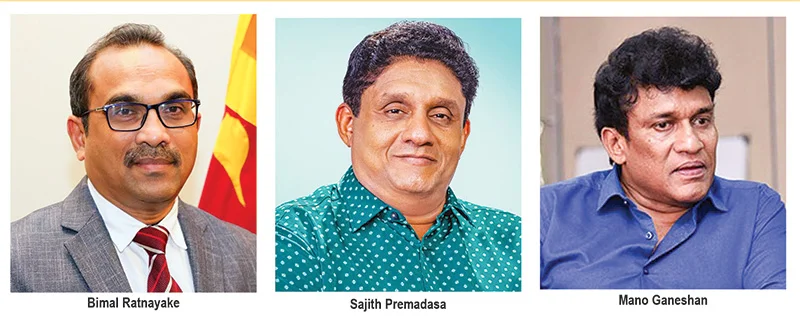
At a symposium on reconciliation organised by the National Peace Council last week, more than 250 religious clergy, civic activists and political representatives from different communities gathered to discuss the country’s future. Speaking at the event, Minister Bimal Rathnayake explained the government’s approach to national reconciliation. He said the government viewed the country’s recovery in terms of a three stage process. The first stage was stabilisation, the second was development and the third was transformation. Reconciliation, he implied, would come in that final stage. The participation of Opposition Leader Sajith Premadasa at the same symposium, and the constructive nature of his comments, strengthens that hope.
When the present NPP government took office in 2024, the country was emerging from one of the gravest crises in its post Independence history. The economic collapse of 2022 had led to shortages of fuel, food, medicines and electricity. Inflation soared, foreign reserves disappeared and long queues became part of daily life. The political upheaval that followed culminated in the resignation of former President Gotabaya Rajapaksa after mass public protests under the banner of the Aragalaya movement. The country was then governed by a leadership that spoke the language of reform and reconciliation but was widely perceived as lacking a direct popular mandate.
Sri Lanka’s past experience suggests that stabilisation and transformation cannot be treated as entirely separate stages. Postponing reconciliation until some future moment risks repeating the failures of the past. If transformation is endlessly delayed until a supposedly perfect moment arrives, there will always be new crises and new reasons for postponement. Minister Rathnayake’s contention that the government’s immediate priority has necessarily been stabilisation flows from the government’s awareness of the precarious situation the country is. Over the past two years, the government has succeeded to a significant extent in restoring economic and political stability. Inflation has reduced, shortages have ended and public institutions have regained a degree of functionality.
Guaranteed Changes
On the other hand, the country’s development continues to face challenges due to adverse global conditions, including disruptions caused by conflict in the Middle East and extreme weather events that have affected tourism, trade and the cost of living. The danger is that reconciliation may be indefinitely postponed in the name of stabilisation. This danger can be reduced if the government works proactively with the opposition and civil society to commence practical measures of transformation now rather than later. The participation of Opposition Leader Sajith Premadasa at the symposium, and the constructive nature of his comments, has strengthened the sense that bipartisan engagement on reconciliation may now be possible.
The urgency of transformation came through strongly in the presentations made by representatives of the Sri Lanka Tamil and Malaiyaha Tamil communities. ITAK parliamentarian S.Shritharan spoke of the frustration caused by unresolved post war issues in the north and east. He referred to disputes regarding land occupied during the war years, including controversies linked to Buddhist temples and state sponsored settlement activity in areas claimed by local communities. He also pointed to the continuing large scale presence of the security forces in the north and east nearly two decades after the end of the war. These grievances have remained central to Tamil political discourse since the end of the armed conflict in 2009. Families displaced by war continue to seek the return of ancestral lands. Civil society organisations in the north have repeatedly called for greater civilian control over local administration and a reduction in military involvement in civilian life.
Academic research and practical work on the ground have shown that reconciliation cannot be separated from questions of dignity, equality and justice. Former minister Mano Ganesan, leader of the Democratic People’s Front, focused on the longstanding problems faced by the Malaiyaha Tamil community. He spoke passionately about continuing housing shortages, landlessness and economic marginalisation, issues that have persisted since Independence. He also highlighted the devastating impact of recent extreme weather events on estate communities that remain socially and economically vulnerable. The condition of the Malaiyaha Tamil community remains one of the enduring social justice issues in Sri Lanka.
After Independence in 1948, a large proportion of them were denied citizenship and voting rights through legislation that rendered them stateless. Though citizenship rights were eventually restored, the social and economic consequences of exclusion continue to be felt generations later.
Many families still lack secure housing and land ownership despite their immense contribution to the country’s plantation economy. Minister Rathnayake’s responses to both these concerns were politically significant. He argued that recent political developments, including the declining influence of narrow ethnic politics across communities, indicated a major shift in public attitudes. According to him, the political ground has changed in ways that make it increasingly difficult for politicians who rely primarily on ethnic division and communal insecurity to retain public support.
Inter-Connected
There is evidence to support the assessment about the changing political grounding which sees future prospects in the resolution of long standing problems. . The economic collapse of 2022 affected all communities alike and generated a new politics centred on governance, anti corruption, accountability and economic justice. The Aragalaya protests brought together Sinhalese, Tamils and Muslims in a common demand for political change. Although ethnic grievances have not disappeared, the crisis created space for a broader understanding that the country’s future depends on cooperation rather than division. Opposition Leader Premadasa’s comments at the symposium reflected this changing political climate. He emphasised that national reconciliation could not be separated from economic justice and the need to address disparities between regions and social classes.v He also mentioned the need for civil society organisations to take this message to the community. This wider understanding of reconciliation is important because ethnic inequality and economic inequality have often reinforced each other in Sri Lanka’s history.
Academic studies have identified the denial of citizenship rights after Independence as a historic injustice that set back the Malaiyaha community for decades. The challenge now is to ensure that transformation becomes part of the stabilisation and development process itself. Practical first steps are both possible and necessary. The release of civilian lands still under state control, greater devolution of administrative authority, reduction of military involvement in civilian affairs, language equality in public administration and accelerated housing and land ownership programmes in the plantation sector are all measures that can begin immediately without waiting for a final stage of transformation.
The government’s recent commitment that provincial council elections will finally be held this year is therefore significant. These elections have been repeatedly postponed by successive governments. Holding them would not solve the ethnic conflict by itself. But it would signal a willingness to restore democratic institutions and share power in a meaningful way.
Sri Lanka has repeatedly postponed difficult reforms in the hope that a more convenient political moment would eventually arrive. But opportunities are invariably created and fought for instead of being provided as a gift by a benevolent government.
The present moment, shaped by the economic crisis and public demand for accountable government, offers a rare opportunity to move simultaneously towards stability, development and reconciliation. Provincial council elections can be the first meaningful step. But they must not be the last.
by Jehan Perera
In a significant move aimed at steering Sri Lanka’s environmental governance towards a more science-based and evidence-driven path, the Ministry of Environment has initiated a new collaborative mechanism to integrate leading researchers into national policy formulation and conservation planning.
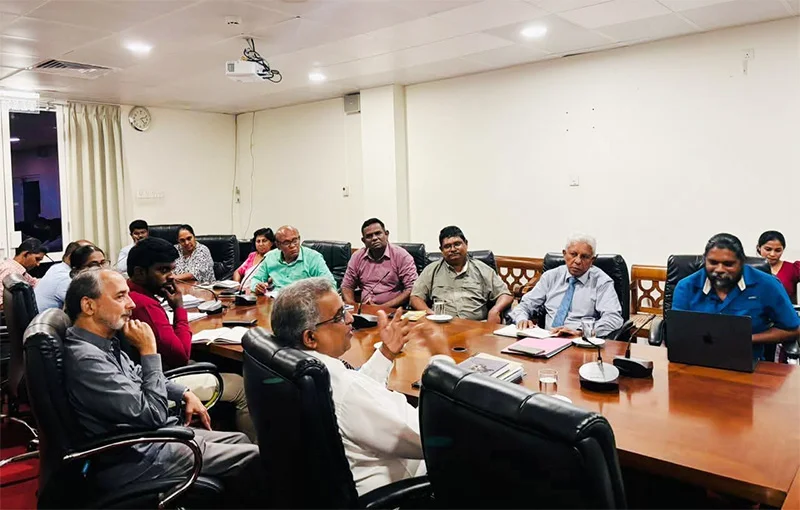
The initiative was discussed at a high-level meeting chaired by Dr. Dammika Patabendi at the Ministry of Environment on Tuesday, where top environmental scientists, wildlife experts and researchers were invited to contribute towards what officials described as a “strategic transition” in the country’s environmental management framework.
The discussions focused on strengthening the scientific basis of environmental conservation programmes and national policy decisions while creating a more research-friendly environment for academics and field scientists engaged in biodiversity and ecological studies.
Particular attention was paid to long-standing concerns raised by researchers regarding procedural and operational difficulties encountered when conducting studies in collaboration with the Department of Wildlife Conservation and the Forest Department.
Minister Patabendi stressed the need for environmental policies to be guided by credible scientific data rather than ad hoc administrative decisions, ministry sources said.
Among the key proposals discussed was the establishment of a streamlined mechanism that would reduce bureaucratic obstacles faced by researchers in obtaining approvals, accessing field sites and sharing scientific findings with state institutions.
The Minister highlighted the importance of building stronger partnerships between policymakers and the scientific community at a time when Sri Lanka is grappling with escalating environmental challenges including deforestation, biodiversity loss, human-elephant conflict, climate-related disasters and ecosystem degradation.
Environmentalists attending the meeting had also highlighted the urgent necessity of incorporating empirical research into national decision-making processes to ensure long-term ecological sustainability and better resource management.
The meeting brought together several of Sri Lanka’s leading environmental researchers and academics including Rohan Pethiyagoda, Saminda Fernando, Sewwandi Jayakody, Samantha Gunasekara, Dinidu Devapura, Himesh Jayasinghe, Manoj Prasanna, Mendis Wickramasinghe and Suranjan Karunarathna.
Director General of Wildlife Conservation Ranjan Marasinghe also participated in the deliberations.
Officials said the proposed framework is expected to pave the way for a more transparent, data-oriented and scientifically credible environmental governance structure capable of addressing emerging conservation challenges more effectively.
The government expects the new mechanism to support the implementation of practical and scientifically robust programmes aimed at safeguarding Sri Lanka’s ecological future while enhancing cooperation between state agencies and the country’s growing community of environmental researchers.
By Ifham Nizam
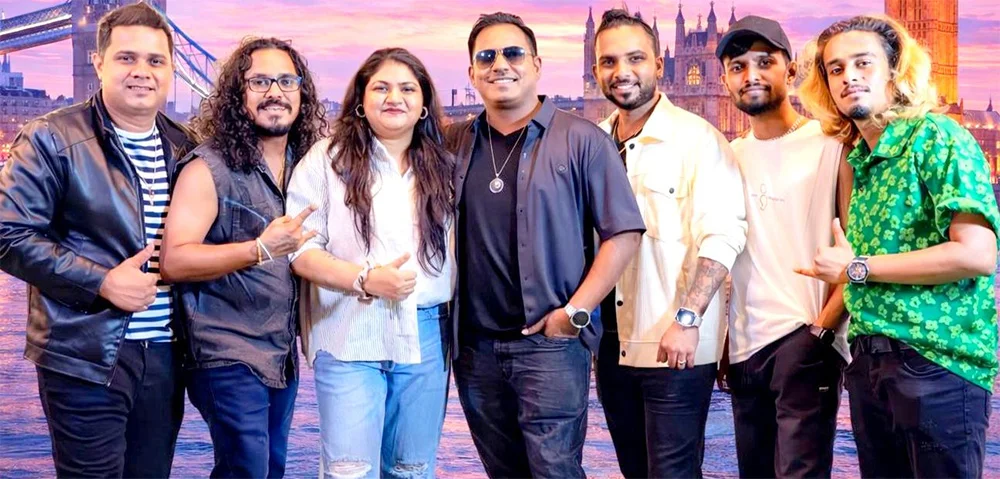
 Niluk Uswaththa, of Seven Notes fame, based in Dubai, surprised many when he and his wife Apeksha, turned up in Colombo, last week … unannounced.
Yes, they had a purpose in their surprise visit … to wish Apeksha’s mum for her birthday, which was on Monday, 18th May, and what a surprise it turned out to be!
In an exclusive chit-chat with The Island, Niluk said that the scene in Dubai is improving and Seven Notes do have work coming their way.
Since the members of Seven Notes are all employed (doing day jobs), they operate only on Saturdays and Sundays.
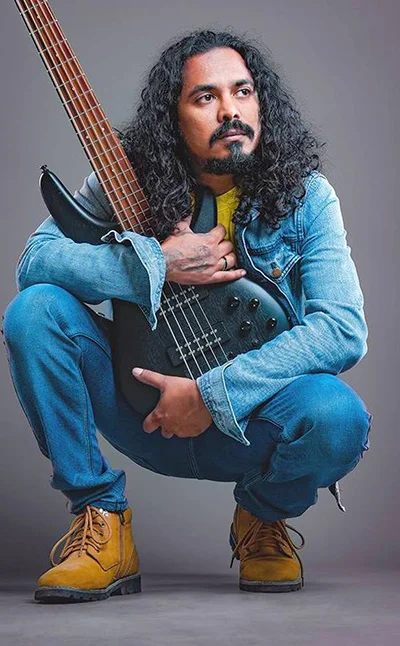
Niluk: Didn’t come prepared to perform, but obliged
friends in Galle
In fact, to get to Colombo for the birthday surprise (on Monday, 18th May), the band had to skip their 17th May, Sunday gig.
“Although it’s a short vacation, my wife and I are enjoying the setup here,” said Niluk, adding that they spent two days in Galle and that their next destination is Anuradhapura.”
Niluk didn’t come prepared to perform, but he obliged the crowd present, at a friend’s birthday celebrations, in Galle, singing and playing guitar.
They are scheduled to leave for their home, in Dubai, in the first week of June.
Seven Notes is an outfit made up of Sri Lankans and the band has been around for almost nine years.
Niluk came into their scene nearly seven years ago.
“When I went to Dubai, I had offers coming my way but it was Seven Notes that impressed me because of their acoustic style.”
The Dubai’s entertainment scene is showing clear signs of bouncing back and even levelling up in the next few months.
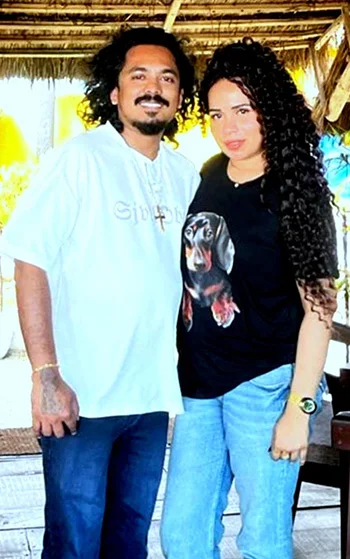
Niluk and Apeksha: Enjoying their short vacation
After a slowdown earlier this year due to regional tensions, shows and festivals are back on the calendar, and organisers say late 2026 could be the busiest concert season in years.
Time Out Dubai says “the 2026 concert calendar is filling up nicely” and “the city is ready to party once again” after some reschedules.
Dubai Summer Surprises in July brings retail activations, comedy nights, and indoor art exhibitions.
Organisers point to a backlog of postponed events that are being rescheduled for late 2026 and early 2027.
Yes, Dubai is calm on the surface but on alert. Life is mostly normal in the city, but there’s a “balancing act” as people watch for escalation.

Patidar leads the way as Royal Challengers Bengaluru storm into second straight final

Kandy Royals sign Vijay Shankar for LPL 2026

Cabinet approves sale of Paddy stocks held by the Paddy Marketing Board
Amendment to the Promotion of Export Agriculture Act, No. 46 of 1992 to be gazatted
Ms. M.K.D.N. Madampe, appointed as Director General of the Department of Management Services

Cabinet approves collaboration agreement between Sri Lanka and Brazil for the implementation of the “Sugarcane Project in Sri Lanka”

‘Dates have the highest sugar content to fight Coronavirus’

Sunday Island 27 December – Headlines

#SundayIsland 17th December – Headlines

Sunday Island – 28th March

Sunday Island Headlines – 21 March

Sunday Island – 21st February – Headlines
-
 Features7 days ago
Octopus, Leech, and Snake: How Sri Lanka’s banks feast while the nation starves
-
 Sports7 days ago
Sri Lanka women’s volleyball team ready for Central Asian challenge
-
 Opinion6 days ago
Murder of Ehelepola family, Bogambara Wewa and Sightings of Wangediya
-

 Business5 days ago
Historic launch of CCWE Fashion Week & International Summit 2026
-
 News6 days ago
Steps underway to safeguard Sri Lanka’s maritime heritage
-
 News2 days ago
Police probe underway to ascertain links between criminals deported from UAE and local politicians
-
 Features3 days ago
The NPP’s pivot to the past
-

 News3 days ago
All-New GRAVITE launches at LKR 6.99 Mn