
Features
The truth will set us free – II


Lesson 2: Renewal begins with children
Timothy Snyder (55) maintained interaction with his two children (ten-year-old son and the younger daughter) while he was in a Florida hospital at the beginning of 2020. No doubt, his wife Marci Shore (53), also teaching history at Yale University then, helped this loving interaction between the father and his children. The children told him about their school work and inquired about his progress towards recovery. Snyder remembers how he kept thinking about his children even in his sickest moments. and finds fault with America for falling short of the standards reached by countries like Austria in infant and child health.
Of course, in fairness to America today (2025), it must be said that children, parents, and their health and welfare, and the family institution are receiving the highest recognition in the country, irrespective of untenable extremes of neoliberalism ideologies like wokeism and related lgbtqa+ and transgender sex change surgery issues, etc., as evident at least in the American domestic political domain. Elon Musk (53), Senior Advisor to US President Donald Trump (78), is often seen with his youngest son having a piggyback ride on his busy father’s shoulders even on state occasions; President Trump sometimes proudly shows off his nineteen-year-old son Barron accompanying him on the stage, the fresh young man stealing the show at his old father’s expense, especially among young voters. The youngish US Vice President J.D. Vance (40) and Usha Vance (39), his wife of Indian origin, were on a four-day visit (beginning April 21) to resurgent India recently with their three little children who, innocently unaware of and unconcerned about what was going on around them, endeared Americans to Indians, thereby greatly enhancing the efficacy of their parents’ diplomatic endeavour to strengthen bilateral bonds and economic and security cooperation between the two powerful nations. Musk and Trump are businessmen turned politicians, while the Vances have been lawyers. But all four are normal parents. Cynics might cavil at such ‘childish displays’ as advertising gimmicks for promoting the pro binary sex ideology perspective, where children are insensitively exploited as mascots for their propaganda. But a more sober judgement would be to view such high-profile demonstrations as indicating an emergent trend in America towards a return to healthy normalcy in its sex culture where parents with their own children form close knit stable family units that coalesce into a vibrant society.
Snyder recounts how well he and his wife Marci were treated as first-time parents in a public hospital in Vienna in Austria, where their son was born in 2009. They had to pay hardly anything by way of hospital fees. The Snyders ‘experienced a sense of what good health care felt like from inside: intimate and inexpensive’. Marci was given a ‘mother-child passport’, which was recognised at health facilities throughout Austria. When she entered any hospital or doctor’s office, she was asked to show the ‘passport’. The doctor or the nurse didn’t look at a screen to identify the mother and her child.
In Austria, according to Snyder, pregnant mothers close to delivery time are asked to come to the maternity hospital at water breaking (i.e., when the amniotic sac covering the foetus breaks) or when contractions occur at 20-minute intervals. In America, they are asked to wait longer until the contractions are only three or four minutes apart. So, in America, deliveries sometimes happen in the back seat of a car, putting both the babies and the mothers in danger. In Austria, again, the mother and the baby have to stay in hospital for 96 hours (4 days) after delivery, allowing time for the baby to have a good start, and for the mother to learn to breastfeed. The difference between America and Austria in this respect, Snyder says, is one between a logic of profit and a logic of life.
Even the general public in Austria are helpful towards parents with children. The institutions that helped the Snyders (as first-time parents) ‘from the public hospital to the public kindergarten to the public transport were an infrastructure of solidarity that helped people together, making them feel that at the end of the day they were not alone’, whereas in America, ‘birth is where our story about freedom dies. We never talk about how bringing new life into the world makes heroic individualism impossible’. (That is, doing everything alone, with little outside help, preserving one’s autonomy, is not possible in the real world)
This applies to children in their formative years, as well. A piece of wisdom Snyder offers is that ‘to be free involves having a sense of one’s own interests and of what one needs to fulfill them. Thinking about the constraints of life under pressure requires an ability to experience, name and regulate emotions’. But this freedom cannot be gained without help. That is the paradox of freedom as Snyder calls it; no one is free without help
Snyder distils into his critique of the unsatisfactoriness of the American healthcare system an important insight in respect of early childhood care: it is that ‘how children are treated when they are very young profoundly affects how they will live the rest of their lives. That is perhaps the most important thing that scientists have to teach us about health and freedom today’. Speech, thought and will emerge as infants and toddlers interact with other people. ‘We learn as very small children, if we ever learn, to recover from disappointment and to delay pleasure. …what allows these capacities to develop are relationships, play and choices’.
Snyder points out that providing good healthcare facilities for children leads eventually to a lower crime rate, functional democracy, and efficiency in decision making. He feels that emotional regulation is overlooked in America. There is no sufficient focus on the relationship between parents and children. The regrettable lapses in American health care affects children more negatively than for adults. Parents need to relate to their children in ways that promote their optimal physical, mental and ethical development is part of a good healthcare system. Healthy interaction between parents and children is of vital importance for the education of children. Probably, the situation in Sri Lanka may not be better than in America in view of, among other things, the economic hardships that parents inevitably have to face.
Children and young adults, particularly in suburban and rural areas, are a threatened species. Apart from the economic difficulties that their parents experience, restricting their ability to meet the cost of augmenting the education that the state provides free of charge, non-urban Sri Lankan children often suffer due to a lack of basic infrastructure facilities like good transport, proper school buildings, modern libraries and adequately equipped labs, internet facilities and easy accessibility to local and foreign online sources of learning and research.
Lesson 3: The truth will set us free
After a procedure done on his liver in the emergency room of an American hospital on December 29, 2019, Timothy Snyder was admitted to a room, where he spent the last days of the year and the first days of the next ‘raging and contemplating’. He had to share that room with a Chinese man with a number of afflictions. The Chinese didn’t know any English. So, a lot of ‘personal and medical information was communicated loudly, slowly and repeatedly’. The Chinese was senior to Snyder by fourteen years; he was in withdrawal from nicotine smoking and alcohol drinking after five decades of daily consumption of the two intoxicants. The two became mutually accommodating friends.
But Snyder suffered a lung infection due to close contact with the Chinese, who had himself succumbed to illness caused by a parasite ingested while eating raw fish on a previous visit to China, but got well later. However, Snyder recovered and left the hospital, after exchanging farewell messages with the friendly Chinese, who had to stay on further in hospital.
The latter, Snyder says, is an example of two ways that medicine can get to the truth: thinking along with the patient, focusing on their story, and searching for information through tests. His conclusion is that in early 2020, the federal government failed Americans in both ways. There was no sensible discussion of the history of pandemics, and no procedure to test for the new coronavirus. The sections of the National Security Council and the Department of Homeland Security meant to deal with epidemics, as well as a special unit in the Agency for International Development meant to predict epidemics had been disbanded. American health experts had been called back from the rest of the world. The last officer of the Centers for Disease Control and Prevention assigned to China had been recalled to the US in July 2019, a few months before the epidemic broke out.
President Trump had overseen budget cuts for institutions looking after public health. The US surgeon general sang in a tweet on February 1, 2020: ‘Roses are red/Violets are blue/Risk is low for #coronavirus/But high for the flu’. Nero was fiddling while Rome was burning! As the year began, Americans were denied the basic knowledge necessary for making independent decisions of their own. President showed little anxiety about the steadily growing threat of the coronavirus. ‘It is going to disappear…like a miracle’. In effect they were creating a ‘news desert’. The media kept silent about the spreading pollution. Google and FB don’t carry news. They only raked in advertising revenues as usual.
But the disease was transmitted rapidly across the counties. The Covid death toll rose in leaps and bounds. ‘The seven American counties with the most Covid deaths would now rank among the top twenty countries. These are simple facts’. Snyder observes: ‘Since the truth sets you free, the people who oppress you resist the truth’. Historian Snyder refers to why British people have unkind memories of prime minister Neville Chamberlain because he tried to please the public in 1938 by falsely asserting that there was no need to go to war against Hitler. Winston Churchill earned their love and honour for having told them the unpleasant truth that they had to make war on the Nazi leader to stop him.
Snyder remembers reading (J.R.R. Tolkien’s) The Lord of the Rings to his son and daughter before he became ill. In that story Gandalf the wizard is a noble character with great power. He tells truths that people don’t want to hear. He is usually disliked as a bearer of bad news, and his advice is ignored. Although Gandalf is powerful, he cannot save the world by himself. He needs to build up a coalition by convincing others of the reality of a threat; but they won’t listen to him. Instead, out of ignorance, they look for an excuse for submission.That is human nature, but no way to be free. In frustration, Gandalf finally retorts that without knowledge, freedom has no chance.
Lesson 4: Doctors should be in charge
Snyder’s unexpected midnight admission to a hospital in Florida and two days stay there coincided with his mother’s birthday that year. So, he was unable to be with her on the occasion. The attention he got from the doctors was hurried and seemingly perfunctory, and it was hardly face-to-face. The longest time of fifteen minutes he saw a doctor was over Skype with a neurologist. Snyder thinks that the problem is not that doctors do not want to work with patients. They do work really hard, as people saw during the pandemic, risking their own health and even their lives in order to save others’ lives. The problem, according to Snyder, is that they have no say in what happens around them, but waste their time and energy pacifying greater powers. In America, doctors no longer have the authority that patients expect and need from them.
Readers, please remember that this was five years ago. The situation in America may have improved since, especially after the coronavirus pandemic took its toll and departed. The alleged mercenary bias of the American healthcare system largely caused by the profiteering Big Pharma, the insensitivity of the colluding political authorities, and the misinformation peddled by the media (particularly digital) that Snyder sharply criticizes in this book may have eased, too.
However, a little reflection will convince the intelligent readers that Timothy Snyder’s Four Lessons have great relevance to certain aspects of the deplorable situation in Sri Lanka today. This ad hoc review of mine of Snyder’s book, if read with a ‘comparative research’ oriented mind, will make the book look like a mirror held up to the prevailing reality there. (I have used a paperback edition of the book in my possession, issued by The Bodley Head, London, in 2020, in which year Snyder’s book containing his cogent case and powerful appeal for redress was first published.)
Concluded
by Rohana R. Wasala
(Continued from April 25, 2025)


For much of its modern history, Britain was an imperial power connected to every corner of the globe, yet it was not a major destination for large-scale international migration. Different waves of newcomers arrived over the centuries, but the overall foreign-born population remained relatively small by contemporary standards. The 1901 Census recorded 82,844 people from Eastern Europe living in Britain, while the Chinese population numbered just 387. Even at the beginning of the 20th century, migrants from Asia and other parts of the world constituted only a tiny fraction of the country’s population. Britain was a nation shaped by migration, but not yet one transformed by it. That would begin to change dramatically in the aftermath of the Second World War.
One of the most significant changes in Britain’s migration patterns after World War II came from the former colonies of the British Empire. Faced with acute labour shortages and the demands of post-war reconstruction, the government introduced the British Nationality Act of 1948, granting citizens of the Commonwealth the right to live and work in the United Kingdom. Although immigration controls were tightened through legislation, such as the Commonwealth Immigrants Act of 1962, migration from former colonies continued. Many of those who arrived belonged to the educated middle classes of their home countries. Having passed through education systems established by Britain during the colonial period, they were already familiar with the English language, British institutions and aspects of British culture. For them, Britain represented a land of opportunity, professional advancement and social mobility.
A different set of motivations drove migration from continental Europe, particularly from Eastern European countries. For these migrants, the United Kingdom offered significantly higher wages, stronger labour markets and living standards that often exceeded those available in their countries of origin. This trend accelerated further after Britain joined the European Economic Community in 1973, initiating a period in which citizens of member states gradually acquired rights to move, work, study and establish businesses across national borders. The expansion of the European Union in the early 21st century, particularly the accession of several Eastern European states in 2004, would later transform these flows on an unprecedented scale.
Immigration has rarely been determined solely by economic forces; it has also reflected the priorities of governments in power. During the period between 1997 and 2010, when the Labour Party was in power, immigration policies became comparatively more open in several key areas. Combined with economic growth and labour demand, these policies contributed to a substantial increase in migration, with net migration reaching levels that had few historical precedents in modern Britain. The debate over whether this growth was an economic necessity, a policy success or a political miscalculation continues to influence British politics to this day.
The next major turning point came with the Brexit referendum of 2016 and Britain’s eventual departure from the European Union. For decades, European citizens had enjoyed relatively unrestricted access to the British labour market through the principle of free movement. As the post-Brexit immigration system took shape, that privilege largely disappeared. The result was not the end of migration, but a significant shift in its composition. Labour shortages remained across sectors, ranging from healthcare and social care to information technology, logistics and higher education. As European migration declined, employers increasingly turned to other parts of the world to meet these demands.
This created new opportunities for migrants from countries such as India, Pakistan, Sri Lanka and several other Asian nations. In many respects, these arrivals filled a vacuum left by the reduction in European labour mobility. The overall pattern suggests that Britain’s economy continued to require migrant labour even as its immigration framework underwent fundamental change. Migration flows did not disappear; rather, they were redirected.
Yet this shift has done little to calm public anxieties surrounding immigration. If anything, concerns over migration have remained a central feature of British political debate. Governments of different political persuasions, including those that once defended relatively liberal immigration policies, have increasingly adopted tougher rhetoric and stricter measures aimed at reducing migration levels. Across the political spectrum, there is growing pressure to demonstrate greater control over borders, tighten visa pathways and, in some cases, encourage or require migrants to leave once their economic or educational purpose has ended.
This pressure has translated into a series of policy changes. In 2025, the government announced new restrictions designed to reduce migration and increase employer reliance on the domestic workforce. Among the most significant measures were plans to shorten the list of occupations for which employers could sponsor workers from overseas and to introduce tougher compliance requirements for sponsoring organisations. Social care, a sector that had become heavily dependent on international recruitment, was particularly affected, with employers facing tighter limitations on recruiting care workers from abroad. These changes reflected a broader political commitment to lowering migration numbers, even as many sectors continued to report persistent staffing shortages.
The higher education sector has also found itself at the centre of this debate. International students have become one of the most important contributors to Britain’s universities and local economies. They pay tuition fees that help sustain institutions, support jobs in university towns and cities, and contribute billions of pounds annually through spending on housing, transport and everyday living expenses. For many students, however, studying in Britain is not merely an educational experience but a substantial personal and financial investment made with the expectation that it will open pathways to professional opportunities.
Against this backdrop, proposals to reduce the standard length of the graduate visa have generated considerable concern. The graduate route has allowed international students to remain in the United Kingdom after completing their studies in order to gain work experience and establish careers. Supporters of restrictions argue that student visas should not become a long-term migration pathway. Critics counter that reducing post-study opportunities risks making Britain less attractive in an increasingly competitive global market for talent. Countries such as Canada, Australia and Germany continue to compete aggressively for skilled international graduates, and students weighing their options may choose destinations that offer clearer prospects after graduation.
These debates often frame migration as a problem to be solved through numerical reductions. Yet, what should be noted here is that many of the pressures commonly attributed to immigration are connected to wider economic and political challenges. The decade following Britain’s departure from the European Union has been marked by an unusual degree of political instability. Since the Brexit referendum, the country has seen seven prime ministers, with governments frequently changing direction on economic strategy, public spending and immigration policy. Such instability has contributed to uncertainty about Britain’s long-term trajectory and has complicated efforts to build a consistent approach to migration.
Public concerns about immigration are real and cannot simply be dismissed. Anti-immigration demonstrations and calls for stricter border controls continue to attract significant support in some parts of the country. At the same time, these concerns often become a focal point through which broader anxieties about housing, public services, economic stagnation and national identity are expressed. Immigration is therefore not merely a migration issue; it is also a lens through which deeper social and political tensions are debated.
The increasingly restrictive tone of migration policy has also raised questions about community cohesion and the treatment of migrants already living in Britain.
While much public attention focuses on new arrivals, long-term residents can also find themselves affected by changing rules and enforcement practices. Earlier proposals such as the Rwanda asylum plan, announced in 2022, sought to relocate certain asylum seekers to Rwanda for the processing of their claims, though the policy was never ultimately implemented. More recently, cases involving migrants being instructed to leave the country despite having established families, employment and community ties have generated public debate. One widely discussed example involved Chamila Dilrukshi, a Sri Lankan mother, who was instructed by the Home Office to leave the United Kingdom with her three children while her husband remained in Britain. Cases such as these illustrate how immigration policy extends beyond statistics and labour markets, affecting family life, community relationships and the sense of belonging experienced by migrants who have built their lives in the country.
This raises a more fundamental question than the familiar debate over whether immigration numbers should rise or fall. If Britain continues to face an ageing population, labour shortages in critical sectors and increasing competition for global talent, can it realistically sustain economic growth while simultaneously reducing its reliance on migrants? Equally important, can successive governments build a migration system that balances economic necessity, public confidence and social cohesion at a time of continuing political uncertainty? The answer may prove decisive not only for Britain’s future migration policy, but for the broader question of what kind of society, economy and national identity the United Kingdom hopes to shape in the decades ahead.
by Viran Maddumage
Assistant Lecturer & PhD(Reading) Department of Human Geography and Migration, Macquarie University, Australia
and Sanduni Rathnayake
Lecturer (Probationary) Faculty of Law, General Sir John Kotelawala Defence University
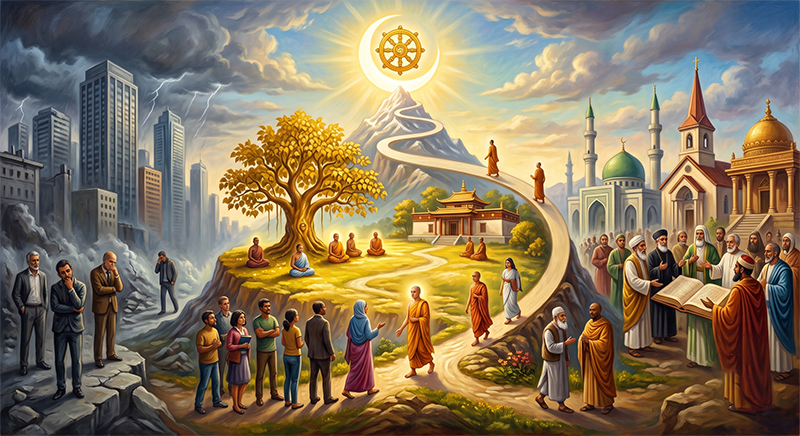
Today all the major religions of the world must respond to a double challenge. On one side is the challenge of secularism, a trend which has swept across the globe, battering against the most ancient strongholds of the sacred and turning all man’s movements towards the Beyond into a forlorn gesture, poignant but devoid of sense. On the other side is the meeting of the great religions with each other. As the most far-flung nations and cultures merge into a single global community, the representatives of humankind’s spiritual quest have been brought together in an encounter of unprecedented intimacy, an encounter so close that it leaves no room for retreat. Thus, at one and the same time each major religion faces, in the amphitheater of world opinion, all the other religions of the earth, as well as the vast numbers of people who regard all claims to possess the Great Answer with a skeptical frown or an indifferent yawn.
In this situation, any religion which is to emerge as more than a relic from humanity’s adolescence must be able to deal, in a convincing and meaningful manner, with both sides of the challenge. On the one hand it must contain the swelling tide of secularism, by keeping alive the intuition that no amount of technological mastery over external nature, no degree of proficiency in providing for humanity’s mundane needs, can bring complete repose to the human spirit, can still the thirst for a truth and value that transcends the boundaries of contingency. On the other hand, each religion must find some way of disentangling the conflicting claims that all religions make to understand our place in the grand scheme of things and to hold the key to our salvation. While remaining faithful to its own most fundamental principles, a religion must be able to address the striking differences between its own tenets and those of other creeds, doing so in a manner that is at once honest yet humble, perspicacious yet unimposing.
In this brief essay, I wish to sketch the outline of an appropriate Buddhist response to the second challenge. Since Buddhism has always professed to offer a “middle way” in resolving the intellectual and ethical dilemmas of the spiritual life, we may find that the key to our present problematic also lies in discovering the response that best exemplifies the middle way. As has often been noted, the middle way is not a compromise between the extremes but a way that rises above them, avoiding the pitfalls into which they lead. Therefore, in seeking the proper Buddhist approach to the problem of the diversity of creeds, we might begin by pinpointing the extremes which the middle way must avoid.
The first extreme is a retreat into fundamentalism, the adoption of an aggressive affirmation of one’s own beliefs coupled with a proselytizing zeal towards those who still stand outside the chosen circle of one’s co-religionists. While this response to the challenge of diversity has assumed alarming proportions in the folds of the great monotheistic religions, Christianity and Islam, it is not one towards which Buddhism has a ready affinity, for the ethical guidelines of the Dhamma naturally tend to foster an attitude of benign tolerance towards other religions and their followers. Though there is no guarantee against the rise of a militant fundamentalism from within Buddhism’s own ranks, the Buddha’s teachings can offer no sanctification, not even a remote one, for such a malignant development.
For Buddhists the more alluring alternative is the second extreme. This extreme, which purchases tolerance at the price of integrity, might be called the thesis of spiritual universalism: the view that all the great religions, at their core, espouse essentially the same truth, clothed merely in different modes of expression. Such a thesis could not, of course, be maintained in regard to the formal creeds of the major religions, which differ so widely that it would require a strenuous exercise in word-twisting to bring them into accord. The universalist position is arrived at instead by an indirect route. Its advocates argue that we must distinguish between the outward face of a religion — its explicit beliefs and exoteric practices — and its inner nucleus of experiential realisation. On the basis of this distinction, they then insist, we will find that beneath the markedly different outward faces of the great religions, at their heart — in respect of the spiritual experiences from which they emerge and the ultimate goal to which they lead — they are substantially identical. Thus, the major religions differ simply in so far as they are different means, different expedients, to the same liberative experience, which may be indiscriminately designated “enlightenment,” or “redemption,” or “God-realization,” since these different terms merely highlight different aspects of the same goal. As the famous maxim puts it: the roads up the mountain are many, but the moonlight at the top is one. From this point of view, the Buddha Dhamma is only one more variant on the “perennial philosophy” underlying all the mature expressions of man’s spiritual quest. It may stand out by its elegant simplicity, its clarity and directness; but a unique and unrepeated revelation of truth it harbors not.
On first consideration the adoption of such a view may seem to be an indispensable stepping-stone to religious tolerance, and to insist that doctrinal differences are not merely verbal but real and important may appear to border on bigotry. Thus, those who embrace Buddhism in reaction against the doctrinaire narrowness of the monotheistic religions may find in such a view — so soft and accommodating — a welcome respite from the insistence on privileged access to truth typical of those religions. However, an unbiased study of the Buddha’s own discourses would show quite plainly that the universalist thesis does not have the endorsement of the Awakened One himself. To the contrary, the Buddha repeatedly proclaims that the path to the supreme goal of the holy life is made known only in his own teaching, and therefore that the attainment of that goal — final deliverance from suffering — can be achieved only from within his own dispensation. The best known instance of this claim is the Buddha’s assertion, on the eve of his Parinibbana, that only in his dispensation are the four grades of enlightened persons to be found, that the other sects are devoid of true ascetics, those who have reached the planes of liberation.
The Buddha’s restriction of final emancipation to his own dispensation does not spring from a narrow dogmatism or a lack of good will, but rests upon an utterly precise determination of the nature of the final goal and of the means that must be implemented to reach it. This goal is neither an everlasting afterlife in a heaven nor some nebulously conceived state of spiritual illumination, but the Nibbana element with no residue remaining, release from the cycle of repeated birth and death. This goal is effected by the utter destruction of the mind’s defilements — greed, aversion and delusion — all the way down to their subtlest levels of latency. The eradication of the defilements can be achieved only by insight into the true nature of phenomena, which means that the attainment of Nibbana depends upon the direct experiential insight into all conditioned phenomena, internal and external, as stamped with the “three characteristics of existence”: impermanence, suffering, and non-selfness. What the Buddha maintains, as the ground for his assertion that his teaching offers the sole means to final release from suffering, is that the knowledge of the true nature of phenomena, in its exactitude and completeness, is accessible only in his teaching. This is so because, theoretically, the principles that define this knowledge are unique to his teaching and contradictory in vital respects to the basic tenets of other creeds; and because, practically, this teaching alone reveals, in its perfection and purity, the means of generating this liberative knowledge as a matter of immediate personal experience. This means is the Noble Eightfold Path which, as an integrated system of spiritual training, cannot be found outside the dispensation of a Fully Enlightened One.
Surprisingly, this exclusivistic stance of Buddhism in regard to the prospects for final emancipation has never engendered a policy of intolerance on the part of Buddhists towards the adherents of other religions. To the contrary, throughout its long history, Buddhism has displayed a thoroughgoing tolerance and genial good will towards the many religions with which it has come into contact. It has maintained this tolerance simultaneously with its deep conviction that the doctrine of the Buddha offers the unique and unsurpassable way to release from the ills inherent in conditioned existence. For Buddhism, religious tolerance is not achieved by reducing all religions to a common denominator, nor by explaining away formidable differences in thought and practice as accidents of historical development. From the Buddhist point of view, to make tolerance contingent upon whitewashing discrepancies would not be to exercise genuine tolerance at all; for such an approach can “tolerate” differences only by diluting them so completely that they no longer make a difference. True tolerance in religion involves the capacity to admit differences as real and fundamental, even as profound and unbridgeable, yet at the same time to respect the rights of those who follow a religion different from one’s own (or no religion at all) to continue to do so without resentment, disadvantage or hindrance.
Buddhist tolerance springs from the recognition that the dispositions and spiritual needs of human beings are too vastly diverse to be encompassed by any single teaching, and thus that these needs will naturally find expression in a wide variety of religious forms. The non-Buddhist systems will not be able to lead their adherents to the final goal of the Buddha’s Dhamma, but that they never proposed to do in the first place. For Buddhism, acceptance of the idea of the beginningless round of rebirths implies that it would be utterly unrealistic to expect more than a small number of people to be drawn towards a spiritual path aimed at complete liberation. The overwhelming majority, even of those who seek deliverance from earthly woes, will aim at securing a favorable mode of existence within the round, even while misconceiving this to be the ultimate goal of the religious quest.
To the extent that a religion proposes sound ethical principles and can promote to some degree the development of wholesome qualities such as love, generosity, detachment and compassion, it will merit in this respect the approbation of Buddhists. These principles advocated by outside religious systems will also conduce to rebirth in the realms of bliss — the heavens and the divine abodes.
Buddhism by no means claims to have unique access to these realms, but holds that the paths that lead to them have been articulated, with varying degrees of clarity, in many of the great spiritual traditions of humanity. While the Buddhist will disagree with the belief structures of other religions to the extent that they deviate from the Buddha’s Dhamma, he will respect them to the extent that they enjoin virtues and standards of conduct that promote spiritual development and the harmonious integration of human beings with each other and with the world. (Courtesy Buddhist Publication Society.)
by Bhikkhu Bodhi
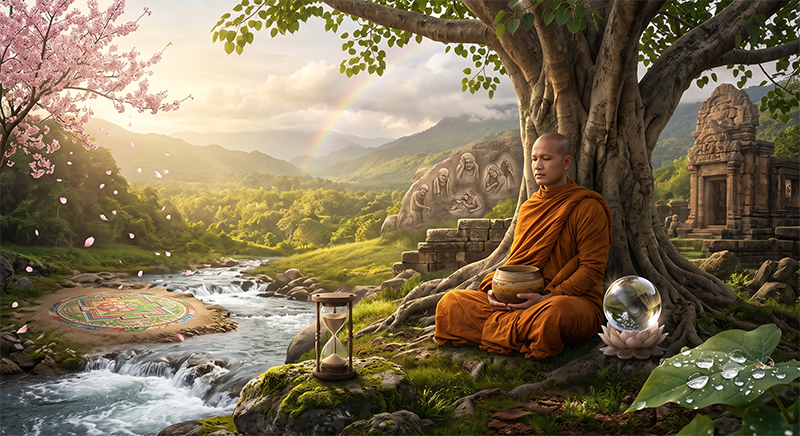
Buddhism offers a profound moral and philosophical framework aimed at guiding individuals toward enlightenment and alleviating suffering. A key aspect of this journey is understanding reality through the lens of the Three Marks of Existence, a concept deeply rooted in Buddhist scriptures and teachings. This understanding can often become obscured by delusion and ignorance, hindering our ability to perceive the true nature of reality and trapping us in cycles of suffering.
The Three Marks of Existence, also known as the Three Universal Truths, are (1) impermanence (Anicca), (2) suffering or unsatisfactoriness (Dukkha), and (3) non-self or insubstantiality (Anatta). These principles, articulated by the Buddha over 2,500 years ago, reveal universal truths applicable to all beings and serve as a foundation for deeper insights into life. They emphasise that all phenomena are transient, that lasting happiness is elusive, and that the notion of a fixed self is fundamentally illusory.
In the Pali Canon, teachings highlight that all conditioned phenomena (saṅkhārāā) are subject to Anicca and Dukkha, while Anatta extends even further, applying to all dhammas. As stated in the Anatta-lakkhana Sutta, the Buddha underscores the reality that there is no enduring self within the five aggregates, indicating that the belief in “I” or “mine” is a source of Dukkha that must be relinquished. Understanding Anatta encourages practitioners to recognise the emptiness of the self and to understand how clinging to identity leads to suffering.
These three characteristics are incontrovertible facts that apply to both animate and inanimate things. Whether Buddhas arise or not, these truths exist in the world. In Buddhism, to see things as they truly are means to consistently view them through the lens of the Three Marks. Failing to do so, or deceiving oneself about their reality and range of application, is the defining mark of ignorance (avijja). This ignorance of our true nature and the true nature of our surroundings leads to actions based on delusions, accumulating karma that keeps us bound to the cycle of rebirth and death.
Dissolving that ignorance through direct insight into the Three Marks is said to bring an end to samsara and the resulting suffering (dukkha nirodha or nirodha sacca, as described in the third of the Four Noble Truths). To perceive things as they truly are, one must cultivate an understanding of these truths—not merely through intellectual contemplation but also through insights gained from personal experiences. A deeper comprehension of the Three Universal Truths fosters wisdom and leads to liberation from the cycle of rebirth, culminating in Nibbana, the ultimate goal of Buddhism.
Recognising the interplay of these three characteristics in our lives is essential. Ignorance of these truths breeds delusion and results in actions that generate karma, confining us to a persistent cycle of birth, death, and rebirth. Gaining direct insight into the Three Marks of Existence enables us to transcend suffering (Dukkha Nirodha), aligning with the third of the Four Noble Truths.
Moreover, a lack of understanding regarding these universal truths can lead to frustration and despair. Conversely, a clear grasp of the Three Marks equips us to navigate life’s complexities, allowing for realistic expectations, resilient acceptance of suffering, and protection against misleading beliefs.
The Satipatthana Sutta highlights mindfulness as a vital tool for engaging with reality as it is. By observing our thoughts, feelings, and sensations without attachment or aversion, we cultivate a clearer perception of impermanence, suffering, and non-self. The realisation that all phenomena are fleeting allows us to develop a compassionate response to ourselves and others, breaking the cycle of craving and clinging that fuels suffering.
Rev. Nyanapoke further articulates that the Three Marks are observable in every facet of existence—physical, emotional, mental, and social. He notes that natural cycles, shifts in emotions, evolving thoughts, and changing relationships epitomise the transient nature of life. Even when contemplating minute aspects of life, we encounter an immense variety of living forms, from microbes to humans, demonstrating that these three basic features are common to everything that possesses animate existence. Through this comprehensive understanding, we can better navigate the complexities of life and deepen our connection to the essence of existence.
By reflecting on the first of the Three Marks of Existence, the universal truth of impermanence, we come to understand the stark reality that everything we acquire and hold dear—possessions, achievements, cherished relationships, and loved ones—will ultimately succumb to time and cease to exist. This notion is poignantly captured by the philosopher Heraclitus, who famously remarked, “No man ever steps in the same river twice,” underscoring the idea that both the river and the man are in constant flux, the transient nature of existence.
This idea of impermanence also resonates with the biblical acknowledgement, “Why do you not even know what will happen tomorrow? What is your life? You are but a mist that appears for a little while and then vanishes” (James 4:14). The first truth, impermanence, is intricately connected to all aspects of our existence.
The second characteristic. Dukkha is an important concept in Buddhism, commonly referred to as suffering. It is the first of the Four Noble Truths. Suffering is an inescapable part of life, and it can come in many forms. It refers to the habitual experience of mundane life as fundamentally unsatisfactory and painful. There are many times in our lives when we feel overwhelmed by our suffering and wonder how we can overcome it. Dukkha refers to the inherent unsatisfactoriness and suffering present in life. It encompasses a broad range of experiences, including physical pain, emotional distress, and existential dissatisfaction. In other words, dukkha can vary from minor irritations to profound suffering, and it is not limited to overt suffering. It also highlights the subtle discomfort that arises from life’s impermanence and the transient nature of happiness. Even moments of joy are often tinged with the knowledge that they are fleeting, leading to a perpetual sense of longing or fear of loss. The Buddha applies the characteristic of suffering to all conditioned things in the sense that for living beings, everything conditioned is a potential cause of experienced suffering and is, at any rate, incapable of giving lasting satisfaction.
Buddha says, “The world is established on suffering, is founded on suffering” (Dukkha loko patitthito). His whole doctrine rests on the pivot of suffering. He perceived the universality of suffering and propounded a remedy (Noble Eightfold Path) for the universal sickness of humanity. By that, Buddhism does not denote an attitude of hopelessness and pessimism toward life. Buddha did not expect his adherents to be constantly brooding over the ills of life and so make their lives unhappy.
If you look at the world with dispassionate discernment, it becomes abundantly clear that there is only one problem in the world, which is suffering, dukkha. Today, people all over the world suffer untold suffering and agony, and there is so much misery all around us. People’s lives are plucked at a young age. Many people suffer from incurable diseases and tragic deaths. Humanity is continuously grappling with many natural disasters and destruction. Yet, through ignorance, people go chasing after shadows, dwelling in delusion, unable to confront the adversities that life brings. Suffering appears and passes away, only to reappear in other forms. All forms of suffering are either physical or psychological. All is in a whirl; nothing escapes this inexorable, unceasing change.
Understanding Dukkha is crucial for practitioners, as it invites introspection about the nature of existence and our responses to experiences. Instead of viewing suffering as something to be avoided, Buddhism encourages us to confront it, recognize its roots, and understand its universal presence in human life. This acknowledgement allows us to cultivate compassion for ourselves and others who are also caught in this cycle of suffering. By facing Dukkha with awareness, we can begin to unravel the causes of our suffering and start the journey toward alleviation.
The third truth, Anatta, embraces the concept of non-self or insubstantiality, suggesting that there is no permanent, unchanging self within us. This realisation challenges the deeply ingrained belief in a fixed identity or essence. Instead, Buddhism teaches that what we consider the “self” is actually a collection of ever-changing physical and mental components, known as the five aggregates: form, sensation, perception, mental formations, and consciousness.
Understanding Anatta is liberating in that it encourages us to let go of attachments to our identities, beliefs, and notions of self. When we cling to a fixed identity, we create suffering through desires and fears related to maintaining that identity. By recognising that the self is contingent and fluid, we can reduce suffering and anxiety associated with self-identity and experience greater freedom. Embracing Anatta allows individuals to break free from the confines of ego, leading to a deeper connection with the world and others.
Together, the truths of Dukkha and Anatta highlight the importance of understanding suffering and the illusion of self in the journey toward enlightenment. By facing these truths, practitioners can cultivate wisdom, compassion, and ultimately find liberation from the cycles of rebirth and suffering.
by Dr. Justice Chandradasa Nanayakkara

Australia, India, South Africa and Great Britain qualify for women’s event at LA28 Olympics

South Korea football coach quits as president calls for probe into World Cup loss

Europe’s heatwave linked to 1,300 deaths, WHO says, as Germany hits record 41.7C

Padikkal fifty, Sudeera five-for before India A, Sri Lanka A settle for draw

“May this sacred Poson Festival illuminate every heart with compassion, loving-kindness and wisdom”- President

Canada score late to beat South Africa and reach last 16 at World Cup 2026

‘Dates have the highest sugar content to fight Coronavirus’

Sunday Island 27 December – Headlines

#SundayIsland 17th December – Headlines

Sunday Island – 28th March

Sunday Island Headlines – 21 March

Sunday Island – 21st February – Headlines
-

 News15 hours ago
LAWASIA warns against ad hoc initiative to increase judges’ retirement ages
-

 Opinion7 days ago
Ranasinghe Premadasa: The man who would not take ‘No’ for an answer
-
 News2 days ago
Another 1,132 Sri Lankan Personnel to be deployed for United Nations Peacekeeping Missions
-

 Opinion6 days ago
Sri Lanka’s national security: Justice, reconciliation, and forward-looking vigilance
-

 News4 days ago
Kelaniya emerges as highest ranked Lankan uni in Times Higher Education Sustainability Impact Ratings
-

 News6 days ago
US Assistant Secretary of State for South and Central Asian Affairs meets President
-
 Opinion5 days ago
A triumph for Pakistan’s skilled diplomacy at Iran-US talks
-

 Features2 days ago
People’s Bank expands digital banking network with 125th cheque deposit kiosk