
Features
The social radicalism of the Christmas-Event


By Fr. Leopold Ratnasekera OMI
The Christmas story records the birth of a carpenter’s son whose home was destined to be Nazareth, an interior hamlet in Galilee, to the north of today’s Israel where his lower middle-class parents were to raise their family-home. Only his dear parents were aware of the secrets behind his birth with the mother Mary knowing the circumstances of her pregnancy and Joseph her husband convinced of the story he heard from her and in the light of many other factors that surrounded the mysterious birth. A purely secular mind that worships only the empirical evidence of science whose truths and conclusions are corroborated by verifiable facts and figures, will no doubt seriously raise doubts about a virgin-birth that apparently contravenes the laws of nature and its manifestations. However, this is exactly the reality of Christmas, the birth of the Messiah, the Savior of mankind foretold in the most ancient of religious literature we have in hand. At times religious truths are more abiding and long-lasting than scientific truths that keep changing and evolving as new evidence begins to surface to the contrary.
The birth connected with Christmas is on purpose given in the context of great poverty and simplicity. The savior of the world is born not in a royal chamber of a magnificent palace with all the comforts, that one can imagine, but in a cave in the backyard of an inn where the cattle lay since all inns in that crowded night in the city of Bethlehem filled to capacity. One can imagine the anxiety of a couple expecting their first child under those trying circumstances. The news of this great birth was announced to the humble shepherds who were watching their flocks by night nearby and we are told that their immediate response was curiosity and the spontaneous decision to hasten to cave and verify the news.
Shepherds who were a marginalized lot in society with their profession not much held in honor were the first to be invited to gaze at the face of the God-man and redeemer. This child was one of destiny who will revolutionize mankind’s entire history with his life, message and teaching. The shepherds see their true shepherd who will as a lamb will lay down his life to redeem the world of sin and disgrace. The shepherd will not feed on the sheep but to the contrary become nourishment to the sheep, especially the weak and those lost in the woods.
The poverty and simplicity of his birth, the Lord Jesus will carry through his entire life living a hidden span of thirty years assisting his father in the livelihood of a carpenter’s shed, attending to family chores and growing as we are told, in age, wisdom and grace before God and men. He shows remarkable intelligence in being versed with religious scriptures sending doctors of the law into tantrums of shock at the depth of his insight-knowledge and the questions he poses to them as a child of twelve: a child prodigy as we might call today. Many things he said even as young man was beyond the comprehension of his mother who pondered over them in her heart trying to decipher its meaning. Jesus, the young itinerant teacher taught strange doctrines that sounded entirely new in the hearing of the crowds who flocked to the mountains and beaches to listen to him.
He would speak about the blessedness of the poor and those who are persecuted for the sake of righteousness. He would teach the importance of forgiving even the enemies and doing good to those who hurt and persecute you. To be fully his disciple, young men were challenged to go home, sell what they have and give to the poor and then come and join his company. The rich were never called blessed in his vocabulary since they are inclined to fall into the worship of idolatry regarding things they possess. Rather, his listeners were encouraged to seek for the riches of the kingdom that no moth destroys or brigand steals. It was the unconditional invitation to seek first the kingdom of God.
Having known poverty, life’s hardships and simplicity, he claimed himself to be hidden in the lives of the poor, the sick, the naked, the prisoners and the hungry. Going to their aid meant serving him and such charity and compassion would prove to be the measuring rod of one’s eternal destiny as taught in the parable of the last judgment. He dared to keep the company of sinners, to touch and heal lepers and to admit women to minister in his journeys with this disciples. He taught a new understanding of what it means to relate to him as mother, brothers and sisters based on one’s compliance with the Word of God addressed to them: it is a new family-bond not based on flesh and blood. In this light, the self-righteous Pharisees and Sadducees had no place in his kingdom. In fact, they were a category of people, though religious leaders and teachers of the law, with whom Jesus found very difficult to enter into dialogue. The gospel is full of stories of incidents where Jesus clashed with them particularly when he broke the Sabbath to heal someone or in his teaching, he claimed to be the Son of God. He was falsely implicated for challenging the authority of Caesar himself and Herod the governor of his district.
A teacher who wished in the heart of hearts to bring reconciliation between the Jews and Samaritans was accused at his trial as a social rabble-rouser and one who questioned the imperial rule of Rome in his home-country. He claimed himself to be a king, whose kingdom is not of this world but embraces those who receive him as a bearer of truth and as such hear and hearken to his voice. It was a voice that came from the heart of a good shepherd and one who can bring solace and rest to all who are weary finding life burdensome and weighing heavily down on them.
The scene of the birth of Jesus Christ is on purpose placed in an aura of poverty with the parents away from home attending a census proclaimed by CThis caaesar and with no room available in the inns of the over-crowded city of Bethlehem, the event takes place in the backyard of an inn, where the cattle used to lay. It was not at all a comfortable environment for the birth of a child to take place. After the birth, the new family had to be on exile in Egypt since the life of the new-born was under threat from imperial hands and return home only long after the risks disappeared. The carpenter’s son did learn a worker’s life by following in the livelihood of his father who was given to that trade. Yet, he ventured on his own mission and life-plan by choosing fishermen from the Galilean beaches to launch his work of being a wandering ascetic, teacher and miracle-worker.
He would cry over villages, cities and even Jerusalem for not lending their ears to his call to effect a transformation in their ways of belief and life. He demanded true and authentic worship of God in spirit and truth. He chastised the merchants and the business that was going on in the sacred precincts of the temple while declaring that a temple is a house of prayer for all nations and should not be turned into a den of thieves and a market-place. It is certainly not a place for mammon. His teaching was revolutionary, praising the prayer of a humble man and denouncing that of a self-righteous person.
He never said blessed are you rich but certainly blessed are you poor, the real and materially poor who challenge the rich to be poor in spirit and call for sharing their riches with the poor and the less privileged. The unexpected overturning of the destiny of the rich man who refused to let even a morsel of bread falling from his table to the poor man at his door, is really some shocking bit of revelation!. In this sense, it is a contemporarily very relevant challenge to a world economy that remains very unjust and oppressive of world’s poor. There is the culture of waste that does not heed to the 800 million of world’s people who suffer from sheer hunger and even basics such as health care, education, healthy food and even water and good air to breathe when entire cities are inundated with polluted air. There is the call to be good Samaritans in our way of reaching out to those who are hurt and rendered helpless without any distinction of race, color, creed, religion, ethnicity or language.
Forgiving the wrong-doer, being full of compassion as to be able to forgive seventy times seven if need be, to turn the other cheek, never to demand tooth for a tooth and eye for an eye, are revolutionary teachings never ever heard of before from any religious teacher other than Jesus of Nazareth, the eternal Galilean. He is teaching us to appreciate goodness from whomsoever it radiates, even an unbeliever and the un-godly.
Christmas, therefore is the birth-story of this great religious founder that the world has the opportunity of celebrating at every year’s end. For the spirit and meaning of Christmas to enter the world, humanity must enter this world of Jesus of Nazareth or else it will just be at best an annual festival event or a cultural fiesta of external glitter and gaiety. Every Christmas will recall the great challenges that Jesus brought that are radically needed for the social transformation much needed today in which human dignity of all is respected, preciousness of life defended, human rights preserved, no one is exploited for whatever the purpose be and the world of the poor and the most vulnerable given an opportunity to rise up to a life of honour and dignity.

A recent discussion by former Environment Minister, Eng. Patali Champika Ranawaka on the Derana 360 programme has reignited an important national conversation on how Sri Lanka plans, builds and rebuilds in the face of recurring disasters.
His observations, delivered with characteristic clarity and logic, went beyond the immediate causes of recent calamities and focused sharply on long-term solutions—particularly the urgent need for smarter land use and vertical housing development.
Ranawaka’s proposal to introduce multistoried housing schemes in the Gannoruwa area, as a way of reducing pressure on environmentally sensitive and disaster-prone zones, resonated strongly with urban planners and environmentalists alike.
It also echoed ideas that have been quietly discussed within academic and conservation circles for years but rarely translated into policy.
One such voice is that of Professor Siril Wijesundara, Research Professor at the National Institute of Fundamental Studies (NIFS) and former Director General of the Royal Botanic Gardens, Peradeniya, who believes that disasters are often “less acts of nature and more outcomes of poor planning.”

Professor Siril Wijesundara
“What we repeatedly see in Sri Lanka is not merely natural disasters, but planning failures,” Professor Wijesundara told The Island.
“Floods, landslides and environmental degradation are intensified because we continue to build horizontally, encroaching on wetlands, forest margins and river reservations, instead of thinking vertically and strategically.”
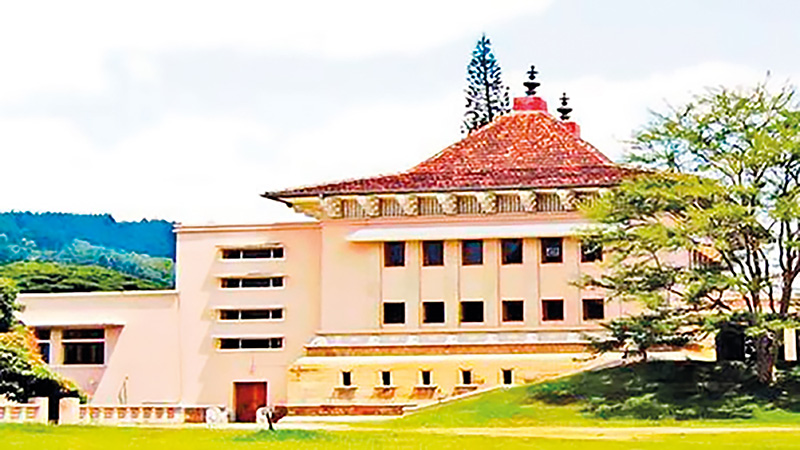
The former Director General notes that the University of Peradeniya itself offers a compelling case study of both the problem and the solution. The main campus, already densely built and ecologically sensitive, continues to absorb new faculties, hostels and administrative buildings, placing immense pressure on green spaces and drainage systems.
“The Peradeniya campus was designed with landscape harmony in mind,” he said. “But over time, ad-hoc construction has compromised that vision. If development continues in the same manner, the campus will lose not only its aesthetic value but also its ecological resilience.”
Professor Wijesundara supports the idea of reorganising the Rajawatte area—located away from the congested core of the university—as a future development zone. Rather than expanding inward and fragmenting remaining open spaces, he argues that Rajawatte can be planned as a well-designed extension, integrating academic, residential and service infrastructure in a controlled manner.
Crucially, he stresses that such reorganisation must go hand in hand with social responsibility, particularly towards minor staff currently living in the Rajawatte area.
“These workers are the backbone of the university. Any development plan must ensure their dignity and wellbeing,” he said. “Providing them with modern, safe and affordable multistoried housing—especially near the railway line close to the old USO premises—would be both humane and practical.”
According to Professor Wijesundara, housing complexes built near existing transport corridors would reduce daily commuting stress, minimise traffic within the campus, and free up valuable land for planned academic use.
More importantly, vertical housing would significantly reduce the university’s physical footprint.
Drawing parallels with Ranawaka’s Gannoruwa proposal, he emphasised that vertical development is no longer optional for Sri Lanka.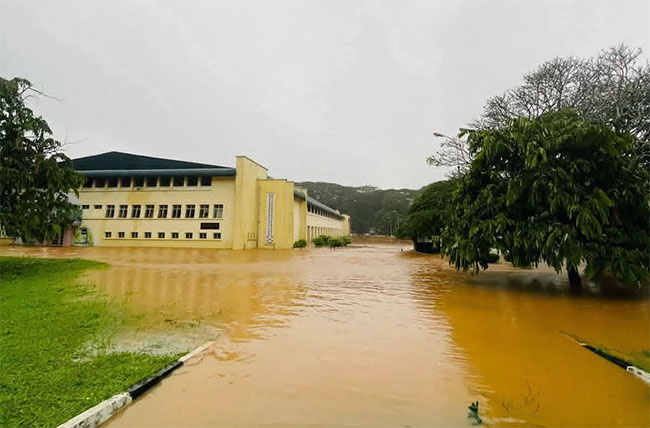
“We are a small island with a growing population and shrinking safe land,” he warned.
“If we continue to spread out instead of building up, disasters will become more frequent and more deadly. Vertical housing, when done properly, is environmentally sound, economically efficient and socially just.”

Peradeniya University flooded
The veteran botanist also highlighted the often-ignored link between disaster vulnerability and the destruction of green buffers.
“Every time we clear a lowland, a wetland or a forest patch for construction, we remove nature’s shock absorbers,” he said.
“The Royal Botanic Gardens has survived floods for over a century precisely because surrounding landscapes once absorbed excess water. Urban planning must learn from such ecological wisdom.”
Professor Wijesundara believes that universities, as centres of knowledge, should lead by example.
“If an institution like Peradeniya cannot demonstrate sustainable planning, how can we expect cities to do so?” he asked. “This is an opportunity to show that development and conservation are not enemies, but partners.”
As climate-induced disasters intensify across the country, voices like his—and proposals such as those articulated by Patali Champika Ranawaka—underscore a simple but urgent truth: Sri Lanka’s future safety depends not only on disaster response, but on how and where we build today.
The challenge now lies with policymakers and planners to move beyond television studio discussions and academic warnings, and translate these ideas into concrete, people-centred action.
By Ifham Nizam ✍️

At the initial stage of my six-year involvement in uplifting society through skill-based initiatives, particularly by promoting handicraft work and teaching students to think creatively and independently, my efforts were partially jeopardized by deep-rooted superstition and resistance to rational learning.
Superstitions exerted a deeply adverse impact by encouraging unquestioned belief, fear, and blind conformity instead of reasoning and evidence-based understanding. In society, superstition often sustains harmful practices, social discrimination, exploitation by self-styled godmen, and resistance to scientific or social reforms, thereby weakening rational decision-making and slowing progress. When such beliefs penetrate the educational environment, students gradually lose the habit of asking “why” and “how,” accepting explanations based on fate, omens, or divine intervention rather than observation and logic.
Initially, learners became hesitant to challenge me despite my wrong interpretation of any law, less capable of evaluating information critically, and more vulnerable to misinformation and pseudoscience. As a result, genuine efforts towards social upliftment were obstructed, and the transformative power of education, which could empower individuals economically and intellectually, was weakened by fear-driven beliefs that stood in direct opposition to progress and rational thought. In many communities, illnesses are still attributed to evil spirits or curses rather than treated as medical conditions. I have witnessed educated people postponing important decisions, marriages, journeys, even hospital admissions, because an astrologer predicted an “inauspicious” time, showing how fear governs rational minds.
While teaching students science and mathematics, I have clearly observed how superstition acts as a hidden barrier to learning, critical thinking, and intellectual confidence. Many students come to the classroom already conditioned to believe that success or failure depends on luck, planetary positions, or divine favour rather than effort, practice, and understanding, which directly contradicts the scientific spirit. I have seen students hesitate to perform experiments or solve numerical problems on certain “inauspicious” days.
In mathematics, some students label themselves as “weak by birth”, which creates fear and anxiety even before attempting a problem, turning a subject of logic into a source of emotional stress. In science classes, explanations based on natural laws sometimes clash with supernatural beliefs, and students struggle to accept evidence because it challenges what they were taught at home or in society. This conflict confuses young minds and prevents them from fully trusting experimentation, data, and proof.
Worse still, superstition nurtures dependency; students wait for miracles instead of practising problem-solving, revision, and conceptual clarity. Over time, this mindset damages curiosity, reduces confidence, and limits innovation, making science and mathematics appear difficult, frightening, or irrelevant. Many science teachers themselves do not sufficiently emphasise the need to question or ignore such irrational beliefs and often remain limited to textbook facts and exam-oriented learning, leaving little space to challenge superstition directly. When teachers avoid discussing superstition, they unintentionally reinforce the idea that scientific reasoning and superstitious beliefs can coexist.
To overcome superstition and effectively impose critical thinking among students, I have inculcated the process to create a classroom culture where questioning was encouraged and fear of being “wrong” was removed. Students were taught how to think, not what to think, by consistently using the scientific method—observation, hypothesis, experimentation, evidence, and conclusion—in both science and mathematics lessons. I have deliberately challenged superstitious beliefs through simple demonstrations and hands-on experiments that allow students to see cause-and-effect relationships for themselves, helping them replace belief with proof.
Many so-called “tantrik shows” that appear supernatural can be clearly explained and exposed through basic scientific principles, making them powerful tools to fight superstition among students. For example, acts where a tantrik places a hand or tongue briefly in fire without injury rely on short contact time, moisture on the skin, or low heat transfer from alcohol-based flames rather than divine power.
“Miracles” like ash or oil repeatedly appearing from hands or idols involve concealment or simple physical and chemical tricks. When these tricks are demonstrated openly in classrooms or science programmes and followed by clear scientific explanations, students quickly realise how easily perception can be deceived and why evidence, experimentation, and critical questioning are far more reliable than blind belief.
Linking concepts to daily life, such as explaining probability to counter ideas of luck, or biology to explain illness instead of supernatural causes, makes rational explanations relatable and convincing.
Another unique example that I faced in my life is presented here. About 10 years ago, when I entered my new house but did not organise traditional rituals that many consider essential for peace and prosperity as my relatives believed that without them prosperity would be blocked. Later on, I could not utilise the entire space of my newly purchased house for earning money, largely because I chose not to perform certain rituals.
While this decision may have limited my financial gains to some extent, I do not consider it a failure in the true sense. I feel deeply satisfied that my son and daughter have received proper education and are now well settled in their employment, which, to me, is a far greater achievement than any ritual-driven expectation of wealth. My belief has always been that a house should not merely be a source of income or superstition-bound anxiety, but a space with social purpose.
Instead of rituals, I strongly feel that the unused portion of my house should be devoted to running tutorials for poor and underprivileged students, where knowledge, critical thinking, and self-reliance can be nurtured. This conviction gives me inner peace and reinforces my faith that education and service to society are more meaningful measures of success than material profit alone.
Though I have succeeded to some extent, this success has not been complete due to the persistent influence of superstition.
by Dr Debapriya Mukherjee
Former Senior Scientist
Central Pollution Control Board, India ✍️


 Australian Prime Minister Anthony Albanese has done very well to speak-up against and outlaw race hate in the immediate aftermath of the recent cold-blooded gunning down of several civilians on Australia’s Bondi Beach. The perpetrators of the violence are believed to be ardent practitioners of religious and race hate and it is commendable that the Australian authorities have lost no time in clearly and unambiguously stating their opposition to the dastardly crimes in question.
The Australian Prime Minister is on record as stating in this connection: ‘ New laws will target those who spread hate, division and radicalization. The Home Affairs Minister will also be given new powers to cancel or refuse visas for those who spread hate and a new taskforce will be set up to ensure the education system prevents, tackles and properly responds to antisemitism.’
It is this promptness and single-mindedness to defeat race hate and other forms of identity-based animosities that are expected of democratic governments in particular world wide. For example, is Sri Lanka’s NPP government willing to follow the Australian example? To put the record straight, no past governments of Sri Lanka initiated concrete measures to stamp out the evil of race hate as well but the present Sri Lankan government which has pledged to end ethnic animosities needs to think and act vastly differently. Democratic and progressive opinion in Sri Lanka is waiting expectantly for the NPP government’ s positive response; ideally based on the Australian precedent to end race hate.
Meanwhile, it is apt to remember that inasmuch as those forces of terrorism that target white communities world wide need to be put down their counterpart forces among extremist whites need to be defeated as well. There could be no double standards on this divisive question of quashing race and religious hate, among democratic governments.
The question is invariably bound up with the matter of expeditiously and swiftly advancing democratic development in divided societies. To the extent to which a body politic is genuinely democratized, to the same degree would identity based animosities be effectively managed and even resolved once and for all. To the extent to which a society is deprived of democratic governance, correctly understood, to the same extent would it experience unmanageable identity-bred violence.
This has been Sri Lanka’s situation and generally it could be stated that it is to the degree to which Sri Lankan citizens are genuinely constitutionally empowered that the issue of race hate in their midst would prove manageable. Accordingly, democratic development is the pressing need.
While the dramatic blood-letting on Bondi Beach ought to have driven home to observers and commentators of world politics that the international community is yet to make any concrete progress in the direction of laying the basis for an end to identity-based extremism, the event should also impress on all concerned quarters that continued failure to address the matters at hand could prove fatal. The fact of the matter is that identity-based extremism is very much alive and well and that it could strike devastatingly at a time and place of its choosing.
It is yet premature for the commentator to agree with US political scientist Samuel P. Huntingdon that a ‘Clash of Civilizations’ is upon the world but events such as the Bondi Beach terror and the continuing abduction of scores of school girls by IS-related outfits, for instance, in Northern Africa are concrete evidence of the continuing pervasive presence of identity-based extremism in the global South.
As a matter of great interest it needs mentioning that the crumbling of the Cold War in the West in the early nineties of the last century and the explosive emergence of identity-based violence world wide around that time essentially impelled Huntingdon to propound the hypothesis that the world was seeing the emergence of a ‘Clash of Civilizations’. Basically, the latter phrase implied that the Cold War was replaced by a West versus militant religious fundamentalism division or polarity world wide. Instead of the USSR and its satellites, the West, led by the US, had to now do battle with religion and race-based militant extremism, particularly ‘Islamic fundamentalist violence’ .
Things, of course, came to a head in this regard when the 9/11 calamity centred in New York occurred. The event seemed to be startling proof that the world was indeed faced with a ‘Clash of Civilizations’ that was not easily resolvable. It was a case of ‘Islamic militant fundamentalism’ facing the great bulwark, so to speak, of ‘ Western Civilization’ epitomized by the US and leaving it almost helpless.
However, it was too early to write off the US’ capability to respond, although it did not do so by the best means. Instead, it replied with military interventions, for example, in Iraq and Afghanistan, which moves have only earned for the religious fundamentalists more and more recruits.
Yet, it is too early to speak in terms of a ‘Clash of Civilizations’. Such a phenomenon could be spoken of if only the entirety of the Islamic world took up arms against the West. Clearly, this is not so because the majority of the adherents of Islam are peaceably inclined and want to coexist harmoniously with the rest of the world.
However, it is not too late for the US to stop religious fundamentalism in its tracks. It, for instance, could implement concrete measures to end the blood-letting in the Middle East. Of the first importance is to end the suffering of the Palestinians by keeping a tight leash on the Israeli Right and by making good its boast of rebuilding the Gaza swiftly.
Besides, the US needs to make it a priority aim to foster democratic development worldwide in collaboration with the rest of the West. Military expenditure and the arms race should be considered of secondary importance and the process of distributing development assistance in the South brought to the forefront of its global development agenda, if there is one.
If the fire-breathing religious demagogue’s influence is to be blunted worldwide, then, it is development, understood to mean equitable growth, that needs to be fostered and consolidated by the democratic world. In other words, the priority ought to be the empowerment of individuals and communities. Nothing short of the latter measures would help in ushering a more peaceful world.

A few showers may occur in the Northern, Eastern and Uva provinces and in Polonnaruwa, Matale and Nuwara-Eliya districts

Sajith warns country is being dragged into authoritarian rule

Wholesale mafia blamed for unusually high vegetable prices

Cyclone-damaged Hakgala Botanical Garden reopened with safety measures

Holiday travellers generate record revenue for expressways

Another casualty from underworld warfare succumbs to his injuries

‘Dates have the highest sugar content to fight Coronavirus’

Sunday Island 27 December – Headlines

#SundayIsland 17th December – Headlines

Sunday Island – 28th March

Sunday Island Headlines – 21 March

Sunday Island – 21st February – Headlines
-

 News4 days ago
Members of Lankan Community in Washington D.C. donates to ‘Rebuilding Sri Lanka’ Flood Relief Fund
-

 News2 days ago
British MP calls on Foreign Secretary to expand sanction package against ‘Sri Lankan war criminals’
-

 Business6 days ago
Browns Investments sells luxury Maldivian resort for USD 57.5 mn.
-

 News5 days ago
Air quality deteriorating in Sri Lanka
-

 News5 days ago
Cardinal urges govt. not to weaken key socio-cultural institutions
-

 Features6 days ago
Hatton Plantations and WNPS PLANT Launch 24 km Riparian Forest Corridor
-
 Features6 days ago
Another Christmas, Another Disaster, Another Recovery Mountain to Climb
-

 Features4 days ago
General education reforms: What about language and ethnicity?