
Business
The Plight of the Poor

Sri Lanka’s Deepening Economic Crisis:
By Lakshila Wanigasinghe
 Empty supermarket shelves, endless queues to buy essentials and overnight camping around fuel stations are now regular sights in Sri Lanka. As the economy continues to plummet with no viable short-term solutions in sight, levels of frustration among the citizens continue to rise.
The country’s worst economic crisis since independence has battered Sri Lankans from all walks of life but the fallouts are impacting the poor with greater intensity. If urgent measures are not taken to support the most vulnerable at this time, more Sri Lankans will slip into poverty thus increasing intergenerational poverty in the long term. This blog identifies some of the most pressing challenges faced by the poor and vulnerable amidst the prevailing crisis and outlines policy options to safeguard their well-being.
Background
Sri Lanka’s current economic crisis is a result of several years of mismanagement, corruption, shortsighted policymaking, and an overall lack of good governance. Insufficient foreign reserves at Sri Lanka’s Central Bank and loss of access to international capital markets resulted in the country defaulting on debt for the first time in history. Unchecked external borrowings, tax cuts that widened the existing budget deficit, the chemical fertiliser imports ban and the sudden floating of the Sri Lankan rupee are among several factors that contributed to the economic collapse. Tourism, together with apparel and tea exports – some of Sri Lanka’s main income sources – were affected in recent years due to various internal and external factors such as the 2019 Easter Sunday attacks followed by COVID-19 in 2020. Now, the economic crisis presents multiple challenges including severe threats to nutrition, food security, healthcare, and education.
Impacts on the Vulnerable
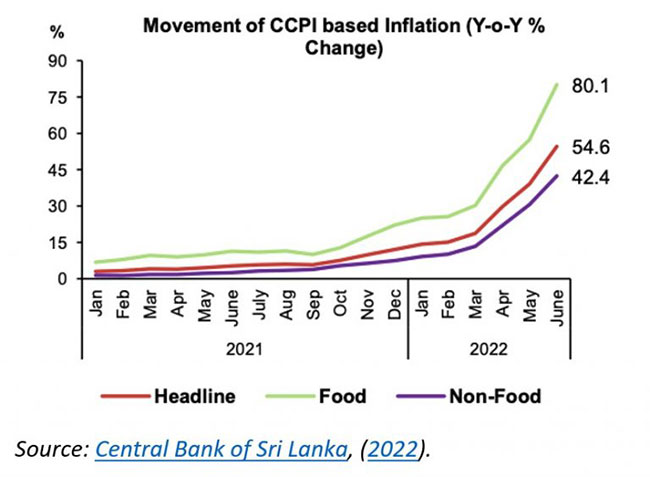
The rapid depreciation of the Sri Lankan Rupee and the inability of wages to keep up with inflation have drastically lowered the standard of living. Inflation, as measured by the Colombo Consumer Price Index (CCPI) for June 2022, was 54.6% in comparison to 39.1% in the previous month. Further, food inflation rose to an alarming 80.1% in June 2022.
The ability to earn a living wage is hampered by insufficient fuel supplies. This along with the rise in transport costs and overcrowded public transport have left workers struggling to commute to work. Daily wage earners such as three-wheel drivers are in fuel queues for days losing out on productive work hours. Regular interruptions to the power supply are affecting small-business owners’ ability to conduct business and with many completely shutting down operations. Shortages in gas and kerosene oil for cooking, rise in commodity prices and supply shortages are changing people’s consumption patterns forcing many families to reduce their consumption and non-consumption expenditure. The inability to receive adequate nutrition due to increases in the cost of living is affecting children’s health and may lead to increased rates of malnutrition in the future. Apart from this, continuous school closures are impeding children’s education, especially at the village level where most families lack the technology for digital learning.
Short-term Relief
Sri Lanka was facing a reversal in poverty levels since the COVID-19 pandemic and faces the risk of many new groups following suit along with those who are already poor falling deeper into poverty. Hence immediate measures must be taken to support the poor and ensure their livelihood sustenance to some extent. As the current fiscal restrictions pose a challenge in supporting all groups in need, emergency relief efforts need to be targeted toward the most vulnerable so as to not further cripple the economy. Providing cash transfers is one such relief option. They were widely popular as a global emergency response during COVID-19. While Sri Lanka also adopted this as a response to the pandemic, the key in this context would be to provide an adequate sum of money to the most deserving households. Although this may include a considerably large number of at-risk families due to rising inflationary pressure, unfortunately only those in dire need of support must be beneficiaries at this time. As such authorities will have to make tough choices to correctly identify deserving households. Financing these cash transfers will require an allocation of a portion of funds from foreign aid, loans and other humanitarian assistance received by Sri Lanka.
Following the declaration of a three-day weekend for public sector employees, primarily to utilise their time to cultivate consumable crops at the household level, the provision of in-kind support such as seeds and fertiliser for cultivation is another option. As with monetary support, these initiatives must be targeted toward the poorest who are unable to meet their required nutrition levels. However, there is an issue with such families not having suitable plots of land for cultivation. Thus, initiatives need to be thought of on how to overcome space limitations. One option is through community gardens which can be introduced in village-level Grama Seva offices, school grounds etc. Proper organisation, allocation, and monitoring are imperative to successfully execute these initiatives.
Although an unpopular solution, temporary rationing measures will need to be put in place, especially for high-demand commodities such as fuel, gas, milk powder and medicine etc. This will help curb excess purchasing of items and ensure all individuals have access to purchase necessities. Excessive purchasing often leaves the poor on the losing end since they do not have sufficient funds to purchase beyond their immediate requirements. Hence rationing will help with maintaining sufficient supplies for low-income groups such as daily-wage earners. While it is important to support the poor and vulnerable at this time, it is imperative to ensure the limited fiscal and other resources are used effectively. Further, these measures need to be taken alongside working towards ensuring political stability and debt sustainability to restore international confidence in Sri Lanka. This will encourage support from the global community to help Sri Lanka work towards overcoming this crisis.
Link to the full blog – https://www.ips.lk/talkingeconomics/2022/07/18/sri-lankas-deepening-economic-crisis-the-plight-of-the-poor/
Lakshila Wanigasinghe is a Research Officer at IPS with research interests in poverty, social welfare, development, education, and health. She holds an MSc in Economics with a concentration in Development Economics and a BA in Economics with concentrations in International, Financial and Law and Economics from Southern Illinois University Carbondale (SIUC), US. (Talk with Lakshila – lakshila@ips.lk)

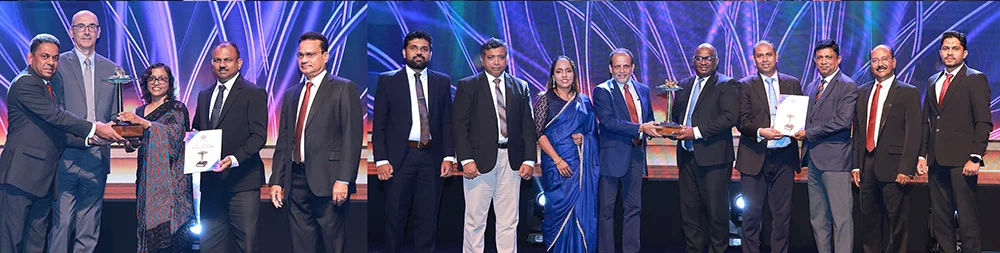
Corporate accolades underscore the alignment between its operational excellence and national development
In an era where national competitiveness is intrinsically tied to digital connectivity, strengthening the country’s digital backbone has become an urgent priority. Within this context, the evolving role of Sri Lanka’s leading telecommunications provider, SLT-MOBITEL, offers valuable insight into how technological infrastructure can underpin broader economic resilience.
Telecommunications and digital networks are foundational to economic transformation. By expanding high-speed broadband access, upgrading enterprise cloud capabilities, and bridging the urban-rural connectivity divide, SLT-MOBITEL helps reduce business transaction costs, streamline supply chains, and enable micro, small, and medium enterprises to reach global markets.
Recent corporate accolades further underscore this alignment between operational excellence and national development. SLT-MOBITEL’s triple triumph at the National Business Excellence Awards 2026 – winning in the Infrastructure and Utilities sector, Performance Management, and ICT Services categories – highlights its growing impact. Notably, the recognition of eChannelling’s contributions to digital healthcare reflects a broader strategic pivot toward integrated technology solutions.
“Institutional efficiency of this nature is critical for attracting foreign direct investment, as global partners increasingly assess a country’s digital maturity and systemic stability before committing capital,” noted industry observers.
Moreover, the company’s transition from a conventional telecom utility to a comprehensive digital solutions provider aligns seamlessly with Sri Lanka’s national digitalisation agenda. As the country pursues public sector modernisation, enhanced e-governance, and a competitive knowledge economy, the private sector must step up to deliver secure, scalable, and future-ready networks. Investments in data centres, cybersecurity frameworks, and advanced ICT infrastructure act as strategic buffers, ensuring that Sri Lanka’s economic apparatus remains agile and resilient amid future global uncertainties.
However, industry experts caution that while these achievements are commendable, SLT-MOBITEL still has a considerable distance to cover in fully enabling a truly digital economy.

Port City Colombo (PCC) took a prominent role as Platinum Sponsor at the second edition of Sri Lanka Beyond Your Dreams, a high-level diplomatic and investment engagement hosted by the Consulate General of Sri Lanka in Dubai and the Northern Emirates. The event, held on 2nd September 2026 at the Hilton Dubai Al Habtoor City, brought together over 400 senior UAE-based business leaders, investors, diplomats, and institutional stakeholders, alongside Sri Lanka’s most senior government representatives.
The gathering was graced by Dr. Thani bin Ahmed Al Zeyoudi, UAE Minister of Foreign Trade, as Guest of Honour, and Vijitha Herath, Sri Lanka’s Minister of Foreign Affairs, Foreign Employment and Tourism. A high-level Sri Lankan delegation – including the Secretary to the Prime Minister, the Chairman of the Board of Investment, the Chairman of the Export Development Board, and the Director General of Commerce – underscored the government’s strong commitment to deepening economic diplomacy with the UAE.
In his keynote address, Minister Herath reaffirmed the centuries-old ties between Sri Lanka and the Arab region, emphasising the UAE’s vital role as a key economic partner. He stressed the urgency of finalising a Comprehensive Economic Partnership Agreement (CEPA) with the UAE, which would establish a robust framework to elevate trade, investment, and bilateral cooperation. Declaring Sri Lanka “open and ready for business,” he positioned Port City Colombo as the physical embodiment of this economic mission – a modern Special Economic Zone (SEZ) with a dedicated legal framework and competitive incentives, offering UAE investors a natural gateway to South Asia while maintaining strong Gulf connectivity.
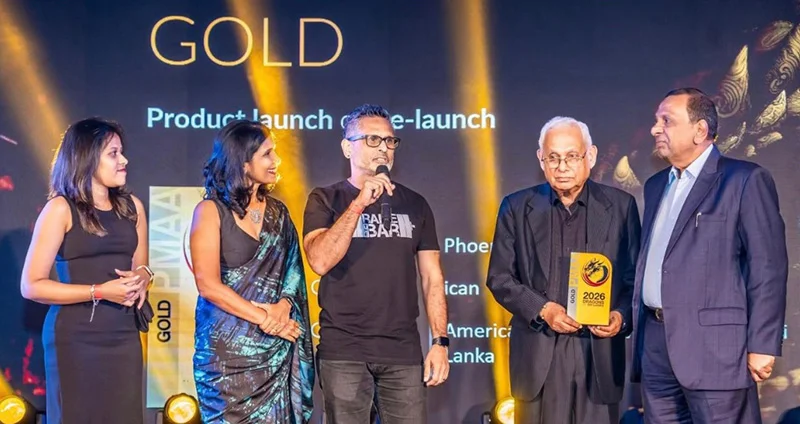
American Premium Water has secured four wins at Dragons of Sri Lanka Awards 2026, including three Gold Dragons and one Black Dragon, marking a significant milestone for the brand following its relaunch last year.
Part of the prestigious Dragons of Asia awards, Dragons of Sri Lanka brings the program’s regional platform to the local market, celebrating creative and effective marketing communications, with entries evaluated on strategic thinking, creativity, execution and impact. Established in 2000, Dragons of Asia is one of Asia’s premier results-driven marketing awards programs.
For American Premium Water, the achievements are particularly significant given that the company’s debut at the Dragons awards has resulted in four Dragons across four categories. In the distinction of Gold Dragons, American Premium Water was recognized across three categories including Product Launch or Re Launch, Cause, Environment or Sustainability and Creative Excellence while the Black Dragon was awarded in recognition of Small Budget.
Competing alongside leading brands and agencies in Sri Lanka, American Premium Water’s four wins demonstrate the strength and effectiveness of its recent work. Winning three Gold Dragons across three distinct categories highlights the breadth of the brand’s achievements, while the Black Dragon for Small Budget further emphasizes its ability to create meaningful impact through focused and efficient investment.

Pakistan seek revenge, Sri Lanka eye another Asia Cup final

Trump says every adult American will get $5,000 if Republicans win midterms

Protesters mistake Pakistan’s U-19 team for asylum seekers in Portsmouth

Steps are being taken to provide accommodation facilities for 16,000 university students – Prime Minister

Showers will occur in the Western and Sabaragamuwa provinces and in Kandy, Nuwara-Eliya, Galle and Matara districts.


‘Dates have the highest sugar content to fight Coronavirus’

Sunday Island 27 December – Headlines

#SundayIsland 17th December – Headlines

Sunday Island – 28th March

Sunday Island Headlines – 21 March

Sunday Island – 21st February – Headlines
-

 News6 days ago
Namal remanded until Sept. 18 over Airbus deal investigation
-

 Latest News5 days ago
Tharanga creates history with Diamond League crown in Brussels
-

 News5 days ago
Dispute which triggered listed company director being detained at BIA resolved
-

 Features4 days ago
After the parade: What a traffic OIC’s walk-out tells us
-
 Opinion7 days ago
In Memory of Dr Upatissa Pethiyagoda
-

 Editorial6 days ago
Power vs Equality
-
Editorial4 days ago
Arrests as theatre
-

 Latest News6 days ago
SLPP MP Namal Rajapaksa arrested by CIABOC