
Latest News
The Men’s 100: Rehan Ahmed stars as Rockets cling on in three-wicket thriller


Trent Rockets geared up for their Eliminator showdown with Northern Superchargers by sneaking past Birmingham Phoenix with one ball to spare after a memorable debut in The Hundred for Ben Cox and an eye-catching all-round display from Rehan Ahmed.
The Rockets confirmed their second-place finish in the group, behind Oval Invincibles on net run rate, and will go into Saturday evening’s contest at the Kia Oval full of confidence after claiming their sixth win in eight.
Spin was the key for the Rockets, with their slow bowlers producing combined figures of 6 for 35 from 50 deliveries after Ben Duckett (20 from 15) and Will Smeed (23 from 12) had made a promising start.
Rockets skipper David Willey may have been questioning his decision to insert the opposition when the Phoenix raced to 36 for 0 from 21 deliveries, but the innings stalled when Duckett scuffed a short delivery from Lockie Ferguson to Rehan at midwicket.
Joe Clarke soon followed, slog-sweeping southpaw spinner George Linde to deep midwicket, and from there the wickets tumbled. The irrepressible Rehan (3 for 15) induced a chop-on from Smeed and snared Jacob Bethell for a duck three deliveries later before Linde (2 for 12) claimed his second when Liam Livingstone’s ugly heave met thin air.
Rehan grabbed his third – and 10th in the competition overall – when Benny Howell picked out Max Holden on the boundary and Joe Root, whose 15 deliveries cost just eight runs, got in on the action when Liam Patterson-White’s edge was brilliantly held by Cox, who only received a call-up to join the Rockets yesterday following an injury to Adam Hose.
Dan Mousley (26 from 25) gave the score some respectability but 111-9 looked well under par, even on a spin-friendly surface.
The chase was far from easy though. After the early loss of Tom Banton for 1, caught at mid-on off Boult, Rehan sparkled once more, racing to 37 in 23 balls before an audacious slog sweep was caught in the deep off Livingstone. Root continued his good recent form in the tournament with a run-a-ball 25 that came to an end when he was bowled by Patterson-White and the left-arm spinner struck again five deliveries later, castling Willey with a devilish delivery that spun back sharply between bat and pad.
Linde was run-out after a mix-up and Marcus Stoinis got a leading edge to cover off Bethell as the Rockets slipped to 89-6, and the left-arm spinner struck again when Sam Hain holed out to leave six required from five.
Bethell was entrusted with the final set and conceded just three runs from his first three deliveries but Cox kept a cool head and swept the fourth to the boundary to finish unbeaten on 17 from 12 balls.
Named Meerkat Match Hero after his three wickets and quickfire knock, Rehan said: “Coxy was always going to do it, I had full trust in him. There was a lot of assistance for spinners on this pitch. We train on similar surfaces so it was about going out there and doing the same thing. I’ve enjoyed the opportunity I’ve been given and hopefully I can do it in the next couple of games.”
Brief scores:
Trent Rockets [Men] 113 for 7 in 99 balls (Joe Root 25, Rehan Ahmed 37, Marcus Stoinis 12, Sam Hain 11, Ben Cox 17*; Trent Boult 1-12, Liam Patterson-White 2-25, Liam Livingstone 1-17, Jacob Bethell 2-22) beat Birmingham Phoenix [Men] 111 for 9 in 100 balls (Will Smeed 23, Ben Duckett 20, Liam Livingstone 10, Dan Mousely 26, Trent Boult 11*; Ben Sanderson 2-26, Lockie Ferguson 1-20, George Linde 2-12, Rehan Ahmed 3-15, Joe Root 1-08) by three wickets
[Cricinfo]

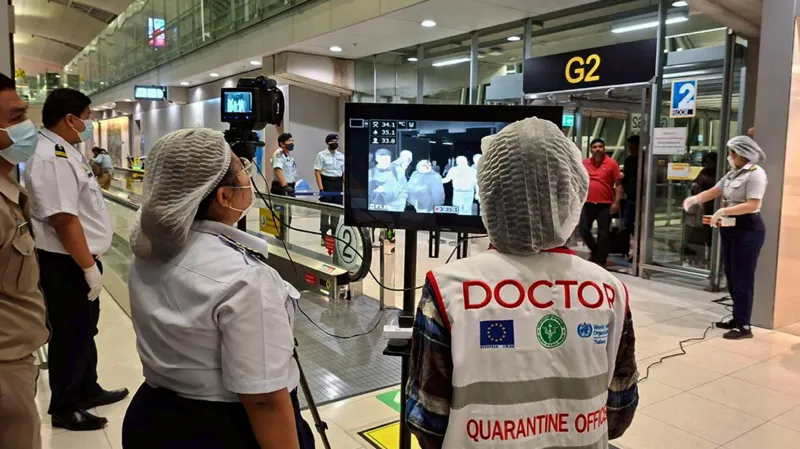
An outbreak of the deadly Nipah virus in India’s West Bengal state has sparked concern in parts of Asia, with some tightening screening measures at airports.
Thailand has started screening passengers at three airports that receive flights from West Bengal. Nepal has also begun screening arrivals at Kathmandu airport and other land border points with India.
Five healthcare workers in West Bengal were infected by the virus early this month, one of whom is in a critical condition. Some 110 people who were in contact with them have been quarantined.
The virus can spread from animals to humans. It has a high death range – ranging from 40% to 75% – as there is no vaccine or medicine to treat it.
The Nipah virus can be transmitted from animals, like pigs and fruit bats, to humans. It can also spread person-to-person through contaminated food.
The World Health Organization has described Nipah in its top ten priority diseases, along with pathogens like Covid-19 and Zika, because of its potential to trigger an epidemic.
The incubation period ranges from four to 14 days.
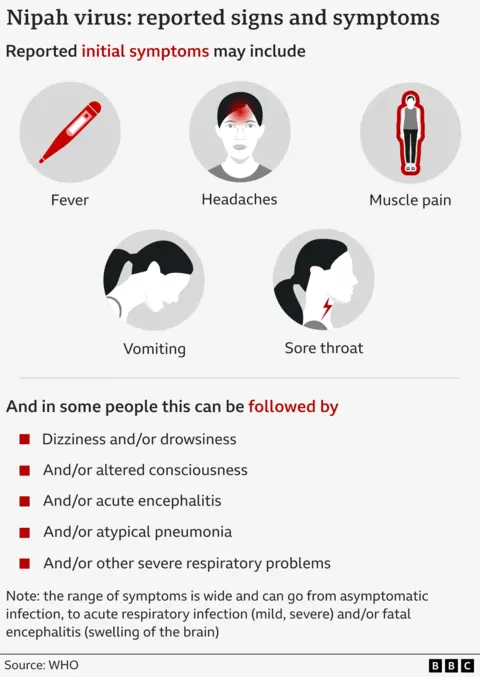
People who contract the virus show a wide range of symptoms, or sometimes, none at all.
Initial symptoms may include fever, headaches, muscle pain, vomiting and sore throat. In some people, these may be followed by drowsiness, altered consciousness, and pneumonia.
Encephalitis, a sometimes-fatal condition that causes inflammation of the brain, may occur in severe cases.
To date, no drugs of vaccines have been approved to treat the disease.
The first recognised Nipah outbreak was in 1998 among pig farmers in Malaysia and later spread to neighbouring Singapore. The virus got its name from the village where it was first discovered.
More than 100 people were killed and a million pigs culled in an effort to contain the virus. It also resulted in significant economic losses for farmers and those in the livestock trade.
Bangladesh has borne the brunt in recent years, with more than 100 people dying of Nipah since 2001.
The virus has also been detected in India. Outbreaks were reported in West Bengal in 2001 and 2007.
More recently, the southern state of Kerala has been a Nipah hotspot. In 2018, 19 cases were reported of which 17 were fatal; and in 2023, two out of six confirmed cases later died.
At least five confirmed cases were reported as of last week, all of whom were linked to a private hospital in Barasat. Two nurses are being treated in an intensive coronary care unit, one of whom remains in “very critical” condition, local media reported citing the state’s health department.
No cases have yet been reported outside India, but several countries are stepping up precautions.
On Sunday, Thailand started screening passengers at three international airports in Bangkok and Phuket that receive flights from West Bengal. Passengers from these flights have been asked to make health declarations.
The parks and wildlife department has also implemented stricter screenings in natural tourist attractions.
Jurai Wongswasdi, a spokeswoman for the Department for Disease Control, told BBC Thai authorities are “fairly confident” about guarding against an outbreak in Thailand.
Nepal, too, has begun screening people arriving through the airport in Kathmandu and other land border points with India.
Meanwhile, health authorities in Taiwan have proposed to list the Nipah virus as a “Category 5 disease”. Under the island’s system, diseases classified as Category 5 are emerging or rare infections with major public health risks, that require immediate reporting and special control measures.
[BBC]
The European Union and India have announced a landmark trade deal after nearly two decades of on-off talks, as both sides aim to deepen ties amid tensions with the US.
“We did it, we delivered the mother of all deals,” European Commission President Ursula von der Leyen said at a media briefing in Delhi. Indian Prime Minister Narendra Modi called the deal “historic”.
It will allow free trade of goods between the bloc of 27 European states and the world’s most populous country, which together make up nearly 25% of global gross domestic product and a market of two billion people.
The pact is expected to significantly reduce tariffs and expand market access for both sides.
Von der Leyen and European Council President António Costa are in Delhi, where they met Modi at a bilateral summit.
The European Commission said the agreement would eliminate tariffs on most exports of chemicals, machinery and electrical equipment, as well as aircraft and spacecraft, following phased reductions. Significantly, duties on motor vehicles, currently as high as 110%, would be cut to 10% under a quota of 250,000 vehicles. That is six times larger than the 37,000-unit quota India granted to the UK in a deal signed last July, Bloomberg reported.
India’s deal with the EU is set to lower costs for European products entering the country – such as cars, machinery and agricultural food items, after import duties are reduced.
Brussels said the agreement would support investment flows, improve access to European markets and deepen supply-chain integration.
Delhi said almost all of its exports would get “preferential access” into the EU, with textiles, leather, marine products, handicrafts, gems and jewellery set to see a reduction or elimination of tariffs.
While commodities such as tea, coffee, spices and processed foods will benefit from the agreement, Delhi “has prudently safeguarded sensitive sectors, including dairy, cereals, poultry, soy meal, certain fruits and vegetables, balancing export growth with domestic priorities”, it said.
Delhi and Brussels have also agreed on a mobility framework that eases restrictions for professionals to travel between India and the EU in the short term.
“This is India’s biggest free trade agreement,” Modi said. “It will make access to European markets easier for India’s farmers and small business. It will also boost manufacturing and services sectors. It will boost innovative partnerships.”
The trade deal comes as both India and the EU contend with economic and geopolitical pressure from the US.
Delhi is grappling with 50% tariffs imposed by President Donald Trump last year amid talks aimed at securing a trade deal between India and the US that are still dragging on.
Last week, Trump threatened to escalate his trade war with European allies for opposing a US takeover of Greenland, before backing off.
That larger geopolitical context was evident in statements made by leaders.
On Tuesday, von der Leyen said: “This is the tale of two giants – the world’s second and fourth largest economies. Two giants which chose partnership in a true win-win fashion. A strong message that co-operation is the best answer to global challenges.”
A day before that Costa had said, without naming the US, that the trade deal would send an “important political message to the world that India and the EU believe more in trade agreements than in tariffs” at a time when protectionism is on the rise and “some countries have decided to increase tariffs”.
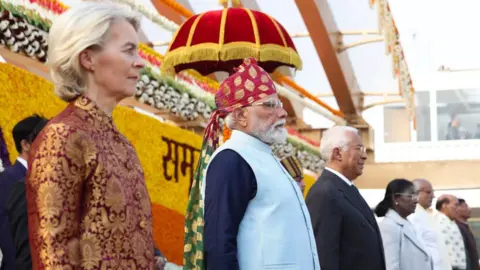
Von der Leyen and Costa arrived in Delhi over the weekend and were the chief guests at India’s colourful Republic Day celebrations on Monday.
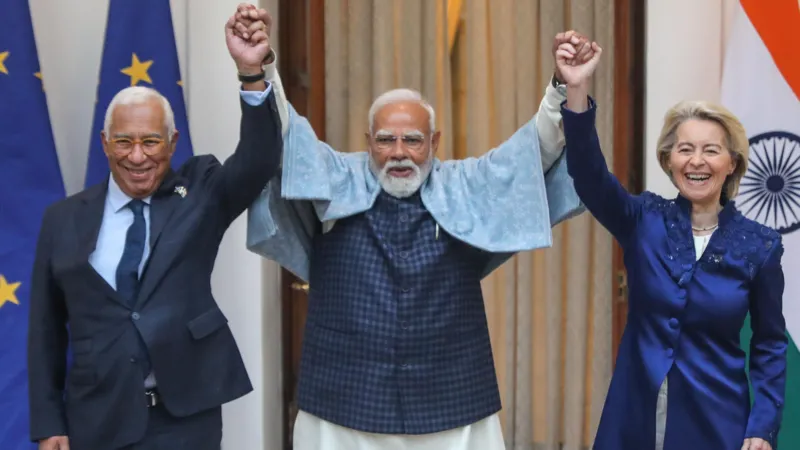
On Tuesday, the leaders posed for photos with Modi, with the bonhomie between them evident.
The formal signing is likely to take place only later this year, after the agreement is approved by the European Parliament and the European Council.
Alongside the trade agreement, India and the European Union are also advancing separate talks on security and defence co-operation, and climate action.
On Tuesday, India’s Defence Minister Rajnath Singh said he had discussed a range of bilateral security and defence issues with the European Commission’s vice-president Kaja Kallas, including opportunities to integrate supply chains to build trusted defence ecosystems and develop future-ready capabilities.
The two sides are working on a draft security and defence partnership covering areas such as maritime security, cyber threats and defence dialogue, Reuters news agency reported.
The EU is India’s largest trading partner in goods, with bilateral merchandise trade reaching $136bn (£99.4bn) in 2024-25, nearly doubling over a decade.
Talks for a deal between them started in 2007 but stalled in 2013 over roadblocks in market access and regulatory demands. Discussions were formally restarted in July 2022.
Officials from both sides worked hard over the past few days to finalise outstanding chapters of the agreement, aiming to wrap it up before the EU leaders’ visit.
The agreement comes as pressure grows on Delhi and Brussels to secure alternative markets for exporters.
In the past seven months, India signed major trade agreements with the UK, Oman and New Zealand, and a 2024 pact signed with the four-nation European Free Trade Association bloc of Switzerland, Norway, Iceland and Liechtenstein has come into effect. It signed a trade pact with Australia in 2023.
The EU, meanwhile, signed a trade deal with South American trade bloc Mercosur earlier this month after 25 years of negotiation.
[BBC]
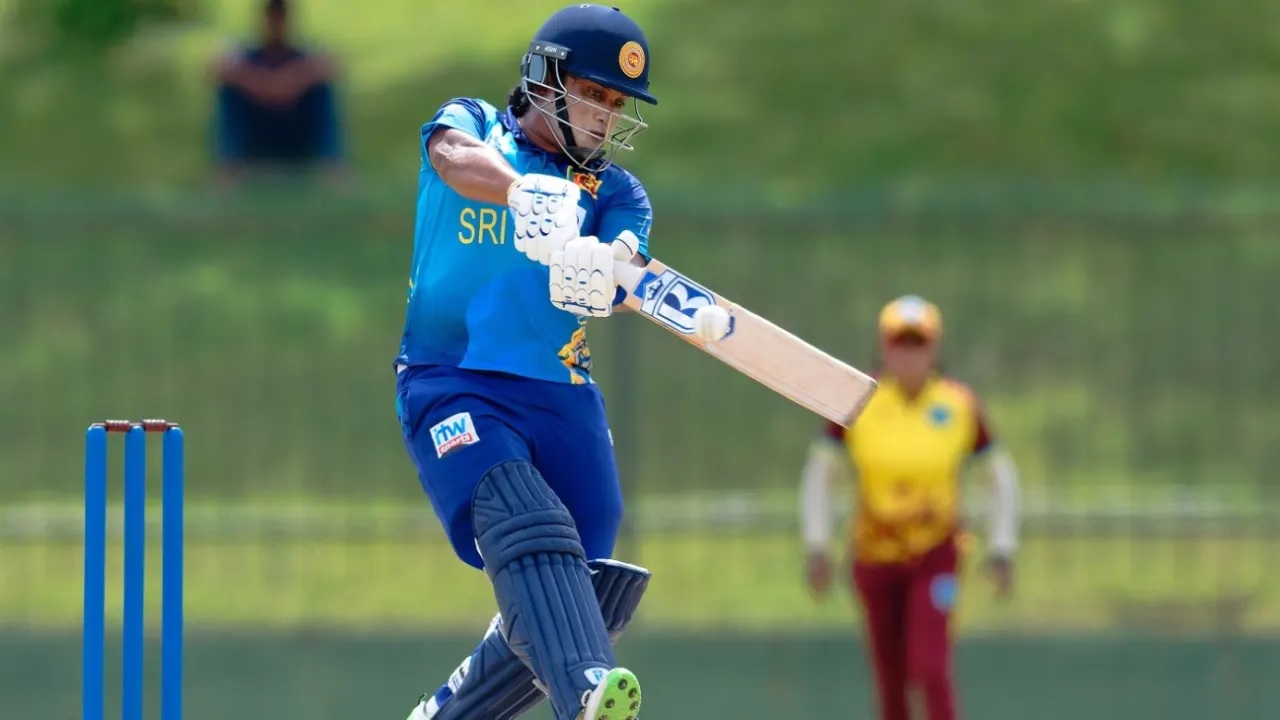
Sri Lanka women will tour the West Indiesfor a multi-format white-ball series in February-March. The tour will consist of three ODIs and three T20Is between February 20 to March 3.
All six games of the tour will be played at Grenada National Stadium. The first ODI will be on February 20, followed by games on February 22 and 25. The T20I series then starts on February 28, followed by games on March 1 and 3.
The T20I series, in particular, will be crucial as both teams look to build their prep towards the 2026 Women’s T20 World Cup in the UK this summer. Both West Indies and Sri Lanka are in Group 2 of the competition alongside hosts England, New Zealand and two qualifiers not yet determined.
Sri Lanka will be looking to win their first T20I series since their Asia Cup triumph of 2024. West Indies have won their last two T20I series at home against Bangladesh and South Africa.
Sri Lanka last toured the Caribbean for an ODI and T20I series in 2024. That tour saw the visitors win the ODIs 3-0 and the hosts claim the T20Is 2-1.
[Cricinfo]

Nipah virus outbreak in India triggers Asia airport screenings

India and EU announce landmark trade deal

Sri Lanka women to tour West Indies for ODI and T20I series in February-March 2026

Scotland bank on ICC assurances over Sharif visa after naming T20 World Cup squad

England bat, Sri Lanka bring back Wanindu Hasaranga

Don Bradman baggy green sold for AU$460,000

‘Dates have the highest sugar content to fight Coronavirus’

Sunday Island 27 December – Headlines

#SundayIsland 17th December – Headlines

Sunday Island – 28th March

Sunday Island Headlines – 21 March

Sunday Island – 21st February – Headlines
-
 Business2 days ago
ComBank, UnionPay launch SplendorPlus Card for travelers to China
-

 Business3 days ago
ComBank advances ForwardTogether agenda with event on sustainable business transformation
-
 Opinion6 days ago
Remembering Cedric, who helped neutralise LTTE terrorism
-
 Business6 days ago
CORALL Conservation Trust Fund – a historic first for SL
-
 Opinion3 days ago
Conference “Microfinance and Credit Regulatory Authority Bill: Neither Here, Nor There”
-

 Opinion5 days ago
A puppet show?
-

 Opinion2 days ago
Luck knocks at your door every day
-
 Features7 days ago
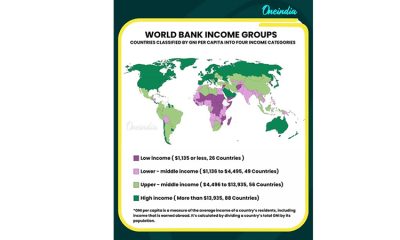
The middle-class money trap: Why looking rich keeps Sri Lankans poor