
Features
The irrepressible Dr J.C Fernando – athlete, medic and gentleman

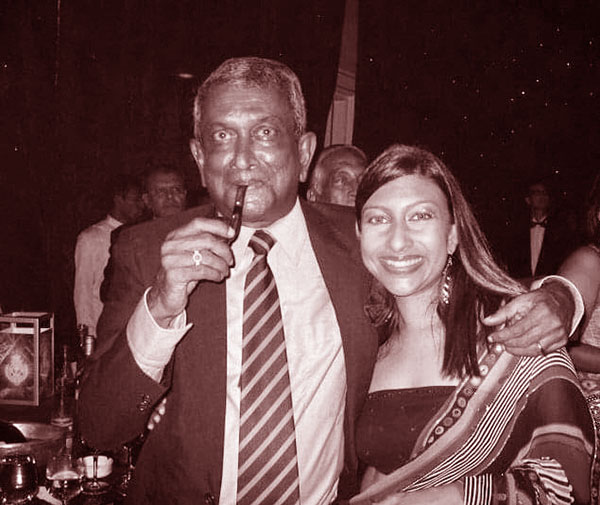
by Dr NiHAL DAMErAsEkErA
Janaka Chandana Fernando (JC)– the name raises a smile on everyone’s face. He is a force of nature that brings happiness to all around him. Gregarious, sociable and flamboyant are all descriptions that come to mind portraying a person whom we have all come to know and love since medical schooldays. He had that irrepressible bohemian flair which was associated with medical students of the 1960’s.
In our citadel in Kynsey Road, no one epitomised the era more than JC. He enjoyed its trappings abundantly. Being from that great institution, Royal College, he knew the large contingent from that school that filled our batch and almost filled the rest of the Faculty of Medicine. JC became an integral part of the Faculty sooner than most.
I first got to know him during the infamous rag. He knew many of the raggers but got no reprieve. He struggled like the rest of us. JC didn’t suffer the indignities gladly. In his usual forthright manner, he did let them know how he felt, muttering under his breath what he thought of it all.
Many will remember JC arriving at the Faculty Cycle Shed every morning on his Honda 50 motorbike. The canteen was his first port of call for the customary ‘tea-punt’. He was a popular guy in our batch and spoke with everyone and was friendly to all. With his affable ways JC made friends with the girls more easily. This made the rest of the boys envious.
JC was never shy to speak his mind and with his loud voice he stood out in a crowd. Born to blush unseen, we always made fun of his jet-black skin which he accepted with civility. For his regal demeanour I often called him the ‘Dark Knight’. All through medical school he wore brilliant white shirts and trousers. With his sparkling white teeth this enhanced the contrast no end.
JC was an outstanding athlete at Royal College. I recall seeing his name in the sports pages of the daily newspapers for his many achievements at school and inter-school athletics. In 1957, JC broke the school’s inter-house 440 yards record held by Summa Navaratnam, an impressive feat. At the Public Schools Meet in 1958, Royal College won both the Tarbat and Jefferson Shields. This must be ingrained in the school’s athletic history as the pinnacle of JC’s achievements when he captained the Royal College Athletics team that won the 4×440 yards relay breaking the Public Schools Record. A great honour for a rare feat.
JC won the University of Ceylon Colours for Athletics from 1961 to 1965 and represented the University Track and Field Team in 1964 at the All India Inter-Universities Meet held in Jaipur. Despite being vocal, his simplicity stood out. To my knowledge he never bragged about those brilliant achievements. For several years he coached the Royal College Athletics Team. At his old school, JC was the medical doctor and physical training instructor for the Rugby and Cricket teams for a good 20 years. For his loyalty, presently he is a Vice-President of the Royal College Union. He is particularly proud of his magnificent collection of cups, medals and trophies from those golden years. They adorn his trophy cabinet with distinction and pride.
JC was tenacious, competitive and single minded. He knew what he wanted and did what was necessary to achieve his goals. His determination never faltered. Once he had an idea in his head, there was no letting go of it. He is often frank and candid and this attracted controversy. In any argument he was persuasive. JC was never a push-over and fought his corner to the very end. Perhaps these are characteristics of a competitive sportsmen. Despite all this he was charming, helpful and kind and was well liked.
Gaining entrance to the Faculty of Medicine in the 1960’s was a gargantuan task. The available spaces were limited, there were hordes of applicants and the competition was fierce. To be a top athlete he had the natural ability and talent and the discipline to practice regularly. This required staying in the school grounds at the end of the school day. Returning home late in the evening, tired, one required stamina and self-discipline to get back to books and revision. Hence to gain entrance to the Faculty of Medicine demanded much more than intelligence and the Midas touch. We were fortunate to have several fine sportsmen and women in our batch who had the grit, determination and the strength of character to be successful. They added an extra dimension to our batch and to the life of the faculty.
He had tremendous enthusiasm for the social events in medical school. Being a fine musician, many of us got to know JC at the social functions. We sang and danced at the memorable and raucous evening booze-ups in the Men’s Common Room. My abiding memory at these events is the lithe figure of the ‘Dark Knight’ strumming his guitar, singing in graphic detail the itchy tale of “the dance of the phthirus pubis”. His signature song was “Saima cut wela” a tragic tale of a novice’s hangover and the effective home remedy. He sang “Suranganee-ta malu genawa“, tempting fate long before they became a pair! Those songs have never left my recall. As I listen to them now on YouTube I’m transported to those happy days of our youth. He was ever present at the dances held at the King George’s Hall of the University’s Science Faculty, twisting the night away to the music of the Harold Seneviratne Combo. Those evenings generated much gossip and scandalous tales of adventures. He capped it all with an enduring contribution to the final year trip making the days brighter and the nights merrier. This will remain a special memory.
In the rigid and grim environment of medical education, the Men’s Common Room was our refuge from the storms of life. I can still picture JC in that setting with a fag between his lips holding a cup of tea. He joined in the billiards, table tennis, carrom and the never-ending chit chats. He was an entertaining talker. If the truth be told he could be prickly and argumentative and there were frosty moments too. All through medical school my memories of JC are of a colourful, jolly guy ever ready for a chat and a laugh. He could talk about anything and everything. I associate him with much of our faculty jargon like ‘tea-punt’ and ’pol-mess machang’ and numerous vivid unprintable expressions delivered with a mischievous smile. These words he used frequently and to great effect. I could still picture him walking the long corridors of the General Hospital Colombo greatly animated, waving his arms relating a story. His tales were peppered with esoteric facts and his own brand of humour brilliantly embellished for good effect. I loved listening to his tales no matter how outrageous. Whether one agreed or disagreed with his views he presented them in such an amusing manner he could even make nonsense sound like a genuine and alluring revelation.
With the “finals” came the great dispersal in 1967. I lost contact with JC for several years. Both Suranganie and JC after a stint in the UK forged successful careers in Hong Kong. There his work in Orthopaedic Surgery flourished and he was greatly valued and respected. Those happy times were curtailed eventually by the demanding concerns for the education of their two daughters. I was a regular visitor to Hong Kong which was my wife’s country of birth. It would have been lovely to catch up with JC and Suranganie, only if I knew. I would have cherished their wonderful company and shared in his first-hand knowledge of the best watering holes in town.
I haven’t been a part of the multiple batch reunions in Sri Lanka. Hence our last meeting was around 2003. This was with Dr Lucky Abeygunawardene and we met up at the Sinhalese Sports Club. JC joined us for drinks and dinner. The ambience, good food and the ‘Double Distilled’ brought out the best in JC. Rarely boring or predictable, sometime brazenly outrageous, JC is excellent company. Many of the old stories resurfaced with the perennial batch tales. A tirade of ‘gossip’ rounded off a momentous evening. This is a memory I will treasure. Although not quite in the digital world, JC sent me emails giving his forthright views and observations about life back home.
We all recognise our medical faculty batch as a tribe. Both JC and Sura are faithful to the tribe and their old friends. I am aware they have been enthusiastic, generous and hospitable entertainers to the multitude of winter visitors from our batch and also to our medical community in Colombo. They have had a fascinating life together working in several countries, enjoying a good social life. Their two daughters have done them proud.
JC has had a rewarding professional career. We have enjoyed his company, humanity and joie de vivre. I do wish JC and Suranganie a long and happy retirement. His is a good life well lived and long may it last. By his achievements he has made his mark in the history of that great school and the Medical Faculty batch of 1962.
Acknowledgements: My grateful thanks to Prof Sanath Lamabadusuriya for providing the information hitherto unavailable in the public domain. Credits go to JC’s daughter Nilanthi and to his wife Suranganie for sending me those brilliant photos that light up the script.


 With no military quick-fix in sight to the ongoing, convoluted West Asian conflict it ought to be clear to the rationally inclined that there is no other way to a solution to the blood-letting other than through a negotiated one. Unfortunately, there are not many takers the world over for such an approach.
Consequently the war rages on incurring the gravest human costs to all relevant sides. Whereas it should be obvious to the Trump administration that Iran wouldn’t be backing down any time soon from its position of taking on the US frontally and with the required military competence in the Hormuz Strait and adjacent regions, the US demonstrates a stubbornness to persist with war strategies that are showing no quick, positive results on the ground.
Clearly, the virtual ‘lock down within a lock down’ situation in the Strait is not proving beneficial for either party. Instead, the spilling of civilian blood in particular continues with unsettling regularity along with an all-encompassing economic crisis that carries a staggering material toll for ordinary people all over the world.
From this viewpoint it is commendable for Pakistan to offer itself as a peace mediator and go ‘the extra mile’ to keep the principal parties engaged in some sort of negotiatory process. But its efforts need to win greater support from the world community. It is a time for peace-makers the world over to stand up and be counted.
It is also a time for straight-talking. To his glowing credit Pope Leo XIV is doing just that and he is the only religious head worldwide to do so. Very rightly he has called on President Trump to end the war through negotiations and described it as ‘unjust’ and ‘a scandal to humanity’.
May this crucial cause be taken up by more and more world leaders, is this columnist’s wish. Instead of speaking fatalistically about a ‘Third World War’, decision and policy makers and commentators, and these are found in plenty in Sri Lanka as well, would do better to help in drumming-up support for a peaceful solution and the latter is within the realms of the possible.
Incidentally, the commonplace definition of the phrase ‘World War’ is quite contentious and it would be premature to speak forebodingly about one right now. The fissures within the West on the Middle East conflict alone rule out the possibility of a ‘World War’ occurring any time soon.
Instead, it would be preferable for the international community, under the aegis of the UN, to take the ‘straight and narrow’ path to a peaceful solution. As implied, this path is no easy avenue; it is cluttered with obstacles that only doughty peace makers could take on and clear.
However, the path to a negotiated peace is worth taking and no less a power than the US should know this. After all, the US ‘bled white’ in Vietnam and had to bow out of the conflict, realizing the futility of pursuing a military solution. A similar lesson should have been learned by Russia which bled futilely in Afghanistan. It too is in an unwinnable situation in Ukraine.
The Pope’s observations to President Trump on negotiating peace have earned for him some snarls and growls of criticism but with time these critics would realize that peace could come only by peaceful means and not through ‘the barrel of a gun.’
For far too long the ‘silent majority’ of the world has allowed politicians to take the sole initiative on working towards peaceful solutions to conflicts and wars. As could be seen, the results have been disastrous. The majority of politicians speak the language of Realpolitik only and this tendency runs contrary to the ways of the selfless peace maker.
Power, which is the essence of Realpolitik, and peace are generally at loggerheads in the real world. Power and self-aggrandizement have to be shelved in the pursuit of durable peace anywhere and it is a pity that the likes of Donald Trump and his team are yet to realize this.
At this juncture the ‘peace constituency’ or the silent majority would need to take centre stage and play their rightful role as the ‘Conscience of the World’. If the latter begins to take on the cause of peace in earnest everywhere, the politicians would have no choice but to pay heed to their cause and take it up, since a contrary course would earn for them public displeasure and votes.
An immediate challenge would be for the ‘peace constituency’ to come together and act as one. Right now, such a coordinating role could be played effectively by only the UN and its agencies. Practical problems are likely to get in the way but these need to be managed insightfully and resourcefully by all stakeholders to peace.
In fact the time couldn’t be more appropriate for the backers of peace to come together and work as one. Right now, economic pressures are increasing worldwide and no less a public than that in the US is beginning to feel them in a major, crushing way.
Going ahead the US public, along with other polities, would find the economic consequences of war to be intolerable. There would be no choice but for governments and peoples to champion peace. Peace makers would need to ‘strike while the iron is hot.’
The success of the above endeavours hinges on the importance humans attach to their consciences. The danger about prolonged wars is that they deaden consciences; particularly those of politicians. The latter deaden their consciences to the extent that they prove impervious to the pain and suffering wars incur.
Thus, the ‘peace constituency’ has its work cut out; it cannot rest assured that politicians would prove sensitive to their demands. The latter would need to be constantly dinned into the hearts and minds of politicians and decision-makers if peaceful solutions to conflicts are to be arrived at.
Likewise, the publics of war-torn countries would need to demand the activation and sustaining of accountability processes with regard to those sections that are suspected of committing war crimes and like atrocities. Those publics that cease to demand accountability from powerful sections among them which are faced with war-time atrocity charges are as good as condemning themselves to lives of permanent dis-empowerment and enslavement.
Chaminda Jayasekara
There is a particular stillness in Sri Lanka’s forests, after dusk — a kind of hushed expectancy where shadows lengthen, cicadas soften their chorus, and the night begins to breathe in its own rhythm. It is a world that does not reveal itself easily. You have to wait for it. You have to listen.
And then, suddenly, you see them — a pair of luminous, unblinking eyes suspended in the dark.
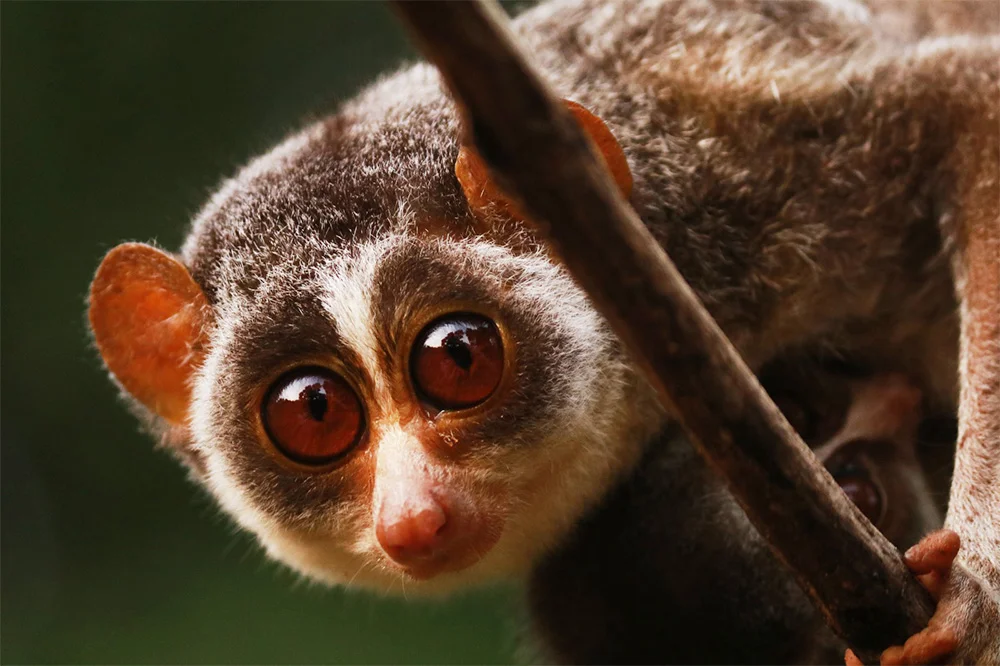
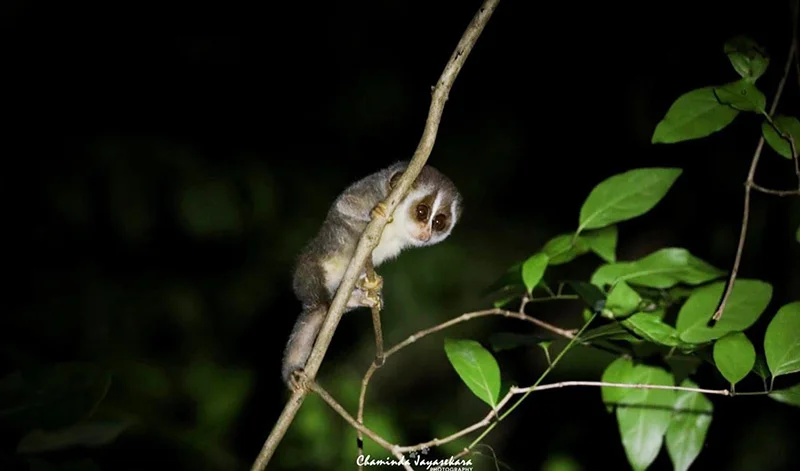
The Grey Slender Loris, or unahapuluwa, emerges, not with drama, but with quiet precision. Small, slow-moving, and almost impossibly delicate, it is one of Sri Lanka’s most enigmatic nocturnal primates — a creature that has survived millennia by mastering the art of stillness.
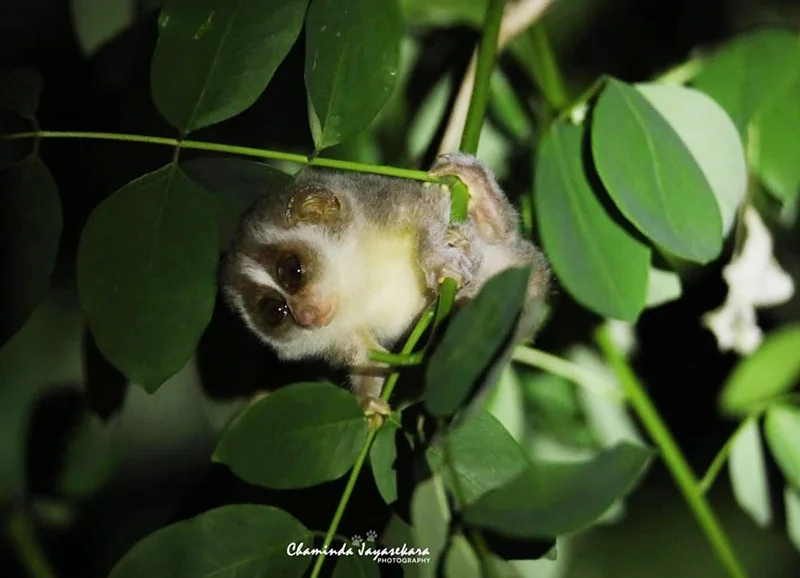
Yet, during these months — from late March through July — the forests hold a more tender story. It is the breeding season of the slender loris, and with it comes a scene that is often misunderstood by those who encounter it for the first time: a tiny infant, alone on a branch, barely three inches long, its fragile body silhouetted against the night.

Grey Slender Loris with twin babies
To many, it appears to be a moment of abandonment.
To nature, it is a moment of trust.
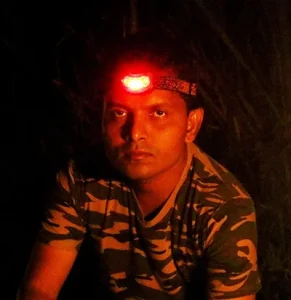
“People often act out of compassion, but without understanding what they are seeing,” explains Chaminda Jayasekara of the University of Hertfordshire. “A baby loris left alone is not necessarily in danger. In fact, it is part of a natural process that is critical for its survival.”
According to Jayasekara, when a baby loris is about a month old, the mother begins a remarkable routine. As darkness settles, she gently places her infant on a secure branch and moves off into the forest to forage. Her journey can take her hundreds of metres away — sometimes close to 800 metres — as she searches for insects and other small prey.
In those hours of solitude, the infant is not abandoned. It is learning.
Clinging to the branch, it begins to explore its immediate surroundings. Tentatively, almost hesitantly, it reaches out — testing balance, grip, and instinct. It may attempt to catch tiny insects, mimicking behaviours it will one day rely on entirely. This is its first classroom, and the forest its only teacher.
“Those early nights are crucial,” Jayasekara says. “The baby is developing motor skills, coordination, and the ability to interact with its environment. These are things that cannot be replicated in captivity.”
And yet, this is precisely where human intervention often disrupts the process.
Across rural and even semi-urban Sri Lanka, stories circulate of well-meaning individuals who come across a lone baby loris and assume the worst. Driven by concern, they pick it up, take it home, or attempt to hand-rear it — believing they are saving a life.
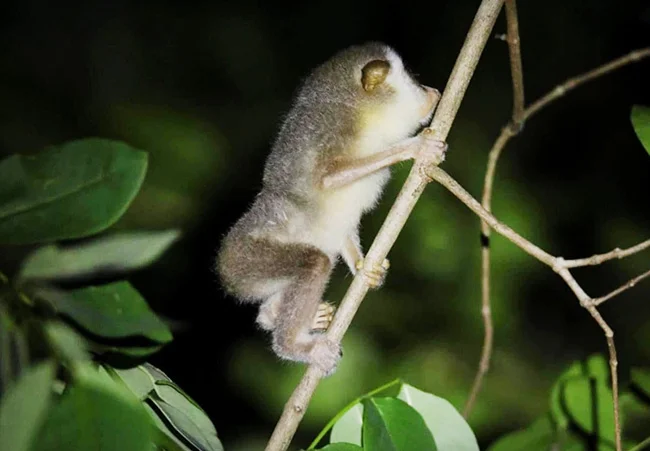
Grey Slender Loris
But the reality is far more complex — and far more tragic.
“When a baby is removed unnecessarily, it loses something fundamental,” Jayasekara emphasises. “It loses the chance to learn how to survive in the wild. Without that, even if it survives in the short term, its long-term prospects are extremely poor.”
The forest, after all, is not just a habitat. It is a living, evolving system of lessons — how to detect predators, how to navigate branches, how to hunt silently, how to recognise territory. These are not instincts alone; they are behaviours refined through experience.
And the mother, contrary to assumption, is rarely far away.
“If people simply waited — even for several hours — they would often see the mother return,” Jayasekara explains. “She knows exactly where she left her baby. Her absence is temporary, purposeful.”
The advice from conservationists is clear and consistent: observe, but do not interfere.
If you encounter a baby loris, watch quietly from a distance. Avoid using bright lights or making noise. Give it time — at least 10 to 12 hours — before drawing conclusions. In most cases, the situation will resolve itself, just as nature intended.
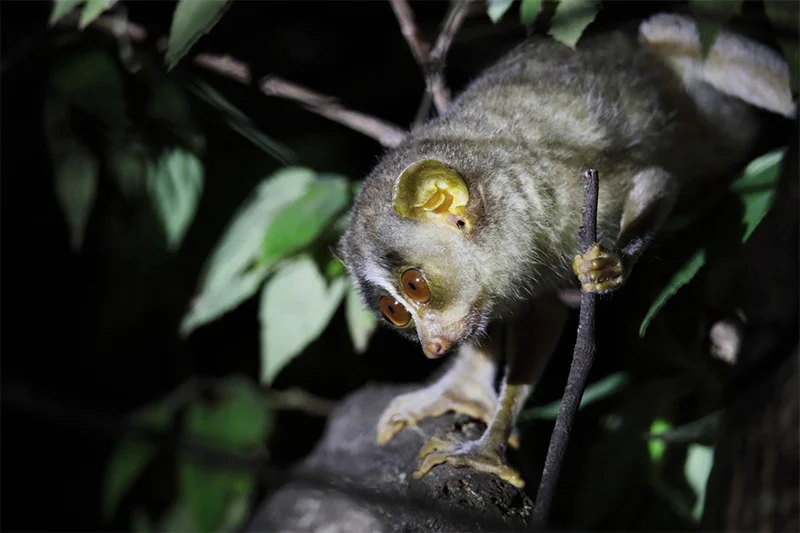
35 days old Grey Slender Loris
Only if the animal is clearly injured, or if there is strong evidence of abandonment after prolonged observation, should intervention be considered — and even then, it must be done through the proper channels, particularly the Department of Wildlife Conservation.
Attempting to care for such a delicate animal at home is not only ineffective but often fatal.
Sri Lanka is home to two species of slender loris — the Grey Slender Loris and the Red Slender Loris — each adapted to specific ecological zones across the island. Both are protected under national legislation and recognised internationally as species requiring urgent conservation attention.
Their threats are many: habitat loss, road mortality, illegal pet trade, and, increasingly, human misunderstanding.
Yet, in the midst of these challenges, there are also signs of hope.
In recent years, the slender loris has become the focus of a unique form of wildlife tourism — one that values patience over spectacle. Night walks, conducted with trained naturalists and strict ethical guidelines, offer visitors a chance to witness the loris in its natural environment without disturbing its behaviour.
At places like Jetwing Vil Uyana, this approach has been refined into a model of responsible eco-tourism. Over more than a decade, the property has developed a dedicated Loris Conservation Project, recording thousands of sightings while educating visitors and supporting local communities.
Here, the loris is not handled, chased, or exploited. It is simply observed — a quiet presence in a carefully protected landscape.
“The success of such initiatives shows that conservation and tourism do not have to be at odds,” Jayasekara reflects. “When done responsibly, tourism can actually support conservation by creating awareness and value for these species.”
There is something profoundly moving about encountering a loris in the wild. It does not roar or charge. It does not demand attention. Instead, it exists — quietly, deliberately — as it has for millions of years.
And perhaps that is why it is so easily misunderstood.
In a world that often equates visibility with importance, the loris reminds us that some of the most extraordinary lives unfold beyond the spotlight.
It also reminds us of something else — something simpler, yet harder to practice.
Restraint.
Because conservation is not always about stepping in. Sometimes, it is about stepping back. About recognising when nature does not need our help, but our patience.
So if, on some future night, you find yourself walking beneath the trees, and your light catches a tiny figure sitting alone on a branch — do not rush forward.
Pause.
Watch.
Let the moment unfold.
Because somewhere, moving silently through the darkness, guided by instinct and memory, a mother is already on her way back.
And by morning, the forest will be whole again.
By Ifham Nizam
 We first saw him on the small screen in January 1986 – a relatively raw, totally untrained and a very nervous 24-year-old presenting ‘Bonsoir’ on ITN.
And now, 40 years later, and as one looks back, one realises what a multi-dimensional journey Kumar de Silva has navigated across the small screen yes, from your television screens to your laptops, and iPads, tabs, and mobile phones.
Says Kumar: “It is the French language I speak that opened the world of television to me, 40 years ago. It was ‘Bonsoir’ alone, and so to my French teacher at Wesley College, Mrs. BA Fernando, to ‘Bonsoir’, and to the Embassy of France in Sri Lanka, I am eternally grateful”.
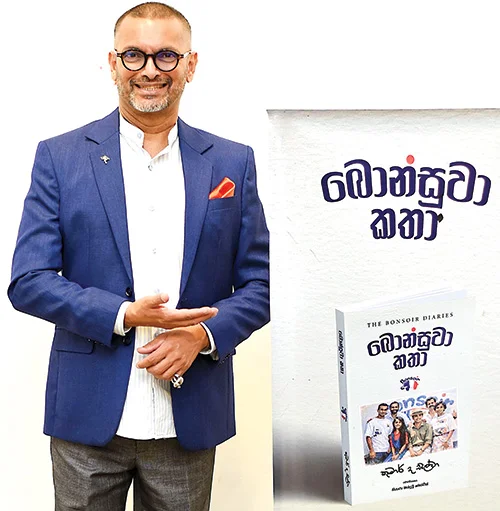
Promoting the French language, and culture, in Sri Lanka, in a big way
Kumar went on to say that on the heels of ‘Bonsoir” came ‘Fanclub’, on ITN, describing it as yet another resounding success story which saw him as a music DJ on TV.
His inherent talent saw him handle a range of contrasting programmes across ITN, TNL, Prime TV and SLRC with consummate ease – from News Reading, Business Talk Shows, Celebrity Chats, to Dhamma discussions, on Poya Days, to name a few.

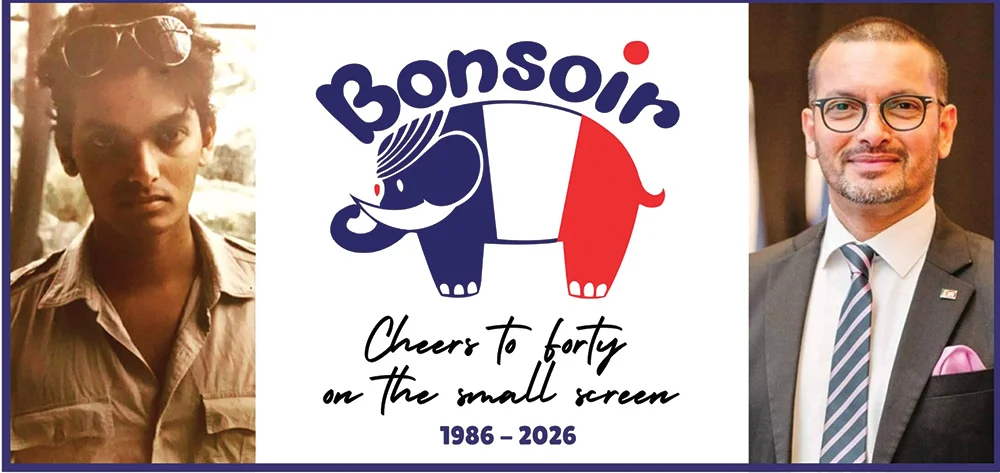
Kumar – the 1986 look
Trained in Paris in television production and presentation, the Government of France, in 2012, conferred on him the title of ‘Chevalier dans l’Ordre des Arts et Lettres’ (Chevalier in the Order of Arts and Letters) in recognition of his contribution to promoting the French language, and culture, in Sri Lanka.
In celebration of his four decades on the small screen, Kumar recently launched ‘Bonsoir Katha’, the Sinhala translation (by Ciara Mendis) of his English book ‘Bonsoir Diaries’ (2013), at a gala soiree. at the Alliance Francaise de Colombo, under the distinguished patronage of the French Ambassador in Sri Lanka, Remi Lambert, and francophone President Chandrika Kumaratunga.
He’s now excited about launching the French version of this book, ‘Les Coulisses de Bonsoir’, in Paris, in autumn this year. It is currently being translated by Guilhem Beugnon, a former Deputy Director of the Alliance Francaise de Colombo. This will, co-incidentally, also be Kumar’s 30th visit to Paris.

Chief Guest French Ambassador in Sri
Lanka Remi Lambert
Says Kumar: “The word GRATITUDE means a lot to me and so I always make it a point to spend time with two very special French people every time I go to France. One is Madame Josiane Thureau, formerly of the French Foreign Ministry, who began ‘Bonsoir’ in Sri Lanka. way back in the mid-1980s. The other is Madame Aline Berengier, the lady who designed the ‘Bonsoir’ logo – the Sri Lankan elephant in the colours of the French national flag”.
Kumar is also a much-sought-after Personal Development and Corporate Etiquette Coach in Colombo’s corporate world. Over the past 15 years, tens of thousands of corporates, have been through the different modules of his interactive training sessions. There have also been thousands of school leavers and undergraduates from national and private universities, many of whom will constitute the corporates of tomorrow.
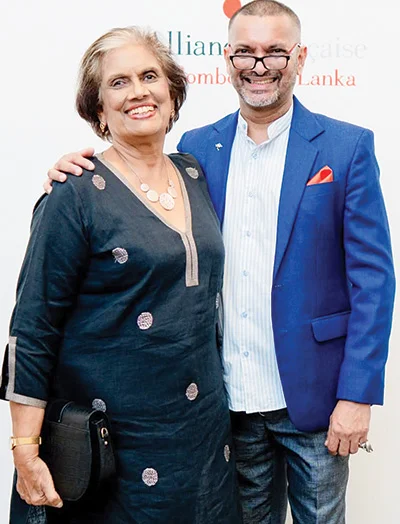
Guest of Honour francophone President Chandrika Kumaratunga at the gala soiree
at the Alliance Francaise de Colombo
The multi-talented Kumar turns 65 next year, and his journey on the small screen still continues – you see him on the (monthly) ‘Rendez-Vous with Yasmin and Kumar’ on the French Embassy’s YouTube Channel, and (every Friday) on ‘Fame Game with Rozanne and Kumar’ on Daily Mirror Online, Hi Online and The Sun Online.
There’s yet another podcast in the pipeline, he indicated, but diplomatically declined to give us details. All he said, with a glint in his eye, was, “It will hit your screens soon.”
Whatever he has in mind, one can be certain that the new programme will continue to showcase Kumar de Silva’s enduring presence in Sri Lanka’s entertainment scene.

Landslide Early Warnings issued to the Districts of Kurunegala and Ratnapura

US boards ship carrying Iranian oil, as Iran MP says first Strait of Hormuz toll paid

Advisory for Severe Lightning issued for the Western, Sabaragamuwa, Central, North-western, North-central, Southern, Uva provinces, and Ampara and Batticaloa districts

Will another film star be able to sway the election in India’s Tamil Nadu?

‘Team audit’ done, Kirsten hopes Sri Lanka keep ‘progressing and improving’

Nuwan Thusara withdraws lawsuit against Sri Lanka Cricket

‘Dates have the highest sugar content to fight Coronavirus’

Sunday Island 27 December – Headlines

#SundayIsland 17th December – Headlines

Sunday Island – 28th March

Sunday Island Headlines – 21 March

Sunday Island – 21st February – Headlines
-

 News3 days ago
Rs 13 bn NDB fraud: Int’l forensic audit ordered
-

 Business6 days ago
Harnessing nature’s wisdom: Experts highlight “Resist–Align” path to resilience
-

 Opinion4 days ago
Shutting roof top solar panels – a crime
-

 News6 days ago
Gratiaen Trust announces longlist for the 33rd Annual Gratiaen Prize
-

 News5 days ago
From Nuwara Eliya to Dubai: Isha Holdings markets Agri products abroad
-

 News6 days ago
Heroin haul transported on 50-million-rupee contract
-

 News4 days ago
Church calls for Deputy Defence Minister’s removal, establishment of Independent Prosecutor’s Office
-

 News5 days ago
‘Agents of the devil’ seeking to block Easter probe, Cardinal warns