
Features
Ministry of Industries: Working with Mr. Cyril Mathew

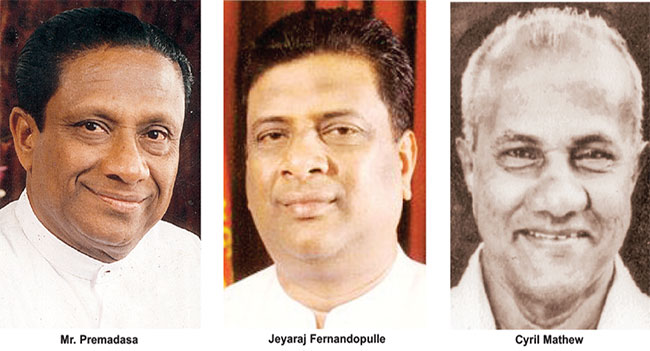
(Excerpted from the Memoirs of Chandra Wickremasinghe, Retd. Additional Secretary to the President)
In the National Housing Authority where I worked after returning from Canberra, I received the complete support of my friend Dunstan Jayawardena who was Chairman of the Authority, to effect an organizational restructuring of the Authority, recruit new technical personnel and revise the existing salary structure. The reorganization enabled officers who had come on secondment to the Authority from the Housing Dept., to exercise the option of staying on in the Authority as permanent employees of that organization. They benefited substantially by being placed at higher levels in the organizational hierarchy as well as receiving much higher salaries. With time, I was happy to note many of these officers, coming to occupy the highest management positions including those of Chairman, General Manager and Deputy General Manager.
The Authority was indeed a hive of activity with Minister Mr. Premadasa in his characteristic manner, pushing the implementation of the numerous housing projects he commenced throughout the island. He worked with incredible energy and commitment, virtually driving all officials to follow suit. However, following certain differences I had with the Secretary to the Ministry over the appointment of Managers to the Authority, I thought it best to leave the set up. Fortunately for me, Mr. Premadasa happened to be out of the island at the time which facilitated my exit without much fuss.
There were two positions available to me to move into viz. Deputy Commissioner of Food and Director /Corporations in the Ministry of Industries. I opted for the latter position where I had to work with Minister Mr. Cyril Mathew.
The Ministry of Industries, Science and Technology
The Ministry had at the time, 47 Corporations and Statutory Boards coming under its purview. These included, certain giant Corporations such as Petroleum, Steel, Ceramics, Paper, Salt, Fertilizer, Tyre etc. I got down to work straight away and got involved in the nitty gritty of things. Mr. Mathew who had a sharp mind, had the not too uncommon weakness of surrounding himself with party loyalists, the more qualified of whom were selected fortunately, as Chairmen of the many Corporations coming under the Ministry while the brawny types who had their own uses, were given the post conveniently designated ‘Working Director’. This latter category had confabulations with the Minister when certain disruptive activities had to be planned and carried out like breaking up rival party rallies, street marches etc.
I must however say that Mr. Mathew never interfered with the work assigned to me. Through the grape vine he may have learnt perhaps, that I was attending to my work conscientiously. Within one year he promoted me as Additional Secretary in the Ministry much to the chagrin of certain senior colleagues in the Service, some of whom, I learnt later, had even taken the matter up with Mr. DBIPS Siriwardhana, Secy. Public Aministration at the time. Mr. Siriwardhana, I was told, had made it clear to them that the appointment of Additional Secretaries was a matter for the Minister concerned.
Chairing Tender Boards
I found the work in the new Ministry quite challenging, having to Chair Tender Boards of about 15 Corporations on an on –going basis. Additionally, I was appointed to Chair the standing Tender Board in Agro-Chemicals of the Petroleum Corporation which work alone, was quite a handful. I must say that the Minister had complete faith and trust in my integrity and aptitude in handling all these Tender Boards. I must also reiterate here for the record that Minister Cyril Mathew never interfered with any of my ‘tender’ work. I must however, further state here with much regret, that certain friends of mine (outside the Ministry) did try to influence me on tender matters, going to the extent of asking me to remain silent during certain Tender Board meetings. This I vehemently declined to do, stating categorically that as Chairman of a Tender Board, it was clearly my duty to ensure that a poor country like ours, should get the best supplies on offer and also ensure that we get our money’s worth. Happily for me, word spread around quickly and I was never bothered thereafter with such unfortunate requests. What I would like to stress here is that once people realize that you cannot be bought over, you are seldom approached by these wheeler –dealer types with their sly requests.
As a Director of the Central Environmental Authority, I had the benefit of attending a Seminar at D.S.E. Berlin in June-July 1982, on Industrial Pollution and Abatement. The CEA also sponsored my participation at a seminar on the pollution of lakes and reservoirs in Tokyo, Japan in September 1984.
Most of the 47 Corporations and Statutory Bodies coming under the Ministry had professionals as their Chairmen who for the most part, discharged their duties with due diligence and competence. However, there were a few Heads of Corporations who abused their positions and tried to make a fast buck. The Minister who had his own unofficial grapevine in this regard, was kept well informed by his many informants, of any irregularities in the numerous Depts. and Corporations coming within his purview.
I recall the Minister summoning me to his room one day to say that he was not at all happy with some of the untoward goings on in the Ceramic Corporation as he had received many complaints from customers about commodes and bathroom fittings cracking up within an year or so of their purchase. He instructed me to visit the Ceramic Factory in Piliyandala with Deputy Chief Accountant Sivaguru and check on the procedures followed and report to him. Siva and I accordingly, decided to visit the factory the following day. Interestingly, on the morning of our scheduled visit to the factory, I received an anonymous telephone call enquiring from me whether I was going to inspect the factory that day. On my replying in the affirmative, the caller who refused to identify himself, said in a matter of fact tone ‘We are having the kiln ready for you and the Accountant when you visit us’.
I replied that we were coming in any case, as it was our duty to inspect the factory and report to the Minister. Siva and I had our suspicions as to who the anonymous caller was as we had been forewarned that there was a supervisor with political backing who was ruling the roost there. We were not going to be cowed down by any threats and just laughed the whole thing off saying that ‘we would face things as they come’! We were also told that this unsavoury character was in the habit of even assaulting employees who did not do his bidding and was virtually terrorizing the entire place. When we visited the Piliyandala Factory as scheduled, we were met by the General Manger who though a nice person, looked a rather docile individual. We were thereafter, taken round the factory and shown the different stages of the entire production process.
At this stage, I requested specifically that we be taken to the kiln and the supervisor concerned promptly led us there. Siva and I deliberately got close to the kiln and peered into it’s blazing interior. Siva, who was a qualified Chartered Accountant, questioned the supervisor closely on the duration of time assigned for each stage of the production process etc. Having collected all the required detailed information both from the GM and the Supervisor concerned ,we retired to the GM’S office and obtained whatever further information we deemed necessary for our investigation and left the factory.
On our return to the Ministry, Siva and I pored over the notes and the relevant information we had taken down on our visit. It became clear to us that the problem of breakages lay in the deliberate acceleration of the production process particularly at the stage of firing of the ceramic ware in the kiln. By such deliberate acceleration, the culprits had ensured an output higher than what was reflected in the production statistics, enabling them to divert the created excess clandestinely, out of the factory to be sold to shops outside.
The following day we gave our report to the Minister explaining in detail what we had discovered. The Minister told us that his suspicions about the people behind the racket, had been confirmed by our findings. Late that evening, the Minister telephoned me and said that he had shown our report to a certain gentleman who was he said, with him at the time. I was aware that this gentleman was an influential person in the political set up at the time. The Minister then said that the particular gentleman would like to speak to me regarding the concerned subject. I recall clearly overhearing certain audible protests made by the gentleman concerned at the other end. Eventually, this gentleman came on line and spoke to me apologetically saying that although he had had suspicions about this particular supervisor, he had not till the time the irregularities had been revealed by our inspection, been able to confirm his suspicions. He further assured me that he would initiate an inquiry against him and see that he was disciplinarily dealt with. He further said that he had assured the Minister that he would guarantee that no irregularities would be permitted to occur in the factory in the future. The Minister came on line again and thanked me and Siva for giving him the report while apologizing, in his characteristically gentlemanly manner, for having disturbed me at that late hour.
Poverty the biggest polluter in developing countries
This was also the time when developed countries were obsessed with the spectre of a rapidly depleting ozone layer and were frantically adopting sophisticated pollution prevention measures in their industrial production processes. This was the run up to the Kyoto Protocols. They were equally anxious to impose these high standards in the running of ‘struggling’ industries in developing countries which were trying desperately to break free of the poverty trap. While having a conversation with the Minister on the subject, I casually expressed the view that it was grossly unfair of developed countries to badger developing countries to conform to these high standards of pollution prevention, as these highly industrialized, affluent countries had built up their economic and material prosperity on decades of indiscriminate abuse of the environment and on the worst forms of exploitation of women and children.
Developing countries on the other hand, which suffered from widespread poverty and were struggling to industrialize, could not possibly think of maintaining pristine environments by investing in costly additional facilities to minimize environmental pollution, which meant burdening the end product by the additional cost that had to be incurred thereby, which clearly meant eroding the competitive edge our exports enjoyed. Furthermore, I said that China, was the least concerned, despite the pressures brought to bear on them by the West, about maintaining pollution standards, in their determined drive towards rapid industrialization, which was accorded the highest priority in their single minded endeavour to reduce mass poverty in that country. I also said that our major concern should be the alleviation of poverty through a sustained developmental thrust ,as poverty was our biggest polluter.
The Minister who had listened carefully to what I said, wanted me to prepare a brief note incorporating these points and hand it over to Sarath Perera who was the Additional Secretary handling the subject. This was accordingly done by me. To my surprise a major headline carried in the following day’s newspapers read – ” The Ministry of Industries takes the view that the strict industrial pollution standards followed in the developed Western countries need not be adopted here.” It should be remembered that these decisions were taken more than 30 years ago when more than 60% of the population of this country was living at subsistence level, occupying substandard housing with no proper facilities for sewage and waste disposal.
Poverty alleviation was hence, a major policy imperative we had to pursue relentlessly. There was no gainsaying that there was widespread environmental pollution stemming from widespread poverty. But the hard logic that had to be underscored was that, poverty was indeed, irrefutably, the biggest polluter in poor developing countries. This was why they were according the highest priority to poverty alleviation and were trying frantically to break loose of what seemed an inexorable poverty cycle, through rapid industrilisation.
I also benefitted by attending a workshop on “Modern Management Techniques” at the D.S.E. Berlin in June – July 1983. I had to leave the Ministry of Industries under somewhat distressing circumstances. Mahinda Bandusena who was Senior Asst. Secy. of the Ministry at the time, and I were entrusted by the Minister the rather unenviable task of handling disciplinary inquiries against certain errant Heads of Corporations coming under the Ministry. It was a painful task given to us as some of the Corporation Heads were our close friends. But the Minister did not seem to be affected by these sensitivities and insisted that we carry on with these Inquiries.
I remember one particular case where I conducted an inquiry against a Chairman of a Corporation who had defalcated a substantial amount of money. There was enough evidence to conclude that the said Chairman had defrauded the Corporation and my report was submitted to the Minister along with my findings. The Minister summoned me the next morning and I found the Chairman seated before the Minister with his head bowed. The Minister at that stage gave me the file containing my report asking me to read the section on my findings. At the end of it, the Minister asked the Chairman what he had to say. As the Chairman remained silent, the Minister berated him saying that he was being badly let down by the Chairman and wanted the latter to pay back the full amount of money he had misappropriated immediately. The said Chairman I was told, had post haste paid back the full amount of money and had thereafter got himself warded, purportedly seeking treatment for high blood pressure. He had remained in hospital for a week and on his return to office, had been given another severe tongue lashing by the Minister who I was told, had felt sorry for him and accommodated him in another Statutory Board in the Ministry.
I still recall vividly an incident which happened when the Ministry Votes were being debated in Parliament with myself, Bandu and other Ministry official looking on from the Officials’
Box. We were embarrassed no end when Mr. Jeyaraj Fernandopulle who was at the time in the Opposition, pointed to us and said in Sinhala –”There you can see the Minister’s Supreme Court, Mr. Chandra Wickramasinghe and Mr. Mahinda Bandusena. They are the two who sit in judgment over Chairmen of Corporations”. (Recorded in Hansard.)
All this was in addition to the normal duties I was saddled with. Mahinda Bandusena too was similarly burdened with this additional workload. The Minister who was however, impatient to have these inquiries finalized in double quick time (which would have been most unfair by the accused persons most of whom happened to be our friends), summoned the two of us to his office at Flower Road and berated us for ‘delaying’ these inquiries. We both thought that the Minister was being unfair by us and tried to explain to him why we could not possibly accelerate these inquiries. However, the Minister was in no mood to hear us out. As we left the Minister’s office I told Bandu that I was leaving the Ministry and would look for a suitable place immediately.
I telephoned Mr. DBIPS Siriwardhana that afternoon and conveyed my intention of leaving the Ministry. I remember distinctly his cynical laugh while asking me “Do you take these characters seriously? They are just birds of passage and you should not get emotionally affected by what they say”. However, as I was insistent on leaving, he asked for two days for him to try and do something. However, within half an hour, he rang back and asked me whether I was interested in the post of Additional Secy. in the new Ministry of National Security where he had just been appointed Secretary. I promptly said that I would be privileged to serve under him but at the same time expressed certain doubts about my being able to secure my release from the Industries Ministry. Mr. Siriwardhana laughed and said that Minister Mathew should be happy to see me leave, having given me a blackguarding!
The next morning Mr. Mathew called me to the Ministry and was very sweet to me. I was with him for a good two hours and in between consultations he had with officials, he asked me what I thought about some new projects that came up for discussion and also sought my opinion about certain officers who visited him that morning. I however, was discreetly reticent particularly in expressing my personal views on certain officers most of whom were known to me well. When he was about to leave office I thought it was time for me to inform him that I would be leaving the Ministry. From the manner he reacted, it was clear that it came as a shock to him.
He asked me where I was going and the Minister in charge of the Ministry concerned. When I informed him that it was the new Ministry of National Security which had been created by the President, he realized that he would not be able to block my release. He then asked me who would succeed me and when I suggested a few names he did not seem happy with them and said that he would find a suitable successor. I liked Mr. Mathew despite the reputation he had for using strong arm tactics. Apart from the last episode which he obviously regretted, going by the manner he treated me the following day, I must say that he was extremely good to me during my stay of four years in that Ministry.
However, when I was leaving the Ministry to take up the appointment as Additional Secy. in the newly created Ministry of National Security, I was somewhat amused when a member who regularly served on these Tender Boards, told me that he was happy to see me leave, as I did not make money for myself nor did I allow others to do so! Although I was momentarily taken aback by what the person said, I knew again that it was indeed, a grudging compliment paid to me.





Harshitha Samarawickrema was 14 when Sri Lankan women’s cricket first pricked the national consciousness. She had already been playing cricket for her school, Gothami Balika Vidyalaya, but had largely pursued cricket merely for the sake of playing a sport, and also because she had enjoyed watching the men’s team play. But watching Sri Lanka defeat England in a thriller at the 2013 World Cup stirred up a deeper yearning.
“I’d watched all of the matches at that World Cup actually – that was the first time those kind of matches were telecast,” Samarawickrama said once. “That’s when I decided I was going to play and win matches for Sri Lanka one day.”
That victory against England was a new dawn for Sri Lanka’s women for two reasons. First up it was the highest-profile victory on their ledger until then, marking an unexpected high point in a World Cup in which little was generally expected of the team. But it also marked the rocket-powered arrival of Chamari Athapaththu, who top-scored with 62 to help set up the chase.
Thirteen years later, Samarawickrama has not only fulfilled her promise to herself, she has also helped Sri Lanka bring to life the promise of that 2013 campaign. Athapaththu, who has since has become the superstar around which Sri Lanka’s cricket orbits, has never known a more consistent batting collaborator than Samarawickrama. In T20Is, the pair have put on 1,202 runs together – easily the best for Sri Lanka. Though both are lefties who revel in pressure, that’s about where the similarities end – Athapaththu having grown up idolising the big-hitting of Sanath Jayasuriya, while Samarawickrama had been a disciple of the Kumar Sangakkara school of left-handed batting. (Samarawickrama still tries to replicate that famous bent-kneed cover drive, though she invariably sprinkles a little of of her own flair to the endeavour.) Oppositions have found this combination difficult to contend with, Athapaththu commanding through the legside and brutal on errors of length, while Samarawickrama flits around the crease and carves boundaries through cover and point.
It has been clear for years now that Sri Lanka’s chances in pretty much any match depend primarily on Athapaththu runs. But Samarawickrama’s advance as a T20 batter has now opened up a new frontier in the team’s batting performance. Ideally, what Sri Lanka want is not merely big runs from their captain, but a strong partnership between Athapaththu and Samarawickrama. In victories, the Athapaththu-Samarawickrama stand averages 41.38.
More tellingly, a good Samarawickrama innings has become as reliable a predictor of a strong Sri Lanka showing as a good Athapaththu innings. In T20I wins, Athapaththu averages 40.18 and strikes at 131, in comparison to 17.94 and a strike rate of 94 in losses. Samarawickrama’s corresponding numbers are even more stark. In Sri Lanka victories, Samarawickrama averages 44.08 with a strike rate of 109. In losses those numbers are 16.94 and 87. Other Sri Lanka batters have leveled up in recent years too – Kavisha Dilhari, Nilakshika Silva and Hasini Perera having become more frequent contributors, while 20-year-old Vishmi Gunaratne has also showed promise. But 11 years into her international career, Samarawickrama now has a serious body of work.
Samarawickrama had been modest in the shortest format in 2025, but she arrives at the Women’s T20 World Cup 2026 having had a good six months. Against Bangladesh in April, Samarawickrama had cracked 61 off 35, then 49 off 29, in back-to-back matches that Sri Lanka won (Samarawickrama was top-scorer on both occasions). This was in addition to having put up good numbers in the ODI series that preceded the T20Is. Her 36 not out off 34 in a comfortable warm-up win against Netherlands suggests she is still riding on that form.
This is the first T20 World Cup in which serious runs are expected of Samarawickrama, and if history is much to go by, she is not the sort to be daunted by occasion. Samarawickrama’s finest moments as a Sri Lanka cricketer had come in their most-celebrated win of all, in the Asia Cup final of 2024, against India. Typically, that chase of 166 in Dambulla had been propelled by an 87-run Athapaththu-Samarawickrama stand, but when Athapaththu was dismissed, Samarawickrama ensured she remained at the crease until the winning moments, hitting 69 not out off 51, ultimately collecting the Player-of-the-Match award.
If 2013 was a new dawn inspiring a fresh generation of Sri Lanka cricketers, 2024 was the year in which the team hammered its stake into the ground, breaking through into an entirely new galaxy of recognition and acclaim at home. Frequently batting in the shadow of Athapaththu, but always charting her own path, Samarawickrama has grown into a leader.
[Cricinfo]
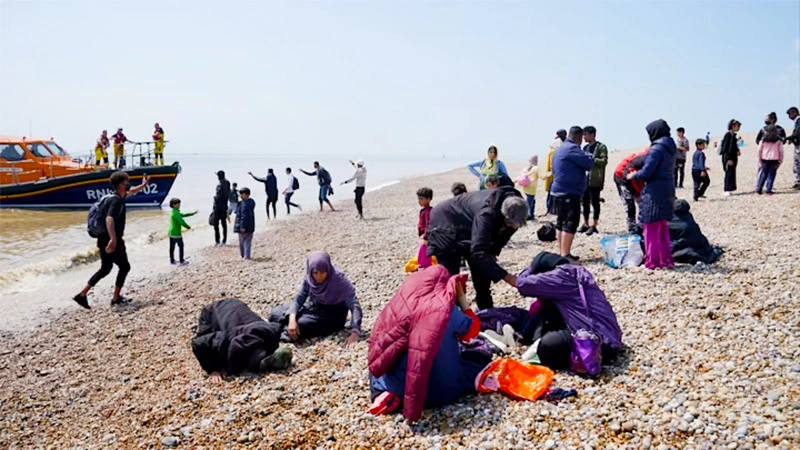
 The announcement by the US authorities of an anti-migrant stance during a recent commemoration in France of the epochal D-Day Landings of June 6, 1944, ought to strike impartial observers as a supreme irony. Whereas what should have been expected was a vibrant celebration of the beginning of the process of Western Europe freeing itself decisively from Nazi or fascist control during the crucial stages of World War Two, this was not to be.
What the world heard instead was a call to contemporary Western Europe to arm itself against a seemingly rising and threatening migrant presence in the region. In other words, the migrant must be despised and ‘shown the door’.
Instead of a commemoration that rejoiced in the flourishing of liberal democracy and its values what one got was a strong affirmation of fascism and racial chauvinism. US Defense Secretary Pete Hegseth vented his spleen against the migrant or foreigner presence in Europe reportedly thus: ‘Sadly today different European beaches are stormed by different dangerous ideologies.’ To ‘beaches in Spain and Italy and Greece and Bulgaria, boats and men arrive. When will European capitals do something about that invasion?’
While at the outbreak of World War Two it was Nazi Germany that was doing the invading and bringing some principal European countries under its suzerainty, this time around we are being given to understand that it’s migrants to the West who are seeking to colonize the latter. It goes without saying that such inflammatory rhetoric would have the deleterious effect of keeping racial tensions alive in the West and jeopardize all possibilities of the countries concerned cementing and maintaining social stability.
The Trump administration gives the impression of taking a leaf from the politically underdeveloped regions of the South to keep the US polity stable and united. In South Asia, for instance, we are not short of ambitious demagogues who use what is referred to as the ‘race card’ to gather unto themselves a following and thereby further their political fortunes. By seeking to stir and sustain anti-migrant hysteria, the Trump administration is also essentially replicating Nazi Germany’s policy of anti-Semitism. That is, fascism is very much alive in the US under President Trump.
Such efforts at churning racial hysteria at this juncture in the US should not come as a surprise. For all intents and purposes, the Trump administration is nowhere near achieving its aims in West Asia, for instance, in the short term. It has failed to bring Iran down to its knees, as it hoped to do, but is adopting the expedient of keeping the world guessing and confused on what it is doing in the region, since it cannot withdraw from the theatre in a hurry without losing face.
While perhaps working out an escape strategy the Trump administration it seems, is hoping to maintain its following at home intact and silent by playing on their racial biases and insecurities. Hence, the anti-foreigner campaign.
Simultaneously, the Trump administration will need to keep a close eye on how economic pressures on the domestic front are panning out. Anti-administration sentiments first break to the surface at meal tables. On this score, the news cannot be good because the average US family’s spending power ought to be shrinking on account of rising energy and oil prices. Consequently, it would not be a bad idea to keep the attention of the US consumer diverted by adeptly playing ‘the race card’; once again, lessons from intellectually bankrupt Southern politicians are coming in handy.
To be sure such comparisons many politicians in vibrantly democratic countries would find quite unflattering. But the stark truth is that racism cannot be tolerated in civilized societies and those politicians who resort to it risk being branded as racists of the first degree. In fact they could be seen as being on par with the likes of German dictator Adolph Hitler and his close collaborators.
However, on the question of migrant policy the Trump administration would likely be at polar opposites with the most vibrant of liberal democracies of the West. This will be the case with the UK, France and Italy for instance. The latter continue to keep their doors open to legal migrants and they are likely to view a virtual blanket ban on migrants as reprehensible.
Moreover, in the foremost democracies of the West debates are vibrantly ongoing on the need to keep racism or any hint of it completely outlawed in the public plane. There is the case of the UK, for instance, where the authorities continue to emphatically pinpoint their adherence to the principle of anti-racism in the conduct of public affairs.
One proof of the above was the parliamentary debate relating to the killing of 18-year-old Henry Nowak in Southampton. Police handling of the victim came in for sharp scrutiny by particularly the opposition in the House of Commons but there seemed to be a consensus over the main political divide that the matter should not be politicized.
Moreover, the UK authorities stressed in the House the government’s strict adherence to the policy of non-racism. It was also pointed out that British institutions set up to manage racism at the national, county and neighbourhood levels, for example, were very much intact. In fact, Sri Lanka could gain considerably by studying and implementing locally, legislation modeled on the relevant UK laws if it is in earnest when it speaks of ‘reconciliation’.
Accordingly, it is highly unlikely that Western Europe would ‘cave in’, so to speak, to US pressure on issues related to migration. The liberal democracies of Western Europe in particular would remain for the foreseeable future migrant-welcoming, multi-ethnic and plural democracies.
Nor is it likely that Western Europe would be passively receptive to US demands that it drastically increases its defense spending to meet the latter’s aims. Within the Western fold the EU is remaining committed to backing Ukraine, for instance, in its ongoing armed resistance to the Russian invasion and it is not giving any indication of being deferent to US pressure.
However, although tensions would continue to bristle within US-Western Europe relations on the above and numerous other matters of contention it would be far too premature to announce a parting of company between the two sections of the West. In that sense, the post-World War Two order remains essentially intact. There are still many things in common between the two, particular on the economic plane, that will ensure the continuance of the partnership.
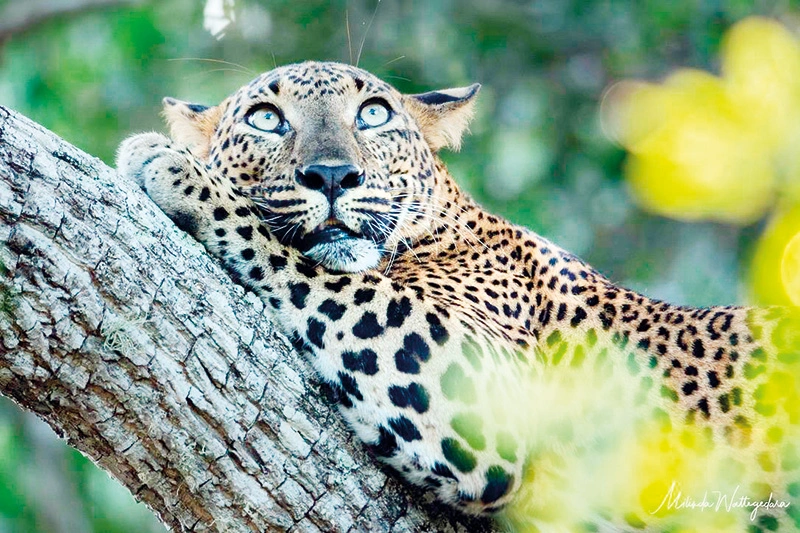
The first rays of dawn creep over the ancient rocks of Yala. The Indian Ocean glimmers in the distance, and the wilderness slowly awakens. Somewhere amid the scrub jungle, a pair of amber eyes scans the landscape.
For wildlife conservationist and leopard researcher Milinda Wattegedara, moments such as these have defined more than a decade of dedication to one of Sri Lanka’s most iconic creatures—the Sri Lankan leopard.
What began as fascination evolved into a remarkable conservation journey that has transformed the understanding of Yala’s leopard population and placed Sri Lanka firmly on the global wildlife research map.
“Long before I ever lifted a camera, leopards had already captured my imagination,” says Wattegedara. “What fascinated me was not merely their beauty but the complexity of their lives—their hunting strategies, movements, reproductive behaviour and their remarkable ability to adapt to changing environments.”
That fascination led to the birth of the Yala Leopard Diary in 2013, an ambitious long-term project dedicated to documenting individual leopards and unraveling the mysteries surrounding their lives.
For many visitors, a leopard sighting is a fleeting thrill. For Wattegedara and his team, every encounter is a chapter in an ongoing scientific story.
“Each photograph was never the end of an encounter,” he explains. “It was the beginning of deeper questions. How did a particular leopard use the landscape? How did its behaviour change with the seasons? What environmental pressures shaped its decisions?”
These questions drove years of meticulous fieldwork. Every sighting was carefully recorded with details including location, habitat, behaviour, date and time. Photographs were analysed to identify individual animals through unique spot patterns, allowing researchers to distinguish one leopard from another with remarkable accuracy.
What followed was groundbreaking.
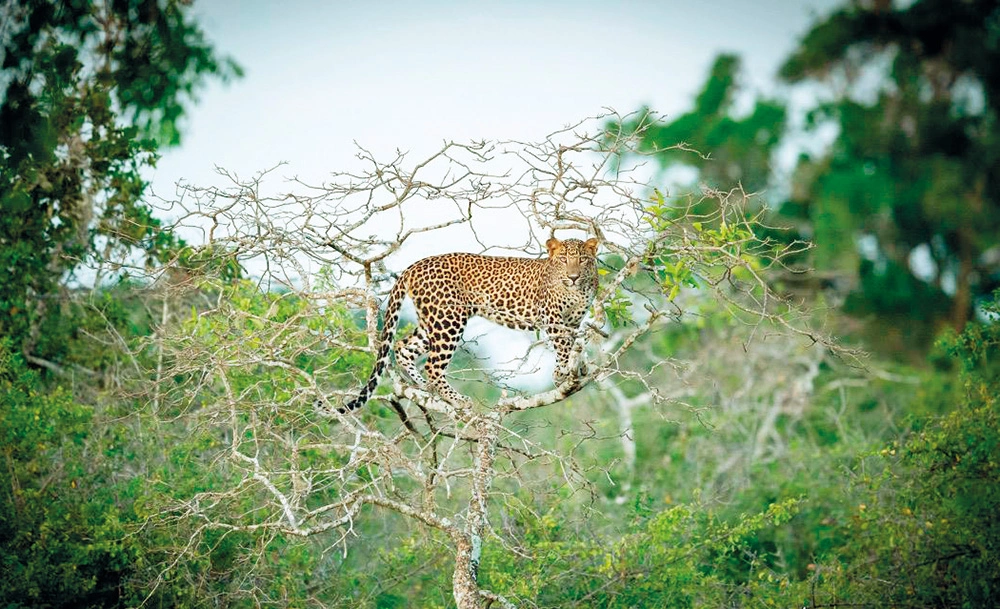
YF77 “Shelly” pauses in quiet observation, embodying the alertness
and grace that define Yala’s leopard population.
From 2013 to 2026, the Yala Leopard Diary identified an astonishing 189 individual leopards within the Yala Block 1. The research revealed a leopard density of approximately 0.524 leopards per square kilometre, making Yala one of the highest leopard-density landscapes ever recorded anywhere in the world.
Such findings have elevated Yala’s status among global wildlife researchers.
Nestled between the Indian Ocean and a mosaic of habitats, ranging from rocky outcrops to dense scrub forests, Yala offers an ecological stage unlike any other.
Here, leopards are photographed silhouetted against ocean horizons, perched atop ancient granite formations, resting on tree branches and stalking prey across sunlit grasslands.
The images tell stories of extraordinary lives.
There is Haminee, a devoted mother navigating the challenges of raising cubs in a competitive landscape. There is Lucas, one of Yala’s most frequently documented males, striding confidently across the Gonalabba Plains with the vast ocean forming an unforgettable backdrop.
There is Ruki demonstrating the species’ incredible strength by hoisting prey onto branches, and Shelly, quietly surveying her surroundings in a moment of feline vigilance.
Together, these individuals have become familiar characters in a living wilderness drama.
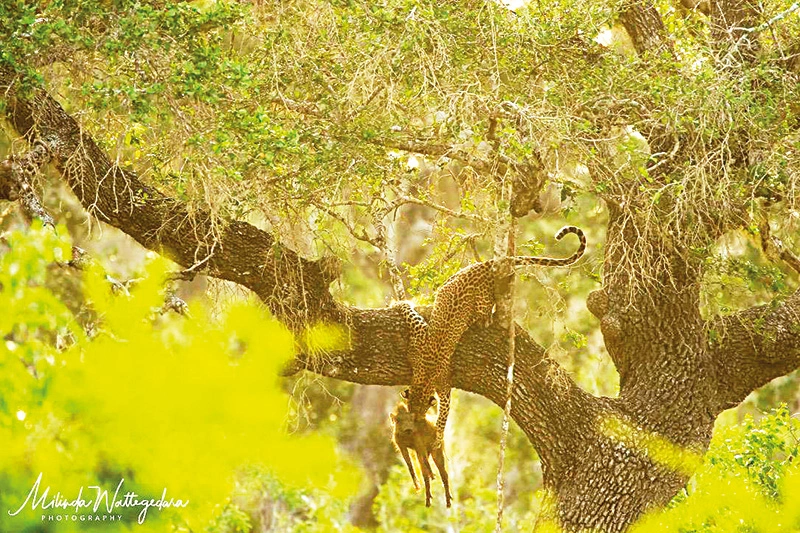
YM31 “Ruki” secures prey on a branch, illustrating the remarkable strength and coordination of the Sri Lankan leopard.
Recognising the immense value of long-term documentation, Wattegedara joined forces with fellow researchers Dushyantha Silva, Raveendra Siriwardana and Mevan Piyasena to establish the Yala Leopard Centre in 2020.
Located at the Palatupana entrance to the Yala National Park, the centre is believed to be the world’s first information facility dedicated exclusively to leopards.
“The centre serves as a repository of knowledge, accumulated through years of observation and research,” Wattegedara says. “Our goal is to connect visitors with the science behind conservation and foster a deeper appreciation of these magnificent animals.”
The project’s impact extends far beyond Sri Lanka’s borders.
Research arising from the Yala Leopard Diary has been published in internationally recognised scientific journals. One study introduced an innovative framework for identifying individual leopards, while another documented an extraordinary and previously unrecorded case of a leopard cub being consecutively adopted by two different adult females—first a relative and later an unrelated leopardess.
The discovery attracted international scientific attention and highlighted the complexity of leopard social behaviour.
Yet for Wattegedara, the most important lesson remains one of humility.
“One conclusion has become increasingly clear,” he reflects. “Our understanding of these leopards remains far from complete. We are only beginning to understand how they live, adapt and persist in one of Sri Lanka’s most dynamic protected landscapes.”
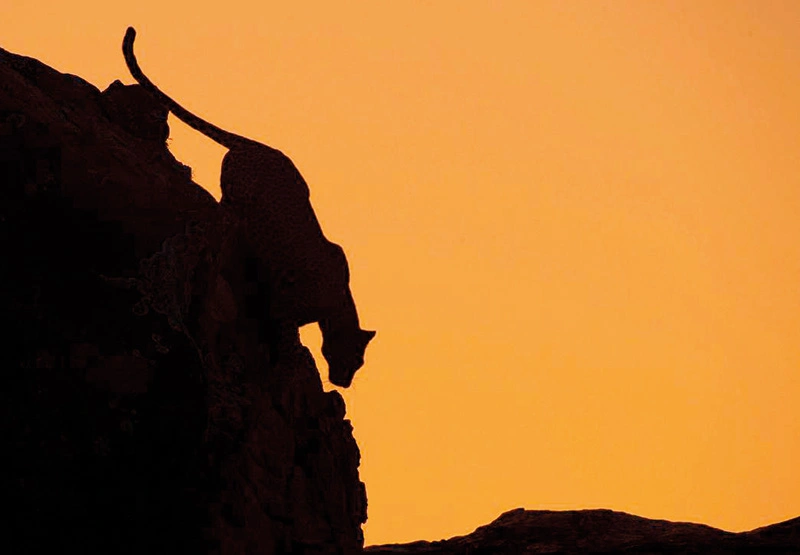
YF15 “Hope” descends Rukvila Rock at dawn, showcasing the agility and adaptability of Yala’s leopards.
His words underscore an essential conservation truth: the more we learn about nature, the more mysteries emerge.
As Sri Lanka navigates growing environmental challenges, the Yala Leopard Diary stands as a shining example of what sustained observation, scientific curiosity and public engagement can achieve.
Beyond the stunning photographs and remarkable sightings lies something even more valuable—a growing body of knowledge capable of informing future conservation decisions and ensuring that future generations inherit a wilderness where leopards continue to roam free.
For more than a decade, Wattegedara and his colleagues have followed the tracks of Yala’s elusive predators through dust, rain and scorching heat.
Their work has revealed that every leopard has a story, every sighting has significance and every photograph can contribute to conservation.
And perhaps, most importantly, it has reminded us that the golden ghosts of Yala still have many secrets left to share.
By Ifham Nizam
Sri Lanka look to their bowlers against big-hitting West Indies

Edgbaston takes center stage as England, Sri Lanka kick off T20 World Cup

Trump says US will hit Iran ‘very hard tonight’

Firefighters on scene at Pentagon during ‘hazardous materials incident’

Samarawickrama’s rise gives Sri Lanka a second pillar

Prabhsimran, Gaikwad, Tilak score fifties in DLS loss to Afghanistan A

‘Dates have the highest sugar content to fight Coronavirus’

Sunday Island 27 December – Headlines

#SundayIsland 17th December – Headlines

Sunday Island – 28th March

Sunday Island Headlines – 21 March

Sunday Island – 21st February – Headlines
-
 Features7 days ago
Power crept into the Sangha and is now tearing it apart
-

 News5 days ago
Women’s T20 World Cup 2026 warm-up: Chamari Athapaththu’s 94 helps Sri Lanka beat Pakistan
-

 Features7 days ago
Kondachchi wind farm and battery storage project to boost energy security, says Power Ministry Secretary
-

 Features7 days ago
Saudi Arabia sets new benchmark in Hajj management as 1.7 million pilgrims complete sacred journey
-

 News6 days ago
Asst. Manager, security officer arrested over Rs 30 mn snatch at Horana PB branch
-

 Editorial4 days ago
Probe Sallay’s complaint
-

 News5 days ago
Lankan-Canadian inducted to Toronto Sports Hall of Fame
-
 News2 days ago
Local firms move millions of dollars overseas for phantom imports: Govt.