
Sports
The Great Wallaby Rout

by Rajitha Ratwatte
For mysterious reasons that make sense only to TV executives and the governing body of world rugby, they have chosen to play the so-called “World Championship of Rugby” in Australia. Covid regulations decry that stadia can only be half full and social distancing must be maintained among spectators. Only 18, 000 tickets were sold, Of course, this means more people have to pay exorbitant rates and watch TV! NZ could have easily got around 40,000 people into the ground, on a day that made even the Gods’ cry. Pouring with rain all day and the Wallabies kicked off, fielding a side with 6 NZ born players and a handful of Pacific Islanders’ to boot. A much-vaunted 20-year-old no10 and 13, both not to belabour a point, born in Aotearoa! The All Blacks not giving a start to new discovery – loosehead prop Alex Hodgeman and sticking with Karl Tu’inukuafe to replace regular Joe Moody who was unable to play due to concussion protocols. Also, Hoskins Sotutu coming in at no8 as the incumbent was on paternity leave, on a day that would ensure a tough forwards battle.
Within 3 minutes the Wallabies displayed part of their game plan and committed a foul on the dynamic young Abs’ winger Caleb Clark. Filipo Daugunu his Pacifica origin opposite number, was immediately pinged by the referee who displayed his penchant for using the cards at his disposal and a level of undecidedness and reliability on the TV ref, by dishing out an early yellow card. So, Wallabies down to 14 players for the next 10 minutes. The Aussie skipper was spotted offside in the 5th minute and the resulting touch kick saw the new prop Karl Tu’inukuafe disregard a massive overlap and barely scramble over the line to score mid-left. If the no1 had not made it over the line he would have committed a Ricco Ioanisque type gaff (trying to touch down with one hand and dropping the ball!) that he would have found hard to live down! All Blacks 7 – 0 up in the 6thminute.
The referee decided to try to even things up for Aussies, and possibly continue with the illusion that he was refereeing a game of netball, by yellow carding Jodie Barret for what was deemed a dangerous tackle. 9thminute both teams down to 14 players each. In the 9th Minute Ritchie Muanga, who had an exceptional game even by his standards, Kicked cross-field for Dan Coles the AB hooker who was lurking in the wing and showed a great turn of speed to put himself onside and get across the line putting enough downward pressure on the ball to satisfy the on-field ref who signalled an on-field try. However, the TV ref soon changed his mind and the try was disallowed! The Blacks kept attacking and the first scrum of the game was held in the 11thminute with the Wallabies defending on their 5-meter line. The Wallaby no9 Nick White let down his debutant no10 by not kicking for clearance himself and passing the ball to the rookie who didn’t do a very good job. The resulting lineout still well inside Wallaby territory saw Sam Whitelock do his usual totally professional job of getting the ball back to his three quarters and Caleb Clark barrelled his way over the line, only to meet with superb defence from his opposite number, who put his body under the ball and stopped the ball being grounded. Great work and another possible 7 pointer disallowed. All Blacks looking ominously good.
At this point in the 13th minute, the Wallabies were back to 15 players and the AB’s still One short. The one-dimensional play of the AB’s no1 Karl Tu’inukuafe was exposed at this stage with a simple knock-on. This lack of skills and mobility has no place in the modern game and is what earned front-row forwards a bad name and much ridicule in the past! It took 19 minutes before Jodie Barret was allowed back into play and Ritchie Muanga decided to show the Wallaby coaches that a mere 20 year old (who probably grew up in NZ idolizing the All Blacks and had just faced a Haka) was no match for him and scythed his way through the Oz defence to score far right in the 20th minute. Now the conversion was difficult and the Blacks have two other kickers in the Barret brothers but a visibly tired Muanga was asked to take the kick and he missed. This is the lack of on-field decisions and the myopic thinking from the leadership and management of this great team that could lead to trouble in a tight match. 12 – 0 to the Blacks. In the 26th minute, Beauden Barret slotted himself into first receiver and a clever chip kick over the first line of Aussie defence saw Ritchie Muanga show his speed once more, a favourable bounce from the notoriously fickle and unpredictable rugby ball allowed Muanga to collect the ball easily and head for the line with no Aussie indigenous jerseys (Aussies were playing in green jerseys in honour of the 14 indigenous players who have represented them over the years) in sight! I wonder if a Black Stripe will be added to their traditional Yellow jersey to honour the NZ born players…In fact, there were only 3 black jerseys in the final frame before Ritchie Muanga touched down under the posts. 19 – 0 All Blacks ahead.
This was time to get worried for the Wallabies. Each AB player was showing consummate skill and professionalism and looked completely at home in his position. The AB’s skipper showed it off by winning a turnover and getting the ball out to Goodhue in the centre who showed just how important it is to think and assess when making decisions in this great game of rugby union and kicked ahead beautifully for his no11 Caleb Clark to make good ground and allow Dan Coles to get his long-elusive try. This time the referee and the TV ref could not find anything wrong and Muanga converted making it 26 – 0 with just a few minutes to go to half time. Muanga almost did it again in the 39th minute, showing a clean pair of heels, he was clear but a last-minute desperate ankle tap saw him lose his balance and the half time score remained at 26 – 0. 4 tries had been scored by the AB’s, two of those by no10 Ritchie Muanga and two more disallowed.
Whatever happened “discussion” wise and consumption wise in the Aussie dressing room at half time resulted in the two NZ born backs Noah Lolesio and Jordan Petaia (the latter played very well throughout) combining beautifully resulting in an Aussie try just 1 minute into the 2nd half. However a fairly straightforward kick was missed by the 20-year-old NZ born no10 Noah Lolesio, and the score read 26 – 5. This resurgence of Aussie play was acknowledged by the weather gods with a cessation of the rain. However, the conditions were still very greasy. In the 44th minute, the Wallabies had a kickable penalty but 3 points didn’t mean much at this stage and the touch option was taken. The Wallabies had their best phase of the game during the next 15 – 20 minutes and the Blacks resorted to their bench. Dan Coles (inexplicably) went off and Codie Taylor came on, so did my favourite no1 Alex Hodgeman. Sam Whitelock continued to do his thing, faultlessly and quietly and most of all SO reliably. Great loose play winning turnovers and even turning them into penalties but the Aussies were playing their hearts out.
In the 52nd minute, the All Blacks got a scrum penalty (my MAN at no1!) but lost the ball to a turnover deep in Aussie territory. A bad mistake and against the run of play. The 55th minute saw Scott Barret come on for Patrick Tuapoletu and TJ Peranara replace Smith at no9. The Aussie dominance needed to be reversed at a kickable penalty in the 59th minute was taken by the NZ team and the score moved on to 29 – 5. At this stage, it seemed like all the bench players were on for both sides. Wallabies wasted a possible touch finder by kicking too deep and sending the ball over the dead-ball line. Inexperience showing through and not the type of mistake a team can make at this level. The Aussies kept attacking and the Kiwi skipper Sam Cane won a great defensive penalty in the 64th minute but shortly thereafter, he took a bad knock on the head and left the field for a HIA. A setback for the Blacks but the ever-reliable Sam Whitelock took over the reins.
Whitelock took the decision to have a scrum off a 5-meter penalty awarded in Wallaby territory and we realised why shortly thereafter. Ricco Ioane was on the field (on the wing and NOT as a centre) and a carefully rehearsed move saw the no8 come out with the ball work the blindside and Ioane went over in a flash and even touched down with his characteristic one-handed move that had been such a disaster two weeks ago. He seemed jubilant when he touched down extreme right and Muanga slotted a difficult kick – 36 – 5.
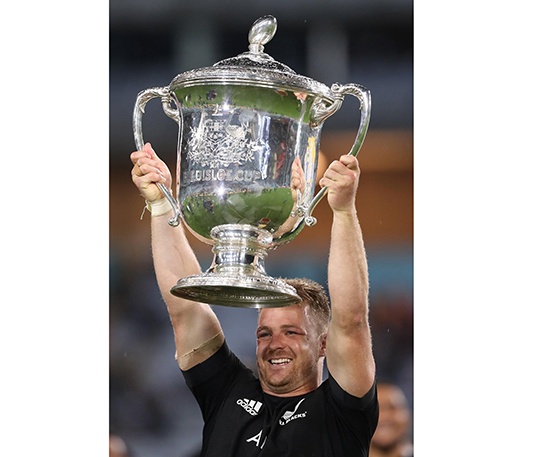
In the 73rd minute Jodie Barret who had now moved to full back as his brother Beauden had been subbed off, joined the line midfield, broke through and sailed down the middle like a galleon under full rig or to use a more modern metaphor like the America’s Cup challenger under full sail and was completely unstoppable. He scored under the posts and Muanga made no mistake. 43 – 5 and the Bledisloe Cup was going to be retained for the 18th year in a row.
The referee, however, was determined to remain the centre of attraction, yellow carding Shannon Frazelle in the last minute of the game for what was deemed an illegal tackle of some sort that could only be deciphered in the convoluted permutations that had clouded his mind throughout the game. Even the TV ref exonerated the cited player but pedanticity (to use another “new” and polite word rather than the word I would REALLY like to use) prevailed.
The big silver trophy was retained, apparently, it holds 42 cans of the cold stuff and no doubt it was used as a worthy receptacle of the finest brew last night. Great game for the All Blacks and the biggest winning margin of the Bledisloe cup EVER.
supersubsports@gmail.com


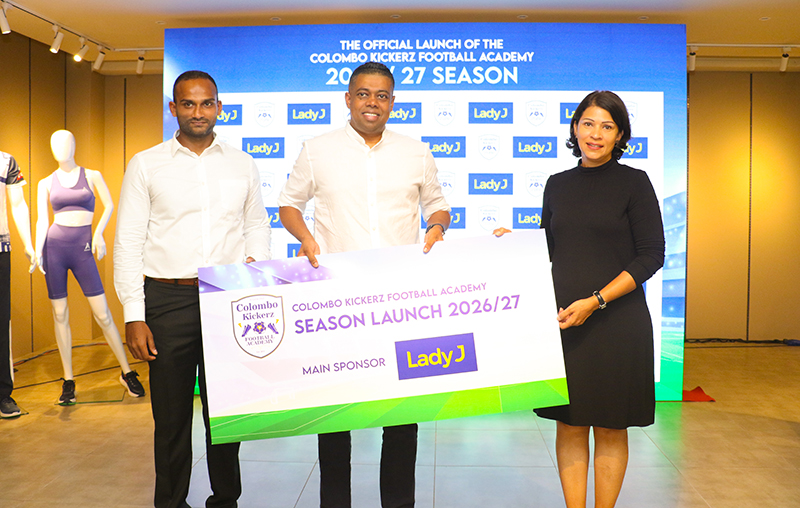
Colombo Kickerz Football Academy at a media briefing held on Wednesday (25) announced that ‘LadyJ’ one of the largest homewear stores in Sri Lanka has come on board as the acadamie’s main sponsor and The Papapare as the Digital Media Partner in the 2026/27 season.
With over 300 aspiring football enthusiasts between the ages of 5 to 18 on roll,
Colombo Kickerz Football Academy founded in 2015 by Ms Viveca Weerasinghe is one of the largest football academies in the island.
The academy provides their changes woth the opportunity of being nurtured by internationally trained coaches and gain experience by playing in local and international competitions on their way to become Sri Lanka’s future football stars.
Managing Director of LadyJ Anuraddha Wijerathne highlighted the importance of investing in sports at grassroot level and supporting young athletes.
Many would argue that had Sri Lanka gone into the recent World Cup with all their big guns fit and firing, they might have reached the semis. That’s the popular line doing the rounds. But if we are calling it as we see it, this campaign was heading for a collapse even before the first ball was bowled.
Reappointing Dasun Shanaka as captain was a gamble, lacked foresight and in the end created divisions within the team. The decision to bring back Pramodya Wickremasinghe as Chairman of Selectors didn’t inspire confidence either. It was a move that had trouble written all over it, the kind that can unsettle a dressing room before a ball is even delivered. It’s like appointing Mervyn Silva as Public Relations Minister. A bull in a China shop is less troublesome than these two southerners.
Of course, injuries played their part. Losing Matheesha Pathirana and Eshan Malinga robbed the attack of bite, but the biggest dent was the absence of Wanindu Hasaranga. A proven match-winner, Hasaranga is the sort who can turn a game on its head in the space of a couple of overs. Without him, Sri Lanka were always chasing the game.
What is more concerning is the recurring nature of Hasaranga’s injuries. Missing yet another global tournament due to a hamstring issue raises serious questions. Over the last two years, the pattern has been far from encouraging, and for a professional cricketer, that’s an area that needs urgent attention.
Clearly frustrated by the injury crisis that derailed the campaign, Sri Lanka Cricket have decided to take a firmer stance. Players seeking No Objection Certificates for the IPL will now have to clear fitness tests first. It’s a step in the right direction and one that had been coming for some time.
In the past, when the board tried to assert control, players pushed back, often using franchise connections to apply pressure. This time, however, SLC seem prepared to stand their ground and ensure that national duty is not treated as optional.
There has to be a sense of accountability. It does not sit well when key players miss a World Cup and then turn up fully fit for franchise cricket. That is a contradiction that undermines both the team and the system.
Nuwan Thushara’s situation, however, presents a slightly different picture. The slinging seamer, who was not part of the World Cup squad, has also struggled to meet fitness standards. SLC have inserted a clause allowing them to withhold NOCs for three months beyond the contract period, a move that shows the board have learned from past lapses.
That said, Thushara’s case deserves a degree of empathy. At 31, he is nearing the latter stages of his career and opportunities like the IPL do not come around often. While fitness standards must be upheld, there is also room for discretion, particularly in cases where the player was not part of the World Cup plans.
If players are now seeking leniency, it also reflects gaps in how fitness has been managed over time. Preparation at this level is a long-term investment, not something that can be patched up overnight.
by Rex Clemetine
Latest News
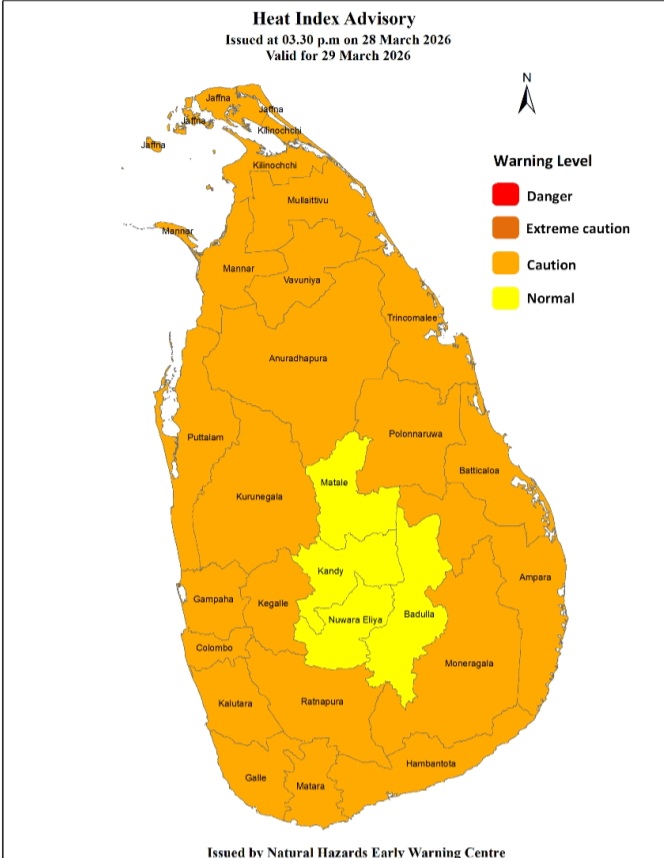
Heat Index likely to increase up to ‘Caution level’ at some places in the Western, Sabaragamuwa, Southern, Eastern, North-western, Northern and North-central provinces and in Monaragala district

Warm Weather Advisory
Issued by the Natural Hazards Early Warning Centre of the Department of Meteorology
Issued at 3.30 p.m. on 28 March 2026, valid for 29March 2026.
Heat index, the temperature felt on the human body is likely to increase up to ‘Caution level’ at some places in the Western, Sabaragamuwa, Southern, Eastern, North-western, Northern and North-central provinces and in Monaragala district.
The Heat Index Forecast is calculated by using relative humidity and maximum temperature and this is the condition that is felt on your body. This is not the forecast of maximum temperature. It is generated by the Department of Meteorology for the next day period and prepared by using global numerical weather prediction model data.

Effect of the heat index on human body is mentioned in the above table and it is prepared on the advice of the Ministry of Health and Indigenous Medical Services.
ACTION REQUIRED
Job sites: Stay hydrated and takes breaks in the shade as often as possible.
Indoors: Check up on the elderly and the sick.
Vehicles: Never leave children unattended.
Outdoors: Limit strenuous outdoor activities, find shade and stay hydrated.
Dress: Wear lightweight and white or light-colored clothing.
Note:
In addition, please refer to advisories issued by the Disaster Preparedness & Response Division, Ministry of Health in this regard as well. For further clarifications please contact 011-7446491.

National Namal Uyana Declared a ‘National Heritage of Sri Lanka’

Philippine transport strikers say Marcos Jr failing to control oil prices

One ant for $220: the new frontier of wildlife trafficking

Three Lebanese journalists killed in Israeli strike, say broadcasters

Showers will occur at a few places in the Sabaragamuwa province and in Colombo, Kaluthara, Galle, and Matara districts after 2.00 pm

War-linked power crunch pushes Lanka to four-day week

‘Dates have the highest sugar content to fight Coronavirus’

Sunday Island 27 December – Headlines

#SundayIsland 17th December – Headlines

Sunday Island – 28th March

Sunday Island Headlines – 21 March

Sunday Island – 21st February – Headlines
-

 News5 days ago
Senior citizens above 70 years to receive March allowances on Thursday (26)
-

 Features2 days ago
A World Order in Crisis: War, Power, and Resistance
-

 Features7 days ago
Trincomalee oil tank farm: An engineering marvel
-

 News3 days ago
Energy Minister indicted on corruption charges ahead of no-faith motion against him
-

 News4 days ago
US dodges question on AKD’s claim SL denied permission for military aircraft to land
-

 Features7 days ago
The scientist who was finally heard
-

 Business4 days ago
Dialog Unveils Dialog Play Mini with Netflix and Apple TV
-

 Sports3 days ago
SLC to hold EGM in April