
Features
The East Asian disanalogy, or why Sri Lanka cannot be a Singapore

by Uditha Devapriya
Economists and political analysts tend to extol the virtues of free markets and the evils of state-led growth. They seem to think that Sri Lanka has, for the most, been caving into the latter approach, i.e. widening the state at the expense of the private sector. The solution, according to analysts, is to let the market decide and to limit the government to the role of what Robert Nozick described as a “Night-watchman”, formulating the rules of the economy without playing with them. These analysts then point at societies that prospered under such a state: the US, much of Western Europe, and the Tiger economies of East Asia.
Unfortunately, much of the hype surrounding advocacy of free market principles and small government is built on a tautological premise: economic liberalisation will lead to growth, so it should be implemented in the country. Import tariffs must be reduced or even eliminated, export-orientation must replace import-substitution, let’s not think of local industrialisation or machine-manufacture yet because we’re an island, and let’s reduce the role of the state because in the US, Britain, and East Asia, it played a minimal role.
Countries are not all endowed with the same levels or the same kinds of resources. Nor do they magically transit to free markets and small governments. To say economic liberalisation worked there and that owing to it these principles must be applied here is to assume that all it takes for a country to prosper is the implementation of policies to which those countries which are supposedly implementing them now resorted only after they had passed through certain stages. This assumption, quoting the late S. B. D. de Silva, is “a veritable non-sequitur of bourgeois scholarship.” As always, context is important.
The US got to where it is largely through its leap to industrialisation in the latter part of the 19th century. Much of the industrialisation which transpired at that time was financed, not by private initiative, but by the government: vast tracts of land running into millions of acres were handed over to railway companies. In Britain the state played an important role in promoting local industry, smothering the up-and-coming textile mills of India. Discussions about the success of private sector led growth in these countries leave out or ignore the role played by colonial conquest, which happened to be financed by the government. “Is there any greater example of a rampant state than the English state in the world?” asked a friend at an Advocata Night-Watchman seminar years ago. “When you’re talking laissez-faire, they were basically robbing the seas around the world, installing slavery.” True.
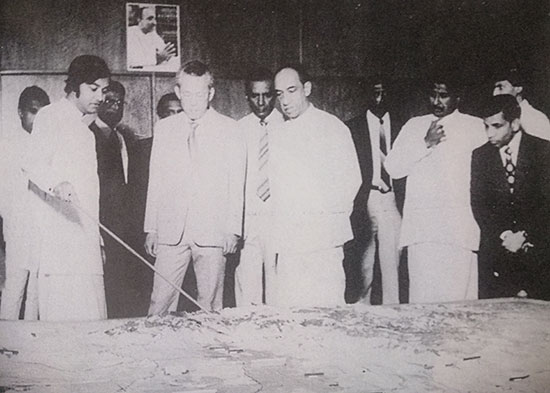
 In East Asia three distinct case studies can be identified: Japan, Taiwan and South Korea, and Singapore. The foundation for Japan’s economy was laid down long before the war by the Tokugawa shogunate; it broke the stranglehold of petty traders, privileging industrial capital over merchant finance. Taiwan emerged from the war cut off from mainland China after the Communist takeover in 1949, yet American experts and economists who formulated that country’s transition to liberalisation didn’t embark on free market reforms right away. First they oversaw rent reduction in 1949, the sale of public lands in 1951, and a land-to-the-tiller program in 1953. Land reform limited ownership of paddy land to 4.5 hectares, much lower than the 10-25 hectare limit imposed by the Sirimavo Bandaranaike government in 1972 (a favourite punching bag for free market “Advocatas”). South Korea implemented the same set of reforms. It hardly need be added that in all three countries, democratisation followed, rather than preceded, the transition from agriculture to industrialisation.
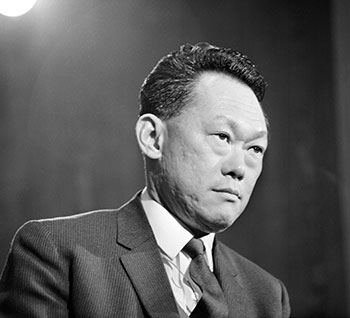
Singapore is a different case, not least because unlike other East Asian countries it lacked a rural hinterland in which a transition from agriculture to industry could take place. Yet there too the role of government intervention cannot be denied, economically and also politically. Milton Friedman once referred to Lee Kuan Yew as a “benevolent dictator”, the very same epithet Maithripala Sirisena used on Mahinda Rajapaksa in 2014 after walking out from the then administration. In a 1993 essay William Gibson described the country as “Disneyland with the Death Penalty”, bringing to mind Jagath Manuwarna’s remark about Sri Lanka at a press conference in late 2014: “kalakanni Disneylanthaya.” Unlike Manuwarna’s statement though, Gibson’s essay was banned by the Singaporean government.
Liberals and classical liberals and even left-liberals tend to look up to Singapore and Yew’s reforms without realising that, as Regi Siriwardena observed, their achievements rested on the denial of democratic and human rights. Hence when one columnist, drawing wildly false analogies, argues that Singapore lacked a president, yet accomplished much (implying that Sri Lanka doesn’t need an Executive Presidency to get things done), he fails to acknowledge or chooses to ignore not only that Singapore had just one political party during its transition from third world to first, but also that it curtailed dissent in a way that makes any hounding of dissent in Sri Lanka today look haphazard in comparison; when asked why he refused to tolerate political cartoons, for instance, Yew bluntly told Fergus Bordewich that in Confucian society politicians ought to be seen as deserving of respect.
The absence of a rural hinterland made it all the easier for Singapore’s government to enact capitalist reforms, since it could dispense with the need to abolish the kind of pre-capitalist social relations that existed in Taiwan and South Korea. Despite this, however, government intervention swept across the country; in the words of one economist, Singapore responded to international economic forces “through manipulating the domestic economy.”
Wage adjustments vis-à-vis a National Wages Council, a high savings and investment culture promoted via state enforced and state directed abstinence, the shift towards manufacturing in the latter part of the 1960s, the growth of public enterprises (believed to have accounted for 14% to 16% of manufacturing output), and tight government control of trade unions all played a part in bolstering its prospects. As Hoff (1995) noted, the paradox of Singapore’s economic success was that while investments came from the private sector, savings relied on the public sector. It is true that contributions by foreign investment were significant, yet had Singapore not had a rigidly regulated economy where, for instance, compensation costs for production workers were one-third that of the US equivalent by 1993, it would not have become the third world’s first success story it is touted as today.
The specific conditions under which the East Asian economies transformed from developing to developed, from inward-looking to outward-looking, make their emulation in other parts of the world untenable, if not unlikely. At the time the governments of these countries were imposing reforms, Western Europe was struggling to recover from wartime recession and MNCs had not become as active in peripheral countries as they would decades later. Their geopolitical alignment with the US in the Cold War guaranteed the success of the East Asian Tigers. Moreover, these were hardly what one could call classical liberal societies: political authoritarianism cohabited with economic liberalisation. Even that dichotomy comes off as false when we consider that government intervention figured heavily in these economies, something the “Advocatas” of free markets don’t seem to be aware of today.
There was another very significant factor: the absence of a merchant trader class in these countries. The Tokugawa reforms extended to Korea and Taiwan after Japan turned them into granaries for its domestic needs. The US experts hired to oversee reforms in Korea and Taiwan facilitated, rather than reversed, these processes. In Sri Lanka and much of the Third World, by contrast, experimentation with free market classical liberalism has resulted in not just political authoritarianism, but also the defenestration of an industrial sector, leading to lopsided growth subsidised by a Pettah merchant class: rather than manufacturing goods, they are imported and resold. The call for “going local”, then, contrary to what intellectuals, institutions, and Opposition MPs think, say, and write, has to do with more than a hysterical call for a garrison state. This is not economics. This is common sense.
False analogies, assumptions, and tautologies will thus get us nowhere. It is certainly ironic that think-tanks and institutions that privilege reason over guesswork end up indulging in selective scholarship. Even more ironic are statements uttered by academics from countries which passed through several stages before making the transition from a planned order to a free market advising us to bypass those stages when implementing policy reforms here. It takes not only foresight and hindsight, but also courage, to swerve from and dispute these assumptions, dig deep into history, and understand what drives the wealth of nations and the poverty of others. Free markets alone will not do, as even the history of countries where they flourish today tell us. Something else can, and something else must.
The writer can be reached at udakdev1@gmail.com

Features
After Iranian frigate sinks near Sri Lanka, a call for a Colombo-based framework to prevent regional spiral

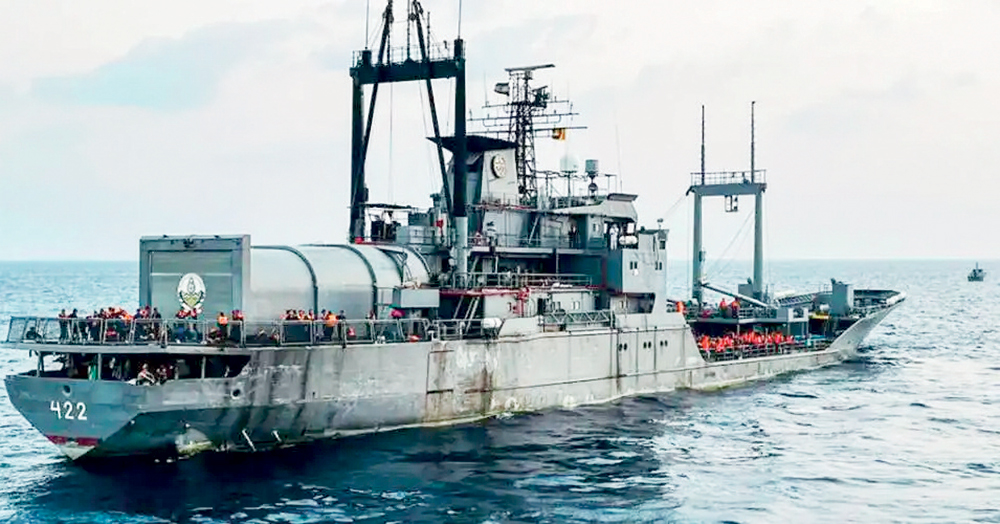
The US Navy’s sinking of an Iranian frigate IRIS Dena just off Sri Lanka’s southern coast has done more than disturb the waters of the Indian Ocean. It has jolted a small island nation into the gravitational pull of a geopolitical drama that is no longer confined to Tehran’s crumbling political architecture. Sri Lanka did not seek this moment. Yet history has a habit of choosing its bystanders, and the detonation beneath the waves has now placed Colombo at the fault line of Iran’s post regime turmoil. What had been a fractured and uncertain transition has suddenly acquired a maritime focal point, one that carries the potential for escalation, misjudgment, and the opportunistic meddling of regional powers eager to shape the emerging order.
In response, Sri Lanka has moved with a discipline that belies its size. Naval vessels were dispatched within hours to secure the wreck site. A formal inquiry was announced even before public speculation could harden into rumor. Senior officials established discreet channels with the International Maritime Organization to ensure that the investigation proceeds within an internationally recognized framework. Throughout these actions, the government has maintained a posture of strict neutrality. Yet the neutrality itself is a message. It signals that Sri Lanka intends to steady the situation without becoming entangled in the rivalries now radiating outward from Iran’s internal collapse.
For weeks, analysts have warned that Iran’s unfolding transition was approaching a dangerous tipping point. That warning has now come to pass. The crisis is no longer political alone. It is no longer a matter of rival factions disputing legitimacy in distant capitals. It has become a security crisis with consequences that wash onto the shores of states that never imagined they would be pulled into the vortex.
It is into this unpredictable moment that I have advanced the proposal known as the Colombo Accord. It is presented not as a government blueprint, but as a scholarly intervention grounded in the mechanics of negotiated transitions and the realities of regional security. The Accord outlines a multi-phase framework for structured dialogue among Iran’s four principal factions and relevant international stakeholders. In any week, the initiative would have been timely. In this week, with Sri Lanka thrust into the story by the accident of geography and the violence of the sea, its logic has become unavoidable. The stakes have risen. So has the urgency.
A Maritime Tragedy Highlights a Political Vacuum
The sinking of the Iranian frigate, still the subject of an evolving investigation, has unleashed a torrent of speculation that mirrors the broader uncertainty consuming Iran’s post regime landscape. Tehran’s provisional authorities have already gestured toward sabotage. Within Iran’s rival factions, whispers circulate that the incident may be a settling of scores disguised as misfortune. Regional analysts, quick to see the hidden hand of intelligence services, suggest the possibility of covert action by states with long standing grievances against Tehran. No version of events has been substantiated, yet each interpretation reveals the same unsettling truth. A nation struggling to define its political future is now projecting its instability outward, and the tremor has been felt far beyond its territorial waters.
In the aftermath, Iran’s political factions have turned upon one another with renewed ferocity. The sinking has become a canvas on which competing narratives of legitimacy are being hastily painted, each faction scrambling to depict itself as the victim of a conspiracy and its rivals as the likely authors of national humiliation. As Tehran’s internal quarrels intensify, regional powers have begun repositioning their naval assets nearer to the Indian Ocean’s key transit routes. The maritime movements speak more loudly than the official communiqués. They betray a quiet preparation for whatever comes next, whether escalation, opportunity, or a larger realignment triggered by the vacuum in Iran.
For Sri Lanka, the event has created a delicate and unfamiliar burden. The country now finds itself attempting to preserve its neutrality while managing the political sensitivities of hosting the wreckage of a foreign military vessel barely beyond its shoreline. Every statement must be calibrated, every operational decision measured. An island that has long viewed geopolitical turbulence as something observed from afar must now contend with the fact that great power politics can arrive not by choice or invitation, but as debris drifting toward its beaches.
The tragedy at sea has made unmistakably clear what distant observers sometimes forget. Geography offers no immunity when instability expands beyond its point of origin. In a world where maritime space is both the arena of commerce and the stage of strategic rivalry, even a nation seemingly far from the epicenter of conflict can find itself drawn into its orbit.
Why Colombo Now Matters More Than Ever
My proposal for the Colombo Accord predates the sinking of the Iranian frigate, yet the incident has given the framework a sharper edge and a sense of immediacy that no academic theorizing could have supplied. Iran’s transition has long been fractured among four principal blocs. Monarchists cling to the memory of a political order that once anchored Iran in a very different world. The National Council of Resistance of Iran (a coalition of Iranian dissident groups) and the People’s Mojahedin Organization of Iran (MEK)—an exiled Iranian opposition group advocating for the overthrow of the Islamic Republic to establish a secular, democratic state—operate with a disciplined organizational machinery that inspires both loyalty and unease. The technocrats and remnants of the Artesh, the conventional Islamic Republic of Iran Army, represent the continuity of a state apparatus that refuses to vanish with the fall of its governing ideology. The democratic coalitions, particularly those rooted in Iran’s ethnic peripheries, carry their own visions of a future that balances autonomy with nationhood. Their rivalry has always posed a significant risk to Iran’s internal stability, but until now it remained largely contained within the fractured political landscape of a country struggling to reinvent itself.
The loss of the frigate near Sri Lanka’s waters has altered the nature of the crisis. What had been an internal contest for legitimacy has tipped outward. It has become transnational, touching actors and geographies that never sought to be involved. The sinking is not merely a maritime accident. It is an early signal that Iran’s instability possesses a centrifugal force capable of drawing in distant states through the mechanisms of happenstance, miscalculation, or opportunistic interference. When a nation in turmoil radiates uncertainty into the sea lanes of the Indo Pacific, it is no longer possible to treat its troubles as an isolated matter.
The Colombo Accord argues that Sri Lanka, or any similarly neutral Indo Pacific venue, provides both psychological distance and geopolitical safety essential for meaningful dialogue. This distance is not a luxury. It is a structural requirement for factions that have spent decades regarding one another as existential threats. Colombo’s neutrality was once a diplomatic asset, useful but not indispensable. After the frigate incident, that neutrality has acquired a different kind of weight. It has become a stabilizing counterpoint to the suspicion that now permeates the region. When the waters grow crowded with vessels watching one another, calculating advantages, and anticipating the next provocation, a neutral shoreline becomes more than a symbolic refuge. It becomes a strategic terrain upon which the first steps toward de-escalation can plausibly be taken.
Sri Lanka did not ask for this role, yet circumstances have placed the island in a position where neutrality is no longer simply a posture. It is a form of strategic relevance. The calm that Colombo projects in the face of a foreign frigate resting near its coast demonstrates a kind of quiet capability that the region increasingly needs. The Accord seeks to build upon this moment, not to entangle Sri Lanka in the ambitions of others, but to offer a platform on which Iran’s fractured actors might finally find a way out of their zero sum contest.
A Scholar’s Framework for a Global Crisis
The Colombo Accord remains, at its core, an intellectual construct rather than an instrument of statecraft. It was conceived not in the corridors of a foreign ministry, but in the analytical space where theory, history, and strategic necessity intersect. Yet the fact that it is an academic design does not diminish its relevance. On the contrary, scholarly frameworks often precede political action, especially when governments find themselves reacting to crises they did not anticipate and do not fully understand. The Accord offers a disciplined structure for a transition that has so far unfolded as a series of disconnected improvisations by actors who distrust one another far more than they fear the consequences of inaction.
The framework proceeds in three distinct movements that reflect the logic of negotiated transitions. The first is a period of stabilisation talks that addresses the most immediate sources of danger. These include the custodial control of Iran’s nuclear infrastructure, the architecture of sanctions relief, and the assurance of safe navigation through the Strait of Hormuz. The frigate incident has now broadened this agenda. Maritime stability is no longer separable from the wider Indo Pacific environment, and any discussion of navigational security must take into account the possibility that Iran’s turmoil can spill outward into seas once considered peripheral to its internal struggles.
The second movement concerns the formation of a Transitional National Council. This requires closed negotiations in which the factions confront the difficult questions of representation, authority, and temporal limits. It demands that monarchists, technocrats, armed political organizations, and democratic regional coalitions attempt to imagine a shared political future after decades of mutual suspicion. A council of this nature cannot be imposed from outside. It must be assembled by the factions themselves yet guided within a structured environment that prevents the stronger parties from overwhelming the weaker and the weaker from derailing the process through fear of exclusion.
The third movement culminates in the drafting of two foundational texts. A Stabilisation Communiqué formalizes the immediate agreements necessary to prevent a descent into chaos. A Transitional National Council Framework sets the rules of the interim governance period and outlines the path toward elections or constitutional ratification. These documents, once completed, would not require Sri Lanka to act as guarantor. They would instead be presented to the United Nations by states willing to sponsor a viable path forward without seeking to dominate its content.
The sinking of the frigate does not alter the design of these phases. What it alters is the timeline. Crises at sea have a way of compressing political space. Maritime insecurity forces actors to confront the possibility that the next miscalculation could ignite a conflict far larger than anyone intends. The Colombo Accord, once a conceptual blueprint, now functions as an urgent scaffolding for de-escalation. It offers a disciplined alternative to the drift that currently characterizes the regional response. The longer the vacuum persists, the more likely it becomes that events will unfold according to the logic of accident rather than the logic of strategy. The Accord exists to prevent that outcome.
Sri Lanka’s Dilemma: Neutrality in the Eye of a Storm
Colombo’s response in the days since the sinking has been marked by a quiet discipline that reflects both prudence and an awareness of the moment’s gravity. Naval patrols have been extended across the affected waters in an effort to ensure that no foreign actor exploits the wreck or attempts to manipulate the scene for strategic advantage. The government has initiated a joint maritime safety review aimed at reassuring international observers that Sri Lanka intends to handle the incident with full transparency and in accordance with international maritime norms. Diplomats have opened discreet channels with Tehran, New Delhi, Washington, and several Gulf capitals, not as an act of alignment, but to prevent premature narratives from hardening into geopolitical assumptions that could force Sri Lanka into positions it has no desire to occupy.
Neutrality, however, becomes most fragile precisely when events press hardest against its boundaries. The sight of foreign debris washing ashore has created a symbolic intrusion that no government can simply cordon off with patrols or press releases. The island now occupies a liminal space between spectator and participant, and this is a position familiar to many small states navigating the undertow of great power rivalry. Their neutrality becomes most prized by the international community at the exact moment it becomes most difficult for them to preserve. It is a paradox that is neither new nor avoidable. It is the structural reality of a world where crises migrate unpredictably across borders and through seas.
Sri Lanka now confronts a moment in which the temptation to withdraw into studied silence must be balanced against the need to shape the narrative before larger powers do so on its behalf. This is where the logic of the Colombo Accord becomes most compelling. The framework is not only a mechanism for easing Iran’s internal fragmentation. It is also a means for Sri Lanka to assert a form of agency that does not compromise its neutrality. By offering a venue for structured dialogue, the island positions itself not as a partisan actor, but as a stabilizing presence in a region increasingly defined by uncertainty at sea and volatility on land. In doing so, Sri Lanka shapes events before events shape Sri Lanka, which is the essential choice required of any state forced, however reluctantly, into the center of a crisis not of its own making.
The Narrowing Window
The sinking of the frigate has emerged as a stark emblem of a deeper reality. Iran’s transition is no longer a distant abstraction that can be managed at diplomatic arm’s length. It has shed the illusion of containment. The crisis now lives simultaneously in contested territorial waters, in competing claims of political legitimacy, and in the widening space between what factions assert and what realities unfold. Its center of gravity remains in Tehran, but its shockwaves have reached Colombo with an insistence that can no longer be ignored.
This moment reveals a simple but unforgiving truth. Statements will not steady the situation, and sanctions will not guide a fractured nation toward coherence. The forces now in motion are too varied, too suspicious of one another, and too willing to interpret every event as either an opportunity or an existential threat. The wrecked frigate near Sri Lanka’s shores is a reminder that crises born of political collapse do not respect geography. They travel outward until they encounter resistance or structure, and at present there is no structure worthy of the name.
The Colombo Accord does not pretend to offer a miracle. It offers something far more modest and far more necessary. It creates a disciplined mechanism within which Iran’s competing actors can confront one another without turning the region into their arena. It provides a framework for de-escalation at a moment when the absence of structure risks inviting a cascade of increasingly dangerous misunderstandings. The Accord is not a promise of peace. It is an attempt to slow the march toward catastrophe long enough for reason to reenter the conversation.
As investigations proceed and diplomats circle carefully around the wreckage, this one fact will not change. Without a neutral venue that can host structured dialogue, the next Iranian crisis will not limit itself to a sinking offshore. It will break outward in ways that no state in the region, and few beyond it, are prepared to manage. History rarely gives much warning before the window for action closes. Sri Lanka now finds itself standing at that window, and the world would be unwise to ignore the view from its shore.
Dr. Achala GunasekaraRockwell is a Sri Lankan–born scholar of international security affairs whose work focuses on political transitions, regional security architectures, and defence strategy. She holds advanced degrees from the University of Wisconsin and has published widely on geopolitical dynamics across the IndoPacific, South Asia, and the Middle East. Her research emphasizes negotiated transitions, smallstate diplomacy, and the intersection of security with political instability. Dr. GunasekaraRockwell writes in her personal capacity, and her views represent her own scholarly analysis.
Disclaimer
The views, interpretations, and analyses presented in this article are solely those of the author. They do not represent, reflect, or imply any official position of the US Government, the Department of Defense, the Department of the Air Force, Air University, or any other federal entity. This work was produced entirely in the author’s personal capacity, outside the scope of her official duties, and is completely unrelated to her employment or responsibilities within the US Government.
By Dr. Achala Gunasekara Rockwell
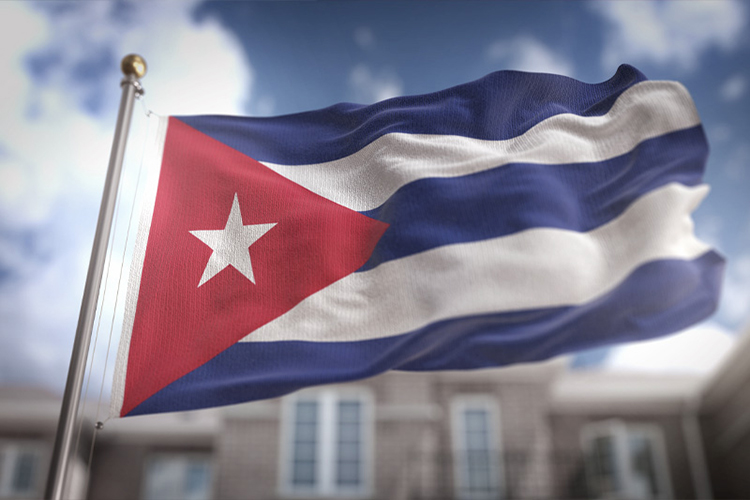
Cuba’s deepening crisis represents more than the failure of an economic model-it signals a turning point in Global South politics. While attention remains fixed on the Middle East, consequential shifts are unfolding across Latin America, shaped in significant part by a more assertive U.S. policy posture that has intensified long-standing pressures on the region.
The island is facing a severe economic and energy crisis, driven by structural weaknesses and the cumulative weight of external constraints. Decades of U.S. economic embargoes-tightened in recent years-have pushed an already fragile system toward breaking point. Fuel shortages, power outages, and rising social strain reveal a system under acute stress, reflecting a wider shift in hemispheric dynamics. Cuba, long seen as an emblem of resistance to Western dominance, now confronts the practical limits of that posture.
For decades, countries such as Cuba, Venezuela, and Bolivia were romanticized across the Global South as symbols of sovereignty and defiance. Figures like Fidel Castro, Che Guevara, and Hugo Chávez occupied an outsized place in this imagination. Yet ideology and symbolism often obscured more complex realities. Cuba became a Soviet outpost during the Cold War, culminating in the Cuban Missile Crisis-the closest the world came to nuclear confrontation in that era.
Economically, Cuba and Venezuela might have achieved more sustained development had they pursued more pragmatic engagement with the United States, as many in the region did.
Today, that question is no longer theoretical. The collapse of Venezuelan support, particularly in the energy sector, combined with sustained U.S. pressure, has left Cuba increasingly isolated. Early signs suggest Havana may now explore limited accommodation with Washington. Even tentative steps would mark a profound departure from decades of entrenched positioning.
If this trajectory continues, it may signal the decline of an older form of Global South politics-once anchored in ideological defiance, now yielding to the imperatives of realism. The Non-Aligned Movement and the Group of 77, once central to the moral and rhetorical architecture of the post-colonial world, are likely to see their influence further diluted in this evolving environment. An earlier era of ideological posturing is giving way to more pragmatic navigation of power and opportunity.
Yet realism does not eliminate the need for dignity. States must recognize their limitations, but major powers must also understand that humiliation can seed future instability. The experiences of Iraq, Afghanistan, and Libya illustrate how coercive or poorly managed transitions often create new crises. Similarly, the post-Cold War order-widely perceived in Moscow as dismissive of its security and status-helped shape grievances that continue to influence global geopolitics.
An instructive counterpoint is the evolution of relations between the United States and Vietnam. Despite a deeply traumatic war, the two countries today engage as pragmatic partners. This transformation underscores that even the most adversarial histories can give way to stable and mutually beneficial relationships-provided transitions are managed with foresight and respect
How transitions are managed can be as important as the transitions themselves.
Amid this evolving landscape, India has a distinct opportunity. It is one of the few countries with credibility across the Global South and sustained engagement with the United States. This positions it to act as a bridge-engaging countries like Cuba while supporting gradual, dignified economic and political adjustment.
India’s own experience-balancing strategic autonomy with pragmatic partnerships-offers a relevant template. Platforms such as the Non-Aligned Movement and BRICS will need to adapt, or be complemented by more flexible coalitions aligned with contemporary realities.
Diasporas also shape outcomes. In the United States, Cuban, Venezuelan, and Iranian communities influence domestic debates and, at times, foreign policy. India, too, must navigate the growing influence of its diaspora in key Western capitals-an asset if managed carefully, but a potential complication if not.
The manner of transition remains critical. Cuba and Venezuela must adapt with legitimacy intact. An emerging order perceived as purely coercive or dismissive will generate resistance, undermining both regional stability and broader strategic objectives. Successful transitions require early, careful engagement, guided by respect and strategic foresight.
The stakes are significant. Cuba, Venezuela, and others remain symbols of a historical narrative, but the world is moving toward a multipolar order shaped by realism, strategy, and negotiated respect. India has both the credibility and the opportunity to help guide this transition-toward a Global South that is pragmatic, resilient, and capable of asserting itself without confrontation.
The Global South is not disappearing; it is being redefined. The question is whether India and its partners will move early enough to shape that process-ensuring the emerging order reflects inclusion, pragmatism, and respect, rather than humiliation.
(Milinda Moragoda is a former cabinet minister and diplomat and Founder of the Pathfinder Foundation, a strategic affairs think tank, can be contacted via via milinda@email.com, was published 2026.03.26 NDTV Opinion section https://shorturl.ad/wZVvt)
By Milinda Moragoda
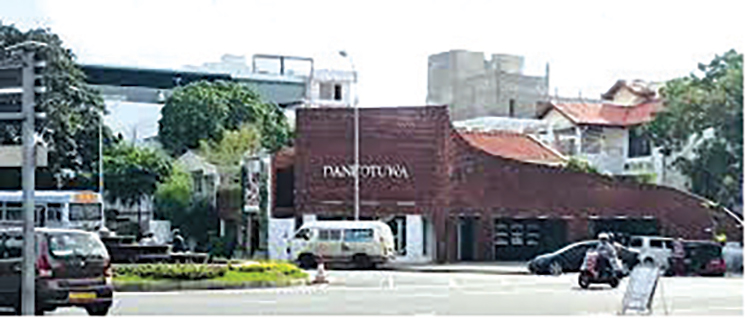
My Stint at Dankotuwa Porcelain – Episode 2
The last episode described some of the interesting experiences during my first stint as non-executive Chairman of Dankotuwa Porcelain, including the privatisation. However, there was one incident I forgot to describe at that time, and I will relate it in this article.
Political interference continues
Political interference at the local level continued unabated. A particular senior minister would walk into the factory without warning at any hour of the day. The security guards were too frightened to stop him. He would speak on behalf of the workers and demand salary increases.
The company was doing well at the time, and our employees’ salaries and benefits were already well above the ceramic industry average. The management felt there was nothing more that could reasonably be given, and we stood firm. No more special increases. The union at the time was the Jathika Sevaka Sangamaya, which was affiliated with the UNP.
One day, the General Secretary of the parent union requested an urgent meeting, which we arranged immediately in Colombo. Since the factory union arrived late, our HR Manager used the opportunity to explain to the parent union official the full details of salaries, the monthly cost-of-living allowance, which increased regularly, and the other benefits provided by the company.
We were operating 26 buses to transport workers from different areas in two districts. Breakfast and lunch were subsidised, and the meals were of good quality. When the union official heard all this, he was shocked. When the factory union leaders finally arrived, he scolded them severely and told them their demands were unreasonable. They left the meeting very embarrassed.
Briefing the minister while pirith was being chanted
Despite this, the agitation continued. I realised that some militant elements had entered the union committee and were determined to create trouble and unsettle the company. Their agenda was different.
I decided I needed political support to resolve the situation and arranged to brief the Minister of Industries. He said he was very busy but suggested that I meet him at an all-night pirith ceremony which had been organised to bless the new building the Ministry was moving into.
When the Minister, Hon. Ranil Wickremesinghe, arrived, he sat on a mat in the middle of the hall, with everyone else seated along the walls. I made myself visible to him, and when he saw me, he signalled me to come forward and sit beside him. I was quite embarrassed, because even senior officials were not seated near him.
I explained the entire situation to him, which took nearly 45 minutes while the pirith chanting was underway. The monks did not look very pleased because the Minister was listening to me rather than the chanting.
When I finished, I quietly asked him whether I could leave. He smiled and said,
“It depends on you. If you want to gain more merit, you may stay. If not, you may leave.”
I took the opportunity and slipped away quietly.
The Politician-inspired Work Stoppage
The demands for salary increases continued, even though the workers already received annual increments, a monthly cost-of-living allowance, a monthly incentive, and an annual bonus. Meals and transport were subsidised.
The senior minister of the area, who was also the President of the Jathika Sevaka Sangamaya, asked the Dankotuwa Porcelain branch union to go on strike. The workers stopped work and left the factory, but remained within the administrative perimeter. They were confident that the Government would intervene and force the management to give in.
At that time, I was also the Executive Chairman of the Employees’ Trust Fund Board, and therefore had access to both the Prime Minister and the President. I met the Prime Minister and showed him the faxes we had received from concerned customers, as well as the details of the salaries and benefits our workers were receiving. He was surprised and told me firmly not to give in.
One night, the Board was invited to the Minister’s house for discussions to settle the issue. I took the other directors with me. The Managing Director joined us halfway. We were slightly nervous about travelling at night, but the journey passed without incident.
We arrived around 8 p.m., but we were called in only at midnight. I felt this delay was deliberate, as the Minister had arranged several political meetings before ours. The discussions were tough. Even when the Minister suggested a small increase of Rs. 50, my fellow directors did not agree. ‘Not one rupee, ’ one Director said. We left without reaching a settlement. As we walked out, the Minister made a veiled threat, but we ignored it.
Keeping the factory running during the work stoppage
Meanwhile, the factory had to continue operating. The main glost kiln could not be stopped suddenly. It had to be cooled gradually over about 14 days. If not, the sudden temperature change would permanently damage the kiln, resulting in a significant loss.
Managers and supervisors themselves had to do manual work to load and unload the kiln. There was also a threat that the strikers would cut off water and electricity to the managers’ quarters within the administrative area. We were also worried that the lorries parked there might be set on fire. Our Managing Director, Mr Jagath Pieris, had to drive the lorries himself into a safer area inside the factory perimeter. He later told me that it was the first time in his life he had driven a lorry.
We then briefed the President, who instructed the Prime Minister to refer the matter for compulsory arbitration immediately. I also requested that the Prime Minister send police from outside the area, as the local police appeared to be under political pressure.
At six o’clock the next morning, I was informed that three busloads of police from other stations had arrived, cleared the premises, and taken control of the factory. Our managers continued to run the operations.
This changed the situation completely. The strikers realised that their political support had weakened. At the same time, the compulsory arbitration order was issued. The newspapers reported that the strike had to be called off, and that those who refused to return to work would be considered to have vacated their posts. The SLBC morning news also carried the same announcement.
The union had no choice. They decided to march to the Minister’s house. The Minister then advised them to return to work.
He later came to the factory and told the union leaders to ask the workers to resume duty because the compulsory arbitration order had to be honoured. They refused, saying it was he who had asked them to strike, and that he himself should address the workers. He did so and then left quickly.
Before leaving, he shouted at the Managing Director,
“Tell your Directors that if my people are harassed, I will not hesitate to bomb the place.”
Discipline restored
Even after the Minister left, the union leaders continued speaking to the workers using the factory microphone. Our HR Manager courageously went forward, took the microphone, and said that they had no right to use it.
He also announced that the workers would not be allowed back until all the placards, caricatures, and effigies placed along the Dankotuwa–Pannala road were removed. Apparently, there were some very well-made effigies of me, along with placards containing language that was not fit to print. I asked for photographs, but my staff refused to show them to me.
That incident effectively ended the union’s power. Management power and discipline were restored, but we continued to treat the employees fairly and provide benefits whenever possible. The union leaders themselves were later reprimanded by their parent union, which had not approved the strike. They even had to bear the cost of the arbitration proceedings personally.
The union leader later came to see me privately. He showed me the loans he had taken to cover the expenses and asked for my help. He promised never to start a strike again. More than 30 years have passed, and he still keeps in touch with me.
After this incident, the company enjoyed industrial peace for many years.
The surprising arbitration award
When the arbitration decision finally came, we were surprised. The award stated that the management’s generosity had actually backfired. Because the company had given regular salary increases and good benefits year after year, the workers had developed higher expectations. Therefore, those expectations had to be recognised.
The arbitrator’s award was much smaller than the union demanded, and we decided not to appeal. It was a small price to pay for the stability we achieved.
The lesson – generosity can create expectations
The lesson from this experience is very clear. Many managers feel happy to give higher wages and better benefits when the company is doing well. However, the happiness level comes down to normal soon. Psychologists call it the ‘Hedonic Treadmill’. Satisfaction with a new benefit soon becomes a norm, and expectations increase. Business conditions do not remain the same forever. When difficult times come, and the company can no longer be generous, workers feel something has been taken away from them and blame management.
When Dankotuwa later faced strong international competition, some workers blamed the management for not getting enough orders. We explained the global situation, and although the younger union members understood and realised that they were on the same side as management in reducing waste and improving productivity, the older leaders still believed they had to fight management to win demands, irrespective of the international situation.
Interestingly, towards the end of my tenure, some young union leaders were even monitoring the Saudi Aramco contract price, because our energy cost formula depended on it. That showed a new level of maturity with the new generation.
A lesson I should have learned earlier
I must admit that I had seen this situation before, but I had not fully understood or internalised the lesson.
Many years earlier, I visited a tea estate owned by a very generous man. He provided his workers with facilities far better than those given in neighbouring estates, and he was very proud of his benevolent management style.
I was there with a retired Deputy Commissioner of a Government Department, a much wiser man. After listening to the owner and his boasts of how well he treats his labour, he quietly said to me,
“Giving much more than the basics will one day boomerang on him.”
Sometime later, I returned to the same estate and saw many vehicles parked there. Officials from a regional union office had come to form a union. One speaker addressing the workers said loudly,
“It is true that the owner gives many benefits, but he makes a big profit too. Therefore, we must demand more, because he can afford it.”
I was shocked by that attitude. Soon afterwards, the union presented a list of demands, and the owner was deeply disappointed. His generous style gradually disappeared. He learned his lesson.
A warning to another company
After the Dankotuwa arbitration award, I was invited to speak to the managers of a factory in the Pannala area. I learned that they were about to introduce several new benefits to workers. I told them our story and advised them to be careful.
The moral is simple. Generosity is good, but it must be balanced with long-term thinking. Several management and motivation theories also warn that once higher pay and benefits become the norm, people quickly adjust their lifestyles to that level. When the benefits stop increasing, dissatisfaction begins.
The next episode will also describe further experiences at Dankotuwa Porcelain, including my return.
Sunil G. Wijesinha, Consultant on Productivity and Japanese Management Techniques, Former Chairman / Director of several listed and unlisted companies
Recipient of the APO Regional Award for Promoting Productivity in the Asia-Pacific Region, Recipient of the Order of the Rising Sun, Gold and Silver Rays – Government of Japan
Email: bizex.seminarsandconsulting@gmail.com
by Sunil G. Wijesinha

It is the government’s objective to create an education system that provides every child with access to modern technological opportunities — Prime Minister

Caf general secretary resigns amid Afcon final fallout

Heat Index likely to increase up to ‘Caution level’ at some places in the Western, Sabaragamuwa, Southern, Eastern, North-western, Northern and North-central provinces and in Monaragala district

National Namal Uyana Declared a ‘National Heritage of Sri Lanka’

Philippine transport strikers say Marcos Jr failing to control oil prices

One ant for $220: the new frontier of wildlife trafficking

‘Dates have the highest sugar content to fight Coronavirus’

Sunday Island 27 December – Headlines

#SundayIsland 17th December – Headlines

Sunday Island – 28th March

Sunday Island Headlines – 21 March

Sunday Island – 21st February – Headlines
-

 News5 days ago
Senior citizens above 70 years to receive March allowances on Thursday (26)
-

 Features2 days ago
A World Order in Crisis: War, Power, and Resistance
-

 Features7 days ago
Trincomalee oil tank farm: An engineering marvel
-

 News3 days ago
Energy Minister indicted on corruption charges ahead of no-faith motion against him
-

 News4 days ago
US dodges question on AKD’s claim SL denied permission for military aircraft to land
-

 Features7 days ago
The scientist who was finally heard
-

 Business4 days ago
Dialog Unveils Dialog Play Mini with Netflix and Apple TV
-

 Sports3 days ago
SLC to hold EGM in April