
Features
The Dutch Burghers and English; Voices of Survivors


Continued from last week
From the beginning of British colonial rule, primary and secondary education in the Sinhalese and Tamil medium was free from the kindergarten to the Senior School Certificate level (equivalent to today’s GCE ‘O’ in Grade 11) . But the English medium schools constituting about 10 -15 percent of the schools in Sri Lanka charged fees. The best the children educated in the native languages, namely Sinhalese or Tamil, could reach was the teaching profession or becoming notaries, village headmen or ayurvedic physicians. The better jobs and access to tertiary education and the learned professions of law and western medicine, judicial positions, executive appointments in the public service as well as the better private sector jobs were only to those who attended the fee levying English medium schools. The official language of the government was English till 1956.
In 1928,the British government appointed a Royal Commission headed by Lord Donoughmore to inquire into further reforms to the constitutions to meet Sri Lankan aspirations. The Donoughmore Commission which consisted of progressive British politicians of the day, was fully convinced that the grant of universal adult franchise should be introduced in order to enable the ordinary people to elect representatives of their choice in order to speak on their behalf in the legislature. The Donoughmore Commission’s recommendations were incorporated to a new constitution, promulgated in 1931. By this constitution, whilst Sri Lanka was still under the British, universal adult franchise was granted to Lankans to elect their own representatives to the legislature which became known as the State Council. In the newly elected legislature, a Board of Ministers were elected. The State Council appointed a Special Committee on Education headed by C.W.W .Kannangara which introduced the free education from the kindergarten to university level in 1942, also by a majority recommended that the medium of instruction in all schools should be the mother tongue in the primary classes.
Having had the privilege of primary, secondary and tertiary education in English, he was one of the most persuasive advocates of native language education known as ‘ Swabhasha’ education. Sir Ivor Jennings records in his autobiography that the politicians’ views prevailed on this policy over the educationists’ opinions. Kannangara proposed that a child should receive education in his or her mother tongue and this triggered a debate in the Special Committee on what ought to be considered the mother tongue of a child. There were some Sinhalese and Tamil children whose mother tongue was English as that language was what was spoken in their homes. According to Sir Ivor, the politicians including Kannangara proposed a legal formula called ‘racial or ethnic mother tongue’. According to this formula, if the language of the progenitors of the ethnic group of the child’s father is Sinhalese, it should be irrefutably presumed that the Sinhalese language was the child’s mother tongue which should then be his or her medium of instruction in primary school even if his mother tongue was in fact English at home. This legal formula was proposed in respect of Tamil children too.
When it came to Muslims, Burghers and Malays, the Special Committee could not recommend applying this principle. If the legal formula of racial mother tongue was applied to these ethnic groups, the mother tongues of Muslim, Burgher and Malay children would respectively be Arabic, Portuguese/ Dutch/English and Malay. In order to overcome this difficulty, Muslims, Burghers and Malays were permitted to receive education in the English medium till the 1970s. Thereafter, the English medium education completely disappeared from the schools and the Dutch Burghers, Muslims and Malays were compelled to study either in Sinhala medium or Tamil medium in the national school system. The Kannangara Committees’ recommendations were adopted after Independence. Sinhalese and Tamil children in the English medium schools were required to study in the Sinhalese and Tamil mediums. The English medium schools were allowed to teach only the Muslim, Burgher and Malay children in English. Kannangara was in fact the father of abolition of English medium education although S.W.R.D. Bandaranaike who was responsible for the enactment of Sinhala Only Act of 1956 is often wrongly blamed for Swabasha education. It was in the Bandaranaike’s tenure and his widow’s terms in power that the English medium was abolished in the secondary school level and in the tertiary level in universities except in Science, Engineering and Medicine courses.
Within two years of the Free Education Ordinance passed in 1942, as many as 44 Central Colleges were established throughout the country, mainly in the rural areas, with well equipped buildings, laboratories and hostels. These schools initially taught rural children in the English medium and some rural children entered the University of Ceylon from them in the early fifties. It certainly was a great revolution. However, the subsequent language policies adopted by successive governments deprived these rural children and others from established English medium schools the benefit of English medium education.
When Singapore gained independence in 1965, only 10 percent of the schools in that country used English as the medium of instruction whilst 80 per cent taught in Chinese and the rest in either Tamil or Malay. Lee Kuan Yew did not abolish English medium education but converted all non- English medium schools to English within a decade giving all Singaporean children, regardless of ethnicity, an equal opportunity to be taught in the English medium. He retained English as the working language of the country making English, Chinese, Tamil and Malay as official languages. Lee did this in a country where 80 percent of the population is ethnic Chinese. If Sri Lanka’s post Independence leaders had adopted this policy, we would not have had ethnic conflicts, tension, communal riots and a 30-year civil war immensely benefiting our development with an ethnically all inclusive public sector, private sector and governance in a unitary state. The Dutch Burghers and Tamils and educated Sinhalese would not have left these shores for more secure and greener pastures in the western countries.
Dutch Burghers of today speak out
In an evening, after the sun set, I paid a visit to Frederick van Buuren, 88,a Dutch Burgher who lives with four Dachshund pet dogs in a small house at Mattegoda, a Colombo suburb. On my arrival, his four dogs started barking at me. Welcoming me Mr. van Buuren said, “They won’t bite” telling the dogs kindly, “Don’t bark. He is a friend.” After their barking subsided, I started my conversation. He said: “My first paternal Dutch ancestor was Willem Regenereus van Buuren. He married Anna Catherina Verwyk. The first European paternal ancestor of my mother’s family, who arrived in Sri Lanka in 1772 was Daniel Meerwald. His hometown was Neusol in Hungary. I was an automobile technician . I studied at Wesley College, Colombo. There were only two Dutch Burghers in my class, myself and another child with the Dutch family name Van Twest. I was born in Trincomalee on September 23, 1932 when my father worked at the Public Works Department as an engineer there.
My Dutch Burgher identity and consciousness within the family I grew up in was very significant in terms of conversations, traditions, customs, perceptions, moral, social, religious and political ideas etc.. My father was very conservative, and he insisted that we should maintain our identity. On the Christmas table we always had Dutch delicacies like Breudher and Poffertjes (Dutch Mini Pancakes) etc. We are a closed community. We moved only with the educated Sinhalese and Tamils. I was a Methodist. My wife, Angela Jansz, was a Catholic. A few months after my marriage I became Catholic by conviction. The Dutch Burghers have always been conservative and right wing politically. Only exception was Pieter Keuneman, a Cambridge educated son of a Dutch Burgher Supreme Court Judge. He was the leader of country’s communist party.”
Asked what the major cause for migration of thousands of Dutch Burghers to Australia, Canada and the United Kingdom,he opined: ” The exodus of Dutch Burghers to these western countries was due to Sinhalese Only policy introduced by Prime Minister Bandaranaike in 1956 and the communal tensions that erupted in its aftermath.” He had migrated to Canada in 1966 with his Dutch Burgher wife and three daughters. His wife passed away in 2006. “I obtained my duel citizenship in 2008. Since 2008, I have lived in Sri Lanka because I feel lonely in Canada and love the climate and warmth of people here. I don’t suffer any discrimination on the basis of my Dutch Burgher identity. My Sinhalese neighbours treat me well.”
Frederick van Buuren
Mrs. Anne-Marie Scharenguivel, 65
, when asked what she thought, had been the major grievance of the Dutch Burgher community in post-independence Sri Lanka, said: “Our major grievance has always been our inability to be educated in our mother tongue, English, as the medium of instruction in the schools and the fact that all Govt departments function in Sinhala. I was forced to educate my sons in International Schools at great cost due to this. Sinhala is a language, not spoken anywhere else in the world! Thankfully the English stream is being reintroduced in schools but there are no proper teachers now competent to teach in English.”
I asked her: “When thousands of Dutch Burghers have migrated to Australia, Canada and the UK, why did your parents and you opt to live in Sri Lanka? She replied: “My father was well established here as Deputy Chief Waterworks Engineer in the Colombo Municipal Council. He later became the Head of the Waterworks Dept (which was absorbed by the Water Board later) and also Acting Municipal Commissioner. I never wanted to leave either, and neither do my sons! But now the future seems to be bleak for the Dutch Burgher community in particular and for the other ethnic minorities in Sri Lanka. This is the first time in our lives that my sons and I have felt like immigrating “
Mrs.Scharenguivel, a born Catholic, schooled at St.Bridget’s Convent and lives in Dehiwela, a suburb of Colombo.
Anne-Marie Scharenguivel
Mrs.Doreen van der Hoeven, 64
, is a mother of two sons. She is a Dutch Burgher who lives in Kalutara, a coastal town 40 km south of Colombo. “My father was a guard in the Ceylon Government Railway. In those days, A lot of Dutch Burghers worked in the Ceylon Government Railway as engine drivers and train guards,” she said adding “My mother who is 94-years old is a Scharenguivel. My parents were Dutch Burghers. I was educated at Methodist College, Colombo. We are Methodists by religion. I am the only child in my family. I became aware of my Dutch Burgher identity when I was a child. I used to ask my parents why we were different from others in language, family name and complexion. Then my parents would tell me about my Dutch Burgher ancestry. I am a nurse by profession. I still remember having Dutch Breudher on our family Christmas table in my childhood. Most of my Dutch Burgher cousins, relatives and friends have migrated to Canada, Australia and the United Kingdom. Our community was affected by the Sinhala Only language policy which did away with English as a medium of instruction in the schools and as an official language. That was the reason for Dutch Burgher migration.”
Doreen van der Hoeven
Voices of the Young
Miss Andriana Melder, 23, is a young Dutch Burgher lady with a Bachelor of Laws degree from the University of London. She is now studying for the Bar examinations A Catholic and old pupil of Holy Family Convent, Colombo 4, she lives in Nugegoda, in the suburbs of Colombo.
Andriana Melder
“My first paternal Dutch ancestor was Reverend Willem Melder who had come from Holland to serve as a minister of the Dutch Reformed Church of Sri Lanka (founded by the Dutch in 1642 and now known as Christian Reformed Church of Sri Lanka). He had married Madalena Petronella Perera at the Wolvendaal Church in Colombo. The initial ancestors of the Melder clan in Sri Lanka worked as Dutch Civil servants and the later as planters and spice traders. At one point in my paternal family tree, my ancestors had become Catholic leaving their Protestant faith for some reasons, she said.
Speaking of the significance of her Dutch Burgher identity ,culture, religious and moral values , Andriana opined: “My Dutch Burgher identity played a pivotal role in my upbringing. My father was very proud of this identity and his heritage. He would often point out old buildings and vast portions of land In Melder Place and Pietersz Place in Nugegoda now mostly sold off or occupied by other communities due to the migration of our relatives to Australia, New Zealand, Canada and the UK. Claiming that these lands once belonged to our ancestors, he had fond memories of playing cricket in the vast fields, fishing and even hunting with my late grandfather with a double barrel gun slung over his shoulder.
“We were brought up to value our culture, the elders set the example by maintaining records and journals for the younger generations to refer. Many articles too have been preserved to generate knowledge of the yesteryears of the Melder clan. My late paternal grandmother and my grand aunts and uncles on my father’s side, used to relate stories from the good old days in the times of Ceylon, about the great big dances and parties they used to throw on various occasions. The carefree, happy- go-lucky attitude passed down through the generations is visible even in the youth in my family today. There is no pressure as to marriage, sense of fashion or lifestyle. The freedom to make up one’s own choices have been ingrained even in our young minds. Learning to play a musical instrument, singing and dancing is an essential aspect of our life. This has resulted in many Burgher youth becoming fond of the arts. My extended family is very religiously and not racially inclusive as many of my relatives have inter married into various faiths and races. Education takes centre stage in our family as most of my ancestors are well educated and rounded individuals who have achieved much in their respective professions. The general perception among the other ethnic communities that most Dutch Burgher youth lack morals and religious affiliation is profoundly untrue. Many of us are staunch practicing Christians (Catholic and Protestant) whose morals have been intertwined with religion. The Dutch Burgher families are a closely knit community and they value familial aspects in their relationships.
Asked what in her opinion, have been the legitimate grievances of the Dutch Burgher community since Independence, Andriana said, “It is the lack of recognition even as a minority. The language and cultural barriers are pertinent to date and the lack of an inclusive system for all races is still present. The Dutch Burgher community has contributed much in terms of construction, law and the judicial system, religion, hybrid culture and cuisines. They are a unique community.
“The post 1956 migration of many Burgher families from the island was a result of their not
seeing a future for their children in the new Ceylon. Most migrated to Australia because
Australians had a life style close to theirs. Others moved to Canada, the UK and New Zealand.
Many Burgher migrants held very senior positions in the Mercantile, Banking, Medical, Academic
and Public sectors abroad. Most of them still consider the island known to them as
Ceylon, as their beloved home that nurtured them as a community for about four centuries.
We decided to remain in SL as my father was well established in his profession and because
of my grandparents from both sides of the family. I would like to leave SL once I complete my studies as many of my friends and relatives are already abroad and seeing how their lifestyle seem much better and their future more promising, I too would like to migrate one day.”
Speaking of the future of the Dutch Burgher Community, Andriana said: “The Dutch Burgher community is dwindling at present with the vast increase in migration and inter marriages taking place. Further, with racist ideologies rising once more, the future for the minorities seem bleak.”
My last interview for this article was with a young Dutch Burgher Fabian Schokman, 24. A graduate in Theology he now reading for a Bachelor of Laws degree of the University of London. A Catholic by faith, Fabian is very outspoken. “My first paternal Dutch ancestor was Jan Arentsz Schokman who had come to Sri Lanka from Amsterdam in 1697 who was a ship’s carpenter’, said Fabian. When asked how significant was his Dutch Burgher identity and consciousness within the family he grew up in the conversations, traditions, customs, perceptions, moral, social, religious and political ideas , Fabian said: “It had a strong bearing on my upbringing, especially in terms of perceptions and to a greater level, openness to liberal ideologies. Tradition has always being a closely guarded and cherished part of my upbringing, especially by the elder generation. It varies starkly across a spectrum. Identity is a matter of self perception and this self perception would vary widely among a single family, multiple families that comprise of a unit and most certainly in the community in general.
“As I mentioned, there is and has always being the ultra-conservative and ultra-liberal ends of the community and every shade in-between. As with the other questions, this must be analyzed from within the spectrum. Of course the more traditional Dutch Burgher families are undeniably facing the extinction of cultural identity as assimilation means more and more of the individualistic aspects of the community are fading off to give way to a more conforming cultural identity. The days of a monolinguistic, starkly distinct community are fast fading, yet in a more general perspective, the community in my opinion, because of its minute size faces a number of issues stemming from lack of political representation. I believe that one’s identity is and should be a part of everyday life. As a lesser minority, even in the context of school and community in general, I have found the Dutch Burgher community to be rather close-knit, not least on account of the vast inter-connection between each other. That being said, this identity is in no way antithetical to centrist Sri Lankan values.
Fabian Schokman
Fabian seems to think that the future for the Dutch Burgher community in Sri Lanka seems less bleak than what other members of his community believe. He opined: “The Dutch Burgher community has always had a spirit of endurance and survival imbued deep within itself and as a result the community will survive, perhaps more intact than other lesser non-monogamous minorities. At present the community has found prominence in the private sector and I particularly don’t see a return to the age of civil service dominance. There is also a deep sense of pride and cultural revival in the younger generation and this does make the future seem less bleak. However in comparison to the larger minorities with considerable communal and political representation, a stable lineal prediction is difficult to project.”

Speak the truth, before the crisis does
 The Sri Lankan rupee is not merely depreciating. It is sending a warning. Once again, the country is being reminded that recovery is not the same as stability, and that an IMF programme is not a substitute for disciplined national economic management.
Beneath the casual conversations of scholars lies a serious argument: Sri Lanka is not yet out of danger. The country may have escaped the worst of the 2022 collapse, but it has not escaped the habits that produced it: delayed decisions, weak communication, excessive import appetite, fuel-intensive lifestyles, and a political reluctance to tell citizens the hard truth.
The vicious cycle
The latest pressure on the rupee should, therefore, not be dismissed as a temporary market fluctuation. It reflects a familiar and dangerous sequence. When the rupee begins to fall, exporters hold on to dollars in expectation of a better rate. Importers rush to buy dollars before costs rise further. Banks become reluctant to release foreign exchange. The interbank market tightens. Anxiety feeds behaviour, and behaviour feeds anxiety. That is how a currency problem becomes a confidence problem.
Sri Lanka has seen this movie before, precisely during 2020-2022. The names, personalities, and policy language may have changed, but the underlying pattern is recognisable. First, the exchange rate comes under pressure. Then the authorities speak calmly. Then temporary measures are discussed. Then import restrictions are considered. Then citizens are told certain goods are “non-essential.” Finally, when pressure becomes unbearable, the truth emerges: the country had less room than officials implied.
The danger today is not that Sri Lanka is exactly back in 2022. It is not. The fiscal position is stronger. The IMF programme is in place. The Central Bank has more credibility than during the worst period of denial. But that is precisely why complacency is dangerous. A country that has just survived a crisis should be more alert, not less and announce “there is no problem”.
The IMF tranche expected shortly may calm the market. It may bring dollars into the system. It may help the Central Bank reassure banks, exporters, importers, and investors. But IMF money is not a national economic strategy. It is breathing space. If that breathing space is used merely to postpone difficult choices, then the country will have learnt very little from its own trauma.
The most dangerous illusion is that import controls can solve the problem. They cannot. They can delay pressure, redirect it, and make the government look active for a few weeks. But they do not eliminate underlying demand. If people cannot import vehicles, the credit and purchasing power do not vanish. They move elsewhere: housing, construction, consumer goods, machinery, travel, or other import-linked spending.
Vehicle imports illustrate the dilemma. They consume foreign exchange and increase future fuel demand. But they also generate large tax revenue and support leasing, insurance, repairs, spare parts, logistics, and employment. A crude ban may reduce one form of dollar demand while damaging revenue and pushing economic activity into other channels. The correct answer is not panic prohibition. It is intelligent demand management.
Fuel is the real battlefield
Petroleum is one of the country’s largest import burdens, yet Sri Lankans still behave as if fuel consumption is a private matter with no national consequence. It is not. Every unnecessary trip, every idle engine, every fuel-inefficient commute, and every avoidable private-car journey becomes part of the country’s dollar problem.
If fuel prices are artificially softened, people continue as before. If the rupee falls further, the eventual pain comes through every channel at once: fuel, electricity, food, water, transport, and imported inputs. The country then discovers that avoiding one price increase only produced a larger national price increase later.
Poor households must be protected
That is why targeted support is essential. Public transport must be supported. But subsidies should not be thrown blindly across the economy. They should be directed through systems that can be monitored: Aswesuma for vulnerable households, route-based support for buses, and transparent cash or coupon mechanisms linked to actual public service.
Sri Lanka should be making public transport the patriotic option, not the poor man’s punishment. If citizens are being asked to reduce fuel consumption, they must be given a credible alternative. That means better buses, cleaner buses, more AC services, higher frequency, safer routes, and regulations that reflect reality rather than outdated assumptions.
Transport system management is vital
Discussions about metro-style bus services is important for precisely this reason. If commuters are willing to stand in an air-conditioned bus because it is cleaner, quieter, smoother, and more comfortable than the ordinary alternative, policy should expand that service. Do not suffocate better service with rules written for a different era. Regulate for safety, yes. But do not block improvement in the name of procedure.
Rail is even more important. A serious country does not solve urban commuting only with buses and private vehicles. The railway should be the backbone of mass commuting into Colombo. Trains move more people with less fuel per passenger. They avoid road congestion. They reduce import pressure indirectly by reducing fuel demand. But this requires frequency, rolling stock, signalling upgrades, centralised control, digital systems, and operational seriousness. Sri Lanka cannot talk about saving dollars while tolerating a transport system that pushes citizens into private vehicles.
Hello, please speak the truth
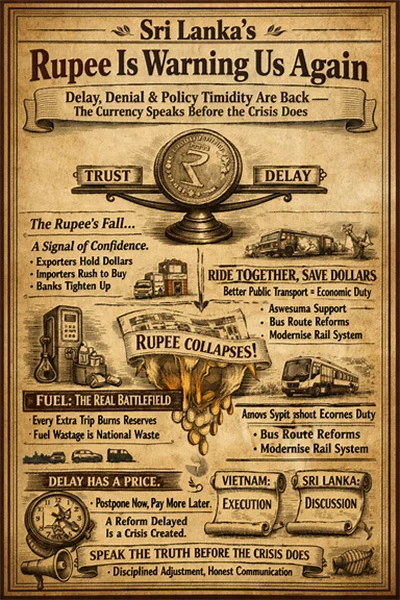 The government’s communication failure is equally serious. Leaders in India and Singapore have been willing to tell citizens that conditions are difficult and that behaviour must adjust. Use public transport. Reduce unnecessary consumption. Work from home where possible. Conserve fuel. Be careful with imports. These are not signs of weakness. They are signs of mature leadership.
In Sri Lanka, the message remains too soft. Officials appear afraid to say plainly that the country is not yet secure. The public is allowed to behave as if recovery means normalcy. Fuel is consumed, imports resume, roads fill, luxury vehicles appear, and private lifestyles continue with little sense of national constraint.
This is irresponsible. Citizens cannot be expected to act prudently if the state refuses to speak honestly. Economic management is not only about interest rates, reserves, and IMF reviews. It is also about shaping expectations. If leaders do not explain the seriousness of the situation early, the market will explain it later through far more painful consequences, such as runaway inflation and shortages of essential goods.
There is also a deeper governance problem. The issue today may not be crude corruption of the old kind. The more immediate danger may be hesitation. The government appears too slow in making necessary decisions. It overthinks. It delays. It waits. It consults. It hesitates. Meanwhile, markets move.
Delay is very expensive
In economics, delay is not neutral. Delay has a price. A decision postponed in May may become a crisis measure in August. A reform avoided today may become a forced adjustment tomorrow. The market does not wait for Cabinet comfort, bureaucratic neatness, or political messaging.
This is where Sri Lanka must learn from Vietnam, which did not become an investment magnet through speeches about development. It made decisions. It signed trade agreements. It improved investor access to land. It aligned policy with competitive advantage. It pushed digitalisation. It treated investment facilitation as practical statecraft, not ceremonial rhetoric.
Sri Lanka remains trapped in procedural delay. Land acquisition takes too long. Export-zone facilitation is too slow. Intellectual property reforms remain incomplete. The Madrid Protocol issue is not a minor technicality. For exporters and investors, brand protection, product security, and legal alignment with global systems matter. A country that cannot protect intellectual property cannot expect higher-value investment to arrive simply because officials request it.
The lesson is blunt: Investors do not reward potential. They reward execution. Sri Lanka has potential. It has always had potential. That is precisely the problem. Potential has become an excuse for underperformance. Vietnam converted potential into policy. Sri Lanka converted potential into discussion.
Disciplined adjustment means telling citizens the truth before the crisis does
If the country responds with another cycle of reassurance, delay, temporary restriction, and vague optimism, then the recovery will remain fragile. If, however, the government uses this moment to speak honestly, manage fuel demand, strengthen public transport, target subsidies, speed up reforms, and treat policy execution as urgent, the rupee’s warning may still be useful.
The choice is not between panic and denial. The choice is between disciplined adjustment and forced adjustment. Disciplined adjustment means telling citizens the truth before the crisis does. It means asking those who can work from home to do so. It means encouraging public transport while improving its quality. It means protecting the poor without subsidising waste. It means recognising that every unnecessary dollar spent today weakens the country’s room for manoeuvre tomorrow.
Forced adjustment is what happens when leaders avoid these choices. Then the exchange rate makes the decision. Prices make the decision. Queues make the decision. Import shortages make the decision. Public anger makes the decision, similar to Aragalaya in 2022. Sri Lanka has already paid once for denial. It should not pay again for hesitation.
The rupee is not only a price. It is a signal of trust. When it weakens, it tells us that markets are uncertain, citizens are unconvinced, and policy has not moved fast enough. The correct response is not to blame exporters, importers, consumers, or global conditions alone. The correct response is to govern. The country does not need another explanation after the damage is done. It needs timely action before the damage spreads.
That is the real message of this moment: the rupee is warning us again. This time, Sri Lanka must listen early.
(The writer, a senior Chartered
Accountant and professional banker,
is a professor at SLIIT, Malabe. Views expressed in this article are personal.)
The IMF staff and Sri Lankan authorities have reached a staff-level agreement to conclude the combined Fifth and Sixth Reviews of Sri Lanka’s reform programme under the Extended Fund Facility (EFF). If approved by the IMF Executive Board, Sri Lanka will gain access to about US$700 million in financing. While the IMF has acknowledged progress in reserves, growth, and revenue performance, it has also warned that Sri Lanka remains exposed to external shocks, including the Middle East conflict and the aftermath of Cyclone Ditwah.
This mixed picture of progress and vulnerability gives added significance to the recent warning by economist Dr. Ganeshan Wignaraja. Speaking on 4 May 2026 at a discussion held at the Regional Centre for Strategic Studies (RCSS) in Colombo, titled “A Global Economy in the Shadow of the Middle East War: Implications for Sri Lanka’s Debt Recovery,” he cautioned that Sri Lanka may once again have to consider the possibility of seeking further IMF assistance if current vulnerabilities are not addressed with urgency.
Dr. Wignaraja pointed out that although Sri Lanka’s current IMF programme is scheduled to conclude in 2027, the country will once again face major external debt repayment obligations beginning in 2028. At the same time, global economic instability, Middle Eastern conflicts, rising fuel prices, and climate-related disruptions could place Sri Lanka’s fragile recovery under renewed pressure.
This is not merely an ordinary economic observation. It is a serious warning about the deep structural weaknesses that have shaped Sri Lanka’s economy for decades. In fact, turning to the IMF is not new for Sri Lanka. Since 1965, the country has entered into 17 IMF programmes, placing Sri Lanka among the nations that have relied most frequently on IMF assistance.
This recurring dependence is not simply the result of temporary financial shortages. It reflects deeper structural problems: weak productive capacity, insufficient export growth, poor fiscal discipline, and an economic model excessively dependent on borrowing. When a country repeatedly requires IMF support, it raises fundamental questions about the sustainability and resilience of its economic system.
According to Table 1.16, “Outstanding External Debt Position,” in the Central Bank of Sri Lanka’s Annual Economic Review 2025, Sri Lanka’s total external debt position at the end of 2025 was reported at USD 54.8 billion at market value and USD 56.2 billion at face value. Of this amount, the government’s external debt stood at approximately USD 36.7 billion at face value. In 2022, Sri Lanka suspended external debt repayments for the first time in its history, after which debt restructuring began under the IMF-supported programme. Although this provided short-term stability, many of the country’s core economic vulnerabilities remain unresolved.For example, Sri Lanka’s export earnings remain relatively low compared to GDP. Countries such as Vietnam, Bangladesh, and Thailand have transformed themselves into export-driven manufacturing economies, while Sri Lanka continues to depend heavily on tourism, worker remittances, and external borrowing for foreign exchange earnings.
Although tourism revenues and remittances improved somewhat during 2024 and 2025, these are not sufficiently stable foundations for long-term economic sustainability. External shocks such as Middle Eastern conflicts, fluctuations in global fuel prices, international market downturns, and climate-related disasters could disrupt these income sources at any time.
Dr. Wignaraja also emphasised that climate change itself may become a major factor affecting Sri Lanka’s future debt sustainability. Floods, droughts, and declining agricultural productivity increase food import costs and place further pressure on foreign exchange reserves, thereby worsening the country’s economic vulnerabilities.
At the same time, IMF programmes carry significant social costs. Since 2023, tax increases, electricity tariff revisions, reductions in government spending, and state-sector reforms have imposed severe pressures on ordinary citizens. The middle class has weakened considerably, poverty levels have risen, and many small and medium-sized enterprises have struggled to survive rising operational costs. Youth unemployment and migration aspirations have also intensified during this period.
Nevertheless, it must also be acknowledged that recovering from the 2022 crisis without IMF support would have been extremely difficult. The IMF not only provides financial assistance but also offers a framework of credibility that enables countries to secure support from institutions such as the World Bank, the Asian Development Bank, and other international lenders. In Sri Lanka’s case, the IMF programme helped restore a degree of investor confidence and international credibility.
However, the deeper problem lies elsewhere. Sri Lanka has repeatedly used IMF programmes as temporary crisis-management tools rather than as opportunities for genuine economic transformation. The 2024 review of the current IMF-supported Extended Fund Facility again highlighted several specific reform commitments that Sri Lanka was expected to continue. These included strengthening revenue mobilisation and tax administration, advancing public financial management and debt management reforms, maintaining cost-reflective fuel and electricity pricing to reduce fiscal risks from state-owned enterprises, improving governance and restructuring of state-owned enterprises and state-owned banks, and implementing stronger anti-corruption and governance reforms. The IMF also emphasized the need to protect vulnerable groups through better-targeted social safety nets while continuing fiscal consolidation.
More specifically, the 2024 programme review required stronger anti-corruption measures in revenue-collecting agencies such as Inland Revenue, Customs, and Excise; greater transparency in public procurement and tax exemptions; publication and implementation of governance reform action plans; stronger oversight of public assets; and reforms to improve the governance of state-owned banks. These were not merely technical conditions. They were meant to address the institutional weaknesses that have repeatedly pushed Sri Lanka back into external financing crises.
Yet Sri Lanka has historically struggled to fully implement such reforms. Tax administration, state-owned enterprise restructuring, public financial management, anti-corruption measures, and cost-reflective pricing have often been delayed, diluted, or weakened due to political resistance, weak institutions, and short-term policy decisions. As a result, IMF programmes have brought temporary stability, but not always lasting structural change. After almost every IMF programme, the country gradually returned to old habits: excessive government spending, politically driven populism, inefficient state-owned enterprises, and debt-financed development.
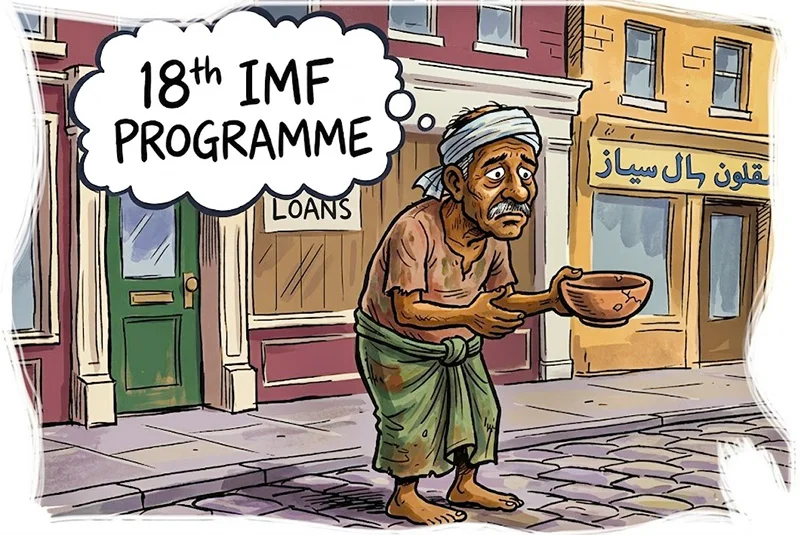
Therefore, the real issue is not simply whether Sri Lanka will enter an 18th IMF programme. The more important question is whether the country is capable of building an economy that no longer requires repeated IMF intervention.
Achieving this requires more than slogans or short-term political promises. It demands a clear and disciplined national economic strategy. Government expenditure must be prioritized carefully. Loss-making state-owned enterprises should be freed from political interference and placed under professional management. The tax system must broaden the revenue base fairly while encouraging investment and reducing tax evasion.
At the same time, Sri Lanka must transform itself into an export-oriented productive economy. Agriculture, manufacturing, tourism, information technology, port services, education services, and healthcare services should all be strategically developed as foreign exchange earning sectors. Investors do not seek tax concessions alone; they require policy consistency, legal stability, efficient approval processes, and an environment free from corruption.
True reform does not mean continuously burdening citizens with higher taxes and reduced living standards. Genuine reform means creating a more efficient state, reducing waste and corruption, increasing productivity, and expanding income-generating opportunities for ordinary people. Whether under an IMF programme or outside one, Sri Lanka urgently needs this kind of national economic discipline.
Ultimately, the IMF is not a symbol of economic success. It is an emergency support mechanism used during periods of crisis. The national objective should not be to secure yet another IMF programme, but to build an economy strong enough to function without repeated external rescue packages.
Otherwise, today’s question — “Will Sri Lanka need an 18th IMF programme?” — may eventually become “When will the 19th programme begin?”
That is not the future Sri Lanka should aspire to. The country does not need an economy that survives by repeatedly seeking external assistance. It needs a mature national economy that produces, exports, innovates, earns global confidence, and builds its future through its own strength and productivity.
by Professor Ranjith Bandara, PhD (Qld.,)
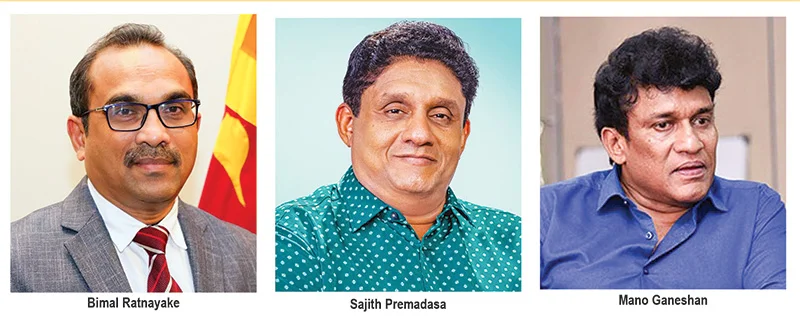
At a symposium on reconciliation organised by the National Peace Council last week, more than 250 religious clergy, civic activists and political representatives from different communities gathered to discuss the country’s future. Speaking at the event, Minister Bimal Rathnayake explained the government’s approach to national reconciliation. He said the government viewed the country’s recovery in terms of a three stage process. The first stage was stabilisation, the second was development and the third was transformation. Reconciliation, he implied, would come in that final stage. The participation of Opposition Leader Sajith Premadasa at the same symposium, and the constructive nature of his comments, strengthens that hope.
When the present NPP government took office in 2024, the country was emerging from one of the gravest crises in its post Independence history. The economic collapse of 2022 had led to shortages of fuel, food, medicines and electricity. Inflation soared, foreign reserves disappeared and long queues became part of daily life. The political upheaval that followed culminated in the resignation of former President Gotabaya Rajapaksa after mass public protests under the banner of the Aragalaya movement. The country was then governed by a leadership that spoke the language of reform and reconciliation but was widely perceived as lacking a direct popular mandate.
Sri Lanka’s past experience suggests that stabilisation and transformation cannot be treated as entirely separate stages. Postponing reconciliation until some future moment risks repeating the failures of the past. If transformation is endlessly delayed until a supposedly perfect moment arrives, there will always be new crises and new reasons for postponement. Minister Rathnayake’s contention that the government’s immediate priority has necessarily been stabilisation flows from the government’s awareness of the precarious situation the country is. Over the past two years, the government has succeeded to a significant extent in restoring economic and political stability. Inflation has reduced, shortages have ended and public institutions have regained a degree of functionality.
Guaranteed Changes
On the other hand, the country’s development continues to face challenges due to adverse global conditions, including disruptions caused by conflict in the Middle East and extreme weather events that have affected tourism, trade and the cost of living. The danger is that reconciliation may be indefinitely postponed in the name of stabilisation. This danger can be reduced if the government works proactively with the opposition and civil society to commence practical measures of transformation now rather than later. The participation of Opposition Leader Sajith Premadasa at the symposium, and the constructive nature of his comments, has strengthened the sense that bipartisan engagement on reconciliation may now be possible.
The urgency of transformation came through strongly in the presentations made by representatives of the Sri Lanka Tamil and Malaiyaha Tamil communities. ITAK parliamentarian S.Shritharan spoke of the frustration caused by unresolved post war issues in the north and east. He referred to disputes regarding land occupied during the war years, including controversies linked to Buddhist temples and state sponsored settlement activity in areas claimed by local communities. He also pointed to the continuing large scale presence of the security forces in the north and east nearly two decades after the end of the war. These grievances have remained central to Tamil political discourse since the end of the armed conflict in 2009. Families displaced by war continue to seek the return of ancestral lands. Civil society organisations in the north have repeatedly called for greater civilian control over local administration and a reduction in military involvement in civilian life.
Academic research and practical work on the ground have shown that reconciliation cannot be separated from questions of dignity, equality and justice. Former minister Mano Ganesan, leader of the Democratic People’s Front, focused on the longstanding problems faced by the Malaiyaha Tamil community. He spoke passionately about continuing housing shortages, landlessness and economic marginalisation, issues that have persisted since Independence. He also highlighted the devastating impact of recent extreme weather events on estate communities that remain socially and economically vulnerable. The condition of the Malaiyaha Tamil community remains one of the enduring social justice issues in Sri Lanka.
After Independence in 1948, a large proportion of them were denied citizenship and voting rights through legislation that rendered them stateless. Though citizenship rights were eventually restored, the social and economic consequences of exclusion continue to be felt generations later.
Many families still lack secure housing and land ownership despite their immense contribution to the country’s plantation economy. Minister Rathnayake’s responses to both these concerns were politically significant. He argued that recent political developments, including the declining influence of narrow ethnic politics across communities, indicated a major shift in public attitudes. According to him, the political ground has changed in ways that make it increasingly difficult for politicians who rely primarily on ethnic division and communal insecurity to retain public support.
Inter-Connected
There is evidence to support the assessment about the changing political grounding which sees future prospects in the resolution of long standing problems. . The economic collapse of 2022 affected all communities alike and generated a new politics centred on governance, anti corruption, accountability and economic justice. The Aragalaya protests brought together Sinhalese, Tamils and Muslims in a common demand for political change. Although ethnic grievances have not disappeared, the crisis created space for a broader understanding that the country’s future depends on cooperation rather than division. Opposition Leader Premadasa’s comments at the symposium reflected this changing political climate. He emphasised that national reconciliation could not be separated from economic justice and the need to address disparities between regions and social classes.v He also mentioned the need for civil society organisations to take this message to the community. This wider understanding of reconciliation is important because ethnic inequality and economic inequality have often reinforced each other in Sri Lanka’s history.
Academic studies have identified the denial of citizenship rights after Independence as a historic injustice that set back the Malaiyaha community for decades. The challenge now is to ensure that transformation becomes part of the stabilisation and development process itself. Practical first steps are both possible and necessary. The release of civilian lands still under state control, greater devolution of administrative authority, reduction of military involvement in civilian affairs, language equality in public administration and accelerated housing and land ownership programmes in the plantation sector are all measures that can begin immediately without waiting for a final stage of transformation.
The government’s recent commitment that provincial council elections will finally be held this year is therefore significant. These elections have been repeatedly postponed by successive governments. Holding them would not solve the ethnic conflict by itself. But it would signal a willingness to restore democratic institutions and share power in a meaningful way.
Sri Lanka has repeatedly postponed difficult reforms in the hope that a more convenient political moment would eventually arrive. But opportunities are invariably created and fought for instead of being provided as a gift by a benevolent government.
The present moment, shaped by the economic crisis and public demand for accountable government, offers a rare opportunity to move simultaneously towards stability, development and reconciliation. Provincial council elections can be the first meaningful step. But they must not be the last.
by Jehan Perera

Explosive top orders in focus as Rajasthan Royals face bogey team Sunrisers Hyderabad

New High-Definition (HD) Television Studio at the University of Vocational Technology handed over to students with the participation of the Prime Minister

Multiple people killed and others missing after chemical explosion at US paper mill

Dozens killed in Lebanon as Israel intensifies strikes

Showers will occur at times in the Western, Sabaragamuwa and North-western provinces and in Galle, Matara, Kandy and Nuwara-Eliya districts

Banking sector claims its integrity intact despite ‘isolated incidents of fraud’

‘Dates have the highest sugar content to fight Coronavirus’

Sunday Island 27 December – Headlines

#SundayIsland 17th December – Headlines

Sunday Island – 28th March

Sunday Island Headlines – 21 March

Sunday Island – 21st February – Headlines
-
 Opinion6 days ago
Murder of Ehelepola family, Bogambara Wewa and Sightings of Wangediya
-

 Business5 days ago
Historic launch of CCWE Fashion Week & International Summit 2026
-
 News6 days ago
Steps underway to safeguard Sri Lanka’s maritime heritage
-
 News2 days ago
Police probe underway to ascertain links between criminals deported from UAE and local politicians
-
 Features3 days ago
The NPP’s pivot to the past
-

 News3 days ago
All-New GRAVITE launches at LKR 6.99 Mn
-

 Editorial6 days ago
A play without its protagonist
-
 Opinion5 days ago
The need to reform Buddhist ecclesiastical order