
Business
The decisions we make today will shape our future – President

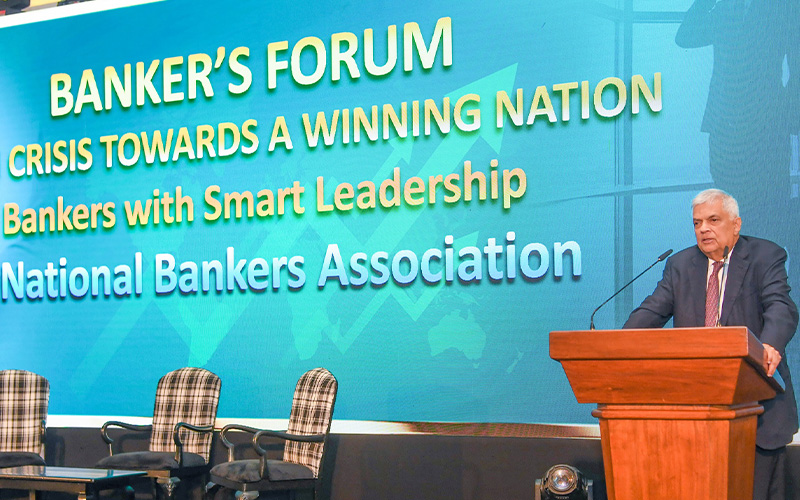
President Ranil Wickremesinghe recently emphasized that as the country builds a new economy, it is crucial to establish a new political system. This system must foster individuals who can take responsibility and speak the truth fearlessly.
He made these remarks during the bankers’ forum organized by the National Bankers Association at Galle Face Hotel, Colombo, on Friday (05).
The President stated that he has updated the people of the economic challenges faced by the country and has also outlined a clear program to lead the nation out of the crisis. He reiterated that there is no alternative program for the country and that it is everyone’s responsibility to identify and support the program rather than living in dream worlds.
He pointed out that while some have cited Argentina’s Martin Guzman as an example, he considers Guzman a failure.
The President stated that his goal is to steer the country towards rapid development through an export-based economy. He mentioned that the necessary legal framework for creating an export economy has been presented to Parliament and highlighted the banking system’s significant responsibility in advancing this program.
Subsequently, a discussion was held featuring President Ranil Wickremesinghe, former Minister of Finance Minister Ravi Karunanayake, and Senior Adviser to the President on Economic Affairs Dr. R.H.S. Samaratunga.
The President said;
“Today, we have made significant economic progress. I need not remind you of what happened from the Jetwing Hotel to the Galle Face Hotel in those days. During that journey, my house was also burned down. Despite these challenges, we have moved forward, but there is still a long way to go. I made it clear back then that if we do not protect our banking system, we cannot safeguard our economy. A collapse in the banking system would lead to an economic collapse.
At that time, I had to take charge of the country. Together, we initiated efforts to uplift the country’s economy, and today, we are seeing the results. Progress does not happen overnight.
Efforts have been made to reduce the loan repayment by USD 8 billion over a period of four years. The economy is once again developing. Now, we have reached a crucial turning point as a country. With the USD 8 billion in debt relief, we are now free to pursue a new economy. We have submitted the necessary legal framework to Parliament to create an export-oriented economy.
We need to progress from this point forward, and the banking system plays a crucial role here. How do we secure funding? Foreign investment is essential for the banks to thrive. We have not yet achieved this objective.
While we have repaired the fractured economic system and made strides, the broken political system remains unresolved.
Former leaders fled in fear during that time. What does this say about political leadership in our country? Can such leaders propel the nation forward without solutions? They fled in fear that day because they lacked answers.
Following the former president’s resignation, the country’s peace and stability began to deteriorate. Some urged me to resign as Prime Minister. Can a country progress under such a political system?
When we introduced the Economic Transformation Bill, Mr.Sunil Handunnetti filed a case advocating for an import-based economy. Today, our economic challenges stem from operating within an import-oriented economy.
Regarding Argentina’s Martin Guzman, some consider him a failure, while others suggest traveling the world to seek financial aid from leaders. I’ve stated firmly that neither I nor the Sinhalese nation are beggars. Despite this, some still advocate for change. Does this imply advocating for an import-based economy?
We must choose wisely and advance with the program that our country truly needs, avoiding the lure of unrealistic ideals.
It’s crucial to grasp the truth and take decisive action. The decisions we make today will shape our future. As we rebuild the nation’s economy, we must also reform our political system. This entails cultivating individuals who can shoulder responsibility and progress, and who bravely speak the truth without fear. Without this foundation, our country lacks a viable future.
Honesty has always been our policy. In politics, there should be no fear of speaking the truth, irrespective of one’s stance towards the government. I united people from various political factions to lead this government forward. While party discipline was lacking, governmental discipline prevailed. Despite challenges, we garnered support, including from young MPs of Podujana Peramuna, who joined us without regard for their political futures. Our political system has yet to match the economic groundwork we’ve laid today. This must be our focus moving forward.

Business
AIA delivers strong first half results in 2026; double-digit growth across key financial metrics


The Board of AIA Group Limited (the “Company”) is pleased to announce the Group’s financial results for the six months ended 30 June 2026. Growth rates are shown on a constant exchange rate basis unless otherwise stated:
New business performance and embedded value
Value of new business (VONB) of US$3,212 million, up 10 per cent overall and 14 per cent excluding Thailand(1)
Record high annualised operating ROEV of 18.0 per cent, up from 15.8 per cent in full year 2025
EV Equity of US$83.4 billion, up 6 per cent per share over the first half on an actual exchange rate basis
IFRS earnings
Operating profit after tax (OPAT) of US$4,163 million, up 13 per cent per share
AIA now expects to exceed OPAT per share CAGR target of 9 to 11 per cent from 2023 to 2026(2)
Record high annualised operating ROE of 17.5 per cent, up from 15.5 per cent in full year 2025
Cash generation and capital returns
Underlying free surplus generation (UFSG) of US$3,935 million, increased by 10 per cent per share
Net free surplus generation (net FSG) of US$2,758 million, up 12 per cent per share
US$3.6 billion returned to shareholders in the first half through dividend and share buy-back
Interim dividend increased by 10 per cent to 53.90 Hong Kong cents per share
Lee Yuan Siong, AIA’s Group Chief Executive and President, said:
“AIA has delivered another strong performance in the first half of 2026, with double-digit growth across our key financial metrics, while continuing to return substantial capital to shareholders. VONB reached a record high of US$3.2 billion with growth across all distribution channels, and all reportable segments excluding Thailand. The Group has achieved 17 per cent CAGR since the first half of 2023(3), demonstrating consistently strong demand for AIA’s professional advice and differentiated products.
“At the core of our unrivalled distribution platform is our market-leading Premier Agency. I am delighted that AIA has once again been ranked the number one Million Dollar Round Table (MDRT) multinational company globally. We have held this position for a record 12 consecutive years and we have more than double the number of MDRT members of our nearest competitor. In the first half of 2026, our Premier Agency achieved strong VONB growth of 11 per cent excluding Thailand(1). Our extensive network of strategic distribution partners further expands our market reach and generated an 18 per cent increase in VONB, supported by very strong performance in both the bancassurance and independent financial adviser (IFA) and broker channels.
“Strong new business, together with disciplined management of our in-force portfolio, has supported sustained growth in recurring earnings with OPAT per share up by 13 per cent in the first half. As a result, we expect to exceed our 9 to 11 per cent OPAT per share CAGR target for 2023 to 2026(2). UFSG, the Group’s core measure of operating cash generation, increased by 10 per cent per share. After allowing for new business investment, net FSG increased by 12 per cent per share. In accordance with our prudent, sustainable and progressive dividend policy, the Board has declared a 10 per cent increase in the interim dividend to 53.90 Hong Kong cents per share. These achievements demonstrate that our financial strategy is working as intended.
“Asia remains the most compelling growth opportunity for life and health insurance. Powerful structural tailwinds across the region continue to create substantial demand for our professional advice and differentiated products and underpin the exceptional long-term prospects for AIA’s business. I am confident that AIA’s disciplined execution of our strategic priorities will continue to deliver long-term sustainable value for all our stakeholders.”
Business
British Council Sri Lanka launches soft skills workshops to elevate learning and empower communication

The British Council Sri Lanka has launched Corporate English Solutions (CES), tailored to the Sri Lankan corporate and education ecosystem, aimed at helping organisations strengthen workplace communication and professional development.
The launch event took place recently at the NH Collection, Colombo 3, gathering corporate partners, clients and education stakeholders throughout the country.
CES extends the British Council’s long-standing work in English language education and teacher training into a dedicated offering for the corporate sector. The launch introduced two new components to the British Council’s presence in Sri Lanka such as public workshops and teacher training programmes, open to learners and educators beyond the organisation’s existing corporate and academic partners. Guests at the event were shown a short video introducing Corporate English Solutions before the formal proceedings began.
Talal Meer, British Council Regional Business Development Director, South Asia, welcomed guests and introduced the British Council’s team in Sri Lanka. In his remarks, Meer set out the scope of the CES launch, covering the introduction of public workshops in Sri Lanka, the rollout of teacher training programmes, and an overview of the CES product portfolio. Meer’s role covers educational partnerships in the South Asia region, and his address framed the Sri Lanka launch within the British Council’s broader regional strategy.

Ogilvy Group Sri Lanka delivered a standout performance at the recently concluded Dragons of Sri Lanka 2026 Awards, securing a total of nine awards comprising two Gold Dragons, one Silver Dragon and six Black Dragons, among the festival’s highest overall award tallies. Gold Dragon wins for Phoenix Ogilvy and Ogilvy Digital, together with the seven additional recognitions across multiple categories, highlighted Ogilvy’s ability to combine creativity, strategic thinking and commercial effectiveness to deliver business results.
Organised by the 4As Sri Lanka, the third edition of Dragons of Sri Lanka shortlisted more than 50 agencies and corporates, making it one of the country’s most competitive marketing communications awards. These local awards, along with the chapters in Malaysia and Pakistan are part of the Dragons of Asia platform, one of the region’s leading programmes for marketing communications effectiveness, with entries being judged on strategy, originality, execution and measurable results.
Ogilvy Digital accounted for eight awards in total, including a Gold Dragon in the Business & Trade Marketing category, and a Silver Dragon in the Innovative Idea or Concept category. The Agency additionally received six Black Dragons across the categories of Innovative Idea or Concept, Business & Trade Marketing, Content Creation, Small Budget, Event or Experiential, and Brand Trial or Sales Generation.
Commenting on the achievement, Sajith Weerasinghe, Chief Operating Officer of Ogilvy Digital, said, “These recognitions reflect the breadth of capabilities we’ve built across strategy, creative, content, experience design, technology and performance marketing. The fact that the work was recognised across so many different disciplines demonstrates our ability to apply creativity to a wide range of business challenges and objectives. We’re proud that this achievement spans multiple clients, categories and types of work, reflecting both the versatility of our people and our commitment to delivering results.”

Sun directly overhead Moratuwa, Kesbewa, Handapangoda, Idalgashinna, Yudhaganawa, Kotiyagala and Panama about 12.08 noon today (05)

Showers above 75 mm are likely at some places in the Uva, Central and Eastern provinces and in Polonnaruwa and Mullaittivu districts after 2.00 p.m

Namal remanded until Sept. 18 over Airbus deal investigation

Dengue cases surpass 96,000 this year

PM Harini, Bhutan King explore closer ties

Johnston granted bail following CIABOC arrest

‘Dates have the highest sugar content to fight Coronavirus’

Sunday Island 27 December – Headlines

#SundayIsland 17th December – Headlines

Sunday Island – 28th March

Sunday Island Headlines – 21 March

Sunday Island – 21st February – Headlines
-

 Features6 days ago
“Wrap Me Up in My Blazer”— A Gentlemanly Bradby Reminiscence
-

 Features5 days ago
When Sri Lankan stories find their own voice
-

 Features6 days ago
JVP/NPP government as seen from outside by Lionel Bopage now domiciled in Australia
-

 News5 days ago
BASL takes exception to Justice Ganepola being denied a place in SC
-

 Features6 days ago
Prof. Savitri Goonesekere: What has she done?
-

 News2 days ago
Denied of promotion to SC despite vacancies, justice Gurusinghe retires
-

 Latest News3 days ago
Grade 5 scholarship exam results released
-

 Features6 days ago
World Trade Politics: Canada rebuffs Trump’s tariff blackmail