
News
The country requires a strong Executive Presidency to navigate the Post-Covid world says Milinda Moragoda

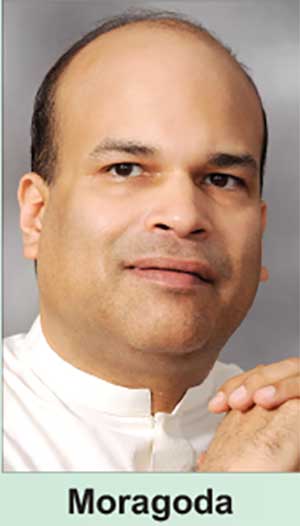
Milinda Moragoda, former Cabinet Minister and founder of the Pathfinder Foundation spoke about the need for Sri Lanka to be fast and agile in order to face the economic, social and international challenges of the Post-Covid environment.
He stated that: ‘there is no disputing the fact that the country benefited from having strong executive decision-making during the early stages of the pandemic. And as a result, many lives were saved.
Disappointingly, no major political party has yet put forward a coherent governance and governing structure for the nation in their policy platforms.
‘Each has been predictably very chameleon-like when addressing issues related to constitutional and governance-structure related matters in their manifestos. This is especially unfortunate in light of the dysfunctional relationship that now exists between the Executive and the Legislature and the proven potential for gridlock, both a result of the enactment of the 19th Amendment.’
Against this backdrop, without any coherent or credible proposals thus far having been presented by any major political party, Moragoda proposes that all thoughtful Sri Lankans take up the following points for their consideration, discussion and if appropriate advocacy :
A. The establishment of a strong Executive Presidency that can act decisively and yet be ultimately accountable to Parliament. After all, the presidency is the only office elected by all Sri Lankan voters. Thus, the individual occupying this post will be implicitly accountable to all citizens, be they from Kankesanturai or Dewinuwara.
B. An independent legislature that will promulgate legislation and act as a responsible check and balance to Executive excess. This legislature should be elected on a first-past-the-post basis with a small percentage of members being chosen through a proportional representation system.
This change should lead to a stable parliament where most members are directly accountable to their constituencies and citizens. The preference vote system which has only created chaos and in-fighting should be dispensed with.
C. The Provincial Councils should be abolished and empowered local councils set up to address the day-to-day issues of the citizenry.
D. An empowered Senate should be created to represent minority and regional interests.
Moragoda further pointed out that ‘Forty-two years have passed since the establishment of Sri Lanka’s Executive Presidency and that all those who criticize this form of government have still not been able to convince Sri Lankans of any better option. Notably, when the opportunity for abolishing the presidential system presented itself in 2015, the then government was unable or unwilling to conduct a referendum to abolish the presidency. And, as we are now on the verge of facing the most challenging period in our post-Independence history, the need of the hour is a strong executive.’
To lend further context to his point he noted that: ‘The first conception of a Presidential system was forged in the late 18th century after the American war of Independence against the British. Extensive debates surrounding the extent of the powers of an Executive Presidency took place during the drafting of the American Constitution. One of the founding fathers and authors of the US Constitution, Alexander Hamilton, argued for a strong Executive leader making the point that:
” ‘A feeble Executive implies a feeble execution of the government. A feeble execution is but another phrase for a bad execution, and a government ill-executed, whatever it may be in theory, must be, in practice, a bad government.’”
‘In the final analysis Sri Lanka cannot afford to have a crippled government especially at this critical juncture where a large number of lives and livelihoods are at stake.

Approval has been granted at the Cabinet meeting held on 22.07.2024 to publish the draft bill of State Assets Management Act in the government gazette notification and thereby present it to the Parliament for its concurrence.
However, the draft bill couldn’t be passed in Parliament as a result of the Parliament being dissolved in the month of October 2024.
Thereafter, the draft bill was subject to further inspection by a
committee appointed which comprised of officials and authorities on the subject.
The said Committee has recognized the amendments to be made and a fundamental draft has been prepared including the proposed amendments.
Accordingly, the Cabinet of Ministers approved the resolution furnished by the President in his capacity as the Minister of Finance, Planning and Economic Development to suspend further activities regarding the draft bill of State Assets Management Act published in the extraordinary gazette of 02.08.2024, and to direct the Legal Draftsman to prepare a draft bill based on the fundamental draft prepared by the subject specialists’ committee.
Considering the compliance of the Cooperative Societies’ operations with the concurrent socio – economic circumstances as well as the changes in the common law, the requirement of amending the Cooperative Employees Commission Act No. 12 of 1972 has been recognized.
A fundamental draft including proposed amendments based on the experience gained by that Commission as well as the opinions and proposals of Cooperative societies, their director board members, cooperative employees and other interested parties has been prepared.
Accordingly, the Cabinet of Ministers granted approval to the resolution furnished by the Minister of Trade, Commerce, Food Security and Cooperative development to provide instructions to the Legal draftsman to prepare a draft bill to amend the Cooperative Employees Commission Act No. 12 0f 1972, based on the said fundamental draft.
Latest News
Dilki Wathsala Marambage appointed as Director General of the Department of Technical Education and Training

The Cabinet of Ministers granted approval to the proposal forwarded by the Prime Minister in her capacity as the Minister of Education, Higher Education and Vocational Education to appoint Mrs. Dilki Wathsala Marambage to the post of Director General of the Department of Technical Education and Training.

Cabinet approves redrafting of State Assets Management Act
Cooperative Employees Commission Act No. 12 of 1972 to be amended
Dilki Wathsala Marambage appointed as Director General of the Department of Technical Education and Training
Declaration of Naakolagane Sanctuary under the Fauna and Flora Protection Ordinance
Cabinet approves transfer and maintenance of selected roads presently under PC’s and Local Authorities to the RDA
Obtaining financial facilities for the Water Supply and Sanitation Improvement Program (Sub-program 2) from the ADB

‘Dates have the highest sugar content to fight Coronavirus’

Sunday Island 27 December – Headlines

#SundayIsland 17th December – Headlines

Sunday Island – 28th March

Sunday Island Headlines – 21 March

Sunday Island – 21st February – Headlines
-

 Features6 days ago
The Sri Lankan who made Scottish history
-

 Sports6 days ago
Nissanka absence opens door for Sri Lanka’s young guns
-

 News5 days ago
NDB fraud Rs 60mn more than reported
-

 News7 days ago
Gnansara Thera to be assigned to prison printing section: Officials
-

 News5 days ago
Removing monk’s robes matter for Sangha to decide: Mahanayake Theras
-
 News7 days ago
OIC of FCID summoned before Maligakanda Magistrate
-

 Features6 days ago
Future of Sri Lanka’s state university system: Should it be shut down and reopened?
-
 News6 days ago
Shiranthi R remanded until 13 Oct.