
Features
The Absence of a Desired Image – a tour de force

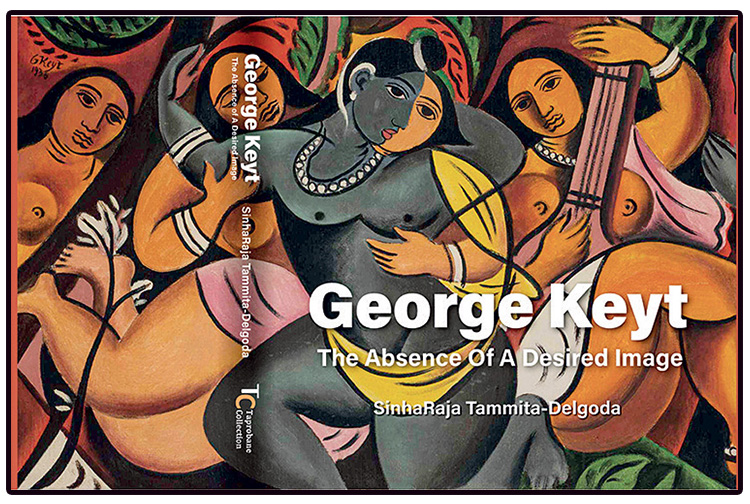
by Seneka Abeyratne
Dr SinhaRaja Tammita-Delgoda’s new art history book, “George Keyt – The Absence of a Desired Image,” provides fascinating insights into the life and work of Sri Lanka’s greatest artist. The book, published by the Taprobane Collection, is 464 pages long from cover to cover with the Appendices (expertly compiled by Uditha Devapriya) comprising about 90 pages. A hefty piece of non-fiction, it is skillfully crafted with meticulous attention paid to detail. Tammita Delgoda has produced a work of art – a tour de force that grips the reader and captures the imagination like an epic novel. Thanks to the author’s breezy writing style and great zest for story-telling, it moves at a brisk pace and takes us on an unforgettable journey. The book’s design is exquisite, especially in respect of the delicate interplay between stylish narrative and ravishing visual imagery.
The book could be viewed as a marvelous tapestry of the painter’s journey through life created by a master craftsman. We discover that not only was Keyt a great, self-taught artist but a brilliant poet, scholar, and linguist as well. How a single individual could excel in so many different fields is something to behold. Here was someone who danced ecstatically to the music of his soul.
Keyt died at the age of 92 and his life spanned all ten decades of the previous century. Though he was playful in his youth, he became a studious and serious-minded individual after leaving school. As The Absence of a Desired Image demonstrates, in terms of range and versatility, Keyt’s artistic and literary output was phenomenal. The book has 18 engrossing chapters plus a lucid Introduction that contains a compact literature review. It is worthwhile noting that several eminent authors have written books on George Keyt including the Indian art historian, critic and curator, Yasodhara Dalmia, whose book is entitled, Life and Times of George Keyt (2017).
Tammita-Delgoda does an excellent job in revealing the multifaceted nature of Keyt’s personality as well as his work. Though Keyt the painter is the central theme of his book, there are several sub-themes, such as Keyt the poet, Keyt the scholar, Keyt the writer, Keyt the translator, and Keyt the illustrator, which also receive close attention. Arguably, The Absence of a Desired Image goes further than any other book on Keyt in terms of weaving the man and his work into a composite whole.
An attractive feature of this weighty tome is that Keyt’s life is interwoven with Sri Lanka’s history, culture, and social fabric. We learn a great deal not only about Keyt’s family background and personal life, but also about how two great religions – Buddhism and Hinduism – influenced his work and his mindset. Keyt was a Burgher and so was his closest friend, Lionel Wendt – Sri Lanka’s greatest photographer. Accordingly, the book’s observations on and impressions of the Burgher community in the first half of the 20th century are highly pertinent to the overarching theme – Keyt the painter.
Because India and Keyt’s life were inextricably linked, the book provides a comprehensive account of how Indian culture influenced Keyt and vice versa. The adroit manner in which it captures the shades and nuances of this synergistic interaction is laudable. But if Keyt ultimately turned to cubism and gave it a distinct Sri Lankan flavor, it was largely due to the influence of Picasso, an artist that he deeply revered.
The focus of Chapter I is the impact that Sri Lanka’s transition from British colonial rule to self-rule had on Keyt’s life. “Confronted with the turmoil of Independent Sri Lanka, Keyt deliberately withdrew into a private world of idyllic romance, divine fantasy and literary symbolism.”
Chapter II contains a fine description of Keyt’s formative years at Trinity College, where students were encouraged to develop their creative, intellectual and artistic skills. Though Keyt never passed any exams, he did win the College Art Prize at age fourteen. And he began to read and write poetry.
In Chapter III we learn how Keyt began studying Buddhism and Pali after leaving school. The Keyt family lived near the Malwatte Vihara, overlooking Kandy Lake, and the scholar monk and poet, Ven. Pinnawela Dheerananda, became Keyt’s mentor.
Chapter IV tells us that when Keyt began to paint, his initial focus was the rhythms and routines of life in Buddhist temples. Meanwhile, he produced many essays and illustrations for various magazines. “His first major literary work was entitled Poetry from the Sinhalese (1938).”
Chapter V indicates that his career as an artist began to take off in his late twenties. “Keyt’s early paintings depicted the landscape and people of Kandy. Naturalistic and representative, they are very carefully structured and solidly organized …” If he was not painting, he was writing poetry. He published several poems in the 1930s, including Image in Absence.
The painter married Ruth Jansz in 1930 by whom he had two daughters. Though Ruth was a devoted wife and mother, Keyt was unfaithful to her, and their marriage broke down before the decade ended. He was in love with Lucia, his daughter’s nanny. Abandoning his family, he went to live with Lucia in her village, Pilawela. Lucia (also known as Pilawela Menike) took good care of him and bore him two sons. The couple relocated several times and eventually made Sirimalwatte (a village in Kandy) their home in 1950.
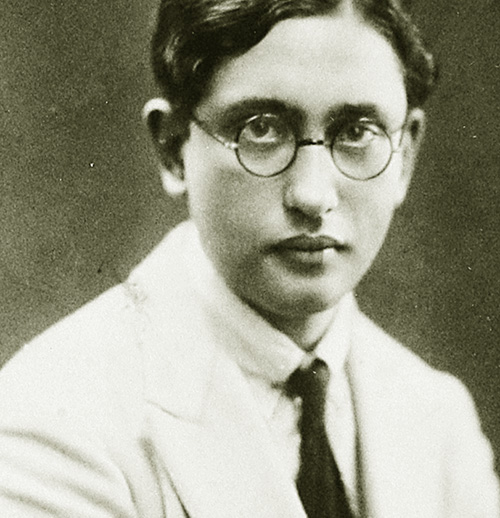
George Keyt
As explained in Chapter VI, “George Keyt was the first contemporary painter to derive inspiration from the wellspring of Sri Lanka’s ancient tradition.” By carefully studying the Sigiriya frescoes, he mastered the art of drawing the vaka deka, double curve. In the 1930s he began to abandon naturalism and representation in favor of the curving line. From then on, sweeping curves and counter curves became a prominent feature of his work. “Two women, painted during the 1930s, shows how integral the curving line was to Keyt’s work …”
The culture of Polonnaruwa during the Middle Ages was an amalgam of Buddhism and Hinduism and Keyt was profoundly influenced by the bronze images of Hindu deities produced by the cholas. “The heads of many of Keyt’s figures, both male and female, were inspired by the Polonnaruwa bronzes. Abstracted and sharply drawn, with their long faces, pointed noses and heavy lidded eyes, many of them resemble Shiva and Parvati.” Examples of Keyt’s paintings that demonstrate these stylized features are Nayika and The Flutist.
Keyt had in-depth knowledge of Kandyan Buddhist art. “Ian Goonetileke notes that the wall paintings of Kandy were a major factor in the artistic language which Keyt evolved for himself.” For example, Gotaimbara closely resembles a Kandyan mural in style, form and color scheme.
Chapter VII , written with verve and sensitivity, is about Keyt and his best friend – the pianist, photographer, critic and cinematographer, Lionel Wendt. If Wendt opened Keyt’s eyes to the world of modernism, Keyt introduced Wendt to the world of Kandyan dance.
Chapter VIII provides a cogent analysis of Keyt’s Kandyan village paintings such as Ploughing, Harvest, Man with Bull, Woman with Parasol, Fruit Seller in respect of style, form, color, and thematic content. It also elaborates upon Keyt’s fascination with Kandyan dance. “Over the years, Keyt became deeply versed in the arts and drumming. His essay, Kandyan Dancing (1953), provides a comprehensive introduction to the world of Sinhala dance.”
As elucidated in Chapter IX, it was through the books, journals and magazines that Lionel Wendt shared with Keyt that the latter discovered modernism. Of these, the most important was Cahiers d’Art, which showcased the work of leading European modern artists. “Keyt’s discovery of cubism caused him to discard the art of representation. By the 1930s his style had changed. Like Picasso, he combined distortion with bold outline. Using crisp, heavy lines, he made the continuing line a defining feature, merging and fusing figures together.” The influence of other European modern artists such as Léger, Braque, Derain and Matisse can also be observed in his work. For example, Matisse’s Odalisque (1920-21) inspired Keyt to paint Reclining Woman almost fifty years later.
Chapter X provides useful information on the formation of the Ceylon Society of Arts as well as the 1943 Group consisting of prominent artists excluded by the Ceylon Society, including Ivan Peries, George Keyt, Justin Daraniyagala, and Harry Peiris. The idea for the establishment of this Group came from Ivan Peries and was executed by Lionel Wendt. “The 43 Group became Asia’s first modern art movement. For Lionel Wendt it was a great moment of fulfillment which embodied the climax of his artistic career …”
From Chapter XI we learn the 43 Group became famous due to its authentic blend of traditional forms with modern Western influence. “In the years which followed Independence, the 43 Group held a series of regular exhibitions which gradually established modern art in Sri Lanka. By the early fifties, the 43 Group was winning international acclaim and showing its work in Europe.” Keyt’s good friend, Ian Goonetileke (a well-known scholar and bibliographer,), observed that though the core members of the 43 Group were highly gifted, they were not genuinely rooted in their culture, which is why the Group disintegrated in the late sixties. But as this book points out, the only exception was George Keyt.
“Crossing the boundaries of alienation, Keyt was able to find a new truth and forge a relationship with his environment. This endowed his work with the enduring relevance which exists to this day.”
Chapter XII provides a fascinating account of how Keyt became more and more “Indian” in respect of his mindset as well as his art. After his first visit to India in 1939, he kept going back. In 2021 Tammita-Delgoda interviewed Keyt’s elder daughter, Diana Keyt, who said: “Once he went to India, he changed and converted to Hinduism. He became a follower of Krishna. Hinduism came to exercise a bigger influence on him. In the end it won over Buddhism.” The painter lived in India from 1946 to 1949.
Ratikeli is a fine example of a Keyt painting inspired by Hindu mythology. The two great Sanskrit epics, the Ramayana and the Mahabarata, also had a profound impact on his work. This chapter demonstrates with the assistance of drawings and paintings the significant extent to which the painter was also inspired by Indian art, sculpture, music, and dancing.
One of the most nostalgic sections in this book is Chapter XIII, where the Indian factor continues to receive attention. Keyt’s circle of friends during his three-year stay in India (1946-49) included Mulk Raj Anand, Minette de Silva, and her sister Marcia (Anil). From 1946 to 1948, Anil was the assistant editor and Minette, the architectural editor of Marg. During this time Lionel Wendt, Geoge Keyt, and the 43 Group as a whole figured prominently in this prestigious magazine.
The trio (Anand and the de Silva sisters) were the chief organizers of Keyt’s first ever solo international exhibition at the Convocation Hall in Bombay in 1947. The exhibition, which featured 64 paintings as well as a comprehensive catalogue, was lauded by both Indian and foreign critics. “What resonated most was the way in which Keyt had absorbed and depicted the Indian heritage.” According to his biographer, Martin Russel (as per his book, George Keyt) as well as the art historian William Archer (as per his book, India and Modern Art), Keyt’s contribution to the evolution of modern art in India was seminal. (Both authors, by the way, were British.)
In 1947 Keyt published an illustrated version of Gita Govinda, an epic poem recounting the loves of Radha and Krishna which he had rendered from the Sanskrit. “Directly linked to Keyt’s portrayal of love, it became the subject for some of his most powerful erotic paintings.” A notable example, in this regard, is Rasa Lila, the Dance of Divine Love. Keyt, incidentally, had a passionate affair with one Barbara Smith – “an attractive and sophisticated woman of Anglo-Indian descent.” A well-known editor with the Oxford University Press, she was based in Bombay.
As per Chapter XIV, the exhibition at the Convocation Hall opened many other doors for this preeminent Sri Lankan artist. His solo exhibition in New Delhi in 1952, which featured 72 paintings, was a great success. “In the years since Bombay, Keyt’s work had become embedded in the Indian consciousness. In new Delhi he was hailed as a product of the Indian tradition.” Mulk Raj Anand’s The Story of India (1948) and well as A.S. Raman’s Tales from Indian Mythology (1961) were illustrated by Keyt. We note that though the two authors were Indian, the illustrator was Sri Lankan.
In Chapter XV we return to Sirimalwatte and to Keyt’s work based on rural life and Sinhalese traditions, culture and folklore. “In much the same way as he had done with his great murals at the Gotami Vihare, Keyt brought the classical inheritance of the country in visual form.” The use of acrylics from the seventies onwards made his colors much brighter and augmented the decorative beauty of his paintings.
During the second half of the 20th century his paintings found buyers in every part of the world and his work was featured in numerous foreign journals, magazines, and newspapers. “He had become famous, a national and international celebrity.” He held several solo exhibitions in Sri Lanka and India and three in London as well. In 1977 he was honored with a special Felicitation Volume to mark his 75th birthday and in 1988, the George Keyt Foundation was established to promote and publicize his work.
We note from Chapters XVI and XVII that female nudity, lesbianism, and unbridled sexuality are the central, interlocking themes in a significant number of Keyt’s paintings. “At the core of his treatment is the line and curve. Key’s mastery of the curving line enables him to create sweeping, all engrossing curves which capture the lush sexuality of a woman’s body. With the curve as his foundation, Keyt combines line with rhythm, evolving a rhythmic line of his very own.” In this regard, Lovers – an acrylic painting depicting a lesbian couple – is one of his most stylish works.
Chapter XVIII, the most poignant section in the book, is where we learn that Keyt eventually left his second wife for a young Indian woman, Kusum Narayan, whom he married in 1973 by converting to Islam. The couple actually stayed in Sirimalwatte for a while before moving to the Western Province. The cities they lived in included Nugegoda and Galle. In 1992, they returned to Sirimalwatte and Pinawela Menike graciously accepted them. Keyt’s health began to deteriorate and his life came to an end in July 1993. This great modern artist, who was fondly known as the Asian Picasso, was so highly regarded in his homeland that he was given a state funeral in Colombo.
The Appendices are breathtaking, especially the Plates section where paintings, drawings and other works by Keyt are featured for the first time in any formal publication. It is truly the icing on the cake.
“George Keyt: Absence of a Desired Image” is available for sale at leading bookstores across the country. For details on direct purchases of the book, you can contact the publishers, Taprobane Collection, at shamilp54@gmail.com.


 US Secretary of State Marco Rubio’s warning to the International Criminal Court (ICC) was stark: ‘Either the ICC will end its threats, or we will end the ICC.’ It followed US central administration accusations that the court was unfairly targeting Americans on the basis of trumped-up war crimes charges.
However, a new plethora of sanctions has been clamped on the ICC by the US, which in turn has spurred accusations by sections of the world that the latter has unleashed an ‘assault’ on the international legal order.
What some of the sanctions would mean for the ICC was outlined by Rubio: ‘We will ban transactions with this rogue court, cutting off their resources and crippling their ability to operate against us.’
The ICC has shown consistency of purpose over the years. Despite some operational constraints it has indicted a large number of political strongmen from around the world, accused of war crimes and other governance excesses that come under its purview. Two such recent figures are: Russian President Vladimir Putin and Israeli Prime Minister Benjamin Netanyahu.
Rather than enjoy a mere nominal presence in the world community, the ICC has proved its effectiveness by detaining and bringing to justice scores of VIP politicians and others of their ilk who have been found guilty of human rights abuses and kindred excesses that come within the terms of reference of the ICC.
Accordingly, the international justice system would be stymied considerably as a result of the ICC being dis-empowered, particularly financially. Needless to say, potential and real perpetrators of the species of crime coming under the jurisdiction of the ICC would stand to gain most from such anarchic tendencies. That is, political repression globally would be enabled to enjoy a new lease of life.
A detailing of the types of crime coming under the purview of the ICC provides an idea of what it would cost the international community if the ICC’s operations are gravely hampered. They are mainly: genocide, war crimes, crimes against humanity and the crime of aggression.
That is, the part of the world to be worst affected would be the global South, since the latter is awash with the mentioned crimes. Needless to say, a chronically-disaffected South will sooner rather than later undermine the well being of the world dangerously. The world is already being put through these paces.
At the time of writing, ‘illegal migrants’ from the South, for example, are aggravating many a Western economy’s woes, besides creating for them acute law and order issues. The fact that these migrants’ presence goes on to become a virtual test of the migrant receiving states’ ability to forge domestic social inclusion in the face of jingoistic protests by mainly white supremacist groups is evidence of the latter. As is known, the US, to take just one example, has been up against this crisis for quite a while.
Accordingly, it will be in the best interests of the West if ‘illegal’ migrant arrivals on their shores are stemmed. If the socio-political and economic problems assailing the South are effectively managed through North-South collaborative, ‘trouble-shooting’ efforts the causes leading to ‘illegal’ migration and connected issues could be resolved at source as it were. For, it is the aggravation of the South’s material questions that lays the basis for the emergence of repressive and anti-democratic regimes in the hemisphere.
Until such time that the aforementioned issues in North-South relations are visited afresh and addressed urgently, a vibrantly functioning ICC would be needed. For, the latter would prove a deterrent to Southern political and military strongmen, highly prone to power abuse and like excesses, from coming into being in the wake of the South’s chronic material woes and the wars and conflicts that result from them.
It stands to reason then that the US would be acting in its own interests by enabling the ICC to perpetuate its mandate without hindrance. For a crop of issues that impinges negatively on internal law and order would be defused.
Meanwhile, there needs to be a meeting of minds among the rest of the West to put back in place a North-South dialogue process aimed at reducing some of the economic pressures that are weighing on the South.
Since economics usually drives politics it will be in the interests of the world community to scrutinizingly re-visit North-South issues of the past and put in place economic relief packages for Southern publics that would enable them to tide over their material hardships rather than permit the latter to aggravate into social disaffection and eventually armed militancy. It is the latter juncture that paves the way for the emergence of authoritarian rulers in the South who then go on to be a blight on their publics.
Accordingly, the Southern-based global development thinking of the past that envisaged a more equitable world economic order needs to be seen as an urgent need. That is, NAM’s international development paradigms need to be resuscitated to the extent possible.
It is unlikely that rightist governments of the West, such as the current Republican administration in the US, would find these projects feasible, but democratic states of Europe, led by perhaps the UK, are likely to think otherwise. For it would not be beneficial for the democratic world to be having on their hands repressive governments in the South who would be gravitating towards the major military and economic actors of the South, such as Iran and North Korea, who tend to be in constant power struggles with the West.
However, until such time that the mentioned, pro-people initiatives are given serious thought the ICC would need to be enabled by the international community to be in place comfortably and carry on with its mandate of bringing repressive rulers to book. Besides the ICC should pave the way for the peoples of the developing world to enjoy some substantial respite from the political repression and even terror which tend to be their lot.
Meanwhile, the wars of West Asia are relentlessly aggravating the economic hardships of people everywhere, driving the point home to enlightened sections that there is no alternative to peacemaking. A challenge is to convert the US under President Trump to this line of thinking.

 This week, I give you five simple, time-tested homemade remedies that help reduce the appearance of blemishes, control excess shine and leave your skin feeling softer and smoother.
The Honey and Lemon Brightening Dab:
For stubborn blemish marks, this is a classic. Mix one teaspoon of pure bee honey with three to four drops of fresh lemon juice. Apply gently, only on the affected spots, and leave for 10 minutes before rinsing with lukewarm water. While honey soothes and softens, lemon helps to brighten naturally. Use twice a week in the evening.
Besan and Rose Water Oil-Control Pack:
An ideal remedy to combat shine, especially on the T-zone. Take two teaspoons of besan (gram flour) and mix with sufficient rose water to form a smooth paste. Add a pinch of turmeric for its antiseptic goodness. Apply evenly, keep for 15 minutes and wash off. It absorbs excess oil without over-drying, leaving a beautiful matte finish.
Aloe Vera and Cucumber Ice Soother:
Blend fresh aloe vera gel with the juice of a grated cucumber and freeze the mixture in an ice tray. Each morning, wrap one cube in a soft muslin cloth and gently rub over a cleansed face for 30 seconds. It calms, tightens pores and imparts a baby-soft smoothness.
Oatmeal and Curd Gentle Polish:
Roughness and old blemish marks need gentle exfoliation. Combine one tablespoon of finely powdered oatmeal with one tablespoon of fresh curd (yoghurt). Massage very gently, in circular motions, for one minute, leave for five minutes and rinse. It removes dead cells and unveils softer, clearer skin.
Multani Mitti and Green Tea Magic Mask:
Brew some green tea and allow it to cool completely. Mix one and a half teaspoons of Multani Mitti (Fuller’s Earth) with the tea water to make a fine paste. Apply for 10 to 12 minutes – do not let it dry and crack completely – and wash off. It draws out impurities, fades blemishes and bestows a fresh, shine-free glow.
A Gentle Reminder:
As with any natural remedy, always do a patch test on your inner arm first. For those with oily or combination skin, avoid heavy coconut oil application and harsh scrubbing, as they tend to aggravate shine and blemishes.

 Dream of performing on a world stage? Well, here is your unique, golden opportunity!
The World Championships of Performing Arts (WCOPA) — the one and only official “Talent Olympics” — is the world’s premier global platform for aspiring singers, dancers, actors, models, instrumentalists, etc., to compete, shine and be discovered!
And, yes, this world stage is open to YOU, Sri Lankans living in Sri Lanka and overseas!
Held annually in glittering Las Vegas, WCOPA brings together over 70 countries, all competing for Gold, Silver and Bronze Medals, just like the traditional Olympics.

Lakisha Bernard: Will represent Team Sri Lanka at WCOPA 2027
Outstanding performers vie for the coveted titles of Junior and Senior Grand Champion Performer of the World, with winners and standout participants awarded over $500,000 in scholarships, cash awards and prizes to catapult their education and careers!
Sri Lanka is already making waves! At WCOPA 2026, Natharie Wickramasinghe, representing Team Sri Lanka, made the nation proud by winning a Bronze Medal in the Ethnic/Folklore Dance category!

Lakisha: Accomplished freelance Model and Fashion Design graduate
Recruitment for this prestigious competition is handled through a system of scouts and licensed National Directors — and this is where our very own Chris Rajendra, now based in Las Vegas, and National Director for Team Sri Lanka, comes into the scene.
If you are a singer, dancer, actor, model, instrumentalist — if you have talent burning inside you — contact Chris Rajendra today for registration and, who knows, you may find yourself in Las Vegas, and proudly draped in the Sri Lankan flag, at WCOPA 2027!
The contact address is: Chris Rajendra, wcopa.nationaldirector.sl@gmail.com
or chris.rajendra@gmail.com
Meanwhile, a star is born for 2027, in the form of Lakisha Bernard who is all set to represent Team Sri Lanka at WCOPA 2027.
Originally hailing from the sun-drenched coastal city of Colombo and now carving out her creative career in Canada, 22-year-old Lakisha is stepping into the international spotlight.
This accomplished freelance Model and Fashion Design graduate has officially been appointed as the Team Sri Lanka Promoter for Canada as she prepares to represent Team Sri Lanka at WCOPA in Las Vegas.
Lakisha brings a unique blend of high-fashion sensibility, captivating camera presence and expert garment design to the Team.
Having built her career, from local college shoots to high-glamour concepts, Lakisha’s inspiring journey embodies the true spirit of cultural bridge-building and creative resilience, bringing immense pride and recognition to Sri Lanka on the global stage.
WCOPA 2027 will be held at the legendary Westgate Hotel & Casino, Las Vegas, from 12th to 20th July – the very same iconic arena where the late, great Elvis Presley himself performed!
Your moment is now. Your stage is Las Vegas, so hurry and contact Chris Rajendra.

Showers or thundershowers will occur at most parts of the island

Prison rules to be revised over monks’ attire

AC President recuses himself from hearing prison attire case pertaining to Gnanasara Thera

Court orders steps to obtain INTERPOL Red Notice against Basil

CID informs Fort Magistrate’s Court investigation into money laundering case against Namal completed

No force used to make Gnanasara Thera wear prison garb – Prisons

‘Dates have the highest sugar content to fight Coronavirus’

Sunday Island 27 December – Headlines

#SundayIsland 17th December – Headlines

Sunday Island – 28th March

Sunday Island Headlines – 21 March

Sunday Island – 21st February – Headlines
-

 News6 days ago
NDB fraud Rs 60mn more than reported
-

 News6 days ago
Removing monk’s robes matter for Sangha to decide: Mahanayake Theras
-

 News4 days ago
Sri Lanka escalates anti-graft drive with Shiranthi’s jailing
-

 News5 days ago
NPP govt. reminded of its responsibilities as US warship leaves Colombo
-

 Latest News5 days ago
Farhan, Sadaqat help Pakistan ace 183 chase to go 1-0 up
-

 News6 days ago
BHC, Colombo: “LTTE remains a proscribed org. in the UK”
-

 Latest News3 days ago
Farhan and Sadaqat help Pakistan seal series in style
-

 News4 days ago
Iranian ships stranded, Lanka fears US sanctions