
Foreign News
Thai court dissolves reformist party that won election


A Thai court has ordered the dissolution of the reformist party which won the most seats and votes in last year’s election – but was blocked from forming a government.
The ruling also banned Move Forward’s charismatic, young former leader Pita Limjaroenrat and 10 other senior figures from politics for 10 years.
The verdict from the Constitutional Court was expected, after its ruling in January that Move Forward’s campaign promise to change royal defamation laws was unconstitutional.
The court had said changes to the notoriously harsh lese majeste law was tantamount to calling for the destruction of the constitutional monarchy.
Wednesday’s verdict again serves as a stark reminder of how far unelected institutions are willing to go to preserve the power and status of the monarchy. But the ruling does not mean an end to the reformist movement in Thai politics.
The surviving 142 Move Forward MPs are expected to transfer to another registered party and continue their role as the main opposition in parliament.
“A new journey has begun. Let’s keep walking together, people,” the party said in a message accompanied by a video on its social media platforms.
Chaithawat Tulathon, the leader of the opposition and one of the MPs barred from politics, stood up in the chamber and bid farewell to his colleagues, saying it was an “honor” to work with them.
This verdict “may raise the question whether Thailand is a constitutional monarchy or an absolute monarchy”, said Thitinan Pongsudhirak, professor of political science at Chulalongkorn University.
He said it was “deja vu on one hand, and uncharted territory, on the other”.
This is more or less a repeat of what happened in 2020 when the then Future Forward Party, which had also done unexpectedly well in an election, was also dissolved, and transformed itself into the Move Forward Party.
That verdict four years ago ignited huge street protests, led by a new generation of student activists, which lasted for six months and voiced unprecedented demands for the monarchy to be made more accountable.
The authorities have since made extensive use of the lese majeste law to prosecute hundreds of protest leaders, including some Move Forward MPs.
The law has been widely criticised as stifling freedom of expression in Thailand, and in its manifesto Move Forward had proposed less severe punishments – jail sentences have been as high as 50 years – and a more rigorous process for filing charges.
Fears among reformists that Move Forward would not do as well in last year’s election as Future Forward had in 2019 proved unfounded.
The party defied expectations to outperform every other party and become the largest in parliament, revealing a strong yearning for change among Thai voters.
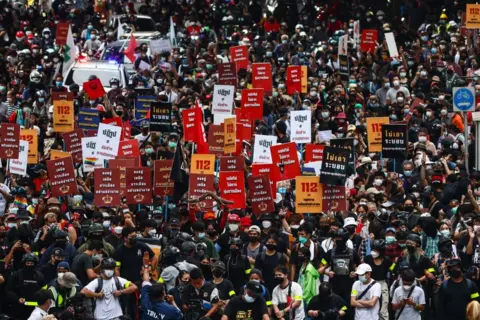
However, the military-appointed senate blocked Move Forward from forming a government over its lese majeste proposals, allowing a 11-party coalition of more conservative parties to take power instead.
With so many activists in jail, in exile or fighting criminal charges the large-scale protests seen back in 2020 are much less likely today.
Even Move Forward’s very mild proposals for a less severe lese majeste law have led to the party being stripped of its top leaders, just as its previous incarnation Future Forward was four years ago.
And anyone thinking of organising protests similar to those four years ago will know that they too will be subjected to the tough penalties of lese majeste and several other sweeping laws in the Thai criminal code.
Thailand’s constitutional court, which has dissolved 34 parties since 2006, has long been the principle guardian of the conservative status quo – at its heart is the monarchy, protected by a politically-assertive military. Beyond that, unaccountable power is wielded by palace officials, senior judges, business tycoons, and military and police officers.
Under the military-drafted constitution the senate has a decisive role in the appointment of constitutional court judges, and over the composition of other influential extra-parliamentary bodies like the Election Commission and the National Anti-Corruption Commission.
The previous senate was appointed by the military junta which ruled Thailand from 2014 to 2019, and rewrote the political landscape in which parties have to operate today. It played the central role in blocking Move Forward from forming a government.
It was unclear what to expect from the new senate this year – but the peculiar election system allows only those seeking a seat in the senate to vote for the candidates in several rounds. That, and some murky backroom dealing, have produced a new 200-seat senate, most of whom appear to be linked to a party known for its uncompromising loyalty to the monarchy.
[BBC]


A court in Malta has acquitted businessman Yorgen Fenech of masterminding the murder of prominent anti-corruption journalist Daphne Caruana Galizia.
Fenech, 44, was acquitted on Wednesday at the end of a jury trial. He had been tried on charges of complicity to murder and for the lesser charge of criminal association to commit murder.
If found guilty, Fenech could have faced life in prison.
Caruana Galizia’s family were seen weeping in the packed courtroom in Valletta after the businessman was cleared of both counts by an 8-1 margin following eight hours of deliberation by the jury.
“Nine years after Daphne’s brutal assassination, the institutional failures that enabled her murder remain unaddressed and unreformed,” the slain reporter’s family said in a statement.
“Lasting justice means no person should ever face the same risks again. Our country failed to protect Daphne’s life. It owes it to her to prevent other lives being lost.”
Fenech’s family members were seen celebrating the jury’s decision.
The killing of Caruana Galizia in October 2017 shocked Europe’s journalist community and set off a political firestorm in Malta, focusing international attention on its police and judiciary.
Dubbed a “one-woman WikiLeaks”, Caruana Galizia had exposed corruption at the highest level in the Mediterranean island country, shining a spotlight on links between Malta’s business and political elites. She was 53 when she was killed.
Prosecutors argued that Fenech had wanted Caruana Galizia killed because she was about to reveal information about him.
Fenech has denied the accusations. His defence instead pointed fingers at his one-time friend Keith Schembri, the former chief of staff of then-Prime Minister Joseph Muscat and a target of Caruana Galizia’s blogs.
Muscat, who was never linked to the murder, stepped down in January 2020 due to the political fallout from the assassination.
Police told the court that Schembri had never been a suspect. He has denied any role in the murder.
An independent inquiry in 2021 found that officials in Malta had failed to protect Caruana Galizia from threats to her life before her death.
[Aljazeera]

A head teacher’s quick decision to evacuate his school saved 900 pupils from deadly flash floods along the Nepal-Tibet border
Rajendra Dawadi tells the BBC he was tipped off about incoming flood waters and moved students to higher ground with just minutes to spare. One pupil says she and her friends survived by just 10 seconds and watched as a nearby bazaar was swept away
Wednesday’s disaster has killed at least 794 people and more than 2,500 people are missing in Nepal, local officials say
In Tibet, the official death toll is 16, with 546 reported to be missing, according to Chinese state media –
[BBC]

A ferry carrying around 260 people has capsized off the coast of northern Cyprus with a search underway for survivors, according to local media.
The catamaran-style boat was travelling from the port of Kyrenia, also known as Girne, and started sinking a few kilometres off the coast of the island state on Sunday.
There were no immediate reports of casualties.
[Aljazeera]

Afghanistan to host Zimbabwe, Bangladesh in ODI tri-series

Sandhu’s 6 for 7 seals Pakistan’s semi-final spot

INS Udaygiri makes port call in Colombo

Showers in the Uva, Central and Eastern provinces and in Polonnaruwa district

22A: Exclusion of 8 petitions questioned, action filed against SC Registrar, others

Thailand shuts door on undesirables from Sri Lanka

‘Dates have the highest sugar content to fight Coronavirus’

Sunday Island 27 December – Headlines

#SundayIsland 17th December – Headlines

Sunday Island – 28th March

Sunday Island Headlines – 21 March

Sunday Island – 21st February – Headlines
-

 News6 days ago
Denied of promotion to SC despite vacancies, justice Gurusinghe retires
-

 Latest News6 days ago
Grade 5 scholarship exam results released
-

 News6 days ago
22A: SC urged to suspend hearing, appoint full bench
-

 Midweek Review7 days ago
The local and global dynamics of Sri Lanka’s 22nd Amendment
-

 News4 days ago
Namal remanded until Sept. 18 over Airbus deal investigation
-

 Latest News3 days ago
Tharanga creates history with Diamond League crown in Brussels
-

 News6 days ago
Govt. seeks NATO assistance
-

 News7 days ago
40 professional organisations and TU oppose proposed 22A