
Features
Teaching Sri Lanka’s 2009 UNHRC Geneva Win: The Barcelona Lecture

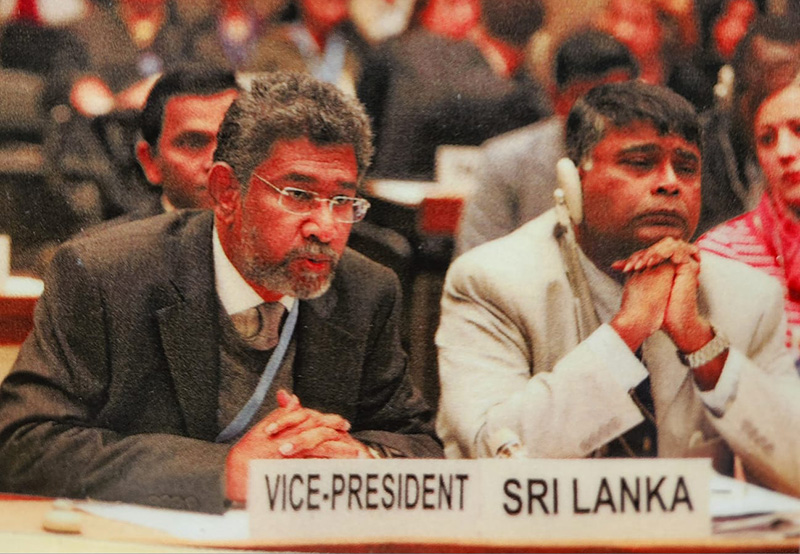
With the discussion on Sri Lanka and the UNHRC resurfacing this year, the singularity of Geneva 2009 and Sri Lanka’s decisive victory has been noted in Parliament by the Leader of the Opposition.
Though no Lankan institution ever asked me to explain that 2009 outcome, it has figured amply in international scholarly literature.
When I served as Ambassador to France, Spain and Portugal, the prestigious Barcelona Institute for International Relations (IBEI), Spain, invited me to deliver a lecture on the topic in May 2012, the third anniversary of the 2009 outcome. I readily agreed, given that Prof Fred Halliday, Emeritus Professor of International Relations at the LSE and iconic Marxist scholar had spent the last five years of his life as Research Professor at IBEI.
My lecture was chaired by Prof Robert Kissack, Co-ordinator of the MA programme, former student of Prof Halliday at the LSE and his successor at IBEI. A discussant was Dr Margarita Petrova, whose specialization is ‘The Politics of Norm Creation’. Her doctoral dissertation won the American Political Science Association’s Prize for best dissertation in International Relations (2008).
I thought it appropriate to publish the text/transcript of my lecture in a Sri Lankan newspaper because it reconstructs context and conceptual underpinnings of the strategy that succeeded—exceptionally, as it turns out.
The Barcelona Lecture, May 24th 2012
I am especially glad to be here because I knew that one of my intellectual heroes from my early teens, Prof. Fred Halliday, spent many years here and was very fond of this place. I am gratified that Prof Robert Kissack who invited me and is chairing this lecture was a protégé and colleague of his.
As you would have gathered from Dr Kissack’s introduction, I am not a career diplomat. Now that usually is a disclaimer but in my case it means that I am more responsible for what I have done — and not done –as a diplomat than a career diplomat would be. I cannot use the usual cop-out and say I was only following orders. Therefore, I was far more vulnerable to the kind of questions and criticisms that you may ask, and I welcome them because I wrestle with these issues everyday myself as well, as an academic and as a former political activist.
Few things are as difficult as meeting the test of objectivity when discussing a significant event or process in which one played a frontline role. A fairly safe method is to commence with assessments of that event, process and role made by sources which were critical or hostile. While these may not themselves be objective, at least their subjectivity would err on the other side and therefore constitute a litmus test of sorts.
Outside of purely partisan ethnic propaganda, the most serious negative account of Sri Lanka’s war and the conduct of the Sri Lankan state is the solidly researched, well written, intelligent and readable book, The Cage by Gordon Weiss. It contains an entire chapter, 30 pages long, on the international and diplomatic dimension of the conflict’s closing stages (Ch 9: The Watching World). That it does so confirms that diplomacy was an important arena of struggle and contradicts the conception of diplomacy as mood setting Muzak for making nice.
Weiss focuses on the UN in two theatres, New York and Geneva. In an earlier chapter he makes clear the situation in New York:
“As the situation unfolded, the positions of China, Russia and India became clear. There would be no resolution from the UN Security Council warning Sri Lanka to restrain its forces. China and Russia, with separatist movements of their own would veto any motion within the Council. India struck a pose of outward ambivalence, even as it discreetly encouraged the Sri Lankan onslaught, though urging it to limit civilian casualties. But of the veto-wielding ‘perm five’ in the Security Council, it was China…which was the largest stumbling block” (pp.139-140)
“In the halls of the UN in New York, Mexico, which held one of the rotating Security Council seats, tried to have Sri Lanka formally placed on the agenda. While Western and democratic nations broadly lined up in support, it quickly became clear that China would block moves to have the council consider Sri Lanka’s actions….The possibility of an influential Security Council resolution remained distant…Sri Lanka had deftly played its China card and had trumped.” (pp 200-201)
Thus, at the UN New York, Sri Lanka was structurally safe, and in Weiss’ book, its diplomats in that theatre at that time, remain unnamed. The UN Geneva is brought to life rather differently in Weiss’ volume:
“On 27 May at the Palais des nations in Geneva, the UN High Commissioner for Human Rights, Navanethem Pillay, addressed the Human Rights Council and called for an international inquiry into the conduct of both parties to the war. While the EU and a brace of other countries formulated and then moved a resolution in support of Pillay’s call, a majority of countries on the Council rejected it out of hand. Instead, they adopted an alternative motion framed by Sri Lanka’s representatives praising the Sri Lankan government for its victory over the Tigers…” (p229)
In his concluding chapter Weiss describes my role:
“Dayan Jayatilleka, one of the most capable diplomats appointed by the Rajapaksa regime, had outmanoeuvred Western diplomats to help Sri Lanka escape censure from the UN Human Rights Council in Geneva (p256)”.
In his Notes he makes this evaluation: “Jayatilleka was the most lucid of the vocal Government of Sri Lanka representatives…” (p 330)
Gordon Weiss is not the only critical source available to the student of international relations for the objective understanding of Geneva 2009. Some of it is in Wikileaks, cables going not only from Geneva to Washington and back but even from cable traffic from the US Embassy in France and conversations between Ambassador Susan Rice and UN Human Rights High Commissioner Navi Pillay.
Here’s an observation about Geneva 2009, made by the international award-winning journalist and author Nirupama Subramanian:
“As Sri Lanka mulls over last month’s United Nations Human Rights Council resolution, it may look back with nostalgia at its 2009 triumph at Geneva. Then, barely a week after its victory over the LTTE, a group of western countries wanted a resolution passed against Sri Lanka for the civilian deaths and other alleged rights violations by the army during the last stages of the operation. With the blood on the battlefield not still dry, Sri Lanka managed to snatch victory from the jaws of diplomatic defeat, with a resolution that praised the government for its humane handling of civilians and asserted faith in its abilities to bring about reconciliation.” (The Hindu)
There has also been some academic research and publication. The most interesting is a piece which helps advanced students of international relations understand the deeper dimension and wider ramifications—far wider than Sri Lanka—of the battles in UN forums including most notably the May 2009 Special session. This essay talks about a clash on norms which took place in the UN Human Rights Council over the Sri Lankan issue and that the Sri Lankan diplomats played a role of ‘norm entrepreneurs’.
Research scholar David Lewis presented a paper at the University of Edinburgh, entitled ‘The failure of a liberal peace: Sri Lanka’s counterinsurgency in global perspective’, and published in Conflict, Security & Development, 2010, Vol 10:5, pp 647-671. Lewis is Senior Research Fellow at the Centre for International Co-operation and Security in the Department of Peace Studies, University of Bradford, and headed the International Crisis Group’s Sri Lanka programme in 2006-7. He writes:
“Many of the battles over conflict-related norms between Sri Lanka and Europe took place in UN institutions, primarily the Human Rights Council (HRC)…it was Sri Lanka which generally had the best of these diplomatic battles…”
“Although this process of contestation reflects shifting power relations, and the increasing influence of China, Russia and other ‘Rising Powers’, it does not mean that small states are simply the passive recipients of norms created and contested by others. In fact, Sri Lankan diplomats have been active norm entrepreneurs in their own right, making significant efforts to develop alternative norms of conflict management, linking for example Chechnya and Sri Lanka in a discourse of state-centric peace enforcement. They have played a leading role in UN forums such as the UN HRC, where Sri Lankan delegates have helped ensure that the HRC has become an arena, not so much for the promotion of the liberal norms around which it was designed, but as a space in which such norms are contested, rejected or adapted in unexpected ways…”
“As a member of the UN HRC Sri Lanka has played an important role in asserting new, adapted norms opposing both secession and autonomy as possible elements in peace-building—trends that are convergent with views expressed by China, Russia and India…”
“The Sri Lankan conflict may be seen as the beginning of a new international consensus about conflict management, in which sovereignty and non-interference norms are reasserted, backed not only by Russia and China but also by democratic states such as Brazil.” (Lewis: 2010, pp. 658-661)
So, there we have it; that’s the story as seen by critical observer-analysts.
The backdrop of the special session of the UN Human Rights Council in 2009 was emotionally as highly charged as you can possibly imagine. The long Sri Lankan war was reaching its endgame, but what would that endgame be?
There was a lot of pressure not only from the Tamil Diaspora communities from the émigrés but also the liberal humanitarian view that there would be a blood bath which had to be stopped by a humanitarian intervention. It took the formula of a ‘humanitarian pause’. Lakhdar Brahimi and Chris Patten had written a piece in the New York Times about the imminent “bloodbath on the beach”. The EU Parliament was pushing a resolution for a ‘humanitarian pause’ and the resumption of negotiations with the Tigers. This was the template for the resolution that was planned for the UN Human Rights Council.
A very serious special session of the sort that was held years later on Syria or Libya in the UN Human Rights Council, was sought to be held. This required 16 signatures. The Sri Lankan team together with our friends and allies in the Non-Aligned Movement, in the South Asian Association for Regional Cooperation (SAARC) etc., fought a bitter rearguard action to prevent the 16 signatures’ requisite for the holding of a special session and managed to hold it back while the war was on. I was fully conscious of what we were doing in fighting hard to hold back the 16 signatures from being obtained so that a special session could not be moved in which there could have been a UN mandated call for a ‘pause’ on what would be the final attack on the Tigers.
Shortly after that the war was over on the 18th-19th of May 2009, the last signature was obtained. The EU was one signature short for 10 days and then it got that signature and then the session moved on at full speed. Instead of waiting for the EU resolution to be tabled and voted on, Sri Lanka together with the Non-Aligned Movement seized the initiative. We presented a resolution of our own. The special session was held on the 26th-27th May 2009 and it went down to a vote. Because of the nature of the counter-resolution that we crafted together with the Non-Aligned Movement, we obtained almost a two-thirds majority of the UN Human Rights Council.
In a search for a synthesis of values, our resolution actually contained quite a few of the points made by the EU resolution, i.e. everything that was unobjectionable, that was progressive, that was generally liberal in the EU’s resolution. It is the defence of sovereignty, but a national or state sovereignty invested with a commitment to popular sovereignty, that enabled us to obtain the support that we did and to defeat the resolution against us.
The battle of norms was not simply the liberal humanitarian interventionism versus a simple reiteration of national sovereignty. Rather, it was the kind of ideology that you would find Brazil, India, Indonesia, the emergent democracies, very comfortable with: a strong defense of national sovereignty but no less strong commitment to progressive reform.
It was indeed a clash of norms but it would be wrong to see it in an over simplified fashion, in which it is presented by many on either side of the divide. It is usually projected as liberal humanitarianism or ‘liberal humanitarian interventionism’ if you are critic of it, versus old fashioned Westphalian sovereignty, now renamed ‘Eastphalian’ sovereignty.
But we know certainly from Gramsci, and reinforced by Poulantzas and Laclau, that in the political arena you do not have simple contention. It is not a football game of two clearly demarcated sides. You are talking about constellations, about blocs, complex agglomerations with their own changing hegemony. This is true also about ideologies and it is ideologies that help cement these blocs. So, what we are talking about are hybrids on both sides, and you find that one prevails over the other depending on (a) the hybrid (b) the situation.
Liberal humanitarianism or liberal humanitarian intervention prevailed in the case of former Yugoslavia/Kosovo but did not prevail in the case of Sri Lanka in 2009. ‘Liberal humanitarian interventionist’ calls work only when dealing with certain kind of situation, certain kind of regimes/states or involving a movement of a certain sort.
I must confess that I rather liked Dr. Kissinger’s book On China because he understands why the Chinese see things the way they do, with a focus on national/state sovereignty. This is true not only about China but also about Vietnam and many of those societies and nations which see themselves as ancient. Old societies, States which had been in existence for millennia and which therefore have a very acute sense of what external intervention can do.
I reiterate an old point made by Lenin, Trotsky and Gramsci, in terms of the nature of State and society in the East and the West. The State is a much harder nut to crack, the further East you go. But a simple reassertion or assertion of State sovereignty in the absence of a situation in which it is credible, and in the absence of other ideals and values, does not prevail either! One has to always try to understand and discern the constellation of ideas and therefore the blocs that the contending parties have been able to put together.
This is the concluding lesson that I would draw out: if you lose the moral high ground, you lose the vote. If you succeed in occupying the moral high ground and displacing your foes from it, not only in your own eyes but in a universal sense, you win.
BY Dr. Dayan Jayatilleka

Features
Combining local resources,traditional knowledge and science to build a food-secure Sri Lanka


World Food Day 2026: Innovating today for a better food future
by Dr. Kaushalya Wijayasekara
What will be on the Sri Lankan dinner table ten years from now? Will our children be able to get nutritious food at a price their families can afford? Will farmers be able to grow enough despite changing weather and rising costs? And how much of the food we produce will actually reach the consumer, instead of being lost or wasted along the way?
These questions can’t wait. A farmer faces unpredictable weather. A family faces rising food costs. Fruit goes unsold after a good harvest. Some children do not get enough nutrition. The future of food is tied to the future of Sri Lanka itself.
World Food Day 2026 is a chance to look beyond the immediate problems and ask whether we can build a food system that feeds our people well, gives farmers better opportunities, protects the environment and makes better use of what we already have. The answer can be yes, but we will have to think differently.
We are not starting from zero. Sri Lanka has diverse crops, fisheries, traditional food knowledge, indigenous varieties, research institutions, universities and a young generation able to create new solutions. What we need is to bring these together and act. Producing more will not secure our food future on its own. It will depend on how intelligently we produce, process, preserve, distribute and consume food.
Making more of what we already have
Innovation does not always mean inventing something new. Often it means finding better uses for the resources we have.
Sri Lanka grows traditional rice varieties, kurakkan, green gram, cowpea, jackfruit, breadfruit, cassava, sweet potato, coconut and palmyrah. All of them have great potential for modern, nutritious, value-added foods. Jackfruit and breadfruit can be made into flour and other convenient products. Traditional rice varieties can go into new foods that suit changing consumer needs. Palmyrah, with its strong cultural heritage, can create new income through better processing, packaging, quality assurance and market development.
The aim is to connect our traditional food knowledge with modern consumer needs and technology, while keeping our food heritage.
Stop wasting the food we produce
Reducing food loss and waste should be a major priority. Seasonal fruits such as mango, banana, papaya and pineapple can be lost in large quantities when production exceeds demand or when storage, transport and processing facilities are inadequate. With suitable technology, these fruits can become dried products, pulps, powders, beverages and other shelf-stable foods.
Agricultural and fisheries by-products are resources too. They could be turned into food ingredients, animal feed, bio-based products and other useful materials, which would move us toward a more circular food economy.
Technology alone is not enough. We need stronger local processing facilities, cold storage, efficient transport, collection centres and market information systems, especially close to where food is produced. Cutting food loss raises the value of what our farmers and fishers already produce.
Nutrition and food safety come first
Food security means more than having enough food. People also need food that is safe and nutritious.
Sri Lanka can develop affordable, nutritious foods from local pulses, grains, vegetables, fruits and fish. Children and other vulnerable groups should get particular attention. Schoolchildren in particular deserve a focus: safe, nutritious, locally sourced products for school feeding programs would support child nutrition, local farmers and domestic food industries at the same time.
Food safety must stay at the centre of food innovation. Good hygiene, quality control, laboratory testing, traceability and appropriate food safety systems are what make new products safe as well as attractive and nutritious.
A food system that can cope with climate change
Climate change is already affecting agricultural production, water availability, crop yields and food prices. We need food systems that can handle changing conditions. That means climate-resilient crops, efficient water use, soil and water conservation, better storage and resource-efficient food processing.
Traditional knowledge matters here. Generations of Sri Lankan farmers have developed practices suited to local climates and ecosystems. Combining that experience with modern science can give us solutions that fit local conditions and are sustainable. Technology alone will not build the future of food. Science, experience and local knowledge together can.
Give young people a bigger role
Sri Lanka’s universities have an important part to play in shaping our food future. Young people should be encouraged to identify real problems in the food system and work on practical solutions in areas such as food waste, sustainable packaging, nutrition, food safety, modernising traditional foods and digital technologies.
A good research project should not always end as a research paper. Where appropriate, research should be supported to move on to products, technologies, enterprises and community solutions. That needs stronger partnerships between universities and industry, along with mentoring, research funding, business support and market connections. If young researchers and entrepreneurs can turn their ideas into viable food innovations, both consumers and producers will benefit.
A pathway designed for Sri Lanka
We do not need to copy food-system models from other countries. We can build a pathway that suits our own resources, culture and needs. It would bring together local resources, traditional knowledge, scientific research, appropriate technology and entrepreneurship, with farmers, fishers, universities, research institutions, food industries, entrepreneurs and policymakers working side by side.
The goal goes beyond selling raw materials. We need to create more value, reduce waste, improve nutrition, generate jobs and strengthen rural livelihoods. This matters especially for small and medium-scale food enterprises, which can drive local economic development when they get the right technical, financial and market support.
The choices we make today
The food future will not create itself. It will be shaped by what we grow, what we research, what we process, what we consume and what we choose not to waste.
So, the question for World Food Day 2026 is this: what can we do today so that every Sri Lankan has safe, nutritious, affordable and sustainable food tomorrow?
The answers are already around us, in our farms, fisheries, food businesses, universities, laboratories and communities. We have the resources, the traditional knowledge, the scientific expertise and talented young people. What we need now is to connect them and act.
A better food future begins with the choices we make today.
Dr. Kaushalya Wijayasekara
Senior Lecturer, Department of Biosystems Technology, Faculty of Technology, University of Ruhuna

By Admiral Ravindra C Wijegunaratne
WV, RWP and Bar, RSP, VSV, USP, NI (M) (Pakistan), ndc, psn, Bsc
(Hons) (War Studies) (Karachi) MPhil (Madras)
Former Navy Commander and Former Chief of Defence Staff
Former Chairman, Trincomalee Petroleum Terminals Ltd
Former Managing Director Ceylon Petroleum Corporation
Former High Commissioner to Pakistan
The Digampathana suicide truck attack on 16th October 2006 remains the deadliest single strike in Sri Lanka Navy history, leaving scars that time cannot erase.
It was a seemingly ordinary Monday morning on 16 October 2006, but the calm of that day would soon be shattered in a way none of us could have imagined. As the Commandant of the Naval and Maritime Academy and Flag Officer Commanding Naval Fleet at Trincomalee, I was aware that a number of my cadets were travelling that morning, part of a convoy of fifteen buses carrying naval personnel from Trincomalee, Colombo, and other bases, heading toward Dambulla to rendezvous with another group. The convoy also included trucks and escort vehicles, a routine movement planned and coordinated with the army to ensure the roads were clear. The morning started quietly. Some personnel greeted friends, handed over their weapons, or strolled to a nearby tea shop. It all seemed so ordinary—too ordinary for what would come next.

Sri Lanka Navy sunk LTTE Ships carrying arms, ammunition and warlike materials thousand miles away from Sri Lanka in Indian Ocean in September and October 2007.
By late morning, both convoys had reached the small ground at Digampathana, near the Sigiriya junction, and personnel mingled briefly, unaware that a carefully orchestrated act of terror was waiting. Then, suddenly, an empty half-truck veered directly into the convoy. It exploded with a ferocity I can still recall as if it were yesterday. Nuts, bolts, and high explosives tore through the air. Pandemonium erupted instantly. I later learned that 107 of our naval personnel were killed on the spot and another 153 critically injured. The scene was indescribable—bodies scattered, vehicles mangled, personal effects strewn across the ground. I remember later hearing that the head of the suicide bomber was recovered more than 100 meters away from the blast, a grim testament to the sheer force of the explosion.
I was in my office at the Naval and Maritime Academy when my mobile phone rang. A young midshipman from the 21st intake called, his voice trembling: “Sir, there was a huge explosion at the convoy point! Many are dead … my batch mate Wijesundara is among them.” I immediately jumped into my jeep with my escort Chief Petty Officer and driver and rushed to Digampathana, relying on every ounce of my driving skill to reach the scene. The journey, which usually took little more than an hour, felt endless that day, each passing mile weighed down by dread.
When I arrived, I was confronted with a sight that no training can prepare you for. The injured were being rushed to Dambulla Hospital, where doctors and nurses worked tirelessly, improvising in ways that saved lives despite the overwhelming chaos. I went back to the site after visiting the hospital. The remains of our naval personnel were scattered across the ground, and someone had begun collecting weapons and protective gear. I immediately contacted Surgeon Rear Admiral Nico Jayasekara and received his instructions: collect all body parts in separate bags and transport them to the Trincomalee Naval Hospital mortuary. This gruesome work had to be done with care and dignity, and it filled the icebox in my vehicle. Through DNA testing initiated by Rear Admiral Nico, we were able to identify every naval personnel lost that day, bringing some closure to grieving families.
The Navy Commander at the time, Vice Admiral Wasantha Karannagoda, was devastated. I had worked closely with him and knew how deeply he cared for his men. He ensured that the fallen were honoured with full ceremonial naval funerals at Welisara Naval Base, attended by families and comrades. Sixty-seven funerals were conducted in a single day—a number that still haunts me.
The Digampathana attack remains the largest single loss of naval life in our history. It was a day of sorrow, but also a day that reinforced our resolve. The tragedy galvanized the Navy to target the LTTE Sea Tiger wing with renewed determination and reshaped our maritime operations forever. Every time I think of that day, I remember not just the lives lost, but the courage, professionalism, and dedication of those who survived, those who treated the injured, and those who ensured the fallen were honored properly. May the souls of our naval hero’s rest in peace, their sacrifice guiding us and inspiring generations of naval personnel to come.

Tales of Mystery and Suspense – 24
I was intrigued by the title of a book I found in a book drop at the condominium of a friend, Murder at Whitby Abbey, and I brought it home with me though I will not be able to return it in the near future. It was described on the cover page as ‘a standout in the crowded medieval mystery field’, though I fear I do not know of other books in this field, apart from the Cadfael series, which I have dealt with earlier.
The book, by Cassandra Clark, is set during the reign of Richard II and has as a backdrop his precarious position, which led to his being replaced, and murdered, by his cousin Henry, who reigned as Henry IV. It is a gloomy book, the action taking place in the twelve days of Christmas leading up to the Epiphany. And the gloom is pervasive, even though this is supposed to be a time of festivity, with mummers performing, and many of those in the guest house where the heroine stays going to town to enjoy themselves, with much drinking and much music, which also fills the guesthouse.
The heroine Hildegarde is a nun, sent to try to acquire a relic being sold by Whitby Abbey, though this was also a penance set by the Abbot of the monastery that governed her abbess because she had had sex with a man. Soon after she and her companions reach the Abbey set high on a cliff, she finds that there are other bidders, and soon suspects that the hierarchy, not perhaps the Abbot who seems a weakling, but his rapacious bursar, is determined to make money, and not above creating false relics to sell to several aspirants.
After Hildegarde and her Cistercian companions – Whitby is a Benedictine Foundation – two monks, Gregory and Egbert, and a young priest Mark, reach the abbey, they find that Aelwyn, a monk they had met on their way to the guesthouse had died. This was in the apple store, and they realize, when they find the surplices of novices stuffed into the air vents, that he had been left to suffocate in the overwhelming scent of apples.

Clark
The Cistercians are asked to look into the death, perhaps because they are likely to get no cooperation from the Abbey folk, but perhaps because those in charge are keen to know what happened. And the infirmarer, an old monk, suggests Hildegarde talk to a man called Edred who worked for the bursar, and had been a friend of Aelwyn’s. But Edred too is killed, before he can keep an appointment he had made with Hildegarde, drowned in a pool near the farmhouse of the Abbey.
Meanwhile tensions arise between the fisherfolk and the abbey for the bursar wants to charge them for using the beach that technically belongs to the abbey to dry their fish and their nets. This leads to physical battles, when the guards used by the abbey, under the command it seems of the bursar whose determination to make money is not resisted by the abbot and the prior, try to storm the area where the fishermen live.
Hildegard finds out more about what had happened through two youngsters, one of whom Torold is the son of Aelwyn by a woman who worked as a prostitute for a cartel, and with whom Mark fell in love. The other works on the farm and had seen Edred meet someone near the pool, after which that someone left the place by himself. And the boy had also found in the pool a sort of dagger with the seal of the abbey.
He and his dog, and Torold who follows her, rescue Hildegarde from a man at arms who has waylaid her and tries to rape her earlier. Escaping into the abbey she was nearly been raped then by the bursar, but she managed to escape, in the process setting fire to him and the muniments room, which led, when he was rescued, to the discovery of a box with the money he said had been stolen, blame being cast on both Aelwyn and Edred.
Matters come to a head when the fisherfolk try to storm the abbey, being resisted by the men at arms stationed on the towers. But then Hildegarde realizes that behind the murders was the bursar’s clerk, whom she pursued to the cathedral. There is great drama then as she escapes from him when he tries to kill her, and then from the man at arms who had tried to both rape and kill her, but they both fall from the scaffolding she had climbed, the latter coming from a tower where he had been stationed.
Both of them think they run the rapacity of the abbey, the latter claiming to work for the nobles opposed to Richard, who is presented throughout the book as devoted to his subjects, not to power or money. But though the villains die, the bursar continues, having got over the hysteria the fire had caused and his acknowledgment then of guilt – and though the abbot and the prior seem less vicious, whether they will be able to assert themselves is questionable.
Before the climax, when the others in the guesthouse were leaving, Hildegarde found that two of them were in possession of the relic, for which they seem to have paid well. Hildegarde herself had made a derisory offer, but before she leaves the abbot gives her the relic, perhaps in gratitude for what she and her fellow Cistercians had discovered, the abbey having made as much money as it needed and more from the gullible other buyers.
Mark’s inamorata is saved from the stews because she moves in with Edred’s widow whom the bursar had thrown out of the rooms he occupied when her husband was found dead. Hildegarde had paid for lodgings, in a house run by the man who ran the brothels, but he had a kindly side and was going to finance them to make nets for the fishermen.
So, the Cistercians set off for their home as swiftly as they can to get there on the day of the Epiphany, having stopped en route to pray for King Richard whose birthday it was.

Physical development must be matched by the enrichment of people’s inner lives through aesthetics and culture – PM

Review of the operations of the 1818 Hotline introduced to report drug-related information

Showers in the Western, Southern, Central, Sabaragamuwa, North-Western and Northern provinces and in the Anuradhapura District

SJB: Govt. trying to reappoint Jayakody, who resigned from Cabinet amidst coal scam

India busts Pakistani salt smuggling via Sri Lanka

Monks brave heavy rains to press for Gnanasara Thera’s release

‘Dates have the highest sugar content to fight Coronavirus’

Sunday Island 27 December – Headlines

#SundayIsland 17th December – Headlines

Sunday Island – 28th March

Sunday Island Headlines – 21 March

Sunday Island – 21st February – Headlines
-

 News5 days ago
Sri Lanka escalates anti-graft drive with Shiranthi’s jailing
-
 News6 days ago
NPP govt. reminded of its responsibilities as US warship leaves Colombo
-
 Latest News6 days ago
Farhan, Sadaqat help Pakistan ace 183 chase to go 1-0 up
-

 Latest News4 days ago
Farhan and Sadaqat help Pakistan seal series in style
-
 News5 days ago
Iranian ships stranded, Lanka fears US sanctions
-

 Latest News3 days ago
Nissanka’s return headlines Sri Lanka’s Test squad against Pakistan
-
 News6 days ago
Interdicted top House official Kularatne receives special recognition in Mexican Parliament
-
 Features4 days ago
Intake 16: 45 years of duty and honour