
Business
Swisstek Aluminium switches to Green Energy through Mega Roof Solar Project


Completes 1,500 KW solar generation project with Rs. 156 mn investment
Swisstek Aluminium Limited, an aluminium product manufacturer that has grown into an industry mainstay in Sri Lanka over the past 12 years, and caters to both local and international markets, announced its contribution towards the national sustainability drive through the installation of solar power generation facilities at its factory complex. This shift to renewable energy is expected to affect positively on its export share, considering the global shift towards cleaner production methods that is pushing suppliers to source materials from more eco-friendly manufacturers.
A rooftop solar panel array was chosen as the most feasible option owing to the factory’s large area and roof capacity, and thus, a total of 3,340 photovoltaic panels were installed under the Ceylon Electricity Board’s net plus scheme, with Swisstek making a significant investment of over Rs. 156.5 million in the project. This initiative contributes more than 2.1 million Kilowatt hours to the national grid annually, in a sustainable manner.
The rooftop solar array enables the generation of up to 30% of the factory’s power consumption requirement through a renewable source, vastly reducing the carbon footprint generated by Swisstek’s operations.
Swisstek Aluminium further explained that the factory, which handles the powder coating and anodizing treatment processes of extruded aluminium products, was recording heavy levels of energy consumption due to the resource-intensive processes being undertaken. With rising electricity rates and the globally increased demand for corporate sustainability, the management decided to implement renewable power generation facilities, thus bringing down the company’s operating costs as well as its ecological impact.
While the company benefits from the reduced operating costs due to this on-site generation facility, the move towards solar power is also in line with the national goal of producing 70% of the national energy requirement from renewable sources by 2030, while marking Swisstek Aluminium’s products as being ahead of its competitors in yet another aspect, in the form of sustainable production. Further company produces and supplies a wide range of solar brackets and accessories to major solar installation companies as a leading partner.
Commenting on the achievement, Swisstek Aluminium Chief Executive Officer Tharindu Atapattu stated, “At Swisstek Aluminium, our quality promise also comes with a commitment to becoming the most environmentally-friendly manufacturer for aluminium extrusions in Sri Lanka. Completing this renewable energy generation project marks a huge step towards ensuring sustainability, as we have reduced a large portion of our carbon footprint.Swisstek
“In this way, we aim to continue contributing towards the country’s progress towards its goals of achieving an export-oriented economy, as well as reducing the demand for non-renewable energy, which we hope will set an example for other industries to follow suit. Especially given the current situation, we believe it is up to all of us to do our part in taking Sri Lanka forward.”
Atapattu further noted, “We aim to further increase renewable powder generation capacity to 100% by undertaking similar efforts in the future, thus achieving a carbon-neutral production process through our next phase of development.”


By Sanath Nanayakkare
On the surface, the 41st Board Meeting of the India-Sri Lanka Foundation (ISLF) in New Delhi on August 28, 2026, was structured as a routine diplomatic engagement. Co-chaired by Indian High Commissioner Santosh Jha and Sri Lankan High Commissioner Mahishini Colonne, the session formally approved a standard slate of cultural and educational projects.
However, looking closer at the broader macroeconomic and geopolitical landscape, the meeting underscored a much deeper structural alignment between the two nations. Against a backdrop of ongoing economic recovery, bilateral discussions increasingly touch upon critical areas of regional integration, investment, and infrastructure.
Among the key areas attracting attention are post-civil war reconciliation efforts and administrative milestones in the Northern Province.
Discussions in diplomatic circles continue to focus on the progressive release of state-held lands back to civilian inhabitants, alongside the anticipated finalization of provincial council elections to support local governance frameworks.
In the economic sphere, commercial integration remains a central theme as Sri Lanka stabilizes its foreign exchange reserves.
Recent financial dialogues in Colombo were seen exploring mechanisms such as transacting in Indian Rupees (INR), aligning with wider regional efforts to facilitate bilateral trade settlements and mitigate foreign currency pressures. Financial institutions, including the State Bank of India, continue to support these bilateral trade facilitation mechanisms.
Cooperation in the energy sector is also progressing through key joint ventures aimed at harnessing renewable resources. Proposals such as the 200MW solar power project in Sampur, developed via a partnership between NTPC and the Ceylon Electricity Board, highlight ongoing efforts to diversify national power generation. Discussions concerning cross-border grid interconnections further reflect strategies to enhance regional energy security and optimize renewable capacity.
At the same time, ongoing reviews of project tariffs – such as those involving renewable initiatives by firms like Adani Green Energy – demonstrate the government’s focus on balancing capital investments with domestic economic interests.
As the ISLF marks decades of supporting bilateral cultural exchanges through hundreds of initiatives, the overarching partnership between New Delhi and Colombo continues to evolve. Navigating these complex frameworks of trade, energy, and development remains essential as Sri Lanka charts its economic future within the South Asian region.

Sysco LABS, the Global Innovation Center of Sysco, has been named one of Sri Lanka’s Most Outstanding Women-Friendly Workplaces at the Women-Friendly Workplace Awards 2026, marking its highest recognition at the awards to date.
The recognition represents an important milestone in Sysco LABS’ ongoing journey to build a workplace where women are supported not only to enter and participate in the technology industry, but to develop, progress and build meaningful long-term careers.
Held recently, the 2026 awards organized by Satynmag continued a six-year journey of recognizing and encouraging organizations to move beyond intention towards meaningful and measurable progress for women at work. This year’s awards placed particular emphasis on a defining question for women-friendly workplaces: beyond representation, how far are women able to go?
This win also reflects a progression in the company’s recognition journey at the Women Friendly Workplaces Awards. Following an “Honorable Mention” in the 2023 edition of the ceremony while winning a special award for “Best Women in STEM Project” in 2025, 2026 marks the first time Sysco LABS has been recognized as one of Sri Lanka’s Most Outstanding Women-Friendly Workplaces.
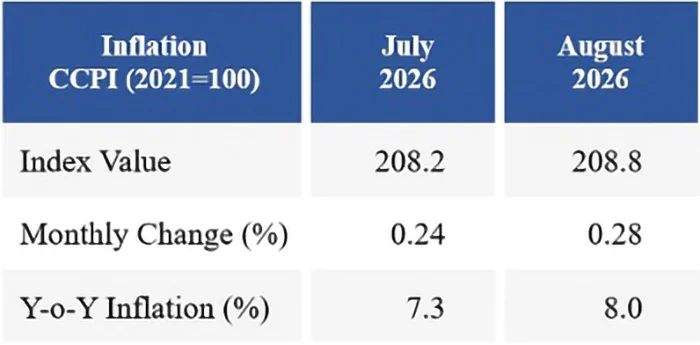
The Colombo Consumer Price Index (CCPI, 2021=100) based headline inflation (year-on-year, Y-o-Y) increased to 8.0% in August 2026 from 7.3% in July 2026, primarily due to the statistical base effect in food inflation. Meanwhile, food inflation (Y-o-Y) increased to 8.5% in August 2026 from 6.3% in July 2026, contributing mainly to the increase in headline inflation, while non-food inflation (Y-o-Y) decelerated to 7.7% in August 2026 from 7.8% in July 2026.
On a month-on-month basis, the CCPI increased by 0.28% in August 2026. This increase was mainly driven by the food category, which contributed 0.20 percentage point, largely owing to the increase in prices of Milk Powder, while the non-food category contributed a marginal 0.07 percentage point.
Meanwhile, core inflation (Y-o-Y) accelerated to 5.1% in August 2026 from 4.4% in July 2026.
According to the inflation projections made at the monetary policy round in July 2026, headline inflation is expected to remain above the target of 5% in the near term, before easing and stabilising around the target over the medium term, supported by appropriate policy measures. These projections are conditional, among other assumptions, on the expectation that the effects of the tensions in the Middle East and their spillovers will be temporary and gradually dissipate.

Showers will occur in the Western and Sabaragamuwa provinces and in Galle, Matara, Kandy and Nuwara-Eliya districts

Sun directly overhead Anamaduwa, Moragollagama, Dambulla, Manampitiya and Valaichchenai, at about 12.10 noon today (02)

SC rejects petitioners’ request for full bench

Seven years RI for former Civil Aviation Minister Piyankara Jayaratne

40 professional organisations and TU oppose proposed 22A

Ai-CHA expands Lankan footprint with new Negombo outlet

‘Dates have the highest sugar content to fight Coronavirus’

Sunday Island 27 December – Headlines

#SundayIsland 17th December – Headlines

Sunday Island – 28th March

Sunday Island Headlines – 21 March

Sunday Island – 21st February – Headlines
-

 News5 days ago
Eight politicians in drug kingpin probe
-

 Features3 days ago
“Wrap Me Up in My Blazer”— A Gentlemanly Bradby Reminiscence
-

 Business5 days ago
Sri Lanka opens up: A new season of direct connectivity
-

 Features5 days ago
Redefining ageing in Sri Lanka
-
 Latest News6 days ago
Nepal-Tibet floods: What happened, what caused them and who is missing?
-

 Editorial6 days ago
Unfolding El Niño and burning issues
-
 Foreign News7 days ago
At least eight killed, hundreds missing after Nepal flash flood
-
 Latest News7 days ago
Advisory for High Waves for the sea areas extending from Colombo to Pottuvil via Galle, Matara and Hambantota