
Features
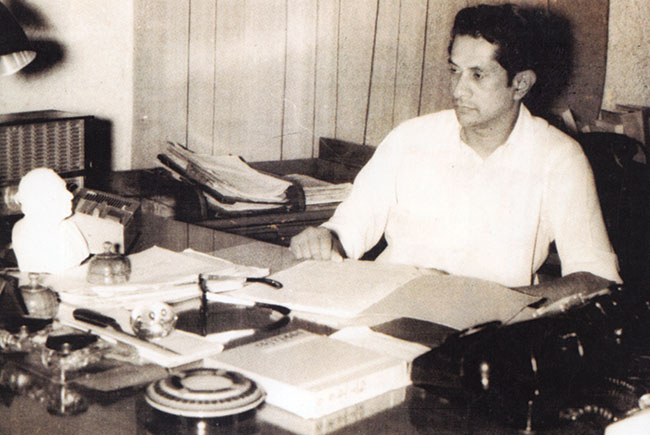
Susil in Politics: Some inside stories

Remarkable astrological predictions
by Sumi Moonesinghe narrated to Savithri Rodrigo
Having built up one of the biggest businesses in the country from scratch with the help of Maha and Killi (Maharaja), and of course Susil, and then selling it for a substantial price sealed the end of a very eventful chapter for me. Susil was my rock, always there to guide and advise me and to comfort me when things went wrong. But his strong political ambitions were not far from the surface and it was just a matter of time before we all became enmeshed in politics.
I was introduced to politics by Susil, whose wide network of political friends and alliances also meant that we were always engaged in long political discussions. He was a great guru and I a good student. Susil absorbed politics into his very being. From our early days in Singapore, I would listen, discuss and debate politics with him. I remember how he studied the successful transformation of Singapore under the leadership of Lee Kuan Yew incessantly, while we were in that country and even after, very enamoured with Lee’s brand of politics.
Lee was Prime Minister of Singapore for 31 years and his political pragmatism was hailed globally. He was credited with transforming Singapore from a third world to a first world country but was an outspoken critic of the western ideal of democracy. Susil’s leftist ideas resonated well with Lee’s ideology but I have always been a great believer that a good left and right balance is the key to good governance. Eventually, Susil began thinking on these lines and I like to think it was I who converted him!
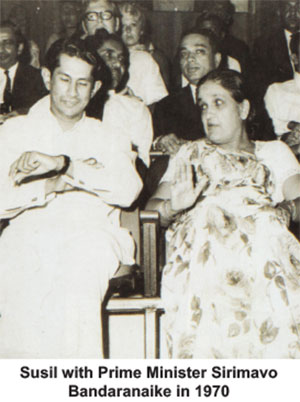
As the 1977 elections drew near, Susil, who had worked hard for the SLFP government in earlier years, was fully involved with the opposition UNP. Having seen Mrs. Bandaranaike’s socialist policies reduce the country to depths unimaginable, there was renewed vigour to work towards electing a more pragmatic, open economy-oriented UNP government. Prior to the elections therefore, our home became ‘election central’. Susil was working closely with the UNP top guns J R Jayewardene, Ranasinghe Premadasa, Lalith Athulathmudali and Gamini Dissanayake, who all became close friends and would end up at our home, discussing issues and strategies well into the night.
Often there were times when J R would invite us for coffee to his home at Ward Place for some nocturnal discussions. He was 70 years old and had amassed a wealth of political experience and knowledge. Wickrama Weerasooria, who would eventually become Anarkali’s father-in-law, and Gamini Dissanayake would most often be at these little informal chats, and quite a young Ranil Wickremesinghe too.
It was at our home over dinner one day that I remember J R casually mentioning he would be removing Mrs. Bandaranaike’s civic rights. We were utterly and truly shocked. This was unheard of and could be construed as vengeful and manipulative. This would also mean Mrs. Bandaranaike, who would be the Leader of the Opposition if J R won, would be expelled from parliament. This wouldn’t augur well for Sri Lanka’s democracy and I remember each of us at the table, Gamini, Susil and I, vociferously voicing our opposition to the removal of her civic rights. Elina, J R’s wife who was also at the dinner, looked at J R very sternly and said, “Dicky, don’t ever do that!”
But J R wouldn’t listen and went ahead. It was not just Mrs. Bandaranaike who lost her civic rights. He extended that diktat to two of her most powerful acolytes as well –former Permanent Secretary to the Ministry of Justice Nihal Jayawickrama and former Cabinet Minister Felix Dias Bandaranaike who were both eminent lawyers. J R impounded their passports and appointed a Special Presidential Commission of Inquiry to investigate alleged abuse and/or misuse of power by the Bandaranaike Government.
The proceedings and findings seemed one-sided and almost vindictive, and with the imposition of civic disabilities, Sirimavo, Nihal and Felix were prohibited from seeking election to parliament, holding any public office or engaging in any political work including making political speeches. They were thus banned from politics for a total of seven years. This was so wrong and went against the fundamental principles of democracy. It is the voters who decide on their elected officials, and permanent secretaries like Nihal, carry out orders given by the elected minister.
It was in 1974, a few years prior to the 1977 elections that I met Gamini Dissanayake, while Mrs. Bandaranaike was yet in power and the country was going through some upheavals. Susil and I had friends in both major political parties – there was Sivali Ratwatte and Upali Wijewardene who strongly supported Mrs. B (as she was called), and J R, Gamini, Lalith and Premadasa who were movers and shakers in the UNP.
Mrs. B had already extended her term by two years and was becoming quite dictatorial. Mrs. B’s son Anura was also among our circle of friends, but he remained non-partisan, although J R was constantly enticing Anura to cross over to the UNP. During the Kalawewa by-election in 1974, J R and Premadasa wanted Anura to get into Parliament. Multiple meetings were held at our home and J R assured Anura that the UNP would not put forward a candidate if Anura contested.
However, the procedure wasn’t that simple. First, the SLFP, which was Anura’s mother’s party, had to nominate Anura as their candidate. Given the relationship, we figured this would be merely procedure; after all, Anura was of Bandaranaike lineage and the Prime Minister’s son. When the SLFP nomination committee sat to make a decision, we assembled at Anuruddha Ratwatte’s home near the Army Headquarters waiting for the results from the nomination board.
But, to our complete surprise, the nomination committee selected an unknown entity to represent the SLFP at the by-elections. The Committee comprised S W R D Bandaranaike’s stalwarts. It was clear that Mrs. B had made it known to them that Anura may become J R’s pawn if he won the election. Anura was inconsolable when he heard the news, quite unable to comprehend being let down by his own mother so publicly.
No sooner had the news been communicated, Sivali’s wife Cuckoo promptly took Anura and his sister Chandrika’s horoscopes and went to visit Mr. Arulpragasam, the astrologer who lived at Station Road, Nugegoda. Having studied the horoscopes for a few minutes, Mr. Arulpragasam looked at Anura’s horoscope and said, “This one will never become anything more than a minister,” but pointed to Chandrika’s and said, “Now, this one will go right to the top!” His words were prophetic. While Anura did eventually get into Parliament but only as Speaker of the House, twenty years after the prediction in 1994, Chandrika was sworn in as Sri Lanka’s fifth President.
Susil was a pragmatist and being a voracious reader, a fount of information and knowledge. This helped him immensely in carving out a successful political career which was well matched with his language capabilities and I should say, handsome looks too. He was elected Chief Minister of the Western Province in 1988, a post he held until 1993. He was Leader of the Opposition of the Provincial Council in 1994, and then went on to become a Member of Parliament for the Colombo District from 2000 to 2002.
Sri Lanka was continuing to grapple with the murderous deeds of the LTTE. Realizing the futility of reasoning with a terrorist organisation, J R decided to enlist the help of the Indian government to quell the LTTE. It was widely believed that Tamil Nadu was quite a hotbed for LTTE supporters and J R needed to get the support of the Indian government to help regain peace in the country. Thus began the discussions for the Indo-Sri Lanka Peace Accord which was signed on July 29. 1987, between Indian Prime Minister Rajiv Gandhi and J R, enabling the 13th Amendment to Sri Lanka’s Constitution.
The Amendment included the devolution of power to the provinces, a withdrawal of troops and the LTTE to surrender arms. India sent in a Peace Keeping Force to help literally, with keeping the peace. However, the LTTE had not been involved in the talks and before long, the uneasy truce flared into active confrontation. In retaliation, Rajiv Gandhi would eventually be assassinated by a female LTTE suicide bomber, four years after the signing of that accord.
In fact, J R handed me the 13,h Amendment and asked me to read it prior to it being passed. This Amendment was a result of the 1987 Indo-Sri Lanka Accord which was brokered by Rajiv Gandhi, with the diktat for full devolution of power to north and east. J R decided to expand the devolution of power to all nine provinces, creating the provincial councils in Sri Lanka. As a result, parliamentarians’ work was reduced drastically, which meant that the number of MPs could easily be reduced to no more than 100.
When I pointed out this fact to him, he replied, “I agree, but I have to keep everybody happy.” Also the provincial council structure introduced a whole new type of politician and with each successive government, “keeping everyone happy,” became the norm. The trend of large cabinets of useless people crept in. We now have a 225-member Parliament.
Gamini, who played a pivotal role in the Indo-Lanka Peace Accord had become very powerful, with the Indians holding him in high esteem due to the role he played. One of the perks of this recognition was being given the full ‘red carpet’ treatment to see Indian guru Satya Sai Baba, who had built up an impressive following of millions around the world. These followers would throng his residence in Puttaparthi in Andra Pradesh in the hope of getting an audience with the great teacher. So when Gamini was invited to see Baba, we joined him on that trip and when we sat in the same room as Baba, it was quite otherworldly.
Baba’s ‘acts of divinity’ are argued by some to be a sleight of hand, but nevertheless they were impressive. He would magically bring out gifts, presenting various items to those he deemed special. Susil was summoned as well and given a photograph. Tiny, Wickrama’s son was asked to join Baba in another room and came out a few minutes later, smiling. But he refused to tell us anything at the time. Many years later, Tiny divulged that Baba said, “Your future wife is in this room with you!” Now I’m not sure if Tiny concocted that story —that’s what he says Baba told him. Nevertheless as a result of this trip, Gamini’s family and ours are intertwined for life. Rohini, who is Gamini’s eldest sister is Tiny’s mother.
During this period, Susil was Chief Minister of the Western Province and Sri Lanka was battling a war on two fronts —the LTTE and the JVP — Tamil Tiger rebels in the north and the Marxist student rebels in the south. At the height of the JVP insurrection in 1988, parliamentary elections were announced and Susil began campaigning from the Colombo District for the Avissawella seat. Our home was filled with party supporters and security detail because the violence in the country was unrelenting. Not a day went by without an innocent person being senselessly and viciously killed by the JVP, or a bomb or assassination by the LTTE. The JVP’s quest was to kill Government officials or those who were supportive of the Government in order to bring the Government to its knees. But none deserved to die. These were all people who were simply doing their job.
As a result, Susil’s life was also under threat which meant we had security details — men walking around with guns — in our house 24×7. I hated it. This exacerbated the fact that we were living in fear and that is when we decided to move the girls to Singapore as they were missing out on school as well. Schools in Colombo had been shut down due to the continuing violence.
With Susil campaigning with gusto, our house once again turned into Grand Central Station, with endless cups of tea, lunches and dinners being served to hundreds of supporters and party activists. I was juggling multiple roles as my business too was at its peak; thank goodness for my domestic staff who kept the wheels turning in my home very efficiently.
Just as Susil had given me unstinted support in building up my business, I reciprocated when it came to his political work. I dived straight into his campaign, accompanying him to his rallies, helping with his speeches and giving him as much support as I could. I walked around the villages he went to, chatting with the people, finding out about their lives and families.
On one occasion, I struck up a conversation with a rubber tapper, a woman whose work day began at dawn. This meant her daughter had to wait at home for her return later in the day for a meal. “How can your daughter stay hungry until you get back home?” I asked. Having no inkling of who I was, she said, “I buy Anchor milk. When I give her that, the child is not hungry and doesn’t cry until I return. I have tried other types of milk powder but they don’t work the same way.”
On hearing this, when I got back to office I telephoned NZDB and shared the information I heard from the rubber tapper. “How can Anchor milk keep her daughter from hunger, when other milks don’t?” Their reply was, “Most milk powder in your market has 26% fat. But Anchor has 28.5% fat. So when the fat content is higher, it is richer and more filling.” Realising the power of our differentiation, I called my Anchor A team and gave them this titbit of information. The result was this slogan: “All we do is remove the water. All you do is add the water.”
Of all Sri Lanka’s leaders I’ve engaged with, it was President Ranasinghe Premadasa who was my hero. He never forgot what it was like to be poor and would always judge a person on the depth of that knowledge. If any consultant came to him with a theory, the first questions he would ask were, “Have you walked barefoot? Have you ever slept on the ground? Have you ever gone without a meal? If you haven’t done any of those things, you can’t work for me.” His method of management was to let the bureaucracy run the country while he envisioned the future. “Ministers should not be involved in day-to-day operations,” was his wise counsel. He was a man of action and a son of the soil.
One of the projects on which I worked closely with him was his Gam Udawa (village reawakening) housing development project, which he launched in 1983 when the United Nations declared 1987 as the International Year of Shelter for the Homeless. He gave himself four years – from 1983 to 1987 –to meet his target of constructing 100,000 houses for the poor. This was an ambitious undertaking but Premadasa was never deterred by the expanse of his vision.
This vision for giving shelter to the poor went beyond simply giving houses. He added a participatory approach, increasing dynamism and vigour to village development with the people deciding on the size and shape of their abodes and contributing material and labour when feasible, with the government providing land and financial assistance. He believed strongly in the Maslow theory of the hierarchy of needs, and felt that fundamental needs had to be met for human beings to get to the next rung. His switched to a state-aided housing development philosophy – ‘of the people, for the people, by the people’ – which was an instant success.
His beginnings were in poverty and he understood the poor man and the way their minds worked. And he was a problem solver. When he first made his declaration of constructing the 100,000 houses, his fellow ministers scoffed at the idea and were reluctant to give him support. In fact, Ronnie de Mel, who was Finance Minister at the time, didn’t allocate money from the budget for the housing programme. Undeterred, Premadasa launched the Sevana Lottery – his solution to giving poor people a roof over their heads. The income from the lottery would fund his project.
Susil and I were very supportive of President Premadasa’s projects because these appealed to our ‘giving’ conscience, strengthening the belief that the giving had to be sustainable and have the buy-in of the recipient. We worked very closely with him, never missing his Gam Udawa launches and even taking J R with us in some instances.
On April 30, 1993 having attended a meeting, Susil and President Premadasa were driving back in the same car. Premadasa turned to Susil and asked, “Susil, are you afraid to die right now?” Susil said, “No,” although he thought it was a rather strange question. It almost seemed as if the President had a premonition of what was to come. That was the last conversation Susil had with him.
The next morning – May Day 1993 – my astrologer, who was in Melbourne, made a desperate telephone call to me asking me to not allow Susil to leave the house. I knew Susil was joining President Premadasa at the May Day Rally and while not telling him about what the astrologer said, I tried my best to make excuses and finally pleaded with him not to leave home.
I kept delaying his departure but he wasn’t listening to my pleas. To placate me he said, “I’ll go to the meeting and be back soon.” He left the house around 12.45 pm and was near the Eye Hospital in Borella when he was informed about the blast which killed President Premadasa. A suicide bomber, who was later identified as an LTTE suicide cadre named Babu had detonated the bomb, killing the President, 17 others and himself. It was that call from my astrologer that saved Susil’s life that day.
Sometime earlier, Premadasa had made D B Wijetunge his Prime Minister. This was quite shocking as it was very apparent that he was side-lining the party strongmen Lalith Athulathmudali and Gamini Dissanayake. Hence, when Premadasa was killed, it was D B Wijetunge who was sworn in as President. Ranil Wickremesinghe was appointed Prime Minister.
The wheels of politics continued to turn in this country despite bombs and assassinations. When Gamini became the presidential candidate for the UNP in the 1994 election, I predicted he wouldn’t win. The country had gone through 17 years of UNP rule and was ripe for change. Nevertheless, both Susil and I put our heart and soul into Gamini’s campaign. Susil was at every single one of Gamini’s campaign rallies.
One day, I wanted Susil to return early from one of those rallies as I had a function to attend. He acquiesced, went to the meeting, delivered his speech and returned home, a little before Gamini arrived at the meeting. Normally, Susil would greet Gamini and stay on with him until Gamini left the meeting.
Just as Gamini got to the rally at Thotalanga, he telephoned our home and asked me where Susil was. I explained that Susil had delivered his speech and since I had to go out, he was on his way home.
A short while later, the phone rang again. I don’t remember who was on the other end but I remember going limp. “A bomb has gone off and Gamini is in hospital.” A suicide bomber had detonated herself at the meeting in retaliation for Gamini’s involvement in the bombing of the Jaffna Library. Susil had just returned and we rushed to the hospital. Not long after, Gamini was pronounced dead.
Meanwhile, Chandrika Bandaranaike Kumaratunga had ousted the UNP in the Provincial Council Elections and become Chief Minister of the Western Province. From then on, her stars were lined up and she became unstoppable. She would eventually become Prime Minister and then the first female President of Sri Lanka, just as Mr. Arulpragasam had predicted two decades ago.
Our dear friends – Lalith Athulathmudali in April 1993, Ranasinghe Premadasa in May 1993 and Gamini Dissanayake in October 1994 – were all dead, just one-and-a-half years of each other. We had by now lost all those leaders who were capable of taking the country forward – either the JVP or the LTTE had killed them. When Gamini died, I felt like life couldn’t get any worse. But then, I told myself that the cycle of life must go on. We who survive do so for some purpose.

 It is obviously too early for an outpouring of joy over the seeming cessation of hostilities between the main antagonists in West Asia. While the prospect of there being a measure of calm in the region is being welcomed by considerable sections of the international community, what is ‘on the table’ currently is only a Memorandum of Understanding between the US and Iran to give peace a chance. The hard part in the peace effort remains to be achieved.
In the Middle East of today we have one of the most complex conflicts to break out in modern international politics and the observer would be naive in the extreme to expect a facile and early closure to the tangle. Yet, for the sake of the world’s publics who have been hurting badly in the prolonged hostilities one could only hope that the US-Iran MoU that is expected to be signed by the sides on Friday would lead eventually to a substantive peace. The world’s thanks are due to Pakistan in this connection for its sustained support in the peace drive.
While the sides have agreed to a ceasing of hostilities in the most general terms and have reached accord on the facilitation of uninterrupted oil and gas supplies to the rest of the world, for instance, the ‘devil will prove to be in the details’ in an envisaged comprehensive peace settlement. It is these details that would make or break peace if the negotiations go on in earnest.
Nevertheless, the details would need to be worked out consensually in a spirit of compromise with an eye to the greater good of the world community. Realpolitik or a narrow focus on solely the national interest among the protagonists, for example, would need to give way to a measure of humanity that would encompass within it a consideration of the overall well being of the world. In other words, it is statesmanship that would crucially matter.
The next few weeks would establish whether humanists are ‘asking for far too much’ when they broach the questions at issue in these terms. Yet it is essentially self interest and national security considerations of the first importance that drove the conflict from even prior to February this year and these questions would need to be taken up and resolved to the satisfaction of the US and Iran in the main if some headway is to be made towards a durable settlement.
The nuclear issue would prove to be the proverbial Gordian Knot. From a realistic viewpoint, Iran could not be expected to be without a potential nuclear deterrent in the face of perceived nuclear threats emanating for it from the West and Israel. In the short term, Iran would need to possess this deterrent to a measure, within a mutually agreed international legal framework maybe, until wide agreement is reached on the nuclear tangle. Specifically, Iran’s immediate threat perceptions with regard to her nuclear-powered rivals would need to be defused during initial negotiations.
Ideally it is a world free of nuclear weapons that must be aimed at but since this goal cannot be achieved in the near or medium terms, unfolding negotiations would need to ensure Iran’s absolute security in a world of powers that continue to swear by the nuclear deterrent, if it is to give up the suspected latter capability.
However, it is to the degree to which the present nuclear powers divest themselves of this capability that Iran could be put at ease on this score. Accordingly, it is nothing short of a complete elimination of nuclear weapons from the world that could dissuade keenly security conscious states from developing nuclear weapons of their own with a mass destruction capability.
This is the number one dilemma the international community needs to grapple with going forward and it is to the extent to which it resolves it that a nuclear weapons free world could be envisaged. No doubt, an uphill challenge.
Compelling Israel to support the present negotiatory process constitutes another grueling challenge for the US. Currently the Iranian position essentially is that a Middle East peace is inseparable from a normalization of the security situation in Lebanon. That is, the present Israeli attacks on the Hezbollah presence in Lebanon must cease if a comprehensive peace is to be realized in West Asia.
However, Israel is showing no signs of drawing back from its attacks on Hezbollah strongholds in Lebanon since the security of the Israeli state is being seen as threatened by the militant group. Co-opting Israel into the negotiatory effort therefore would turn out to be a matter of paramount concern for the US.
Moreover, elements in the rightist administration in Israel are seeing the current peace efforts as a ‘sell out’ to the enemies of Israel. They would have none of it. It is left to be seen how the US would be managing these virtual storm centres in the diplomatic process that could very well bring down the overall purported peace drive.
A recent pronouncement by US Vice President J.D. Vance points to yet another problem area in the US’ current peace overtures. He said that, ‘Regional peace and stability includes stopping the funding of terrorist organizations.’ He was obviously referring to the support extended by Iran to Hezbollah when he mentioned ‘terrorist organizations’ but he has given fresh life to the age-old conundrum of ‘Who is a terrorist?’ by these words.
To the Netanyahu government the Hezbollah and other militant organizations fighting Israel are ‘terrorists’ but from the viewpoint of the Iranian regime they are ‘freedom fighters’. This seemingly insurmountable definitional issue would not only stubbornly bedevil the peace effort but could even figure in bringing about its collapse, unless judiciously handled.
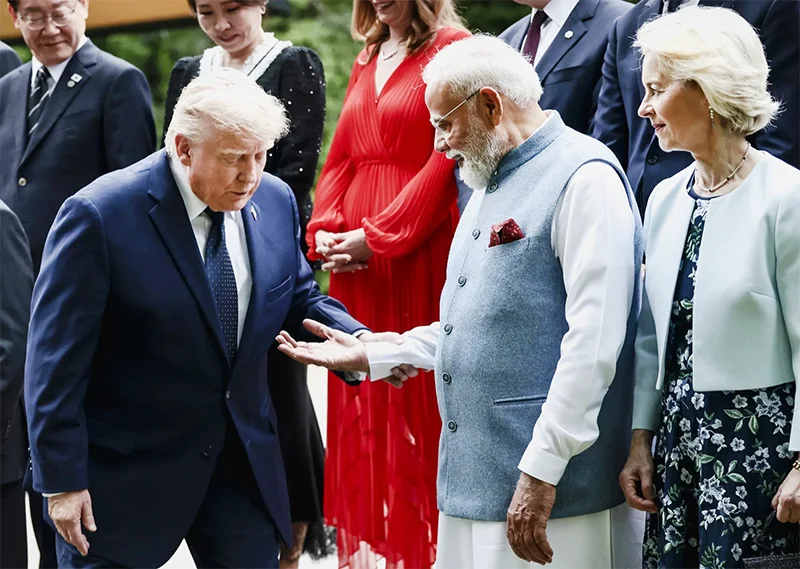
Thus, it’s the thorny details that need to be watched to keep the West Asian peace process afloat, once it gets going in earnest. There is no doubt that US President Trump would be receiving a considerable amount of support from the G7 in this historic peace undertaking and his personal appeals to the grouping currently meeting in France for continuous support are likely to elicit a positive response from it.
Likewise, Trump would need to appeal to also the BRICS countries if almost total global support is to be garnered for the peace drive in West Asia. BRICS’ solidarity with the US and the West is likely to carry considerable weight with Iran and other Eastern actors who are key to a sustained peace drive in the Middle East.
Features
Sri Lanka’s elephant paradox: Govt. counts tourism dollars while playing a dangerous numbers game: Expert
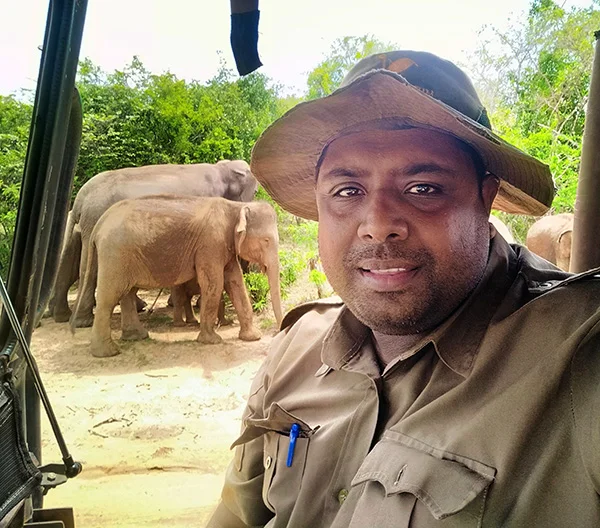
At a time when Sri Lanka is enjoying a resurgence in wildlife tourism, with elephants remaining the undisputed stars of the country’s national parks and one of its most marketable natural assets, elephant conservationist Supun Lahiru Prakash has sounded a stark warning: the nation is in danger of losing the very species that helps attract millions of tourism dollars while sustaining some of the island’s most important ecosystems.
Supun says repeated claims by authorities that Sri Lanka’s elephant population is increasing, despite the absence of a final survey report and amid continuing elephant deaths, risk creating a misleading narrative that could undermine conservation efforts and encourage retaliation against elephants.
According to Supun, the issue is not merely about numbers. It is about political priorities, scientific credibility and the future of one of Sri Lanka’s most iconic species.
“Repeatedly claiming that the elephant population is increasing appears to be an attempt to hide the Government’s inability to manage the rising annual elephant death rate and the complications of human-elephant conflict,” Supun said.
For decades, the Sri Lankan elephant has been a symbol of the country’s rich natural heritage. It is the centrepiece of wildlife tourism, drawing visitors from across the globe to national parks such as Yala, Udawalawe, Minneriya, Kaudulla and Wilpattu. International wildlife documentaries, tourism campaigns and social media promotions frequently place elephants at the heart of Sri Lanka’s nature tourism brand.
Yet, according to Supun, the country’s conservation policies do not reflect the value of the species.
“On one hand, the Government is enjoying increasing tourism revenue, and elephants remain one of Sri Lanka’s most important wildlife attractions. On the other hand, narratives are being promoted that could encourage retaliation against the very species that contributes significantly to the country’s tourism industry,” Supun said.
According to the First Countrywide National Survey of Elephants conducted in 2011, Sri Lanka had 5,879 elephants. However, official statistics show that 4,167 elephants died between 2012 and 2024.
Supun stressed that these figures represent only the deaths officially recorded by the Department of Wildlife Conservation.
“In a context where more than 70 percent of the country’s elephant population reported in 2011 has died within 13 years, it is difficult to accept claims that the population has increased,” Supun said.
The conservationist pointed out that elephants have the longest gestation period among land mammals and that scientific studies have reported increasing interbirth intervals among female elephants together with high calf mortality.
“When such biological realities are taken into consideration, claims of a dramatic increase in elephant numbers become difficult to understand,” Supun said.
Supun believes that repeated references to increasing elephant populations risk fuelling public hostility towards elephants, particularly among farming communities already affected by crop raids and property damage.
“Such claims can create the impression that elephant populations are exploding and thereby promote retaliation against elephants as well,” Supun said.
According to Supun, Sri Lanka’s elephant crisis cannot be understood solely through population estimates. The real issue lies in the country’s failure to address human-elephant conflict through long-term, science-based solutions.
Sri Lanka continues to record among the highest levels of human-elephant conflict in the world. Every year, hundreds of elephants and dozens of people lose their lives as competition for land and resources intensifies.
Despite the scale of the crisis, Supun says authorities continue to rely on strategies that have repeatedly failed.
Lahiru Prakash
These include driving elephants into protected areas, strengthening electric fences to confine them there and allocating additional manpower to maintain fencing systems.
Supun was also critical of several proposals that emerged from district-level discussions on conflict mitigation, including the sowing of paddy and corn using Air Force drones and the planting of fruit orchards within protected areas.
“Such proposals fail to address the real ecological and social dimensions of the conflict,” Supun said.
While welcoming reports that the Government intends appointing a national-level mechanism to tackle human-elephant conflict, Supun said the challenge required intervention at the highest level of government.
“Given the gravity, complexity and geographical spread of human-elephant conflict, appointing any committee other than a Presidential Task Force is not useful,” Supun said.
He argued that a Presidential Task Force chaired by either the President or the Secretary to the President would be better positioned to overcome the bureaucratic delays and institutional fragmentation that have hindered previous efforts.
Supun also stressed the urgent need to restore and protect elephant corridors and home ranges that allow elephants to move safely across landscapes.
He cited the Koholankala elephant corridor in Hambantota as one example where removing obstacles could help reduce conflict while improving habitat connectivity.
At the same time, Supun questioned policies that permit the allocation of forest lands in areas identified by environmental assessments as crucial elephant ranges and movement corridors.
“The opening of elephant corridors and the protection of elephant home ranges must be carried out scientifically and consistently if they are to succeed,” Supun said.
Beyond tourism, Supun emphasised the ecological importance of elephants.
“Elephants are ecosystem engineers. Through their feeding habits and movements, they help maintain habitats that support numerous other species. In many ways, they create safer and healthier environments for wildlife,” Supun said.
According to Supun, protecting elephants means protecting entire ecosystems and the biodiversity upon which Sri Lanka’s wildlife tourism industry depends.
“By protecting elephants, we are also protecting the biodiversity that makes Sri Lanka one of the world’s premier wildlife tourism destinations,” Supun said.
As Sri Lanka seeks to expand tourism earnings and strengthen its reputation as a wildlife destination, Supun believes the country faces a defining choice: continue with policies that have failed to stem elephant deaths and human-elephant conflict, or embrace a science-based conservation strategy that safeguards both people and wildlife.
Without a fundamental shift in policy and political will, Supun warned, Sri Lanka risks losing not only one of its most iconic species but also the ecological and economic benefits that elephants continue to provide.
“The suffering of both farmers and elephants will only intensify unless meaningful action replaces rhetoric,” Supun said.
By Ifham Nizam

Back-to-back victory for Colombia
 Katherine Castaño of Colombia claimed the Top Model of the World 2026 crown, securing a historic back-to-back victory for her country. Angelica Sanchez of Puerto Rico was named first runner-up, and Eunice Deza of the Philippines finished as second runner-up.
Katherine was crowned by outgoing titleholder Natalia Garizabal Vera of Colombia.
Several special category awards, and subsidiary titles, were also presented during the Top Model of the World 2026 pageant.
These awards recognised excellence in modelling, peer support, and regional representation.
Primary Subsidiary Titles

Sri Lanka’s Netalie Withanage: Top 16 at
the grand finale
Miss Globe 2026: Valentina Tabares (Ecuador) — Awarded to the contestant who perfectly balances fashion modelling with traditional beauty queen qualities.
Queen of Europe 2026: Mia Danielle Williams (United Kingdom) — Given to the highest-ranking candidate from a European nation.
Special Awards Recognition
Audience Iconic Award: Charly (Dominican Republic) — Won via the official public online vote, granting her a fast-track direct entry into the Top 6.
Exotic Model of the World: Angel Emeka (Nigeria) — Awarded for exceptional editorial presence and strong runway performance.
Best Body Award: Thailand — Voted directly by fellow contestants at the Flow Spectrum Hotel. The highest-ranking runners-up for this category included Zambia, South Africa, Colombia, and Ghana.

Angelica Sanchez (Puerto Rico): 1st Runner-up
Final Placement
Winner: Katherine Castaño (Colombia)
1st Runner-Up: Angelica Sanchez (Puerto Rico)
2nd Runner-Up: Eunice Deza (Philippines)
Top 6 Finalists: Included contestants from the Dominican Republic, Romania, and Germany.
The pageant, known for focusing on professional modelling careers over just beauty, brought together 36 models from around the globe for two weeks of runway, photoshoots, and cultural events.
Sri Lanka’s Netalie Withanage walked among 36 of the world’s best and powered her way into the Top 16 at the grand finale.

What the Trump-Iran agreement says about Lebanon, Hormuz and Uranium

Scotland face West Indies with a chance to reopen World Cup wounds

Moscow hit by largest Ukrainian attack since start of Russia’s full-scale war

Sooryavanshi to have parents with him on tour of Ireland and England

Luis Diaz, Colombia defeat World Cup 2026 debutants Uzbekistan

Oil prices fall, stocks rally as US, Iran sign framework to end war

‘Dates have the highest sugar content to fight Coronavirus’

Sunday Island 27 December – Headlines

#SundayIsland 17th December – Headlines

Sunday Island – 28th March

Sunday Island Headlines – 21 March

Sunday Island – 21st February – Headlines
-
 News7 days ago
CIABOC summons Yoshitha over his participation in British Navy training programme
-

 News4 days ago
Release of 2025 O/L results likely to be delayed
-

 News7 days ago
Justice Minister responds to social media claims he represented Easter Sunday ringleader
-

 Sports4 days ago
Tharanga set for high-profile javelin clash in Ostrava
-

 Features5 days ago
Politics of protected species
-

 News3 days ago
Beijing Capital Airlines to resume flights to Colombo signalling boost to tourism
-

 News4 days ago
Theft of USD 2.5 mn from Treasury: CoPF accused of complicity in NPP cover-up
-

 News6 days ago
Commonwealth lawyers urge Lanka to uphold rule of law