
Sports
Susantha deserves to be in the Asian Games team

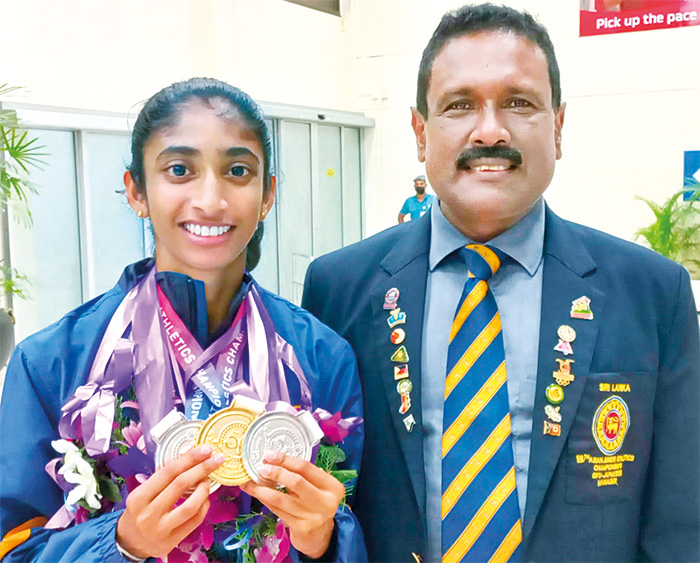
by Reemus Fernando
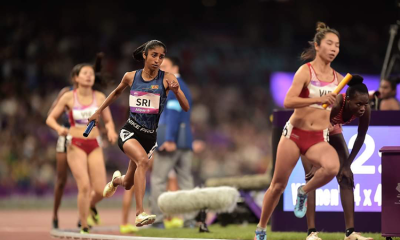
Asian Athletics Championship gold medallist Tharushi Karunaratne is among top medal contenders when Sri Lanka’s track and field team vies to end a long medal drought at the Asian Games which will be held at the Chinese city of Hangzhou from September 23rd to October 8.
Sri Lanka has not won a medal in track and field sports since the men’s 4×400 metres relay quartet of Rohan Pradeep Kumara, Rohitha Pushpakumara, Prasanna Amarasekara and Ashoka Jayasundara and sprinter Susanthika Jayasinghe won medals in Qatar Asian Games in 2006.
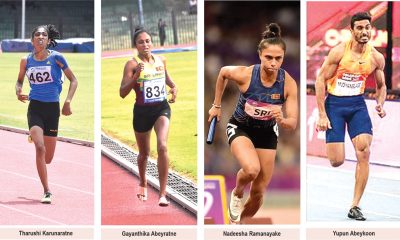
That medal drought could end with the men’s 4×400 metres, women’s 4×400 metres teams and the likes of Tharushi Karunaratne peaking at the right time. Sprinter Yupun Abeykoon too has produced outstanding performances indicating bright prospects at the quadrennial Games.
The Ratnayake Central, Walala runner Karunaratne is the top medal contender in the women’s category for Sri Lanka at the regional Olympics. But the top contender will not have her coach with her as Susantha Fernando’s name had not been included in the list of officials for the multi sports event.
Over the years the country’s Olympic Committee and the Sports Ministry which finalise teams for Multi Sports events like the Asian Games have drawn flack for including big number of officials to accompany teams on public funds.
It is important that Fernando, who has toiled hard for decades to produce athletes in the calibre of Karunaratne to the national level be included in the team for Asian Games as it is them who make the country’s flag fly high at these games. Karunaratne has the potential to reach qualifying standards for next year’s Olympics as well as she has already touched speeds reserved for elite middle distance runners. Karunaratne’s record breaking performance of 2:00.66 seconds at the recently held Asian Championships deserves special recognition.
When contacted on this regard Sri Lanka Athletics officials said that the sports governing body was ready to make amends if the National Olympic Committee does not have any objections regarding his inclusion.
“The ‘long list’ for the Asian team and the list of officials were finalized in January when we had already included Susantha Fernando for the Asian Junior Athletics Championships. Since he was included in the Junior Asian Championship team we gave priority to others. After Tharushi won (at the Asian Championships) it is a new scenario now. We are willing to include him in the team if Olympic Committee is okay with that,” Saman Kumara the secretary of Sri Lanka Athletics said.
Our efforts to contact the General Secretary of the Olympic Committee Maxwell De Silva on this regard found futile yesterday.





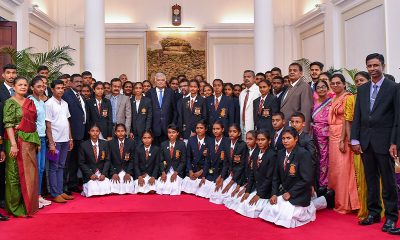





The Cabinet of Ministers approved the resolution furnished by the Minister of Youth Affairs and Sports to establish the proposed National Higher Performance Centre for atletes.

India opener Shafali Verma has received an official reprimand and a demerit point for breaching Level 1 of the ICC Code of Conduct during the second T20I against Zimbabwe on Sunday.
Shafali, an ICC release said, breached Article 2.2 of the ICC Code of Conduct for Players and Player Support Personnel, which relates to “abuse of cricket equipment or clothing, ground equipment or fixtures and fittings during an International Match.”
It was Shafali’s first offence in a 24-month period.
The incident occurred in the 12th over of Zimbabwe’s innings when Shafali threw the ball into the ground in frustration after dropping a chance at mid-off offered by Chipo Mugeri-Tiripano off Sree Charani.
Shafali admitted the offence and accepted the sanction proposed by match referee GS Lakshmi, which meant there was no need for a formal hearing.
Level 1 breaches carry a minimum penalty of an official reprimand, a maximum penalty of 50% of a player’s match fee, and one or two demerit points.
India currently lead the three-match series 2-0 with the third game to be played on Tuesday evening. The T20Is will be followed by three ODIs in Vadodara from October 23.
(Cricinfo)

A total of 146 players will be competing for 27 available slots in the WPL 2027 mini auction on October 28 in Kochi. Of these, England batter Sophia Dunkley and Australia captain Sophie Molineux are the only two players who have listed themselves at the maximum base price of INR 50 lakh.
The auction pool has 119 Indian players, including 22 capped and 97 uncapped players, with 20 slots available for Indian players. The overseas pool has 27 players – 14 capped and 13 uncapped – including six from Associate teams, with seven slots available.
G Kamalini (released by Mumbai Indians), Kiran Navigre (released by U P Warriorz), Heather Graham and Jess Jonassen have registered at the second-highest base price of INR 40 lakh, while a total of 30 players have registered at INR 30 lakh.
Among the notable absentees are West Indies allrounder Deandra Dottin, who was released by UPW, and Australia legspinner Alana King, who was released by Delhi Capitals. Lizelle Lee, who was DC’s highest run-scorer last season, has also not listed herself after being released by the franchise.
What the teams look like going into the auction
Only two English players – Dunkley and Kira Chathli (INR 10 lakh) – have registered for the auction, with several others, including Danni Wyatt-Hodge, Alice Capsey, Dani Gibson, Lauren Filer and Linsey Smith opting to skip the WPL next year.
Cricinfo has learned that England are likely to play three T20Is in Sri Lanka in early February, which will clash with the final week of the WPL. While the ECB is likely to allow players to stay in India to complete the tournament, most players have instead chosen to prioritise their international commitments ahead of the Champions Trophy later that month.
The relatively low salaries on offer at the WPL are also understood to be a factor in many English players deciding not to register, with most internationals earning significantly more to play in the Hundred (up to £190,000 last year) than the highest permitted base price in the WPL of INR 50 lakh (£40,000 approx).
Molineux was part of the Royal Challengers Bengaluru [RCB] title-winning squad in 2024, and had bagged 12 wickets in ten games at an economy rate of 7.31. She was retained by RCB for the 2025 season but a knee injury ruled her out of the season. Dunkley, meanwhile, played for Gujarat Giants [GT] in 2023 before opting not to register for the 2024 season. She went unsold in the 2025 auction.
Among the premier internationals who have listed themselves for INR 30 lakh are Australia allrounder Grace Harris (released by RCB), Sri Lanka captain Chamari Athapaththu, South Africa left-arm spinner Nonkululeko Mlaba and South Africa allrounder Chloe Tryon.
UPW, who released nine players, will go into the auction with the biggest purse of INR 3.75 crore.
[Cricinfo]

Import and Export (Control) Regulations No. 08 of 2026
Draft Bill of the Public Private Partnership Enterprises Act to be gazzetted
Amendment of the Ayurvedha Act No. 31 of 1961

Cabinet nod to amend the Sri Lanka Development Administration Institute Act No. 9 of 1982
Establishment of the National Higher Performance Centre
State patronage for the cremation ceremony of the late deputy prelate (Anu Nayaka Thero) of the Sri Laka Ramangya Maha Nikaya, Gatambe Rajopawanramadhipatha, Siri Chandawimala Wanshalankara, Chandrakeerthi Sri Amarawansha, Sadhdharmawageeshwara, Shasanashobhanna Most Venerable Keppetiyagoda Siriwimalabhidhana Thero

‘Dates have the highest sugar content to fight Coronavirus’

Sunday Island 27 December – Headlines

#SundayIsland 17th December – Headlines

Sunday Island – 28th March

Sunday Island Headlines – 21 March

Sunday Island – 21st February – Headlines
-

 Features3 days ago
Kotahena:A Small Enclave, An Extraordinary Legacy
-

 News7 days ago
Sri Lanka, India caught in US-Iran ship crisis
-

 News4 days ago
Asgiri Mahanayake calls for immediate release of Gnanasara Thera
-

 Latest News7 days ago
Missiles intercepted near Riyadh after Saudi coalition hits Yemen fuel depot
-

 Latest News7 days ago
Kusal Mendis’ unbeaten 87 hands Sri Lanka consolation win
-

 News3 days ago
Record 1,600 students take Russian Classical Ballet examination in Sri Lanka
-
 News6 days ago
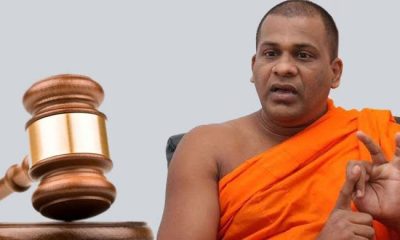
AC President recuses himself from hearing prison attire case pertaining to Gnanasara Thera
-

 Latest News7 days ago
Heavy showers above 100 mm are likely at some places in the Western, Sabaragamuwa, Southern, Central, and North-western provinces and in Anuradhapura district.