
News
Surge in cybercrime shadows SL’s tech leap


As Sri Lanka advances its digital transformation agenda, the nation is confronting a rapidly escalating wave of cyber threats, said a release. The latest cybersecurity data from Kaspersky reveals a concerning surge in malware infections and phishing attacks, putting individuals, businesses, and public sector entities at significant risk.
Globally, Kaspersky blocked over 302 million malware attacks in 2024 alone, while unique malicious web objects detected rose to more than 72 million. Phishing attacks, which trick users into disclosing sensitive information, increased by 26% compared to the previous year. Alarmingly, phishing attacks exploiting financial services and cryptocurrency themes surged by 83.4%.
Sam Yan, Head of Sales for Asia Emerging Countries at Kaspersky, notes, “The trends we see globally are increasingly reflected in Sri Lanka’s digital environment. Phishing attacks have evolved beyond simple email scams to sophisticated social engineering tactics that prey on users’ trust and lack of cybersecurity awareness. Many Sri Lankan organisations and everyday users remain vulnerable due to limited security education and outdated defence systems.”
The surge in cybercrime comes as Sri Lanka embraces digital payments, e-commerce, and cryptocurrency investments. With mobile banking adoption growing rapidly, attackers now target smartphones with malware disguised as legitimate applications, such as fake VPNs or parcel tracking services.
According to Sam, “Sri Lanka’s expanding digital footprint is a double-edged sword. While digital services bring convenience, they also expose users to risks like credential theft and financial fraud. Cybercriminals adapt quickly, exploiting new vulnerabilities and trends such as remote work and digital wallets.”
Experts emphasise that mitigating these risks requires a multi-layered approach: implementing strong technical defenses such as endpoint protection and web filtering; fostering public cybersecurity awareness campaigns; and enforcing stricter regulations around data privacy and online transactions.
Sri Lankan businesses, especially SMEs, must prioritise cybersecurity as a core element of their operational strategy. Sam adds, “Investment in cybersecurity is no longer optional but a necessity. This includes adopting multi-factor authentication, conducting regular staff training, and collaborating with cybersecurity providers for threat intelligence.”
Public institutions also play a critical role. As digital government initiatives expand, safeguarding citizen data and online services from phishing and malware attacks is vital to maintaining public trust.
Kaspersky’s report highlights that financial phishing, particularly in the business-to-business (B2B) sector, is on the rise. Sri Lanka ranks among the countries with the highest number of phishing attacks aimed at B2B financial notifications, with 9,218 incidents detected in 2024.
To counteract this growing threat, Kaspersky recommends that businesses and financial institutions in Sri Lanka implement a series of proactive security measures: Deploy anti-phishing technologies to detect and block malicious communications in real-time. Invest in employee training to raise awareness about phishing tactics and how to spot suspicious activities. And implement multi-factor authentication (MFA) to add an extra layer of protection to sensitive financial transactions.
Sri Lanka’s position as a growing target for financial phishing attacks is not unique. According to Kaspersky’s global statistics, countries such as Belarus, Moldova, and the Philippines top the list for the highest percentage of users attacked by web-borne threats. However, Sri Lanka remains vulnerable, with a significant number of businesses still at risk of falling victim to these cybercrimes.


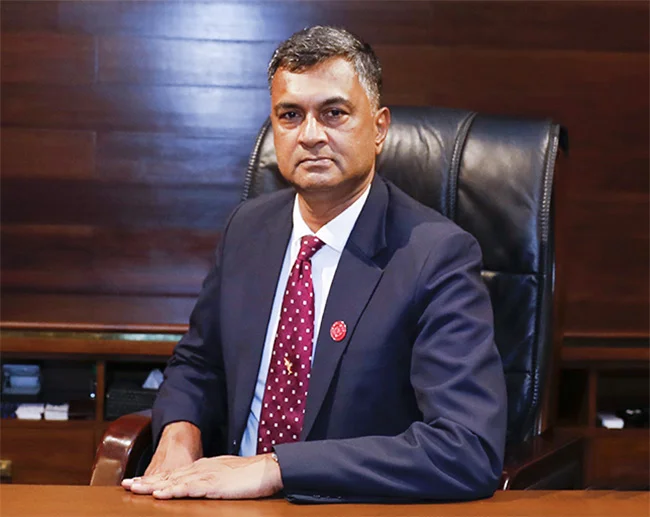
Defence Secretary (retd.) Air Marshal Sampath Thuyakontha has discussed with UN officials in New York the deployment of Sri Lankan troops in Haiti, under a new UN authorised force, tasked with tackling heavily armed gangs operating in the violence ravaged country.
The UN is in the process of building up a force comprising approximately 5,500 officers and men for deployment in Haiti.
The Sri Lankan delegation included Sri Lanka’s Permanent Representative to the UN, former Chief Justice Jayantha Jayasuriya. The UN has tagged the deployment Gang Suppression Force (GSF).
According to the Defence Ministry, Sri Lanka negotiated a Memorandum of Understanding (MoU) regarding the GSF. Although Sri Lanka has contributed to UN-led missions, the proposed deployment differed due to the nature of the operation, sources told The Island.
The delegation has assured that all personnel, assigned for UN missions, including the proposed GSF deployment in Haiti, would be subjected to a comprehensive screening process, in line with UN standards. War-winning Sri Lanka has declared, in New York, that the country was in the process of developing, what the Defence Ministry here called, National Human Rights Vetting Mechanism in consultation with the UN Resident Coordinator in Colombo.
The US has backed the deployment of Sri Lankan troops under UN command. Various interested parties, over the years, protested against the deployment of Sri Lankan troops on the basis of unsubstantiated war crimes allegations.
Thuyakontha has assured that troops would maintain highest standards of discipline during overseas missions. Sri Lanka brought the war here to a successful conclusion in May 2009 against predictions of contrary outcome by so-called experts.
The US and Panama proposed the GSF to replace a Kenya-led multinational force undermined by a lack of funding. Its strength hovered around 1,000, rather than the desired 2,500. The U.N. Security Council authorised the 5,500 strong force on September 30, 2025, with the new power to arrest gang members.
By Shamindra Ferdinando
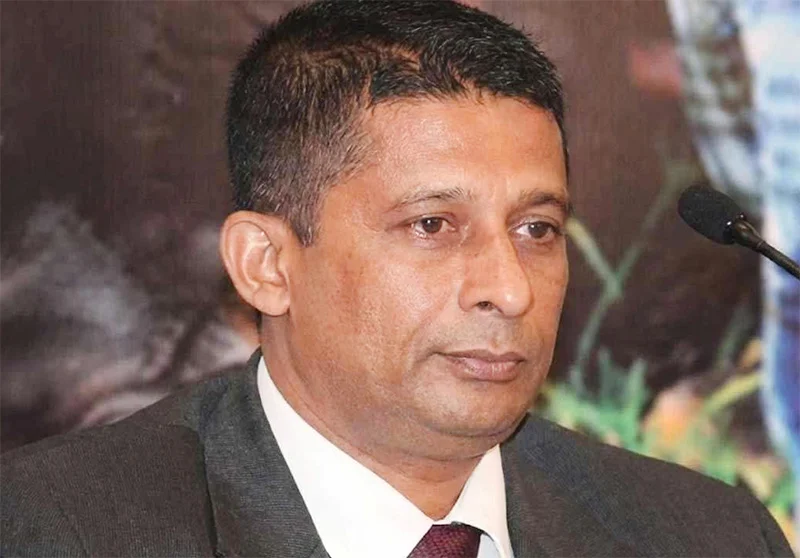
Sallay’s case:
Attorney-at-law Udaya Gammanpila yesterday (27) said a lawyer could not be deprived of his or her right to represent a client.
The former Minister and leader of Pivuthuru Hela Urumaya (PHU) Gammanpila said so addressing the media at the party headoffice at Pita Kotte. Gammanpila was responding to recent media reports that he had been prohibited from representing retired State Intelligence Service (SIS) Chief Maj. Gen. Suresh Sallay. Therefore, there was absolutely no basis for claims that he had been barred from meeting the retired officer, now named the third suspect in the Easter Sunday case, the ex-parliamentarian said.
Gammanpila emphasised that in terms of the Constitution a suspect’s right to be represented by a lawyer was recognised as a fundamental right. The Criminal procedure Code, too, guaranteed the suspect’s right to consult a lawyer, the ex-lawmaker said, pointing out that the Judicial Organisation Act underscored the same.
Declaring that the retired officer’s wife had named him as Sallay’s lawyer in a letter addressed to Director, CID, Gammanpila said that the courts, police and the Attorney General’s Department couldn’t under any circumstances interfere with his right to represent Sallay.
The CID arrested Sallay on 25 February and detained him under Prevention of Terrorism Act (PTA) for a period of 90 days. Sallay has filed a writ petition before the Court of Appeal through his lawyers, challenging his arrest and detention by the CID under the PTA.
Former Minister Gammanpila said that even if a Magistrate had the power to prohibit a lawyer from representing a particular suspect, such a course of action couldn’t be resorted to without giving the lawyer concern an opportunity to explain his/her actions.
Declaring that in case of misconduct on the part of a lawyer only the Supreme Court could take disciplinary action, the PHU leader said, adding that he sought a certified copy of the proceedings of the day when a section of the media reported the Magistrate’s declaration of the purported ban. Gammapila said that he was really keen to know what happened during the proceedings on that day.
Sallay served as Director, Directorate of Military Intelligence (DMI) from 2012 to 2016 and received the appointment as head of SIS following the 2019 presidential election. Sallay held that appointment till early October, 2024.
Gammanpila said that he couldn’t be barred for speaking to the media after meeting Sallay, currently held under PTA, or for authoring a book on the 2019 Easter Sunday carnage. According to Gammanpila as long as the suspect had no objections to his lawyer sharing some information with the media it shouldn’t be an issue for Additional Solicitor General Dileepa Peiris.
By Shamindra Ferdinando
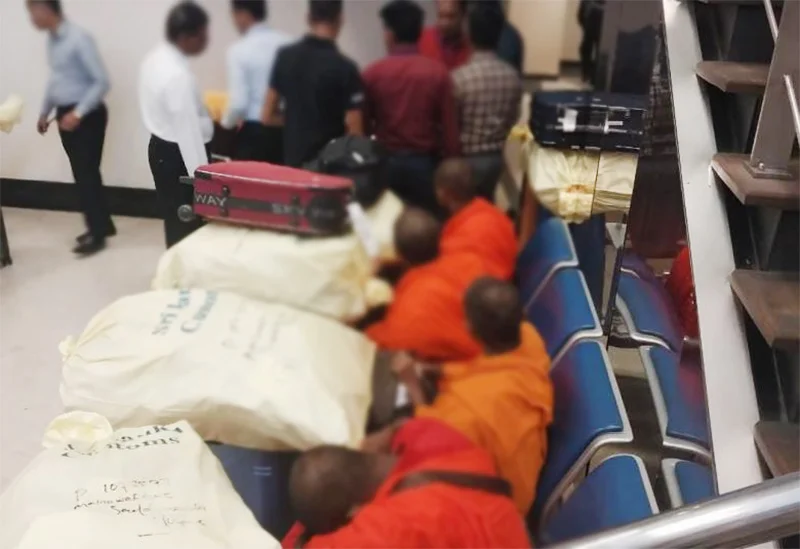
Police investigating the thwarted a bid made by 22 Buddhist monks to smuggle in narcotics, with a street value of Rs 660 mn via BIA, from Thailand, over the weekend, believe the monks who organised the clandestine operation had sent groups of monks to Thailand before.
Sources said that they had brought in narcotics on earlier occasions.
Police have seized the mobile phones used by the suspects and sought INTERPOL assistance.
Earlier, the Negombo Magistrate’s Court remanded those 22 monks, arrested in connection with the largest drug bust in the airport’s history.
The monks were produced before the Negombo Magistrate’s Court and ordered to be held in custody until 02 May, as investigations continue into the alleged smuggling operation and any wider networks involved.
However, other sources said that more than 110 kilogrammes of suspected Kush and Hashish, with an estimated street value exceeding Rs 1.1 billion, had been found, concealed in false-bottoms of their suitcases. The bags reportedly packed with school supplies and sweets are said to have contained over five kilogrammes of narcotics per individual.
The arrests followed a raid by the Police Narcotics Bureau on Saturday night. Investigators have also recovered mobile phone evidence indicating that the group had travelled to Bangkok on 22 April using airline tickets allegedly given by a sponsor. Authorities allege that the suspects were photographed in civilian clothing, while overseas, engaging in activities deemed suspicious.
Police say this marks the first reported instance of a large-scale narcotics operation via the airport involving Buddhist monks. The suspects are young monks from different parts of the country.
By Norman Palihawadana

Plane crashes near South Sudan’s Juba, killing all 14 on board

Gunmen kidnap 23 children from Nigerian orphanage

US press gala shooting suspect charged with attempting to kill Trump

Showers above 75 mm are likely at some places in the Western, Sabaragamuwa, Central, North-western, North-central and Southern provinces and in Mannar district

Hazlewood and Bhuvneshwar lead rout of Delhi Capitals

Govt. assures UN of readiness to introduce ‘vetting process’ for troops on overseas missions

‘Dates have the highest sugar content to fight Coronavirus’

Sunday Island 27 December – Headlines

#SundayIsland 17th December – Headlines

Sunday Island – 28th March

Sunday Island Headlines – 21 March

Sunday Island – 21st February – Headlines
-

 News5 days ago
Lanka faces crisis of conscience over fate of animals: Call for compassion, law reform, and ethical responsibility
-
 News4 days ago
Whistleblowers ask Treasury Chief to resign over theft of USD 2.5 mn
-

 News4 days ago
No cyber hack: Fintech expert exposes shocking legacy flaws that led to $2.5 million theft
-

 News1 day ago
BIA drug bust: 25 monks including three masterminds arrested
-

 Business2 days ago
Nestlé Lanka Announces Change in Leadership
-

 News1 day ago
Banks alert customers to phishing attacks
-
 News2 days ago
Hackers steal $3.2 Mn from Finance Ministry
-

 News5 days ago
USD 2 mn bribe: CID ordered to arrest Shasheendra R, warrant issued against ex-SriLankan CEO’s wife