
Sports
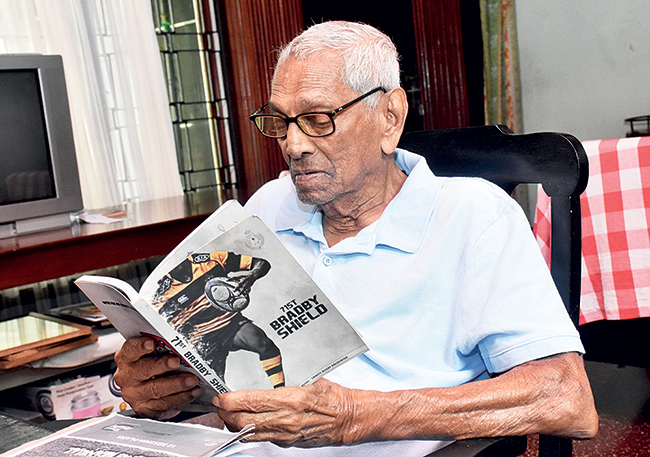
Summa (97) still going strong coaching rugby

By A Special Sports Correspondent
Former Royal College sportsman and Sri Lanka rugby star Summa Navaratnam is going strong at the age of 97 and is still involved in the Rugby Academy he formed in 2009.He makes it a point to visit the academy and goes there on most days, after lunch, around 2.30 pm. The Sunday Island caught up with Navaratnam for a chat at his home at Kynsey Road, Colombo-8 recently. The nonagenarian happily rattled away recalling fond memories in the sports he took part and the milestones passed in his career as a sportsman and as an administrator,
He is the fifth in a family of eight and certainly was not the child to be attracted to books and education. His focus as a schoolboy was on sports; athletics, boxing and rugby union- all for which he received due recognition in school. He remembers the days when the Royal Primary was called the Training College. “I remember winning the lime and spoon race there,” is how he began unfolding old and fond memories of the initial stages of school life.
Then in 1937 he joined Royal College and excelled in sports; also at the same time barely managing to scrape through his exams. “There was much recognition for sports at Royal and I was looked upon as a demigod by junior students of the school. I say this because a junior student had written something to this effect about me in the college magazine,” recalled Navaratnam.
Life really opened up opportunities for him after he left school and joined CR&FC; thanks to a stalwart in the Police called Sydney de Zoysa. A large number of clubs was playing rugby then and the sport was pursued with great camaraderie among institutes and players, according to Navaratnam.
“No one was heard of going to courts to settle a dispute in sports,” he said underscoring the lofty position and respect everyone gave to maintain the spirit of the game. He was not inclined towards joining any club in particular, but joining CR&FC happened quite by accident. It happened when de Zoysa stopped the vehicle Summa was driving for a ‘no head lights’ offence. They had ended up that evening at the CR&FC with Navaratnam taking membership at the Longden Place club.
According to him players were not paid for their services to the club back then. “Players had to in fact pay the club for the jersey and a fee for being selected for each match they represented the club. We were taught to be independent from our young days,” said Navaratnam.
After leaving school his dream of joining the Royal Air Force was shattered despite being selected because his father withdrew his consent given earlier for this adventure. He ended up joining the Army Volunteer Force. He later served the State Trading Corporation (Consolexpo) too.
Despite having a hectic work schedule he continued his interest in sport. Athletics is close to his heart as is rugby. He has fond memories of running the race of his life against Lavy Pinto at the athletics nationals where both athletes returned timings of 11 seconds in the 100 metre sprint event. What’s memorable for him was that after running the race he had gone to the CR&FC that same evening and represented the club at a Division 1 rugby match.
Navaratnam married twice and as he recalled he met both his wives within the rugby community. He was first married to Rosemary Rogers, the bestselling author, with whom he raised two children. His second marriage was to Romaine de Zilwa. His present wife lives in Australia where Navaratnam has citizenship.
When his playing days came to an end he took to rugby administration. He became the president of the Ceylon Rugby Football Union and was also the first president of Sri Lanka’s rugby controlling body when this sports body was renamed as the Sri Lanka Rugby Football Union (SLRFU).
Navaratnam stood for principles and ensured that all clubs at the time showed that they really existed. According to him, all clubs had to have a ground, conduct their own annual general meetings and submit accounts of the club to the rugby union. “We got along very well and the players accepted the decision of the referee without batting an eyelid,” said Navaratnam.
But there was a sour moment waiting to spoil his tenure as president of the SLRFU. Before a tour was to be made by the Sri Lanka side for the Hong Kong sevens a representative team was selected with Navaratnam approving selections. He had then gone overseas for a work related assignment and when he arrived back home he came to know that some changes had been made to the team without his knowledge. He had shown disapproval and in the end he forwarded his resignation as SLRFU president.
Navaratnam was involved with Royal College rugby for many years as a coach and gave away his services for free. But the Reid Avenue school, in later years, brought in a policy to employ only professional coaches for rugby. That rule technically took him out of being involved in rugby coaching at Royal. Undeterred he met the Royal principal and proposed that he be allowed to start a sports academy which would help students at Royal take baby steps in the field of sport. That marked the birth of the Royal Junior Rugby Academy. “Students from grades one to six are entertained at the academy and they are given an introduction to physical sports. These training sessions help to improve hand-eye co-ordination of players. The sessions will also help them work on speed and stamina,” said Navaratnam.
As much as Navaratnam talks about his fondness for rugby he also speaks about the people he met and the friendships he made, thanks to rugby. “I met a wide variety of people from different walks of life,” he said. He had all the time to enjoy rugby and absorb other cultures because he accommodates everybody who comes to him as students, players and officials. Navaratnam affirms that in a multi-cultural country like Sri Lanka students must be taught all three languages spoken in the country and the philosophies of all five religions that are practised here at a very young age.
His parting words at the interview were, “Don’t make playing rugby be hard on you. Forget winning and losing and make sure to enjoy the game”.





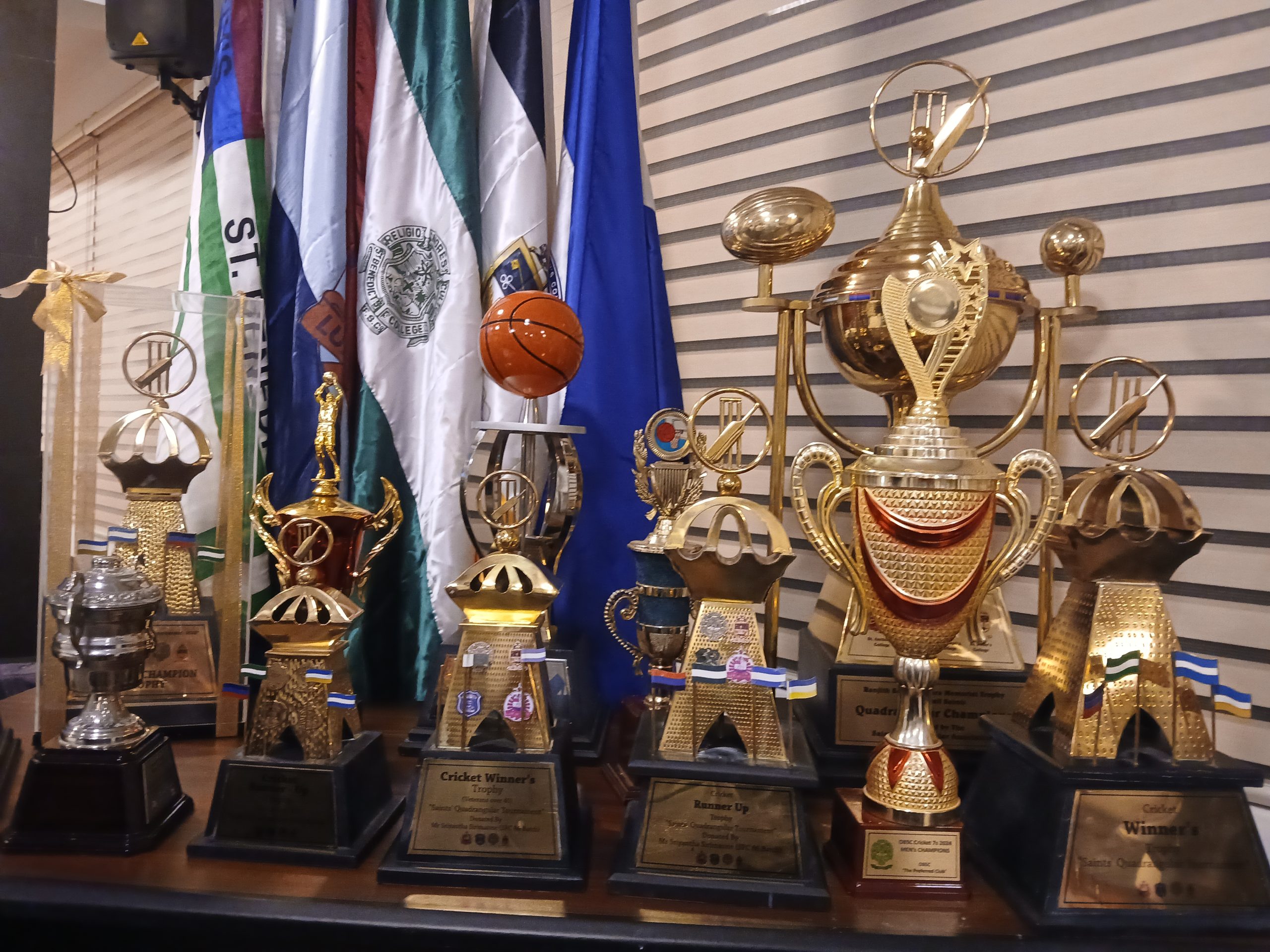
The much-anticipated 57th Annual Saints’ Quadrangular Tournament which brings together four of Sri Lanka’s leading Catholic schools, St. Anthony’s College, Kandy, St. Benedict’s College, Colombo 13, St.Joseph’s College, Colombo 10, and St. Peter’s College, Colombo 04, for a weekend of spirited competition, camaraderie and nostalgia is scheduled to take place this weekend (weather permitting).
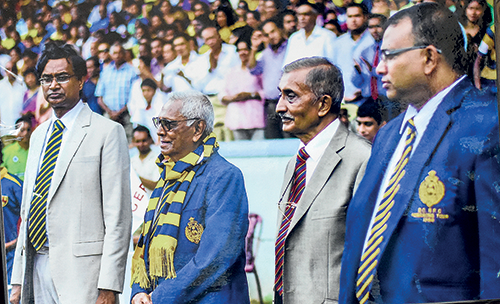
This year’s tournament is being hosted by the St. Peter’s College Old Boys’ Union (SPCOBU) during its Centenary year, marking 100 years since the Union was founded in 1927. The Centenary celebrates a century of service to the College and the Peterite community, under the theme “Honouring the Past, Strengthening the Present, Inspiring the Peterite of Tomorrow.”
The origins of the ‘Saints Quadrangular Tournament’ trace back to 1963, during the Diamond Jubilee celebrations of St. Benedict’s College. An open invitation was extended to schools across the country for a cricket tournament, and coincidentally, only the above three premier Catholic institutions joined
Continuing its evolution, 7-a-side Rugby was introduced in 2014, transforming the Saints’ Quadrangular into a vibrant sports carnival that now features three major sports across four tournaments namely Cricket, over 40 Cricket, Basketball, and Rugby.
This year the organizing committee has opened the doors to four sister schools as well. Good Sheperd Convent Kandy, Good Shepherd Convent Colombo, St Bridget’s Convent and Holy Family Convent Bambalapitiya, are to play a six a side ladies’ softball cricket tournament and a ladies’ basketball tournament.
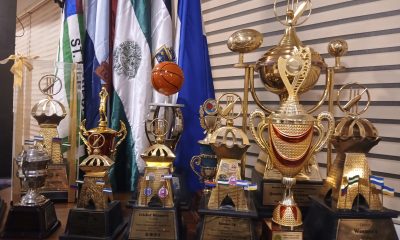
Each sport at the Quadrangular carries its own prestigious silverware:
The Quadrangular Trophy is awarded to the winners of the two Cricket tournaments.
The Very Rev. Fr. Joe E. Wickramasinghe Trophy is presented to the Basketball champions.
The Ranjith Samarasekera Challenge Trophy is awarded to the Overall winners of the tournament.
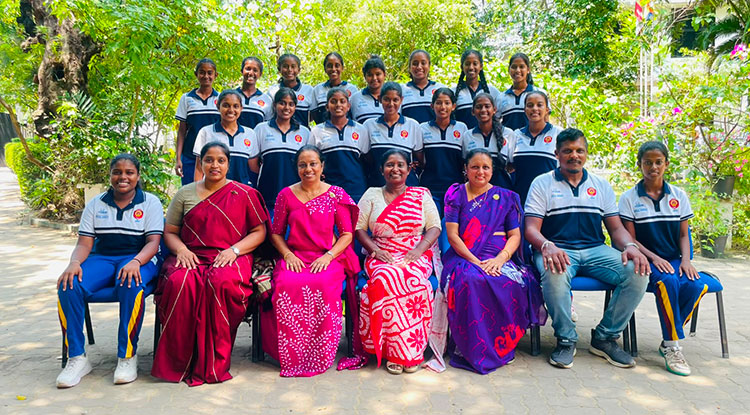
President’s Balika Nawala, won the girls’ hockey title at the All Island Schools Games, held recently at the Astro Turf, Reid Avenue. It was the second consecutive year the school had claimed the title.
Nethuli Dinethmi, who played a vital role in the team’s success, was named Best Player of the tournament.The victorious team is pictured here with the school’s officials, namely, H.P.M.P.D.Hasanthi Pathirathna, Principal, S.K.Tharsha Ranasinghe, Vice Principal, M.D.D. Aloka Dissanayake, Teacher in Charge of Sports, R.P.D. Dilrukshi, Teacher in Charge of Sports and Chathura Kalum Rupasinghe (Coach).
(Pic by Thushara Athapaththu)

by Rex Clementine
Sri Lanka were once pioneers in limited overs cricket, setting the bar so high that the rest of the world was left scrambling to catch up. And mind you, this was not confined to the 50 over format, where Sri Lanka tore up the coaching manuals, embraced an unconventional brand of cricket and took the world by storm.
Even in T20 cricket, despite not possessing an abundance of power hitters, Sri Lanka punched well above their weight.
Clever improvisation, fearless innovation and a willingness to back unorthodox talent helped them make the cricketing world eat humble pie. Fast forward to the present, however, and the picture is anything but rosy. Sri Lanka’s T20 cricket is in a sorry state, and there is no hiding the mountain of work ahead.
In Pakistan, their shortcomings have been laid bare, with the team repeatedly found wanting and left high and dry.
Successive administrations have tried every trick in the book to arrest the slide. Power hitting coaches have been brought in, psychologists engaged, players given unrestricted access to franchise leagues and emerging talent afforded regular exposure. Yet, for all these efforts, Sri Lanka’s players, particularly the batters, have struggled to raise the bar.
The series defeat to Pakistan was Sri Lanka’s fifth this year. Add to that the disappointments at the World Cup and the Asian Games and the picture becomes even more depressing. True, Sri Lanka returned from Japan with a bronze medal, but India provided a brutal reminder of the widening gulf between the haves and the have nots.
So, where do Sri Lanka go from here?
The Cricket Committee would do well to pick the brains of captains and coaches who have cracked the T20 code in recent years. There is no shame in learning from those who have mastered the format. The challenge is to identify a blueprint for su ccess and see how best those ideas can be adapted to Sri Lankan cricket.
Head coach Gary Kirsten himself has worked with successful franchises around the world. Perhaps he should be given a free hand to bring in specialist expertise if he believes that is what the team needs.
For all the disappointments in T20 cricket, fielding had remained one area where Sri Lanka could still hold their heads high. Alarmingly, even that department is beginning to unravel. The wheels appear to be coming off in a discipline that was once a hallmark of Sri Lankan cricket.
There were, however, a few encouraging signs in the final game against Pakistan. The manner in which Kusal Mendis went about his business was a breath of fresh air. The Sri Lankan captain struck at an impressive 181, combining clean hitting with the sort of innovation that has been conspicuously absent from the team’s batting.
Kamindu Mendis, too, showed signs of returning to form and Sri Lankan supporters will be hoping the pair can carry that momentum into the triangular ODI competition, also featuring England, which gets underway later this week.
Sri Lanka badly missed Pathum Nissanka, their highest ranked T20I batter at number nine in the ICC rankings. His absence robbed the batting line up of much needed quality and consistency. To compound matters, a troublesome hamstring has left his participation in the ODI leg uncertain as well.
The occasional flash of brilliance may offer some comfort, but it cannot disguise the larger malaise. Sri Lanka were once the trendsetters in limited overs cricket. Today, they are struggling to keep pace with the rest. Unless there is a serious rethink, the gap will only grow wider.

AgriConnect Sri Lanka’ to be launched on 30 October to Modernise the Agricultural Sector Through Digitalisation

57th Annual Saints’ Quadrangular Tournament on Saturday and Sunday

Showers or thundershowers will occur at most parts of the island

Prison rules to be revised over monks’ attire

AC President recuses himself from hearing prison attire case pertaining to Gnanasara Thera

Court orders steps to obtain INTERPOL Red Notice against Basil

‘Dates have the highest sugar content to fight Coronavirus’

Sunday Island 27 December – Headlines

#SundayIsland 17th December – Headlines

Sunday Island – 28th March

Sunday Island Headlines – 21 March

Sunday Island – 21st February – Headlines
-

 News7 days ago
NDB fraud Rs 60mn more than reported
-

 News7 days ago
Removing monk’s robes matter for Sangha to decide: Mahanayake Theras
-

 News5 days ago
Sri Lanka escalates anti-graft drive with Shiranthi’s jailing
-

 News6 days ago
NPP govt. reminded of its responsibilities as US warship leaves Colombo
-

 Latest News6 days ago
Farhan, Sadaqat help Pakistan ace 183 chase to go 1-0 up
-

 News7 days ago
BHC, Colombo: “LTTE remains a proscribed org. in the UK”
-

 Latest News4 days ago
Farhan and Sadaqat help Pakistan seal series in style
-

 News5 days ago
Iranian ships stranded, Lanka fears US sanctions