
News
‘Suicidal thoughts strike every day’: India’s sextortion scourge


Bikaner and Sidhi, India –Shyam, a truck driver in northern India’s city of Prayagraj, had not had sex with his pregnant wife for six months when he saw an advertisement on the Telegram messaging app promising to make his fantasies come true.
Shyam, 44, was impressed by the ad’s formal tone and eagerly followed a link to a pink-themed website, where he was asked to pay a registration fee of 4,000 Indian rupees ($48.28).Shyam made the payment at his local bank and returned home excitedly to access the website, only to be asked to pay an additional 6,000 rupees ($72.44) for every session of cyber-sex. He paid the sum and was told to wait for a video call during the next 24 hours.
A few hours later, Shyam received a video call from an unknown number. Removing his shirt, Shyam stood in front of his phone’s camera and answered. After a few seconds, a naked young woman touching herself appeared on the screen. Then the call was cut short.As Shyam tried to figure out what had happened, he received a WhatsApp message from the same number along with a recording of the video call. The message came with a threat: Deposit 15,000 rupees ($181) to this bank account within 24 hours or this video will go viral.
Shyam estimated it would take him 10-12 months to save up that amount with his monthly salary of 20,000 rupees ($241), which is barely enough to support his family of four.
“My finances were already running dry, so I had to use the money I was saving for my son’s tuition,” Shyam told Al Jazeera, speaking on the condition that he be referred to by a pseudonym.
“My relief was short-lived as the payment was followed by calls and SMS messages blackmailing me to deposit 30,000 rupees ($362.14), which I eventually did by borrowing from friends.”
Shyam is among the growing number of victims of online sextortion in India.Once a phenomenon associated with public figures in Bollywood and politics, such scams have become more prevalent across all sections of Indian society alongside the ubiquitous rise of smartphones and fast internet.
While statistics on online sextortion scams are not available, 52,974 cybercrimes were reported in India in 2021, according to the National Crime Records Bureau (NCRB), up from 44,735 cases in 2019.A total of 13,196 of those cases were registered under Section 67 of The Information Technology Act, 2000, which penalises the publication or distribution of obscene material in electronic form.
Many experts believe online sextortion is vastly underreported due to data-collection constraints and the social stigma of coming forward. – Al Jazeera
“The cases of this fraud saw a spike during the COVID-19 lockdowns as most people were confined at home working and got exposed to the internet more than ever before,” Rakshit Tandon, a cybersecurity expert based in Noida, told Al Jazeera.
“Internet penetration has also increased as smartphones and the internet reach lower-income groups.”
India has more than 932 million internet users, more than any other country apart from China, according to Statista. Statista estimates that figure will grow to more than 1.5 billion by 2040.People who are lonely or stuck in sexless relationships, young adults desperate to lose their virginity and older people with no outlet for desires are among those vulnerable to sextortion. People with poor digital literacy are considered especially at risk.
Scammers typically use fake personas to target their victims through social media, dating apps, spam text messages and online advertisements.The scam often begins with a friend request or message from a fake profile of an attractive female. Potential targets’ friends are also often contacted to use for the eventual blackmail. Before the scammers approach their target, their social media profile may be examined for evidence that they enjoy a flashy lifestyle.
Another common method involves posting links to scam websites and social media accounts under popular reels and videos on Instagram and Facebook, in Telegram groups, or on popular websites and forums. The scam websites often go to significant lengths to appear professional. In some cases, a pornographic video or sex worker is used to entice the person to perform sexual acts.
“The website pattern contributes to the formation of an authentic impression with a formal tone that is seen as professional,” Natwar, a 26-year-old admitted cyber-fraudster in Mewat, eastern Rajasthan, told Al Jazeera, asking to only be identified by his first name.
For would-be scammers in undeveloped regions such as Mewat, where the illiteracy rate is more than 30 percent, building an entire website can be difficult and time-consuming.Calling a target directly via WhatsApp or engaging them on social media is often more appealing.
“The chances of turning every attempt into a success are roughly the same in all techniques,” said Natwar, who has been arrested several times for cyber-fraud.
“Once we’re successful, we’ll make sure to save the naked photographs and screen record the video, which is blank from our end and lasts only six to 10 seconds, and cut the call.”



By Shamindra Ferdinando
Iran has sought the Indian intervention, at the highest level, to provide lifesaving support to the crews of empty Iranian vessels stranded just outside Sri Lanka’s 12-nautical mile territorial waters off Galle.
Sources familiar with the issue said that Iran had brought the developing situation to the attention of New Delhi as the crews of almost 20 vessels, included Indian nationals. Sources stressed that the group of vessels that unloaded crude oil a couple of months back were now stranded within Sri Lanka’s Exclusive Economic Zone (EEZ).
The US Navy torpedoed an unarmed Iran frigate, returning from India, on 04 March, 2026, about 19 nautical miles off the Galle coast. The unprovoked attack killed nearly 100 Iranians.
The Iranian Embassy in Colombo has inquired from the Indian High Commission of their response to the situation, sources said. The US has issued a global warning against providing food, water, medicine and other services to the Iranian vessels. The outcome of Iran-India talks on the issue at hand was not known, though sources asserted India may not throw its weight behind Iranian efforts to address the issue.
Responding to The Island queries, sources said both Sri Lanka and India were in a dilemma due to the US warning. India couldn’t ignore the plight of the Indian crew members and the Iranian vessels in its backyard.
The Sri Lankan government remains tight-lipped about the vessels stranded in its EEZ. Our efforts to elicit a response from relevant authorities were in vain. In addition to Indians, there are Bangladeshis among the crew members. Iran has explicitly stated the responsibilities of the countries concerned to provide assistance in terms of international law.
The Iranian position was articulated by its Ambassador to Sri Lanka, Dr.Alireza Delkhosh, recently. In a special statement, Ambassador Delkhosh emphasised that in terms of the Convention on the Law of the Sea (Article 98) as well as SOLAS and SAR
Conventions, Sri Lanka couldn’t refrain from providing the needs of the Iranian vessels stranded in its EEZ.
SLMC leader Rauff Hakeem lambasted the NPP government in Parliament for failing to provide assistance to the Iranian ships. The former Minister alleged that the government was simply carrying out dictates of the US. He strongly criticised the way Foreign Minister Vijitha Herath was handling the issue.
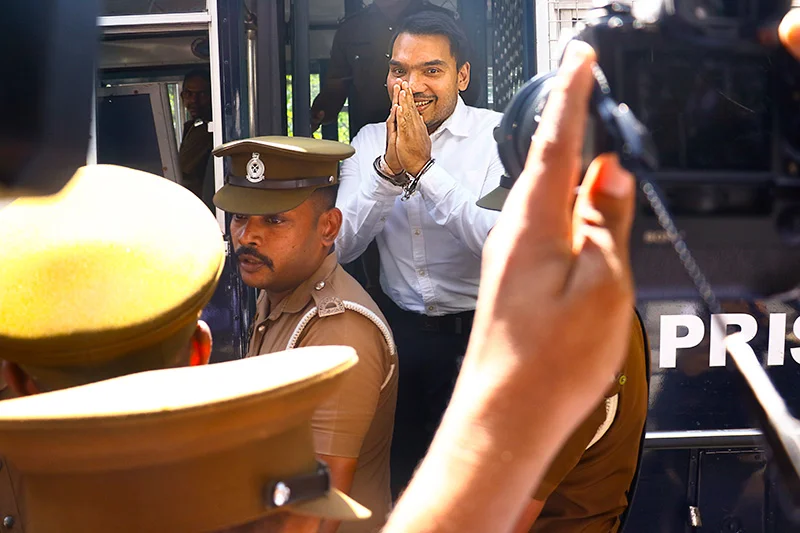
MP Namal Rajapaksa, who is in remand custody over the controversial Airbus deal, was further remanded until October 27 by the Colombo Magistrate’s Court yesterday (13).
Colombo Chief Magistrate Asanga S. Bodaragama made the order after considering submissions by officers of the Commission to Investigate Allegations of Bribery or Corruption and lawyers representing Rajapaksa.

Sri Lanka’s economy is expected to sustain its recovery over the next two years, although growth is projected to moderate amid mounting global uncertainties, according to the International Monetary Fund’s (IMF) latest World Economic Outlook.
In its World Economic Outlook 2026: Resilience Under Strain, Urgent Choices, the IMF projects Sri Lanka’s economy to expand by 4% in 2026, slowing to 3.7% in 2027, following estimated growth of 5% in 2025.
Inflation, meanwhile, is forecast to rise to 5.3% in 2026 and 5.4% in 2027, reversing the average deflation rate of 0.5% recorded in 2025.
Unemployment is expected to remain steady at 3.9% throughout the forecast period.
The projections come amid growing pressure on the global economy from the ongoing conflict in the Middle East, elevated energy prices, geopolitical tensions and trade disruptions.
Sri Lanka’s external position is also expected to weaken, with the current account balance projected to shift from a surplus of 1.6% of gross domestic product (GDP) in 2025 to deficits of 0.5% in 2026 and 0.3% in 2027.
The IMF’s outlook points to continued economic expansion in Sri Lanka, but with slower growth, rising inflation and a narrowing external surplus giving way to current account deficits over the forecast period.

Heavy showers above 100 mm are likely at some places in the Western, Sabaragamuwa, Southern, Central, and North-western provinces and in Anuradhapura district.

Sri Lanka, India caught in US-Iran ship crisis

Namal further remanded

IMF projects Lankan economic growth to moderate amidst mounting global uncertainties

Major Gen Pushpakumara assumes command of 56 Infantry Division

Dickwella axed, Bandara earns maiden Test call up

‘Dates have the highest sugar content to fight Coronavirus’

Sunday Island 27 December – Headlines

#SundayIsland 17th December – Headlines

Sunday Island – 28th March

Sunday Island Headlines – 21 March

Sunday Island – 21st February – Headlines
-

 Features7 days ago
The Sri Lankan who made Scottish history
-

 Sports7 days ago
Nissanka absence opens door for Sri Lanka’s young guns
-

 News6 days ago
NDB fraud Rs 60mn more than reported
-

 News6 days ago
Removing monk’s robes matter for Sangha to decide: Mahanayake Theras
-
 News7 days ago
Shiranthi R remanded until 13 Oct.
-

 News4 days ago
Sri Lanka escalates anti-graft drive with Shiranthi’s jailing
-

 News5 days ago
NPP govt. reminded of its responsibilities as US warship leaves Colombo
-

 Features7 days ago
Future of Sri Lanka’s state university system: Should it be shut down and reopened?