
Features
Still more on the 1971 Insurgency


by Maj. Gen. (Rtd.) Lalin Fernando
Artillery Capt Bashoor Musafer states in the third part of his recall of his operational duties in 1971 that Hambantota had a large Malay population. They came here from Java with the Dutch. Thanks to a grateful British colonial government his valiant, disciplined and loyal ancestors who served in the First Ceylon Regiment in 1802, were allotted land there in addition to Cinnamon Gardens and Slave Island in Colombo. Their descendants continued to serve their adopted country with the very same staunch attributes.
Capt Musafer was trained in the third Intake of Ceylon cadets at the Pakistan Military Academy(PMA) Kakul which historian Arnold Toynbee in his book ‘Between Oxus and Jammu’ said was the most scenic and ideal location for such an Academy. He expected it to be one of the best. The first PMA Ceylon intake had Col PVJ (Jayantha) de Silva(late SL Light Infantry) who was appointed Under Officer and came tuird in the order of merit. This is a magnificent achievement as the Pakistanis have long and glorious history of war fighting. Their cadets came from world renowned martial races such as Punjabis, Pathans and Baluchis.
Capt Musafer and I played rugby for our regiments and the Army XV but at different times. He captained the Army team later. Gemunu Watch(GW) soldiers also played for the Artillery twice when the Gunners were short of players even though the GW team had just finished playing their own inter regiment match on both occasions!
The bestial tragedy at Kataragama brought shocking shame to the country and the Army. The conduct of volunteer force officer Alfred Wijesuriya who died in prison and Sgt Ratnayake who after serving his sentence was himself murdered by the JVP in 1988 was abominable. PM R Premadasa made political capital of the incident by constructing a monument to Ms Premawathie Manamperi at Kataragama. It included an inscription that shamed the Army.
Capt Musafer errs when he says the late Lt Gen (then Capt) Denzil Kobbekaduwa commanded the hurriedly established and named Field Security Detachment (FSD) in April 1971.It was not Division as given either. It was tasked to interrogate suspect JVP sympathizers among serving troops.
Actually it was recalled Volunteer Lieutenant in 1970 Anuruddha Ratwatte who commanded it. Having been commissioned into the Second(Volunteer) Battalion Sinha Regiment in Kandy. He had been declared ‘dead wood’ not long after as he had not reported to the unit for years.
However he was not ‘Struck off Strength’ which was an administration blunder. Thus he retained his commission and was proposed for a job in the Army when Mrs. Bandaranayke became PM in 1970. He had previously been administrator of the Central Ceylon Youth Council Kandy and its library.
He left the army again after the 1977 election but got back into aged 56 in 1994 as he was made deputy Defence Minister and was promoted four star General!
Sarath Amunugama in his memoires says he happened to be at Temple Trees on April 5, 1971 and saw a hilarious sight – his school friends Anuruddha and Denzil lying on the grass behind two Bren (British Enfield) machine guns facing the entrance to Temple Trees even though Armoured cars too were there.
However the FSD was not, as Capt Musafer says, tasked to provide security for the Prime Minister from 1970 when she became into power. That was done by the Composite Guard (CG) raised on the personal instructions of the PM. Its officers and troops, mainly from the infantry, were under a Sinha Regiment Officer, also from Trinity but not a relative. From 1966 until 1970 he had been on compulsory leave like then Lt Kobbekaduwa and a few others.
When the threat of a JVP attack on the Rosmead Place home of the PM was said to be suddenly imminent on April 5, Anurudha and the Army Commander Lt Gen Attygalle, a more disparate professional combination could not be imagined, persuaded the PM to move to Temple Trees. Anurudha manoeuvred deftly to take charge of the PM(his relative)’s security. Maybe the Bren gun story proved his loyal credentials. He swiftly consolidated his new power base by persuading Gen Attygalle to disband the CG.
This was done in real Attygalle overkill style. The CG camp at the 80 Club was surrounded by armoured cars. This was the first and last time this was ever done to an army camp. One must dread to know what orders the crews of the armoured vehicles with two pounder guns and machine guns had been given! The nonplussed and demoralized officers and troops of the PM’s Own Guard the day before returned to their units.
The Sinha Regt Officer Commanding was a short while later taken on trumped up charges of having planned to take over the government! He had just 120 troops but the FSD boss insisted it could have been done as though the extraordinary German Skorzeny (Hitler’s Commando) who rescued Mussolini from captivity in WW2 had been haunting the 80 Club. All this while the insurgency was raging and those in power were in a blue funk.
At the funeral of the Sinha Regt officer (of a heart attack age 52) in 1989 which the former PM with her brothers, Doctors Sivali and Mackie Ratwatte attended, Dr. Mackie apologized to the officer’s younger brother who had also been in the army, for their ill advised decision based on loaded advice. He said the former PM was very sad and that they had vowed that his elder brother would be given due recognition when they came back to power again. Lakshman Jayakody(former Minister in the 1995 Cabinet and also a Trinitian)when he spoke to the younger brother later made no bones about who was behind it all.
Capt Musafer refers to the Panagoda cantonment where hundreds of jittery soldiers imagining they were under attack at night, enacted a riotous, ill disciplined stunning live ammo fireworks display after a single soldier opened fire at a shadow. A huge amount of ammo was wasted. One soldier died. Later on that night Capt Sarath Wijesinghe, Engineers (National putt shot, Javelin etc champion) was dispatched in a jeep to the Sewage Treatment Plant at Habaragala along with a diminutive captain who was in the non combat Army General Service Corps (Pay and Records).
The troops at the Treatment Plant were not informed about this movement. When they saw the jeep coming unannounced, they went berserk and fired frenetically as the others before. The jeep skidded to a halt. The occupants jumped out and rolled down the ditch by the side of the road. Capt Wijesinghe heard someone moaning. Thinking the captain had been wounded Wijesinghe turned round to find out. The captain had cracked and offered his resignation with immediate effect! He later went on to reach the rank of Brigadier! He had been an artillery officer before too!
Capt Musafer mentions the Vavuniya ambush that led to the death of Capt Noel Weerakoon and Bombardier (Corporal in the Artillery) Munesinghe. I heard the news on the army radio at night at the GW detachment, Ella that I was visiting from Wellawaya. I asked to speak to Sergeant Weerakoon, Noel’s brother, who was in charge of the Signal’s Detachment at Diyatalawa. He broke down but confirmed the story. I offered my deepest sympathies. Noel had an exuberant personality with an extravagant imagination. He would be much missed by many.
This was a stunning blow to us all. We now realized we too, not only the police, were on the firing line. We left immediately for our base at Wellawaya driving without lights but were helped by a near full moon on those badly maintained winding mountain roads.
Noel had been at the Royal Military Academy Sandhurst with me. We played in the same cricket team in two summers, spent a Spring holiday in Dublin with later Major Careem Zavahier (National and Sandhurst Fly Weight boxing champion – now in New Zealand).Noel and I toured the British Army on the Rhine (BAOR) Germany units with the Sandhurst cricket team to play cricket during the summer vacations in 1959 and 1960.
The famed Olympic Stadium was our venue in Berlin when we played the BAOR Combined Services team. Berlin then was divided into Russian and Allied (British, American Sectors) but we were allowed to visit East Berlin and even chatted with the Russian sentries at their memorial in the British sector. We went there through East Germany from Hanover by train with strict orders not to open the window blinds to view East Germany under grim Soviet rule. The orders were not strictly followed. Together with us were my fellow Trinitian Sena de Sylva, John Francis (Jaffna) and my brother Eshin (yes five from Ceylon, three from Trinity in that team).Noel, Sena and I then toured Scandinavia after the 1959 tour.
Major Denis Hapugalle later Brigadier was with GA Bradman Weerakoon (Royal Thomian cricketers combine) in charge of affairs at Vavuniya. Denis advised the impetuous Noel to postpone his move to Anuradhapura for the next morning but tragically failed. Noel’s mission was to transport ammo to Anuradhapura, hence his haste.
Flamboyant Volunteer Force Colonel Derrick Nugawela’s arrived as Coordinating Officer at Hambantota. The Kataragama incident happened under his watch. Alfred Wijesuriya vainly quoted orders from higher command as his defence at the murder trial.
The Colonel imagined he was a Theater Commander. (Theater Command is a unified command under a single commander for a force consisting of Army, Navy and Air Force troops – like Eisenhower in North Africa). He was a relative of the PM. He had about two platoons (72 men) under his command. He was a full time tea planter who reveled in military pomp and show.
The first thing the volunteer Colonel on arrival with escorts brandishing weapons did after having had a cup of tea, was to ask an utterly cowed Hambantota Rest House Keeper for ‘baked crabs’ for dinner. This was for effect in English. Waving a revolver for greater effect he added that if there weren’t any by 7.30 pm sharp he would ‘shoot karanawa’him.
Regular officers had to painfully humour such grandees. He then did a flag flying drive with escorts to Wellawaya and Monaragala which were not in his ‘Theater’ but he acted the part well.At Wellawaya he said that foreign envoys had seen the PM and wanted reports of excesses investigated. Apparently Kegalle had been bad.
However at Hanwella police station Lt (later Major General)Janaka Perera stood up to a major of his regiment, the Engineers, who had arrived from Army HQ and ordered him to ‘clear’ the cells of captured insurgents. Janaka refused point blank despite the Major venting his fury on what he called a disgrace to ‘Sandhurst’. The major then asked platoon sergeant Senanayake to do so. If the major was so anxious to pursue criminal orders to please his bosses he should have done it himself.
Sgt Senanayake reluctantly had the ‘prisoners’ lined up and prepared to fire. Many prisoners were crying but one man stood erect to face him. The next moment saw the sergeant vomiting. He could not and did not shoot. The major left, his mission failed. His was not called ‘Mad’ for nothing.
Like Capt Musafer I too, according to one of its prominent officers, was ‘investigated’ by the FSD after I returned to Diyatalawa. That officer added that I came off with ‘flying colours’ whatever that meant. It was for me degrading and humiliating to know it was done at all. Were there ‘Commissars’ at work? This did not auger well for the future of the army. It may well have set a trend that has now firmed in. The FSD was called very unkind (stinking) names by all.



by Jehan Perera
The NPP government is going after powerful figures from the past and present who have engaged in corruption, fraud and criminal activity in a way that no previous government in Sri Lanka has done. Former ministers, politicians and senior state officials are among those facing investigations and legal proceedings. The government has placed before Parliament a document listing 50 cases involving corruption, fraud and other crimes. These include not only financial offences but also cases relating to the Easter Sunday attacks, the killings of Lasantha Wickrematunge and Wasim Thajudeen, the disappearance of Prageeth Ekneligoda and attacks on journalists Keith Noyahr and Upali Tennakoon.
The significance of this effort is that it can demonstrate that nobody is above the law, regardless of political connections or social standing, which will help restore public confidence in institutions that have long been distrusted. It could also recover public resources, improve the investment climate and strengthen the foundations for a more prosperous and just Sri Lanka. When criticised for focusing on the past and not the present, the government position is that these investigations were initiated under earlier governments, particularly between 2015 and 2019, and that it is now allowing investigators to proceed to deal with the backlog without political interference.
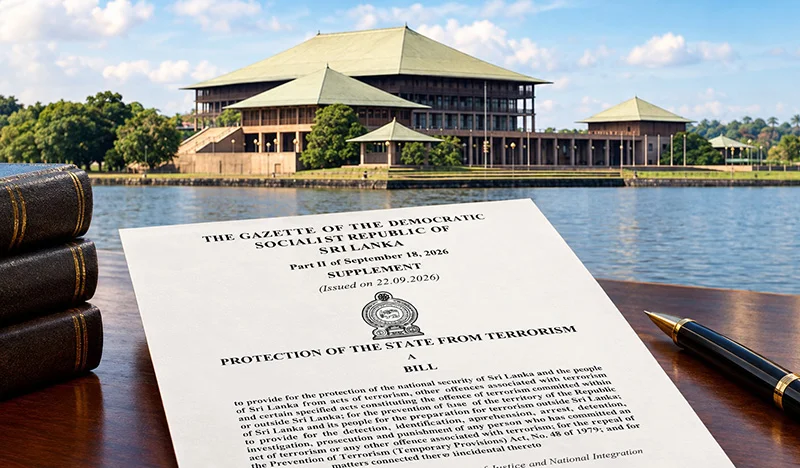
But there is an aspect of the government’s approach that is less justifiable. While pursuing past wrongdoing by powerful individuals, it is also advancing a triumvirate of draft laws that could give the state sweeping powers over citizens, organisations and dissent in the present and future. The draft Prevention of Terrorism legislation, the Prevention of Organised Crimes Bill and the NGO Registration and Supervision Bill raise serious questions about the over-centralisation of power. Each of these laws strengthens the powers of the state while weakening the rights and safeguards that protect people from their misuse and thus questions the basic rights of people in democracy where ‘the power of the people is vested in the government’. This is a recipe for future misrule rather than the rule of law. As the well-known saying goes, power corrupts and absolute power corrupts absolutely.
Proposed Laws
The real test of system change, for which the government obtained an overwhelming mandate, requires not only a government willing to hold others accountable, but one prepared to subject itself to the same principles of legality, transparency and restraint. The three proposed laws that are particularly important in this regard are the Protection of the State from Terrorism Bill, the Prevention of Organised Crimes Bill and the NGO Registration and Supervision Bill. Each of these draft laws has been presented as serving a legitimate purpose. Preventing terrorism, combating organised crime and ensuring that NGOs do not facilitate money laundering or terrorist financing are proper responsibilities of the state. Sri Lanka has international obligations in these areas, and no responsible government can disregard them. However, the existence of a legitimate objective does not justify every means adopted to achieve it.
The proposed Protection of the State from Terrorism Bill illustrates the problem. Although its definition of terrorism draws on a model developed by a former United Nations Special Rapporteur, the Human Rights Commission of Sri Lanka has warned that the definition of terrorism extends beyond the model and could bring legitimate political protest, trade union action and civil disobedience within the scope of counter-terrorism legislation. Its concerns also include prolonged detention, inadequate judicial oversight and restrictions on access to legal counsel. These are objections that go to the heart of the relationship between the citizen and the state. The government cannot credibly promise to protect democratic freedoms while creating powers that could be used to restrict them. It is necessary for the government to reassess the draft through transparent consultation and revise provisions that could criminalise legitimate dissent.
The Prevention of Organised Crimes Bill raises similar concerns. It is presented as giving effect to the United Nations Convention against Transnational Organised Crime, which Sri Lanka ratified in 2006. The Centre for Policy Alternatives (CPA) has argued that the convention does not require many of the bill’s provisions. The proposed law extends to a broad range of offences, permits detention orders lasting up to a year, makes confessions to police admissible for purposes of legal evidence, and introduces extensive surveillance powers. A law intended to dismantle criminal networks should not create a parallel system of exceptional powers that could be applied far beyond organised crime. Nor should safeguards developed through years of experience with abuses under the Prevention of Terrorism Act be weakened through legislation bearing a different name. The government should review whether or not existing laws could be used effectively to control these crimes or whether each exceptional power is necessary.
Civil Society
The proposed NGO Registration and Supervision Bill presents another test of the government’s intentions. The government may reasonably seek transparency in the finances of organisations receiving public or foreign funds, including measures to prevent money laundering and terrorist financing. It seeks to justify its overreach on the grounds of meeting the internationally mandated requirements of the Financial Action Task Force (FATF) for the Asia-Pacific region. But these objectives do not justify placing civil society and NGOs under excessive administrative control when even the FATF ranks them as low to medium risks. The draft bill would require registration and renewal, impose extensive obligations on organisations and empower authorities to suspend or deregister them on broadly framed grounds. It is important to redraft provisions that confer excessive discretion over registration, renewal, suspension and deregistration of NGOs.
Among the concerns raised by United Nations human rights special rapporteurs with regard to the draft NGO law are provisions requiring organisations to align with government policies and restrictions that could affect advocacy, dissent and freedom of association. The implications extend well beyond organisations that engage directly with the government. Community groups, human rights organisations, independent researchers and organisations working on reconciliation or accountability could find their activities constrained by uncertainty over how these provisions might be interpreted. Organisations that criticise government policies are not thereby working against the country. Their freedom to do so is part of what distinguishes a democracy from a system in which the government determines which opinions and activities are acceptable.
The government has generated considerable public goodwill through its pursuit of corruption and criminality. It should not assume that this goodwill gives it an unlimited mandate to strengthen the coercive powers of the state. The NPP knows from its own history that governments can treat dissent as a threat and use the machinery of the state against their opponents. There is still time to correct the drafts through transparent public consultation, narrow definitions of offences, meaningful judicial control over detention and surveillance, and effective remedies against arbitrary decisions. A government that pursues corruption while weakening safeguards against state abuse risks undermining its own achievements. Besides bringing to light the abuse of power by previous governments, the NPP government needs to build a system in which no future government can abuse power in the belief they can get away with it.

 By Ramya Kumar
According to the Quality Assurance Council (QAC) of the University Grants Commission (UGC), quality assurance (QA) refers to “the means (i.e. the policies, attitudes, actions, procedures, etc.), by which an institution can guarantee with confidence and certainty, that the standards and quality of its educational provision are being maintained and enhanced”.
An expansive structure has been in place since 2005 to govern and implement QA processes within the state university system. The QAC is the focal point at the UGC that implements external reviews of state universities and institutes. Each university has its own Centre for Quality Assurance (CQA) tasked with performing QA in line with QAC directives. Faculties, in turn, have Internal Quality Assurance Cells (IQAC) performing their own QA; they are answerable to the CQA.
The big question is whether this all-encompassing top-down QA system, that in many ways undermines the internal dynamics of university governance, actually supports universities to enhance the quality of education. This article highlights some concerns.
Top-down check-box activities
The QAC conducts external reviews of universities and degree programmes. A review team appointed by the UGC (who may or may not have experience in the institution/programme in question) examines the self-evaluation report submitted by the said institution/programme. The team then conducts a site visit to verify the claims made in the university’s self-evaluation report, clarify issues identified during the desk review, and examine how QA procedures operate in practice. The team holds meetings with the university administration, members of the Council and Senate, Deans, Heads of Departments, academic and non-academic staff, students, and others. Following the visit, a draft report is submitted to the relevant institution/programme for comment before final publication. The reviewed institution/programme then prepares and publishes an action plan addressing the recommendations, with subsequent monitoring of progress.
There are some worthy QA initiatives under implementation, such as improving facilities for students with disabilities and strengthening mechanisms to address sexual- and gender-based violence. However, for the most part, QA activities have little to do with improving the quality of education. They are mostly preoccupied with monitoring faculty and department websites, digital transformation, student feedback, subject evaluation, course evaluation, peer evaluation, and, more recently, staff appraisal. These activities, which consume an inordinate amount of time—so precious at understaffed universities—have become check-box activities completed to generate evidence for the next review. Below is an excerpt of a conversation between two academics (1 and 2) that conveys how QA plays out at universities (reproduced with permission).
1: … .it’s like social media you know, like posting things on Facebook or twitter or Instagram. When people do a lot of social media, everything they do, they do thinking, “okay I’m going to post it in this way… this I have to put on my Instagram.” QA is a little like that… everything is considered in light of, “ah we can use this for the review, as evidence… for example very recently we were encouraged to have all the things that we do in our department in the faculty newsletter so then they can put in the review. Every little thing has to be noted down….
2: And with pictures and all…
1: At the very least it has to be written so that you have written evidence .. you can’t be doing something for the sake of doing something or because it is good for the department … and sometimes people tell me “oh yea that’s a good idea we can fit that under this x, y section of the review..”
2: Yea, and nobody really thinks about the actual outcome… whether it’s actually helping anyone..
1: I also find that a lot of the words that we used in different ways have now been co-opted to the QA discourse ..including quality.. I can’t actually say what I want as an “outcome”, for example, that the outcome of this workshop is that my students “think about” … then I am told “ah but no that’s not one of the Bloom’s taxonomy words, “think about”.…
2: And the worst part is these medical and agriculture people, these types of people go around spreading it like some kind of gospel!
1: Yea, this cookie cutter way of doing things, they think is the height of innovativeness or creativity, when actually it is so mundane … for me the most awful thing about it is like some fungus of mundanity has taken over through QA reviews.
2: yea, when you say QA, my mind closes off immediately and I stop listening…
Auditing everything but power
QA leaves out crucial aspects of university governance. For instance, there is no review or assessment of the “quality” of university administrations under Criterion 1 or the integrity of procedures governing the promotion of academic staff under Criterion 6 of the institutional reviews.
The majority in the Council—the university’s executive and governing body, which is responsible for selecting the Vice-Chancellor (VC)—are appointed in ad hoc fashion. Apart from the Ex-Officio members in the Council (VC, Deans, etc.), and the two members elected by the Senate, the remainder are appointed by the UGC with no formal consultation or vetting procedure. The VC appointment process described in UGC Circular No. 03/2023 exemplifies how an ostensibly technical process can become entangled in political sycophancy. The Registrar invites applications for the position of VC through advertisement. Applicants must submit a curriculum vitae, a statement of vision for the university and supporting documents. The University Council appoints a three-member Search Committee of senior academics to encourage “eminent persons” to apply, while the UGC appoints a former VC from another university to “observe” the selection process.
A Special Meeting of the University Council is convened. Candidates are interviewed and must make a presentation to the Council Members, followed by questions. Each Council member “gives marks” for seven prescribed criteria: strategic focus (20%), effective leadership (20%), holistic thinking/conceptual skills (10%), academic and research excellence (15%), personal integrity (10%), professional communication (10%) and managerial competence (15%). Marks are averaged, and the Council recommends three candidates to the UGC in rank order. The UGC-appointed observer separately submits a confidential report on the selection process.
This procedure is expected to guarantee quality, but does it? Applications are submitted to the Council Members, who have been appointed on questionable bases, and who are expected to review the applications and give scores, based on objective assessments. But, in reality, most Council Members are manipulated by VC candidates, who often have personal ties with them. The UGC-appointed observer usually has no genuine interest in the outcome. And there is no way for anyone to actually question the Council’s decision once it is made. Although the highest-ranked candidate may ultimately be appointed, the selection remains a political decision made by the President, who retains the discretion to appoint any one of the three.
External reviews also do not look into the promotions of academic staff, except to scrutinise whether there are policies and procedures in place to govern promotion. Academic staff may apply for promotion to Professor once they satisfy the prescribed eligibility requirements, which typically include the period of service, academic qualifications, research and publication achievements, teaching experience, and contributions to the university and wider community. Applications are evaluated against specified criteria, with research output and academic contributions assessed through documentary evidence and expert evaluation. Under the UGC’s scheme for Professors, two experts from outside the applicant’s institution assess specified aspects of research and knowledge dissemination. Again, beneath this technical process, which is externally evaluated, lies a problematic points-based scheme that can be manipulated and abused with impunity.
Rethinking university QA
Like the VC election process and the schemes of promotion for academic staff, QA reviews are open to manipulation. Before a review, there is a chaotic rush to complete evidence gathering and reporting. Academics leave all other work aside, including at times their teaching, to focus on completing documentation and preparing reports. The standardised criteria in the review manuals and scoring sheets often do not reflect differences in disciplines and institutional contexts. But this does not really matter because any serious problems experienced by institutions or programmes are hastily brushed under the carpet to conceal any evidence that could taint the review. The goal is to obtain an A or at least a B grade at whatever cost.
QA may result in positive change if it moves beyond top-down check-box activities towards internally designed and owned processes encompassing all aspects of university governance, led by departments and faculties, and supported by adequate resources. The current QA system needs to be dismantled and replaced by procedures that are accountable, not to the UGC, but to our students and the communities we serve.
(Ramya Kumar is attached to the Department of Community and Family Medicine, Faculty of Medicine, University of Jaffna)
. Kuppi is a politics and pedagogy happening on the margins of the lecture hall that parodies, subverts, and simultaneously reaffirms social hierarchies.
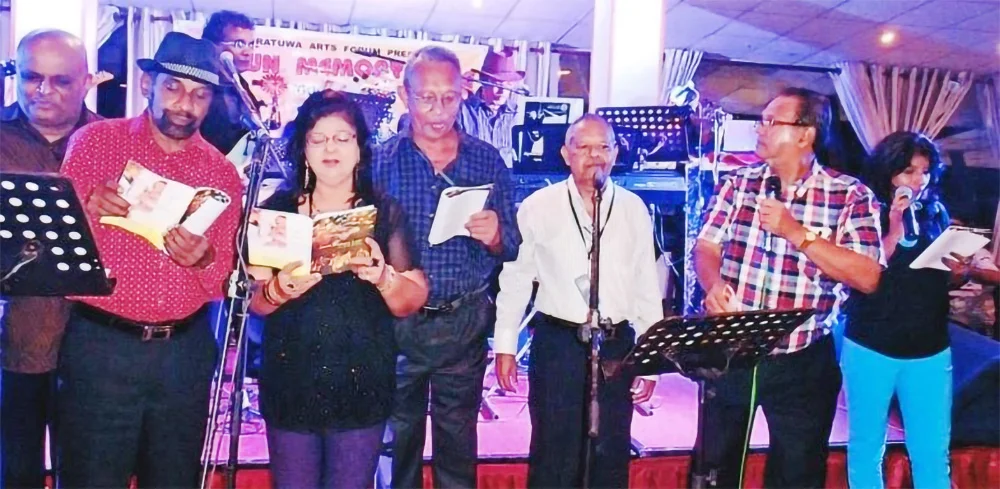
 Yes, Down Memory Lane, the beloved Sing-Along concert series that first struck a chord, way back in 1997, returns for its landmark 20th edition this Saturday, 17th October, at the beautiful Bolgoda Grand Resort, Moratuwa town centre.
Having celebrated its glorious 25th anniversary with the show in 2023, this milestone 20th concert promises to be even more special.
The organisers, the ever-popular Moratuwa Arts Forum, are pulling out all the stops to present yet another unforgettable evening, brimming with camaraderie, fellowship, and pure nostalgia.
Get ready for two-and-a-half hours of non-stop singing as veteran vocalists, from the Moratuwa Arts Forum, will take the stage to lead and inspire the happy audience to sing, sing and sing to their hearts’ content.
The repertoire? Absolutely magical, according to the organisers.
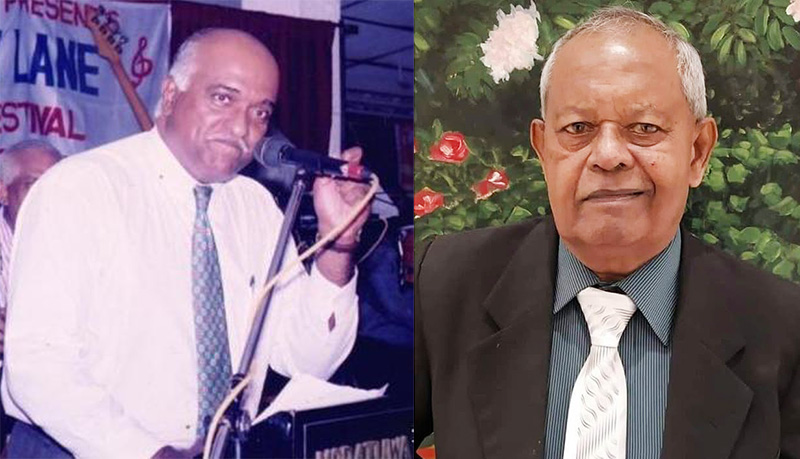
Veteran Arun Dias Bandaranaike: Will handle the evening’s proceedings / Priya Peiris: Event Conceptor
Around 40 golden oldies — from timeless English vintage evergreens and hits from the 50s to the 90s, to toe-tapping calypsos, soulful American plantation melodies, rousing cowboy and Dixieland favourites, aa well as cherished Sinhala standards. All to be sung with much gusto!
This year’s dedicated organising committee comprises Brian Coorey (Chairman), Priya Peiris (Event Conceptor), Hiran Fernando, Suranga Fernando, Viranjan Perera, Hemka Fernando and Neelesh Silva. Guidance and support comes from Moratuwa Arts Forum President Sarana Guneratne and Secretary Chandani Silva.
Adding his signature charm to the evening, as Master of Ceremonies, will be the veteran Arun Dias Bandaranaike.
Don’t miss this landmark celebration of music and memories!
For further details, contact Hiran Fernando on 0772636446 or WhatsApp 0783636446.

Missiles intercepted near Riyadh after Saudi coalition hits Yemen fuel depot

MI5 chief warns of threats to UK from Russia, Iran and AI

Pope diagnosed with lung cancer but had successful surgery, Vatican says

Expedite the cleaning of Colombo’s canals and drainage systems within the next two weeks – PM instructs officials

Kusal Mendis’ unbeaten 87 hands Sri Lanka consolation win

Cabinet approves redrafting of State Assets Management Act

‘Dates have the highest sugar content to fight Coronavirus’

Sunday Island 27 December – Headlines

#SundayIsland 17th December – Headlines

Sunday Island – 28th March

Sunday Island Headlines – 21 March

Sunday Island – 21st February – Headlines
-

 Features6 days ago
The Sri Lankan who made Scottish history
-

 Sports6 days ago
Nissanka absence opens door for Sri Lanka’s young guns
-

 News5 days ago
NDB fraud Rs 60mn more than reported
-

 News7 days ago
Gnansara Thera to be assigned to prison printing section: Officials
-

 News5 days ago
Removing monk’s robes matter for Sangha to decide: Mahanayake Theras
-
 News7 days ago
OIC of FCID summoned before Maligakanda Magistrate
-
 News6 days ago
Shiranthi R remanded until 13 Oct.
-

 Features6 days ago
Future of Sri Lanka’s state university system: Should it be shut down and reopened?