
News
State Minister Dr. Godahewa explains govt economic strategy

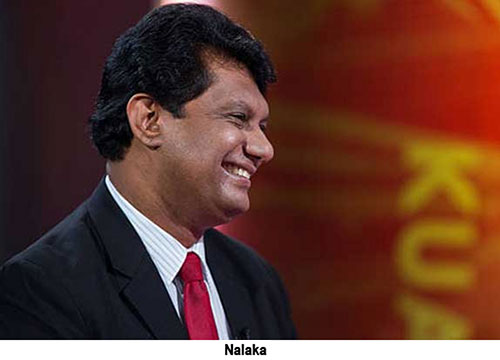
State Minister Dr. Nalaka Godahewa told the parliament on Saturday (21) the government launched a pragmatic programme to lift millions of people from poverty. The minister said that when one member of a family under extreme poverty received a permanent employment opportunity, the entire family achieved some degree of economic stability. The 100,000 jobs programme aimed to achieve that objective. Rs. 4,000 grant for vocational trainees also aimed to give opportunities for the youth of poor families, the minister said.
Dr. Godahewa said: “At the time of the 2015 regime change, I was serving as the Chairman of Securities and Exchange Commission of Sri Lanka which regulates Colombo Stock Market. Generally, Stock market is considered to be the barometer of any economy. Because investor confidence and stock market indices have a direct correlation. Typically the market slumps when investor confidence shatters.
During the post war period between 2010 and 2015, market capitalization of Colombo stock market jumped by 535% and as a percentage of GDP it increased from 11% to 36%. All Share Price Index (ASPI) gained 255% during that period. Colombo stock market had even won accolades as the most promising and sustainable stock market in Asia.
The IMF in its report dated 29 June 2014 identified Sri Lanka as one of the fastest growing economies of Asia. International rating agency Moody’s in July 2014 stated that the strength of the Sri Lankan economy is reflected in its increasing per capita income and global competitiveness index rating.
By this time Sri Lanka was holding Asia’s 1st or 2nd positions in almost all key economic indicators. In 2014 GDP grew by 6.8%. Total GDP (Gross Domestic Product) in 2014 was US Dollars 80 Billion and Central Bank of Sri Lanka (CBSL) forecast was Sri Lanka GDP to reach USD 163 Billion by 2020. Per Capita Income of US Dollars 3,654 in 2014 was anticipated to reach USD 7,500 by 2020.
Unfortunately the ones, who are trying to teach us economic management sitting in the opposition benches today, are the same people who came to power in 2015 January. The opposition had similar arguments and criticisms before 2015 as well. But when they came to power, as a group they proved how incompetent they are. Economic growth slumped year after year.
2015 it came down to 5%
2016 it further reduced to 4.5%
2017 3.9%
2018 3.1%
2019 2.1 %
Though we anticipated per capita income to reach US Dollar 7,500 by 2020, it stagnated at USD 3,852 by end of 2019. GDP Per Capita didn’t even gain by US Dollar 50 in 2019.The first finance minister of the Yahapalana government Ravi Karunanayake in 2019 made a public statement that the country was heading towards bankruptcy. With that kind of economic collapse and a trend, the economic growth rate would have been a negative figure with or without Coronavirus pandemic.
Unfortunately, it is such a team of losers who are trying to teach us economic management today in this parliament.
The reasons for their failures are obvious. They didn’t have a common vision or a program as it was just an unholy coalition consisting of ad hoc political groups formed merely to defeat Mahinda Rajapaksa.
Our government’s approach to economic management is completely different. We have a clear economic vision. That is people centric economic policy articulated in His Excellency President’s “Vision for Prosperity and Splendor” framework.
A National budget should be formulated based on a government policy framework. Yahapalanaya had 10 policy statements for their 5 years. Budget speeches were prepared based on the serving finance minister’s will but not based on any stipulated economic policy.
One has to first read the “Vision for Prosperity and Splendor” policy framework in order to understand the crux of this budget that we are debating. Then it would become a no-brainer to understand the concepts behind these budget proposals.
I would like to elaborate a bit more on this.
Vision for Prosperity policy statement has a 10 pillar policy framework. What are those 10 policies?
1.
Priority to national security
2.
Friendly, non-aligned foreign policy
3.
An administration free from corruption
4.
New constitution that fulfills people’s wishes
5.
Productive citizenry and vibrant human resources
6.
People centric economic development
7.
Technology based society
8.
Development of physical resources
9.
Sustainable environmental management
10.
Disciplined , law abiding and value based society
If these budget proposals are thoroughly analyzed, one could realize that the due attention has been paid to all ten areas. Each and every budget proposal is allied to one or more policies.
If I take a simple example, the increasing of retirement age in the private sector to 60 years comes under “a productive citizen” policy. Re-forestation programme and 2 million trees planting along the roadways come under “Sustainable Environmental Management” policy. Rs.20,000 million allocation for national security is due to its utmost importance. Allocations of Rs. 10,000 million for technology parks and Rs. 8,000 million for digital infrastructure are based on our “Technology based society” policy. 100,000 kilometers of rural road construction with an investment of Rs. 20,000 million and allocation of Rs. 8,000 million for improving rural schools is due to our priority policy for the “Development of physical resources”.
Since we are debating national budget proposals, for a moment let’s explore what is meant by people centric development. After receiving a historic mandate, His Excellency in his inaugural speech in this parliament articulated 4 priority areas of his economic policy.
Firstly, finding solutions for the eradication of poverty
Secondly, creating equal opportunities for everyone to prosper
Thirdly, ensuring an administration free from corruption
Fourthly, encouraging and strengthening local entrepreneurship
In some cases the reason for poverty is the landlessness and in turn, their inability to cultivate economic crops. As outlined by the President in his address to the nation yesterday, the objective of giving one acre each for 20,000 families is to achieve this objective. Everyone should have an opportunity to prosper in a people centric economy and it is the responsibility of the government to remove roadblocks for the same. Higher education doors should be opened to all youth and we should create a conducive environment to produce more and more entrepreneurs amongst them.
That’s why we have paid special attention to expand the capacities and reform curriculums in universities and vocational training institutes in this year’s proposals. City campuses are being initiated based on these objectives. This budget has provisions to increase the intake for vocational training institutes from 100,000 to 200,000.
Today many countries have leveraged technology to uplift the productivity of the government. Hence a special attention has been paid in this budget to foster the technology usage in the government sector. Online tax administration process and e-filing of corporate taxes are good examples.
Private sector has a vital role to play in the economic development process. This budget has several proposals to uplift the local entrepreneurs. Special tax concessions have been granted for agriculture and fisheries sectors. Students who enroll for vocational training are encouraged to start a business by offering Rs. 500,000 loan at concessionary interest rates.


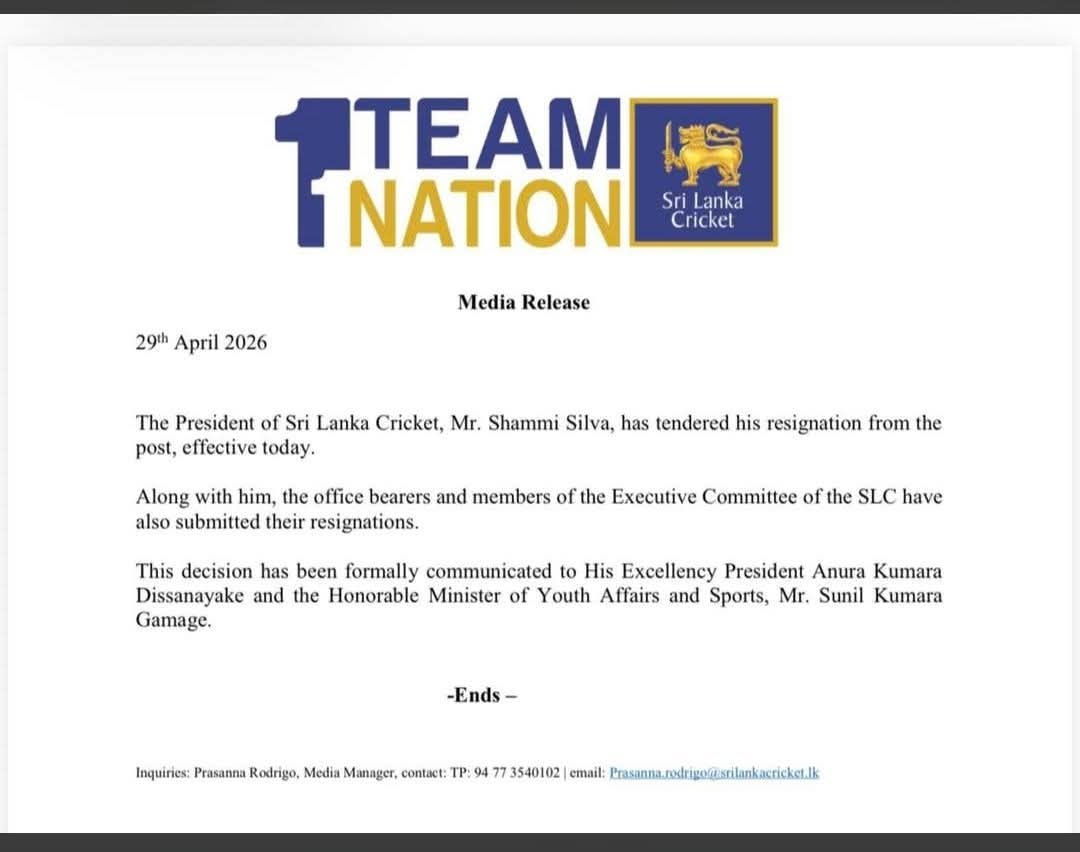
Sri Lanka Cricket has announced today (29) that the President of Sri Lanka Cricket and members of the Executive Committee have tendered their resignations.
The decision has been formaly communicated to President Anura Kumara Dissanayake and the Minister of Youth Affairs and Sports.
Latest News
Heat Index at Caution Level in the Northern, North-central and North-western provinces and in Kegalle, Trincomalee and Batticaloa districts during the day time

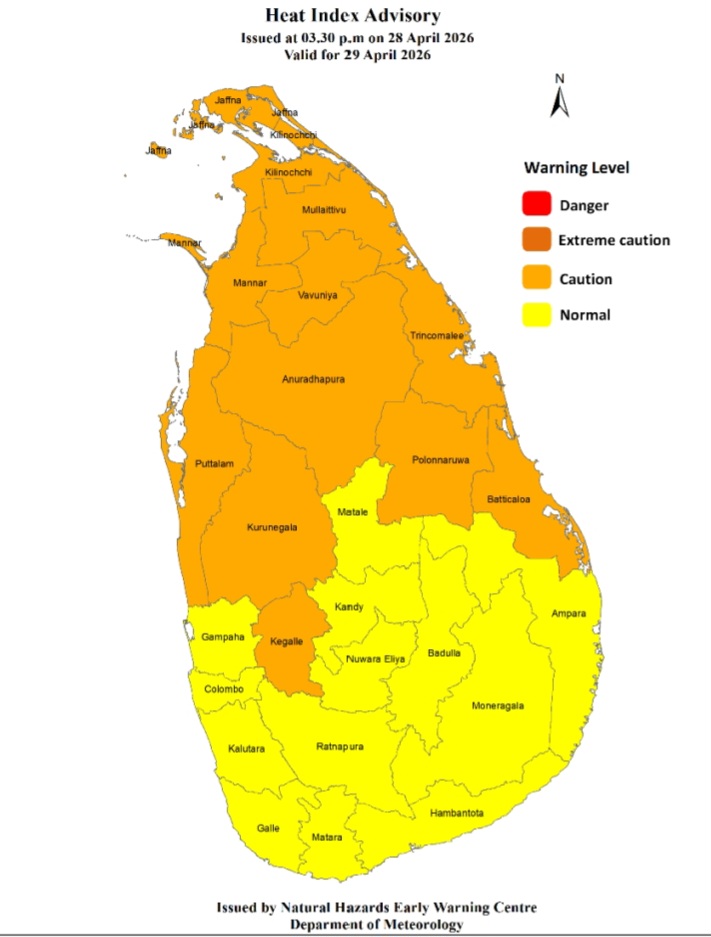
Warm Weather Advisory
Issued by the Natural Hazards Early Warning Centre
Issued at 3.30 p.m. on 28 April 2026, valid for 29 April 2026.
The Heat index, the temperature felt on human body is likely to increase up to ‘Caution level’ at some places in the Northern, North-central and North-western provinces and in Kegalle,
Trincomalee and Batticaloa districts during the day time.
The Heat Index Forecast is calculated by using relative humidity and maximum temperature and this is the condition that is felt on your body. This is not the forecast of maximum temperature. It is generated by the Department of Meteorology for the next day period and prepared by using global numerical weather prediction model data.

Effect of the heat index on human body is mentioned in the above table and it is prepared on the advice of the Ministry of Health and Indigenous Medical Services.
ACTION REQUIRED
Job sites: Stay hydrated and takes breaks in the shade as often as possible.
Indoors: Check up on the elderly and the sick.
Vehicles: Never leave children unattended.
Outdoors: Limit strenuous outdoor activities, find shade and stay hydrated.
Dress: Wear lightweight and white or light-colored clothing.
Note:
In addition, please refer to advisories issued by the Disaster Preparedness & Response Division, Ministry of Health in this regard as well. For further clarifications please contact 011-7446491.
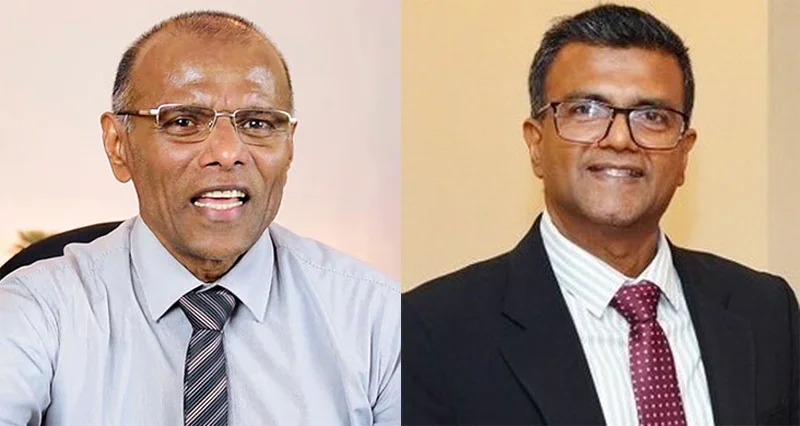
New controversy erupts over missing USD 2.5 mn:
Public interest activist Nagananda Kodituwakku has sought citizenship details of Finance Ministry Secretary Harshana Suriyapperuma from the Department of Home Affairs, Australia.
According to a letter dated 28 April, addressed to the relevant department, Solicitor England and Wales Kodituwakku sought the required information in terms of Section 15 of the Freedom of Information Act No 3 of 1982 of Australia. Suriyapperuma is also the Secretary to the Treasury.
The former Deputy Minister of Finance and Planning Suriyapperuma (from November 2024 to June 2025) is embroiled in a deepening controversy over the theft of USD 2.5 mn from the Treasury.
The leader of the Vinivida Foundation said that he intended to move court against Suriyapperuma for entering Parliament through the NPP National List in violation of the country’s Constitution (Article 91(1)(d)(xiiii).
Kodituwakku said: “This is clearly an accountability and integrity issue and violation of the Constitution of Sri Lanka and also this act contravenes the law of a member in the Commonwealth.”
USD 2.5 mn paid to a third party was meant to be an instalment of a loan taken from Australia. Suriyapperuma neither responded to an SMS nor answered his hand phone.
Geetha Kumarasinghe (UPFA/Galle District) and Diana Gamage (SJB National List) lost their seats in 2017 and 2024, respectively, over citizenship issues.
Meanwhile, public interest group ‘Free Lawyers’ that exposed the theft of Treasury funds questioned the failure on the part of Dr. Harsha de Silva, Chairman of Committee on Public Finance (CoPF), to pressure President Anura Kumara Dissanayake to temporarily remove Suriyapperuma to facilitate unhindered investigations.
On behalf of ‘Free Lawyers’, Rajith Keerthi Tennakoon yesterday expressed concern over the way the CoPF, under SJBer de Silva’s leadership, handled the issue at hand. Issuing an open letter, Tennakoon, urged the CoPF chief to explain his stand on a spate of vital issues which needed to be addressed without any further delay.
By Shamindra Ferdinando

Eran Wickeamaratne named new Sri Lanka Cricket chief

President and Exco of Sri Lanka Cricket step down

Ferreira, Shubham, Rajasthan Royals openers hand Punjab Kings their first defeat

Dulani and Samarawickrama set up Sri Lanka’s victory in T20I series opener

Heat Index at Caution Level in the Northern, North-central and North-western provinces and in Kegalle, Trincomalee and Batticaloa districts during the day time

Showers or thundershowers will occur in most parts of the island after 1.00 pm

‘Dates have the highest sugar content to fight Coronavirus’

Sunday Island 27 December – Headlines

#SundayIsland 17th December – Headlines

Sunday Island – 28th March

Sunday Island Headlines – 21 March

Sunday Island – 21st February – Headlines
-

 News7 days ago
Lanka faces crisis of conscience over fate of animals: Call for compassion, law reform, and ethical responsibility
-
 News6 days ago
Whistleblowers ask Treasury Chief to resign over theft of USD 2.5 mn
-

 News6 days ago
No cyber hack: Fintech expert exposes shocking legacy flaws that led to $2.5 million theft
-

 News3 days ago
BIA drug bust: 25 monks including three masterminds arrested
-

 Business4 days ago
Nestlé Lanka Announces Change in Leadership
-

 News3 days ago
Banks alert customers to phishing attacks
-
 News4 days ago
Hackers steal $3.2 Mn from Finance Ministry
-
 News22 hours ago
Treasury chief’s citizenship details sought from Australia