
Business
SriLankan Airlines brings Entrepreneurs’ Organization Nepal to Sri Lanka


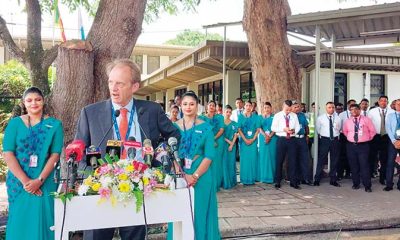
SriLankan Airlines is organizing the first-ever series of meetings in Sri Lanka for Entrepreneurs’ Organization (EO) Nepal as part of its ramped-up efforts to help the country rebuild and grow tourism. The airline’s commercial strategy and product portfolio caters to many different types of travellers, and MICE (Meetings, Incentives, Conferences & Exhibitions) tourism remains a focal segment. As an airline, SriLankan is able to provide the complete package to MICE customers inclusive of air travel; hotel accommodation; transfers; tours and much more.
The Nepal chapter of EO, the world’s only peer-to-peer network exclusively for entrepreneurs, currently has close to 100 members from a diverse cross-section of industries. Members will visit Sri Lanka in groups over the coming months for a series of meetings. The first group wrapped up their visit recently and included Chiefs; Vice Presidents; Directors and Capital Advisors of leading Nepali organizations such as the Reliance Group Nepal; City Tech; Khangri Sourcing; Mercantile group; ARKS Capital Advisors; and Siddhartha Group.
SriLankan Airlines’ MICE services were especially sought by EO Nepal on account of the airline’s experience and capabilities in providing the full range of services required to successfully pull off a destination event. SriLankan is also the only airline to offer direct flight services between Colombo and Kathmandu, Nepal with five frequencies a week.
Additionally, SriLankan provided exclusive benefits to the group that only an airline can deliver such as special airfares, airport facilitation including a dedicated counter at the departure airport, group check-in and seating options and a special onboard welcome. Along with local travel trade partners, SriLankan pulled out all the stops to ensure that the EO Nepal delegation had a quality experience in Sri Lanka.












Business
Labour shortages are pushing Plantation Companies towards machines, data and a different kind of worker


Sri Lanka’s plantation sector is entering a new phase of transformation, as technology and innovation reshape how estates operate, manage resources and sustain productivity. Across the country’s tea estates and other plantations, machines are increasingly complementing skilled workers in tasks once done almost entirely by hand, while software and data bring new precision to decisions traditionally guided by experience.
Automated harvesters, pruning machines and drones are being deployed alongside GIS mapping, digital weighing systems and enterprise software. Though the technologies vary, they point to a common shift: plantations are finding smarter ways to meet rising demands with a changing workforce.
Mechanisation, however, is not without challenges. Sloping terrain, fragmented fields and crop variability limit where machinery can be effectively deployed. Still, as operating costs rise and labour availability tightens, the ability to combine human expertise with technology is becoming essential to sustaining productivity, competitiveness and the long-term viability of the industry.
Addressing the labour shortage
Sri Lanka’s plantation companies face a labour market that has changed from the one on which the industry was built. Migration, demographic changes and attraction from other sectors have made it increasingly difficult to retain workers for plantation work.
That is why mechanization is spreading beyond the most obvious applications. At Bogawantalawa Tea Estates PLC, machinery is being used for land preparation, pruning, weeding, harvesting, and agrochemical application. Selective machine harvesting and mechanical pruning have been introduced in tea, while mechanized and semi-mechanized methods are being extended to other crops.
Agarapatana Plantations PLC has taken a similar approach. Fuel-powered and battery-operated harvesters are being used in the field, while backhoes assist with uprooting and levelling new clearings. Drones are being deployed for foliar spraying. In factories, automation and energy efficient machineries are being introduced where production volumes justify the investment.
The changing face of plantation technology
Beyond mechanisation, plantations are steadily evolving into data-driven businesses, with RPC’s increasingly adopting technologies that are reshaping day-to-day operations. Agarapatana Plantations is rolling out automated green-leaf weighing systems with facial recognition and planning fertigation-based irrigation. Ten factories already operate on solar power, with six of them being carbon neutral.
Likewise, Elpitiya Plantations PLC has introduced Ballotronix tea-leaf readers to assess leaf composition, supported by iHarvest and Microsoft Dynamics 365 Business Central, giving managers real-time visibility across thousands of hectares.
Talawakelle Tea Estates PLC has similarly pursued transformation since 1992, introducing hot-water boilers across all factories from 2008, electronic weighing with real time data collection since 2015, as well as tablets, computers and a new payroll system for employees. Rooftop solar along with three in-house hydro power plants located in Palmerston, Radella and Somerset estates provide renewable energy. State of the art, modern colour separators have been provided to its Low Grown factories. Since 2025, drones are been used for chemical/ foliar spraying. These developments highlight how the plantation sector has steadily embraced technology for greater efficiency and sustainability.
The technological shift does not stop at the edge of the field as factories are becoming increasingly automated, giving special emphasis to energy efficient equipment. At Elpitiya, more than 80% of their factories are mechanized with state of the art machineries, with the intention to raise both capacity and efficiency.
On the other hand, Malwatte Valley Plantations PLC illustrates another possibility. After expanding its cinnamon cultivation, the company encountered a shortage of skilled peelers. Its engineers responded by developing and patenting cinnamon-peeling machinery.
That is more than a labour-saving exercise. It shows how a constraint can encourage technological innovation- and potentially allow an industry to expand beyond the limits imposed by the supply of specialised labour.
The company is also investing in automated factory systems and machinery for “matcha” production. Technology, in this case, is being used not merely to reduce costs but to strengthen value addition to products.
Machines will not make workers obsolete
Workers are being trained to use harvesters, pruning equipment and spraying machinery, while new roles are emerging around upkeep, data collection and digital reporting.
Horana Plantations PLC, for instance, has introduced machine plucking to address labour shortages. The company reports improvement in yields, consistency and labour productivity, while technology-driven harvesting has also been used to make plantation work more attractive to younger workers.
“Technology has become a prerequisite requirement for the plantation sector as we deal with labour shortages and the need to improve productivity,” Secretary General of the Planters’ Association of Ceylon, Lalith Obeyesekere stated. He noted that priority should be given to technologies suited to Sri Lankan conditions, supported by training and enabling workers to use them effectively. “That is a more useful way of thinking about mechanisation than simply counting the jobs a machine might replace”, Obeyesekere went on to note. He is confident that these changes will raise the productivity and profitability in the sector.
The next harvest
The direction of travel is becoming clearer. Precision agriculture, digital crop forecasting, automated weather monitoring, smart irrigation, digital traceability and further mechanisation are likely to become more common.
That does not mean the end of the plantation worker, nor the disappearance of generations of agricultural knowledge. It means that both will increasingly operate alongside technology.
For an industry whose competitiveness has long depended on its ability to extract value from land and labour, the new imperative is simpler: create more avenues, waste less and make each worker- and each hectare- more productive.

By Hiran H. Senewiratne
The CSE yesterday continued to bounce back amid a gradual increase of buying pressure among local and foreign investors.Investors see the market as gradually stabilising, market analysts said.
The All Share Price Index went up by 227.05 points, while the S and P SL20 rose by 48.74 points.
Turnover stood at Rs 1.14 billion with four crossings. Those crossings were; CIC Holdings 1.8 million shares crossed for Rs 47 million; its shares traded at Rs 26, Seylan Bank 400,000 shares crossed for Rs 35 million; its shares sold at Rs 86.50,Distilleries 450,000 shares crossed to the tune of Rs 21 million; its shares sold at Rs 51 and People’s Leasing and Finance 1.2 million shares crossed for Rs 20 million; its shares traded at Rs 17.
In the retail market companies that mainly contributed to the turnover were: CIC Holdings ((Non-Voting) Rs 127 million (5.8 million shares traded ), Commercial Bank Rs 113 million (58,000 shares traded), Hayleys Rs 28 million (127,000 shares traded), RIL Properties Rs 27 million (1.3 million shares traded), Prime Lands Residencies Rs 25 million (735,000 shares traded), Digital Mobility Solutions Rs 24 million (155,000 shares traded) and Sierra Cables Rs 23 million (709,000 shares traded). During the day 68 million shares volumes changed hands in 15619 transactions.
It is said that CIC Holdings led the market both in crossings and retail market trading. Further, banking sector counters, especially Seylan Bank and Commercial Bank, performed well. Sierra Cables also impressed.
Sri Lanka energy firm, Vidullanka, received a Letter of Acceptance for a 1.35 million US dollar mini hydro Engineering, Procurement, and Construction (EPC) contract in Fiji, a market sources said.
The contract was awarded by the Department of Energy under Fiji’s Ministry of Public Works, Meteorological Services and Transport.
Yesterday the rupee was quoted flat at Rs 331.15/25 to the US dollar in the spot market while bond yields were steady, dealers said.

Ambewela, Sri Lanka’s leading premium fresh milk brand, has secured two prestigious recognitions at the Global Business Excellence Awards 2026, being named Most Iconic Brand and Best Dairy Brand.
The dual recognition marks a proud milestone for Ambewela, celebrating both its excellence within the dairy category and the enduring trust it has earned among Sri Lankan consumers over the past 2 decades.
The awards were presented on 6 October 2026 at the BMICH Exhibition Centre Main Hall in Colombo 07. Organized by London Business Consultancy, United Kingdom, the Global Business Excellence Awards recognise achievements and excellence across industries. The programme received institutional recognition from DEC under the Ministry of Industry, Sri Lanka, with business focused research and academic review by the SITC Campus Business Faculty.
Being named Best Dairy Brand recognises Ambewela’s strength and excellence within the dairy category, while Most Iconic Brand reflects the lasting connection the brand has established with Sri Lankan consumers.
Ambewela dairy products is a household name synonymous with freshness and quality. Originating from Sri Lanka’s lushest highland pastures, each Ambewela product is the result of a meticulous process that ensures the highest quality dairy delights, from farm to family. The product range, which includes fresh milk, cheese, and yoghurt, consistently offers superior value and quality, making it one of Sri Lanka’s most beloved brands.
As a leading premium fresh milk brand, Ambewela continues to focus on freshness and quality while championing the value of locally produced dairy. Its journey is closely linked to the development of Sri Lanka’s dairy industry and its contribution to strengthening appreciation for the local dairy sector.

Labour shortages are pushing Plantation Companies towards machines, data and a different kind of worker

Lanka confident of avoiding third FATF grey-listing, says CBSL Governor

Parliament opens first Translation Unit

Lanka, Azerbaijan oil giant discuss energy cooperation

US donates Rs. 330 million worth of cancer drugs to Lanka

Sastralian Premier League to boost school cricket in Matugama

‘Dates have the highest sugar content to fight Coronavirus’

Sunday Island 27 December – Headlines

#SundayIsland 17th December – Headlines

Sunday Island – 28th March

Sunday Island Headlines – 21 March

Sunday Island – 21st February – Headlines
-

 News6 days ago
Sri Lanka escalates anti-graft drive with Shiranthi’s jailing
-

 News7 days ago
NPP govt. reminded of its responsibilities as US warship leaves Colombo
-

 Latest News5 days ago
Farhan and Sadaqat help Pakistan seal series in style
-

 News6 days ago
Iranian ships stranded, Lanka fears US sanctions
-

 Latest News4 days ago
Nissanka’s return headlines Sri Lanka’s Test squad against Pakistan
-

 Features5 days ago
Intake 16: 45 years of duty and honour
-

 News5 days ago
Malwathu Chapter issues statement on talks with President over Gnanasara Thera’s robes
-

 Editorial7 days ago
Another motion of no-confidence