
News
Sri Lanka’s vulnerable forced to risk ‘pathway to destitution’ – Red Cross


The deepening economic crisis is forcing people to make heartbreaking choices between going hungry, buying life-saving medicine, or finding the money to send children to school, International Red Cross and Red Crescent Societies said, following a needs assessment. The assessment, which surveyed more than 2,900 households in 11 of the country’s 25 districts, found that 96% have been affected by the current crisis in some way, with food insecurity, health, livelihoods, and nutrition among the top concerns. Deteriorating physical safety and security, as well as violence against women and children, also stood out.
The report uncovered worryingly high problems accessing food, either because of high cost, income stress or lack of availability. Runaway inflation and loss of livelihoods have doubly impacted people’s ability to cope with the record cost of living. Income loss is causing significant food insecurity, while inflation is driving up the cost of medicine and fuel costs are preventing access to essential healthcare.The report gravely warns as well that without immediate humanitarian interventions, the impact on the population is likely to be long-lasting and cumulative.
Director General of the Sri Lanka Red Cross Society, Dr Mahesh Gunasekara, said: “We work on the ground and at the heart of communities. We hear the most heart-wrenching stories of loss of hope and gripping fear for the future. Life for them is like losing the battle for survival; for single women with children, people living with disabilities, the elderly, casual labourers, and fishermen.
“The most vulnerable need our help now so they can get through the worst of the economic crisis. We need to act to ensure lives are saved and restored.”
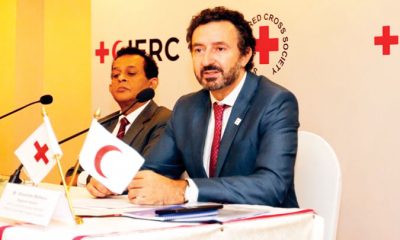
Speaking on a visit to Colombo to meet affected communities, the Government and the diplomatic community, the Regional Director, Asia Pacific of the International Red Cross and Red Crescent Societies, Alexander Matheou, said:
“The report provides first-hand evidence of how the most vulnerable people, who are already under the poverty line, are being driven further towards despair. As a result, people are resorting to borrowing heavily, eating less food and lesser number of times a day, pawning valuables and assets, and using other survival strategies. That, too, just to scrape by only.
“Our main priorities remain meeting humanitarian needs at its worst. Unless this is done effectively and quickly, people who are struggling now will find themselves on a demeaning pathway to destitution from which there is no escape. The time to act is now.”
To meet the country’s spiralling needs, the IFRC has launched an Emergency Appeal for urgent humanitarian assistance for 28 million Swiss francs in support of Sri Lanka Red Cross. In line with the IFRC appeal, the International Committee of the Red Cross supports the Sri Lanka Red Cross to respond to the humanitarian issues arising from the economic crisis with a focus on providing medical equipment to the healthcare system and economic assistance to vulnerable people.





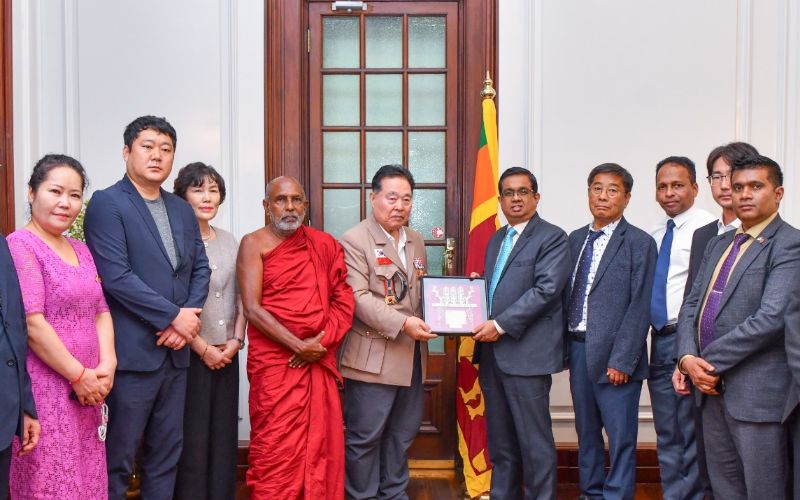
A special delegation led by Deokuju Jung, President of the Korean Volunteer Association for Distinguished Service to the State, met Secretary to the President Dr Nandika Sanath Kumanayake at the Presidential Secretariat on Monday (12) afternoon .
The discussions focused extensively on welfare programmes the association expects to implement in Sri Lanka and the support it hopes to obtain from the Government of Sri Lanka for these initiatives.
Attention was also given to the proposed implementation of a comprehensive programme in collaboration with the Government to support children with special needs in Sri Lanka.
The meeting was also attended by Ven. Wanawasi Rahula Thero, Founder of Namal Uyana and Chief Incumbent of the Namal Uyana Forest Monastery, Senior Additional Secretary to the President Roshan Gamage and Korean Volunteer Association representatives Jungsun Choi, Junyoon Lim, Chaeeun Kim and Wonwook Choi.
[President’s Media Division]
The Human Rights Commission of Sri Lanka (HRCSL) issued its recommendation in Case No: HRC/KIL/031/26 concerning the decision of the Director General, Sri Lanka Customs to seize
four books authored by B Piratheepan.
The books ‘Ippothum Inge Irandu Thesangalthaan’, ‘Elluttal Nan Yuttam Ceykiren’, ‘Bayangaravaathi’, and ‘Cyanide’ are Tamil language books printed in Chennai, India, and were imported to Sri Lanka. Sri Lanka Customs seized the books on 27 March 2026 and had informed the Complainant that they would only be released upon obtaining approval from the Ministry of Defence.
Following an opinion issued by the Arts Council of Sri Lanka and the State Literary Sub-Panel, two of the books, ‘Bayangaravaathi’ and ‘Cyanide’ were released on the basis that the experts on the Council had concluded that these books were works of fiction. Copies of the remaining two books ‘Ippothum Inge Irandu Thesangalthaan’ (75 copies) and ‘Elluttal Nan Yuttam Ceykiren’ (147 copies) were not released and remained under detention.
At the conclusion of its inquiry, the Commission noted that none of the Respondents wished to take direct responsibility for the continued seizure of the remaining two books. It observed that
the handling of the matter was marked by indecision and opacity at every stage.
Sri Lanka Customs purported to act under section 135, read with section 12 and Schedule B of the Customs Ordinance, which authorises it to prohibit ‘Any newspaper, pamphlet, leaflet, book or picture containing matter calculated to lead to acts made punishable under section 120 of the Penal Code’.
Relying on the recent judgment of the Supreme Court in Mohamed Razik Mohamed Ramzy v. Officer-in-Charge, Criminal Investigation Department & Others SC (F.R) No. 135/2020, the Commission found that intent remains an indispensable element of section 120 of the Penal Code and that this mental element is reinforced in Schedule B to the Customs Ordinance by the inclusion of the term ‘calculated’.
The Commission accordingly observed that both causation and intent, which are necessary features of individual culpability, must be established for a person to face legal consequences in terms of section 120 of the Penal Code.
The Commission concluded that the 1st Respondent must be of the reasonable opinion that these elements of individual culpability, causation and intent, are present in a given case to justify the permanent seizure of any publication. However, the 1st Respondent had not demonstrated that he had reached such an opinion.
The Commission observed that, while the impugned content in the Complainant’s two books (e.g. allegations that the Sri Lankan military had attacked civilians, and allegations that the
Janatha Vimukthi Peramuna supported violence) may be classified as ‘shocking’, even ‘offensive’ to some, or ‘disturbing’, there is no evidence to suggest that the impugned passages
were calculated to excite disaffection against the state, promote feelings of ill-will between communities or bring about any other harmful outcome listed in section 120 of the Penal Code.
The Commission reiterated that section 120 of the Penal Code concerns expressions that are directly inciteful and have the capacity to influence large portions of the population to act in a
harmful manner. It found that the impugned passages in the two books merely contain sentences that make allegations, which may prompt reflection among some readers, and which may be dismissed by other readers. They, in the opinion of the Commission, lack the potency expected of content that was likely to ‘excite disaffection’ or ‘promote ill-will’. It found that the continued seizure of the two books, which acted as a form of prior censorship of its contents, is both unnecessary and disproportionate in terms of meeting the legislative aims found in section 120.
The Commission also noted that the contents of these two books were claimed to already be in the public domain and had previously featured in Tamil language newspapers.
Therefore, the Respondents had not demonstrated how such content had thus far contributed to disaffection or promoted feelings of ill-will between communities. In this context, the Commission was unconvinced that the limitation in question is reasonable and concluded that the 1st Respondent’s continued seizure of the two books ‘Ippothum Inge Irandu Thesangalthaan’ and ‘Elluttal Nan Yuttam Ceykiren’ authored by the Complainant violated his right to the freedom of expression including publication guaranteed by article 14(1)(a) of the Constitution.
The Commission separately found that the sequence of events, and the explanations provided by the Respondents, indicated that the language of the Complainant’s books, i.e., the Tamil
language, was pivotal to their seizure. It observed that several state institutions that encountered these books treated them with prejudice and suspicion, which would not have been afforded to books of another language. Given that the Complainant’s two books have remained in detention for a prolonged period, i.e. more than six months, with no formal procedure, the Commission found a violation of article 12(1) of the Constitution. It also found that the actions of the 1st
Respondent were discriminatory on the basis of language, and violated his right to non-discrimination on the grounds of language guaranteed by article 12(2) of the Constitution.
Commenting on the application of article 14(1)(f) of the Constitution, the Commission found that Tamil-speaking people are a linguistic minority in Sri Lanka who enjoy the protection of both article 14(1)(f). The Commission recalled that the marginalization of Tamil-speakers throughout Sri Lanka’s post-independence period has been one of the root causes of the country’s ethnic conflict. Therefore, state functionaries should be particularly sensitive to the implications of treating Tamil language publications with prejudice. The Commission recognized that the essence of the freedom to promote one’s own culture and to use one’s own language is that citizens should have autonomy over the cultural and literary content they wish to produce or consume. The state should not interfere with this freedom except in very limited circumstances governed by article 15 of the Constitution.
Accordingly, it found that the 1st Respondent, through the continued seizure of the Complainant’s two books ‘Ippothum Inge Irandu Thesangalthaan’ and ‘Elluttal Nan Yuttam Ceykiren’, violated his fundamental right to the freedom to enjoy and promote his own culture and to use his own language.
In the circumstances, the Commission recommended that the 1st Respondent forthwith release from detention all copies of the two books titled ‘Ippothum Inge Irandu Thesangalthaan’ and ‘Elluttal Nan Yuttam Ceykiren’ authored by the Complainant.

By Shamindra Ferdinando
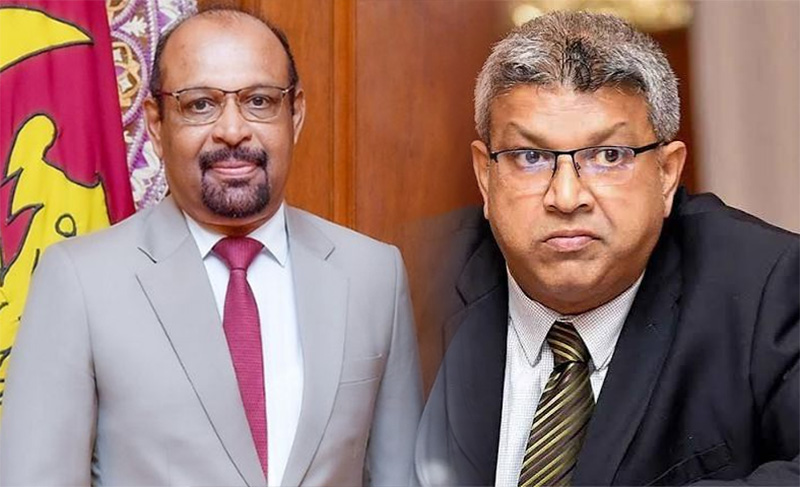
Justice and National Integration Minister Harshana Nanayakkara said yesterday that the Cabinet was studying a set of recommendations made by a Committee, led by retired Supreme Court judge Sithambarampillai Thurairaja, PC, regarding a systematic, fair and transparent mechanism for granting presidential pardons to convicted prison inmates.
Attorney-at-law Nanayakkara said so when The Island raised the issue in the wake of the ongoing controversy over prison authorities compelling General Secretary of the Bodu Bala Sena (BBS) Ven. Galadodaaththe Gnanasara to wear civilian attire when produced in court.
The Minister declined to elaborate but said the Cabinet of Ministers was yet to reach consensus on the recommendations. The NPP government, on 25 June 2025, appointed Thurairaja’s committee to study the provisions of the Article 34(1) of the Constitution, along with other statutory acts and judicial rulings.
Justice Thurairaja handed over his report to Justice and National Integration Ministry Secretary Ayesha Jinasena, PC.
The other members of the Committee were Deputy Minister of Mass Media Dr. Kaushalya Ariyarathne, Additional Secretary to the Ministry of Justice and National Integration Piyumanthi Peiris, Additional Solicitor General Nerin Pulle, Senior Deputy Inspector General of Police (SDIG) Legal Asanga Karawita, Chairperson of the Bureau of Rehabilitation Professor Wasantha Subasinghe, Specialist Dr. Chiththahari Abayanayake, former Acting Commissioner of Prisons Nishan Dhanasinghe, Acting Commissioner General of Prisons Prasad Hemantha Kumara, Senior Assistant Secretary (Legal) to the Ministry of Justice and National Integration Roshani Hettige, and Senior Assistant Secretary to the Ministry of Justice and National Integration Chandima Welikala.
The government called for guidelines regarding presidential pardon over a year before the Supreme Court rescinded, in September this year, the presidential pardon granted by Maithripala Sirisena to Ven Gnanasara serving a six-term of rigorous imprisonment for contempt of court. That pardon was granted in May 2019, the third controversial release by Sirisena during his presidency.
President Sirisena pardoned an ex-LTTE terrorist and also the Royal Park murderer Don Shramantha Jude Anthony Jayamaha, in 2016 and 2019, respectively. The Supreme Court, in June 2024, annulled the pardon granted to Jayamaha and ordered his arrest though he still remains free having fled overseas no sooner he was granted the pardon.

Delegation from Korean Volunteer Association meet Secretary to the President

Imran Khan’s PTI braces to fight federal takeover of Khyber Pakhtunkhwa

Nissanka’s return headlines Sri Lanka’s Test squad against Pakistan

HRCSL issues recommendation on seizure of four books by B. Piratheepan by Sri Lanka Customs

Former Zimbabwe player and umpire Sarah Dambanevana dies aged 36

Deflated Sri Lanka look to prevent whitewash against dominant Pakistan

‘Dates have the highest sugar content to fight Coronavirus’

Sunday Island 27 December – Headlines

#SundayIsland 17th December – Headlines

Sunday Island – 28th March

Sunday Island Headlines – 21 March

Sunday Island – 21st February – Headlines
-

 Features6 days ago
The Sri Lankan who made Scottish history
-

 Sports6 days ago
Nissanka absence opens door for Sri Lanka’s young guns
-

 News5 days ago
NDB fraud Rs 60mn more than reported
-
 News7 days ago
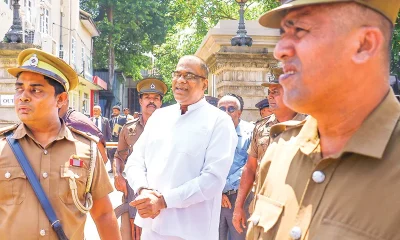
Gnansara Thera to be assigned to prison printing section: Officials
-

 News5 days ago
Removing monk’s robes matter for Sangha to decide: Mahanayake Theras
-
 News7 days ago
OIC of FCID summoned before Maligakanda Magistrate
-
 Features6 days ago
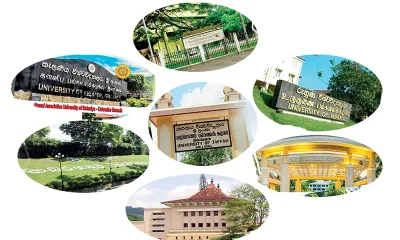
Future of Sri Lanka’s state university system: Should it be shut down and reopened?
-
 News6 days ago
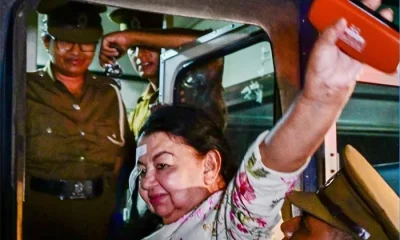
Shiranthi R remanded until 13 Oct.