
Opinion
Sri Lanka’s new govt., Indo-Pacific debt trap, and struggle for the 21st Century – Part 2

By Shiran Illanperuma
(First part of this article appeared in
The Island yesterday (13 Jan.)
Sri Lanka in the International Sovereign Bond Debt-Trap
Sri Lanka was the original poster child for the myth of the Chinese debt-trap, which has now been thoroughly debunked by both local and foreign experts. The truth is that the cause for Sri Lanka’s indebtedness can be traced back to the colonial structure of its plantation economy, which has only been augmented through additional dependencies on tourism, remittances, and low-value added manufacturing. Despite attempts by nationalist and left-leaning governments, Sri Lanka has failed to achieve food and energy self-sufficiency, or to set in motion a self-expanding process of industrialisation.
The end of Sri Lanka’s Civil war in 2009 coincided with the Global Financial Crisis (GFC) and the Great Recession. Sri Lanka was relatively insulated from economic downturn as the end of the war brought about a honeymoon period as tourism and property speculation boomed. The Obama administration’s bailing out of the banks through Quantitative Easing unleashed a wave of speculative investments to the Global South, including countries like Sri Lanka. Meanwhile, China’s going out in the wake of the GFC allowed the Sri Lankan government to engage in further fiscal expansion through an ambitious program of infrastructure development, focusing on roads, ports, energy, and not just a few white elephants. However, these shortcomings in the mobilisation of Chinese development finance are more attributable to Colombo’s lack of vision and coherent industrial policy, than any malice on the part of China. As Chinese envoys have often emphasised, all projects were undertaken at the request of the Sri Lankan government, and shortcomings have usually been due to the lack of domestic capacity to manage projects efficiently.
As a lower-middle income country, Sri Lanka found itself increasingly locked out of concessionary finance from multilateral organisations, and so began turning towards private lenders. The country launched its first International Sovereign Bond (ISB) in 2007. However, it is the rightward shift in policy following the change of government in 2015 that completely transformed Sri Lanka’s debt profile, as the government binged on over USD 10 billion worth of ISBs. Therefore, on the eve of Sri Lanka’s default in 2022, only 13.67% of external debt was owed to China. By contrast, 42.43% of external debt was to private bondholders, like Blackrock and Ashmore. To make matters worse, this private debt was of much higher interest rates than bilateral debt from China, accounting for over 70% of interest payments in 2021.
When the COVID-19 pandemic hit, the vulnerabilities of Sri Lanka’s economic structure became painfully apparent. The lack of foreign exchange inflows due to the collapse of tourism and remittances, combined with inflation caused by global supply chain crunches and commodity price booms, brought the economy to its knees. Following the ouster of President Gotabaya Rajapaksa in 2022, the governor of the Central Bank of Sri Lanka announced a ‘pre-emptive default’ on external debt. In the months that followed, the interim President Ranil Wickremesinghe used the chaos to enforce a dizzying array of shock therapy style reforms, unthinkable under conditions of normality. These included:
* Austerity. Withdrawals of fuel subsidies and cost reflective pricing of energy. This contributed to plunging thousands into poverty and off the electricity grid.
* Domestic debt restructuring. A restructuring of domestic debt that singled out the pension funds of the working class while allowing domestic capitalists, bankers, and bondholders to walk away scot-free.
* Central Bank independence. Legislating Central Bank independence, which would prevent the Central Bank of Sri Lanka from purchasing government debt. Concretely, this means that the government is significantly restrained from countercyclical spending in the event of an external shock. Additionally, it could weaken the government’s ability to control interest rates. The act severs monetary sovereignty as it forces the country to rely exclusively on private lenders for financing.
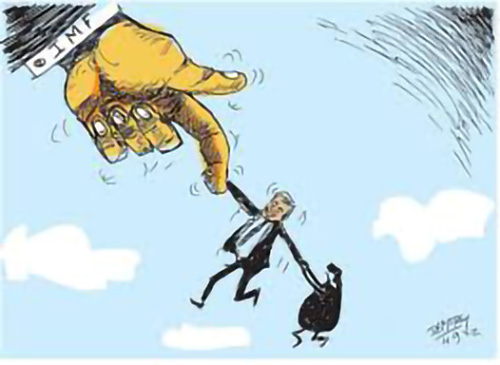
* External debt restructuring. An external debt restructuring agreement negotiated with the mediation of the IMF has been described by local critics as a sell-out. The agreement includes swapping existing bonds for newer bonds, some of them being novel financial instruments.
* Macro-linked bonds – These are bonds, whose interest rates will be linked to Sri Lanka’s economic performance. As GDP growth rates increase, so too do the interest payments. In effect, Sri Lanka must pay its creditors more for growing faster.
* Governance-linked bonds – These bonds tie the interest rate to the government’s implementation of anti-corruption legislation. There is a reasonable concern that this amounts to a kind of blackmail on a sovereign government to adjust its administrative structure according to the whims of international finance capital.
The Rise of the NPP
The NPP coalition includes 21 civil society organisations including trade unions. However, the prime mover within the party is undoubtedly the JVP. The JVP was established by Rohana Wijeweera in 1965, largely through the youth wing of the Ceylon Communist Party (Maoist), which in turn was the result of a 1964 split in the undivided Communist Party of Ceylon that mirrored the tragic Sino-Soviet split.
The JVP was targeted, and its ranks were decimated twice. First, following an attempted youth insurrection in 1971, and again during another insurrection from 1987-1989. The latter resulted in the assassination of Wijeweera along with the entirety of the party’s politburo, except for Somawansa Amarasinghe. Building the party from scratch, Amarasinghe went on to lead the party on the path of reform and was instrumental in taking JVP into electoral politics. During Amarasinghe’s leadership, the JVP dabbled in electoral coalitions, first supporting the SLFP’s Chandrika Bandaranaike Kumaratunga in 1994, then SLFP’s Mahinda Rajapaksa in 2005, and finally joining the UNP in supporting former Army Commander Sarath Fonseka’s bid for Presidency in 2010.
It was in 2014 that the next big shift came, as AKD was made the new leader of the JVP. He has attempted to chart a more independent and centrist path for the party, rejecting coalitions with established political parties and personalities. Following the JVP’s 7th National Congress, the party released a document which proposed a national policy framework for a ‘modernised and industrialised Sri Lanka’. In 2019, the National People’s Power was launched, with the JVP at its core. The broader coalition of NPP helped open JVP’s doors to the middle-class that traditionally was wary of the Party’s radical history. This included professionals, academics, artists, public intellectuals, and even traders and business owners.
The NPP’s success lies in this ability to overcome the JVP’s previous sectarianism and incorporate a broader coalitions of class forces, while at the same time remaining independent of established political parties. For the most part, NPP’s recent electoral campaign avoided a frontal assault that identified the enemy as capitalism, imperialism, or even neoliberalism. Rather, the NPP chose to focus on the vaguer category of corruption, which struck a chord among large portions of the middle-class who felt that the immediate cause of their plight was bad governance. The NPP was able to locate elements of the petty bourgeois that did not have direct access to state power through the established patronage networks of the main parties. This combined with a generational shift in politics helped the JVP construct the NPP as its own ‘civil society’ front. The hunger of this young petty bourgeois to reproduce itself as a class constitutes the strength and weakness of the NPP.
On the election campaign trail, the NPP faced much scrutiny from both the rightist and leftist elements which honed on its lack of an articulate economic plan or strategy. While the NPP platform is explicit about its intention to retain and strengthen public ownership of energy, finance, healthcare and education, questions regarding policy specifics were often dodged with the promise that life would improve with the eradication of corruption. That said, the NPP’s main economic promise was to establish a ‘production-based economy’ that prioritises farmers, fishers and Small and Medium Enterprises (SMEs). Furthermore, the NPP pledged to renegotiate the debt restructuring agreement with the IMF and bondholders in order to ease the tax burden on the people, to establish a development bank, and initiate an expansive science and technology policy to modernise the economy. Concretising these disparate promises into a viable developmental program continues to be the main challenged for the NPP.
One of the most remarkable features of the NPP’s political campaign was its mobilisation of women. This was conducted not in any paternalistic manner but by women party cadres themselves. Rural party meetings often featured women speaking to women, about the specific ways in which economic hardships affected women. This, combined with the party’s sympathies towards people’s economic plights and their sharp vitriol against the perceived corruption of establishment politicians, helped drive an emotive bottom-up campaign. Women in these meetings took the message home, influencing their children, who would go on to popularise the party’s platform on social media platforms, including Tik Tok. In Sri Lanka, where labour force participation for women (FLFPR) is extremely low, 29.6%, they are particularly sensitive to price swings in essential commodities. Meanwhile, the women who work do so predominantly in the public sector, or in export-oriented sectors such as plantations and export processing. This makes political conscious women extremely sensitive to economic shocks, and a powerful political resource once organised.
Struggle for the 21st Century
Sri Lanka’s dilemma is a striking example of the close link between neoliberal debt bondage and subordination to the interests of US-led militarism. In other words, the struggle for sovereignty and development requires a political, economic and even military strategy. In the past, various administrations in Sri Lanka have attempted compromise, thinking that concessions in one area would enable advances in others. The reality is that there is little possibility for negotiation with an increasingly irrational imperialism bent on maintaining US preponderance of power.
The fact is that the NPP governs under conditions favourable to the right. This is to say that the NPP inherits a state that is deeply in debt to Western finance capital, with a military that has been gradually encroached by the US through use of carrot and stick. Moreover, the networks of knowledge production and distribution in Sri Lanka remain downstream of monopoly capital. The JVP itself has only been able to climb into power by moderating rather than dialling up its past socialist and anti-imperialist rhetoric, meaning it does not necessarily have a popular mandate to carry out a revolutionary break from the status quo. Yet even the moderate mandate of the NPP, to improve social welfare and establish a production-based economy, cannot but bring them into confrontation with an imperialism which seeks to stymie the development of the productive forces.
To borrow from the US State Department’s own choice of words, Sri Lanka today stands at the ‘epicentre’ of the struggle for the 21st century. It is a struggle between peaceful development and militarised underdevelopment. Between productive investment for the benefit of the working majority, or debt bondage for the benefit of a ruling minority. While the country appears hemmed in on all sides, entangled in US imperialism both militarily and financially, it would be too simplistic and nihilistic to suggest that there are no alternatives. This struggle for sovereignty and development is today being waged across the darker nations, from the Bolivarian countries in Latin America, to the Sahel region in Africa, and by the Palestinians in West Asia. The struggle of the Sri Lankan people too, will play its role in defining the trajectory of this century.
(This essay was produced by Tricontinental: Institute for Social Research as part of its monthly series Tricontinental Interventions: Conjunctural Analysis from Asia.)

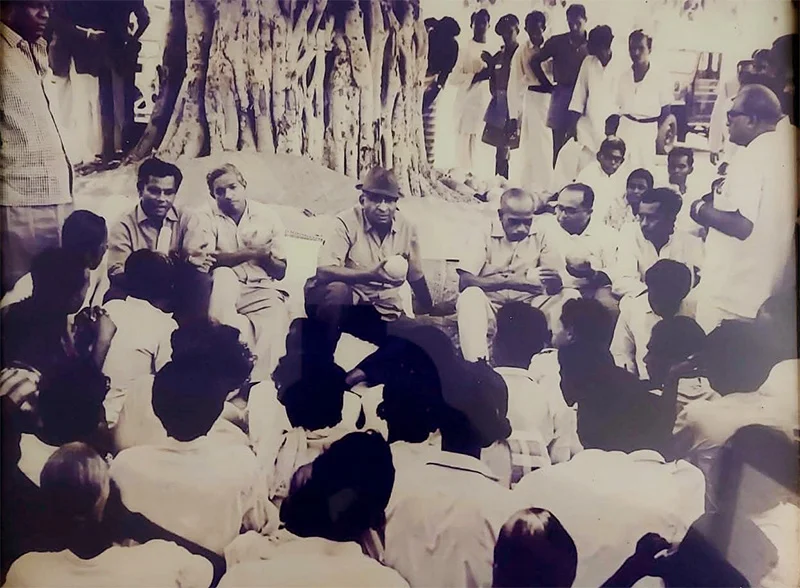
(The 112th Birth Anniversary M. D. Banda fell on March 09.)
My memories of Appachchi when I was very little are nebulous. Whilst this may be the case with all little children, even ones with fathers who have regular 9-5 jobs, in my case, this was due to two additional reasons: our Appachchi lived mostly at “Shravasthi” the special residence for Lankan parliamentarians and not at our ancestral home home, in our village, Panaliya.
Additionally, we were all at boarding schools and spent nine months of the year in our respective school hostels. Thus, it was just during the holidays that the seven of us (my four sisters, two brothers and I) were at home, in Panaliya.
Looking back on this time, I realise that during most of my childhood my father was a Cabinet Minister, and one who was completely dedicated to his duties. He was conscientious to a fault, attending to ministerial duties, attending parliamentary sittings and cabinet meetings diligently. Appachchi first entered Parliament in 1947 when he was just 29 years old, and
was almost immediately appointed to the post of Parliamentary Secretary (Junior Minister) to the Minister of Labour and Social Services in May 1948. He was Minister of Labour and Social Services in February in 1950 and was again appointed to the same post by Hon Dudley Senanayake in March 1952. He became Minister of Education in June 1952 so that by the time I was born in December 1952, he was a senior member of the Dudley Senanayake Cabinet. I only fully realised how busy he must have been much later in life. As young children, it is our mother who gave us love and a sense of security by being fully present in our lives and seeing to all our needs, even when we were in school hostels.
Pivotal points
Our mother informed us one day, when I was around 3 or 4 years old , that Appachchi would be coming home that evening. Although my memories of this period are quite hazy, I recall very clearly the keen enthusiasm with which we awaited his arrival. Evening moved into night and his arrival was pushed back late and further late into the night. The moment I woke up the next morning I remember asking Amma where Appachchi was. “He came home very late last night but had to leave early this morning. He was a little annoyed with you, Lokka (everyone in the family calls me ‘Lokka’ even now), because you had parked your little car near the stairway, and Appachchi nearly tripped over it’ (this was before we had electricity in our home). My little heart was overwhelmed with sorrow for not only had I not seen Appachchi but I had inadvertently caused him injury with my careless parking of my miniature car.
This incident is indelibly etched in my mind because I believe that this was the first time in my life, that I experienced the agony of shattered expectations. Why I felt such intense pain then as a little child was perhaps because of how much I loved my father.
I was admitted to Hillwood College, Kandy at the age of three and a half and lived in the school hostel for three years. I clearly remember Amma visiting us at least once or twice a month with goodies and treats for us and our friends. I do not however have any clear memory of Appachchi visiting us during this time. At the time I didn’t realise that this was due to the busy life he led. At Hillwood, I had all the love and attention I needed from my four older sisters and my four older cousin sisters (our Lokuamma’s daughters).
My younger brother Senaka and I then entered Dharmaraja College, Kandy in 1961 . We were hostelers and attended school from the hostel. I clearly remember Amma visiting us regularly during this period too. I had my first real and meaningful conversation with Appachchi during this time: One day, our warden Mr Wimalachandra informed me that appachchi had come to take Senaka mallie and me out. We visited a relative of ours in Harispattuwa, had lunch with them and on our return journey to the school hostel, I told appachchi that I was playing cricket for the under 12 team at Dharmaraja College, and therefore needed a bat.
“Are you playing hardball?”
(I didn’t understand the question so I was silent)
“Is it the red ball?”
“Ah, yes.”
“Is it that kind of bat that you need?”
“Yes.”
“What is your position in the team?”
(I was once again silent)
“Are you an opening batsman? Or are you number 3, 4 or 5?”
“I can bat and bowl. I do both”
“Ah! Then you are an all-rounder. Number 6,7 – I will buy you this kind of bat. Play well till then.”
And the conversation continued in the vein but no bat has come to date!!!
Little did I know at the time that Appachchi was himself an outstanding cricketer, who represented the St Anthony’s College.Katugastota team and, later, for the Ceylon University College team, as an opening batsman. This is why he was so well versed with the game and was highly interested in my own cricketing capabilities. His passion for cricket was clear to us later on too because we all recall how he and his nephews, Bertie and Nimal, would listen to cricket commentaries and were glued to the radio when England and Australia played biennially for the famous Ashes trophy.
On the day of this momentous conversation, Bertie aiya (appachchi’s long-time Private Secretary, and his sister’s son; a lawyer by profession) had also come with Appachchi. It is from Bertie aiya that I learnt that day that the car they had driven up to Kandy in (an Austin A 70) belonged to Appachchi. I later learnt that Appachchi had not one but two cars (a Fiat 1400 too). Both cars were driven by Ranbanda, the chauffer, and were in Colombo because there was no one who could drive them at Panaliya. Amma always hired a car for her personal use at Panaliya, and would visit us in school in these hired cars, until her youngest brother Tissa came to live in our home at Panaliya. Tissa maama then drove amma around and would very often drive us to our school hostels. Another rather amusing memory from this same time goes like this: during a school holiday when I was in grade 6 at Dharmaraja College, Appachchi asked for my report card. I was 6 th
in class and therefore promptly and proudly took it to him. Appachchi scrutinised my report card carefully and said, not unkindly, ‘If you are 6 th in class with marks like this, all the other children in your class must be buffaloes’.
A shift in gears
I think I really got to know Appachchi well when Senaka malli and I entered Ananda College in Colombo. Although we first went to school from the school hostel, we would go to Appachchi’s official residence at Wijerama Mawatha every weekend. By this time, Amma too had moved to Colombo. Thus, between 1965 – 1970 , our home was at Wijerama Mawatha, with them. So, that is when I got the chance to interact closely with Appachchi. It was only at this time that it dawned on me that Appachchi was a powerful Cabinet Minister who was loved and respected by his constituents and the people of our country.
During this time, when I needed anything, I would go to his room early in the morning to remind him of what I needed. These requests were for the most part fulfilled.
Once I remember that I asked for track shoes (spikes) and Appachchi bought me a pair from abroad. When I needed money to buy a Tennis racket, he told me to go to the sports-ware store, ‘Chands’ at Chatham Street and select a racket. I received top treatment there and was even offered orange barley!
Then again I urgently needed ‘longs’ (trousers) to wear to school. “How many do you need?” he asked. Without thinking I said, “six”. “Why six?” he demanded. “There are only 5 days in the school week, no? Three would do.” Then he directed me to the ‘West End’ tailors’ shop in Pettah and asked me to get them stitched there.
It was Appachchi’s habit to take us to the Lake House Book shop every year and allow us to buy whatever we wanted. Considering that there were 7 of us, Senaka Malli and I chose just three or four books and took them to the counter, while our Chuti Malli Senerath, would bring a pile of books! “Do you want all these books?” Appachchi asked. Chuti Malli nodded “yes” and Appachchi bought all of them for him! This was probably because Appachchi himself loved books and wished to encourage the reading habit in his children.
When apachchi passed away in 1974, Senerath Malli was only 14 years old and I believe that the loss was greatest for him.
(To be concluded)
Loku Putha,
Gamini Leeniyagolla
World Kidney Day falls today
The Chronic Kidney Disease (CKD) crisis in Sri Lanka represents one of the most formidable public health challenges of the twenty-first century, manifesting as a complex tapestry of environmental, social, and physiological factors. Unlike the traditional forms of kidney disease seen in urban centres—which typically stem from well-understood comorbidities like long-term diabetes and hypertension—the situation in the Sri Lankan ‘Dry Zone’ is defined by a mysterious and aggressive variant known as Chronic Kidney Disease of unknown aetiology (CKDu). This specific form of the disease has devastated the agricultural heartlands, particularly the North Central Province, for over three decades, yet it continues to evolve in its geographic reach and its socio-economic impact as of 2026. The persistence of this epidemic despite extensive international research highlights a profound gap in our understanding of how tropical environments and traditional occupational hazards intersect to damage human renal systems.
Historically, the emergence of CKDu was first noted in the late 1990s around the Anuradhapura and Polonnaruwa districts. What began as sporadic cases in rural hospitals quickly transformed into a localized epidemic, catching the medical community off guard because the patients did not present with the usual risk factors. These were not the sedentary, elderly populations usually associated with renal failure; rather, they were lean, active, middle-aged rice farmers.
The demographic specificity of the disease remains a chilling hallmark of the crisis today. It predominantly strikes men during their peak productive years, which triggers a catastrophic ripple effect through the family unit. When a primary breadwinner in a subsistence farming household falls ill, the family is thrust into a ‘poverty trap’ where limited resources are redirected toward transport to distant clinics, expensive nutritional supplements, and eventually, the gruelling routine of dialysis. This economic erosion often forces children out of school and into labour, perpetuating a cycle of systemic vulnerability that lasts for generations.
Intense scientific debate
The aetiology of the disease remains a subject of intense scientific debate and is currently viewed through a multifactorial lens. Researchers have moved away from the search for a single ‘smoking gun’ and are instead examining a lethal synergy of environmental triggers. Groundwater quality remains at the forefront of this investigation. The dry zone of Sri Lanka is characterized by high levels of fluoride and groundwater hardness, and it is theorized that the interaction between these natural minerals and anthropogenic pollutants—such as heavy metals from agrochemicals—creates a nephrotoxic cocktail.
The historical reliance on chemical fertilizers and pesticides in the ‘Green Revolution’ era of Sri Lankan agriculture is often cited as a major contributing factor. While direct links to specific brands of pesticides have been difficult to prove definitively, the accumulation of cadmium, arsenic, and lead in the soil and food chain continues to be monitored as a primary catalyst for the slow, progressive scarring of the kidney tubules.
In recent years, the discourse around CKDu has expanded to include the role of heat stress and chronic dehydration, exacerbated by the changing climate. Farmers in the North Central and Eastern provinces work long hours under an unforgiving sun, often without access to adequate quantities of clean drinking water.
There is growing evidence that repeated episodes of acute kidney injury caused by dehydration can lead to the permanent interstitial fibrosis characteristic of CKDu. This theory connects the Sri Lankan experience with similar ‘Mesoamerican Nephropathy’ seen among sugarcane workers in Central America, suggesting that CKDu may be a global phenomenon tied to the physical realities of manual labour in warming tropical climates. As global temperatures rise, the ‘heat stress’ hypothesis gains more urgency, positioning the Sri Lankan crisis not just as a local medical mystery, but as an early warning sign of how climate change impacts the health of the global agrarian workforce.
Geographical expansion of disease
The geographic expansion of the disease is a significant concern for the Ministry of Health in 2026. While Anuradhapura remains the epicentre, new ‘hotspots’ have been identified in the Uva and Northwestern provinces, as well as parts of the Southern hinterlands. This spread suggests that the environmental or behavioural triggers are more widespread than previously thought or that the migration of labour and changing agricultural practices are carrying the risk factors into new territories. The government has responded by shifting its strategy toward a more decentralized model of care. The establishment of the Specialized Nephrology Hospital in Polonnaruwa was a landmark achievement, providing state-of-the-art facilities for transplantation and dialysis. However, the sheer volume of patients means that the burden on tertiary care centres remains unsustainable. Consequently, the focus has shifted toward early detection through mobile screening units and the empowerment of primary healthcare centres to manage the early stages of the disease through aggressive blood pressure control and dietary management.
Water Security
Water security has become the primary defensive strategy in the national fight against CKDu. The widespread installation of Reverse Osmosis (RO) plants across high-risk villages has been a transformative community-led intervention. These plants provide filtered water that is significantly lower in mineral content and potential toxins compared to traditional shallow wells. While the long-term efficacy of RO water in preventing new cases is still being evaluated through longitudinal studies, there is strong anecdotal and preliminary evidence suggesting a decline in the rate of new diagnoses in villages that have had consistent access to filtered water for over a decade.
However, the maintenance of these plants remains a challenge, as rural communities often lack the technical expertise or the consistent funding required to replace membranes and ensure the water remains safe for consumption over the long term.
Beyond the biological and environmental dimensions, the CKD situation in Sri Lanka is deeply tied to the social fabric and the psychological well-being of the rural population. There is a profound stigma attached to the disease; in some areas, families hide a diagnosis for fear that it will affect the marriage prospects of their children or lead to social isolation.
This fear often drives patients toward traditional healers or unregulated ‘cures,’ which can sometimes exacerbate kidney damage through the use of heavy-metal-rich herbal preparations. Addressing the ‘fear factor’ through community education and the normalization of regular screening is as essential as any medical treatment. Furthermore, the mental health of caregivers—often women who must balance farming, household duties, and the intensive care of a bedridden relative—is a neglected aspect of the crisis that requires urgent policy attention.
Need for paradigm shift
As we look toward the future, the resolution of the CKD crisis in Sri Lanka will require a paradigm shift in how the state manages its agricultural and environmental resources. The transition toward organic or ‘low input’ farming is being discussed not just as an ecological goal, but as a public health necessity to reduce the chemical load on the soil and water. Simultaneously, the push for universal access to pipe-borne water is the only permanent solution to the groundwater problem. The current situation in 2026 is one of cautious optimism tempered by the reality of a massive existing patient load. While the ‘mystery’ of CKDu may never be reduced to a single cause, the integrated approach of clean water, early detection, and social support offers a roadmap for mitigating the impact of this devastating epidemic.
The resilience of the Sri Lankan farming communities, supported by robust scientific research and empathetic governance, remains the greatest asset in overcoming a disease that has for too long defined the landscape of the Dry Zone.
The Northwestern Province of Sri Lanka, particularly within the districts of Kurunegala and Puttalam, has emerged as a critical front in the national battle against chronic kidney disease. Unlike the early epicentre in the North Central Province, the Northwestern region faced a delayed but rapid surge in cases, largely attributed to its unique hydro-geochemical profile.
The groundwater in areas such as Polpithigama and Nikaweratiya is characterized by high levels of calcium and magnesium, leading to extreme water hardness that, when coupled with fluoride, has been statistically linked to accelerated renal damage. As of 2026, the strategy for this province has shifted from reactive medical treatment to a massive expansion of safe drinking water infrastructure, reflecting a policy acknowledgment that the quality of the ‘input’ into the human body is the single most controllable variable in the CKD epidemic.
Clean water projects
Central to this effort is the National Water Supply and Drainage Board’s Regional Support Centre for the North-Western Province, which has accelerated its goal of achieving near-universal pipe-borne water coverage. A primary focus has been the Anamaduwa Integrated Water Supply Project, a multi-billion-rupee initiative designed to serve over 80,000 residents across the most vulnerable divisions. By transitioning communities away from shallow, untreated agricultural wells and toward centralized, treated surface water systems, the project aims to bypass the nephrotoxic minerals inherent in the local bedrock. This shift is not merely a matter of convenience; it is a life-saving intervention. Early longitudinal data from 2024 and 2025 suggests that in villages where pipe-borne water has replaced groundwater as the primary source for over five years, the rate of new Stage 1 CKDu diagnoses has begun to plateau, providing the first tangible evidence that infrastructure development can decouple agricultural livelihoods from the risk of kidney failure.
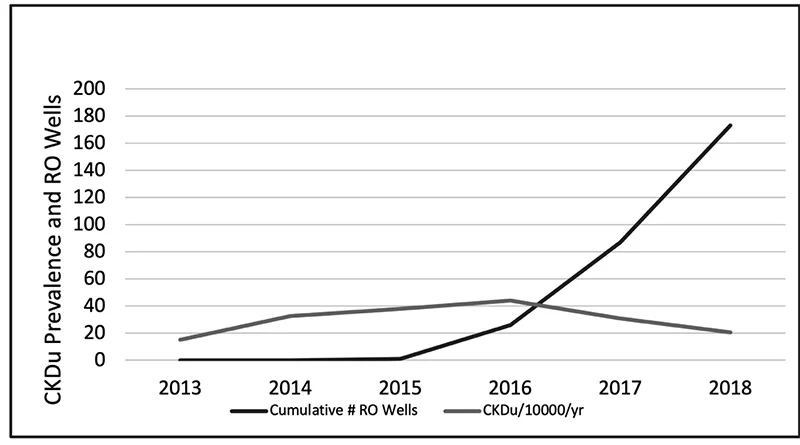
Reverse Osmosis Water Supply Wells and The Reduction of Incidence of CKDu in the North central Province (Source: Kidney disease, health, and commodification of drinking water: An anthropological inquiry into the introduction of reverse osmosis water in the North Central Province of Sri Lanka by de Silva and Albert 2021)
Indispensability of RO plants
While large-scale projects provide a long-term solution, the ‘interim’ role of community-based Reverse Osmosis (RO) plants remains indispensable in the Northwestern hinterlands. These plants, often managed by local community-based organizations (CBOs) with technical oversight from the government, serve as the primary defence for remote settlements that the pipe-borne network has yet to reach. The operational success of these RO plants is increasingly tied to a new model of ‘Water Safety Trust.’
Surveys conducted in 2025 indicate that the reduction of CKD in these areas depends heavily on consistent maintenance; when filters are changed regularly and brine disposal is managed correctly, the resulting ‘soft’ water significantly reduces the metabolic stress on the kidneys of the local farming population. However, the province still faces the challenge of ‘water commodification,’ where the cost of filtered water can occasionally burden the poorest families, highlighting the need for continued state subsidies to ensure that clean water remains a universal right rather than a luxury.
The reduction of CKD in the Northwestern Province is also being driven by a more sophisticated integration of water management and occupational health. Recent initiatives have begun to combine the provision of clean water with ‘cool zones’ and hydration advocacy for farmers working in the intensive heat of the dry zone. There is an increasing understanding that it is not just the quality of water that matters, but the quantity and timing of consumption to prevent the sub-clinical acute kidney injuries that precede chronic failure. By 2026, the regional health authorities have integrated water quality testing with mobile renal screening,
creating a data-driven approach where water projects are prioritized for ‘red-zone’ villages showing the highest incidence of early-stage disease. This holistic strategy marks a transition from viewing CKD as a medical mystery to treating it as a manageable environmental health hazard, with the Northwestern Province serving as a vital testing ground for these integrated interventions.
Biochemical landscape
The biochemical landscape of the Northwestern Province’s water crisis is defined by a sophisticated and lethal interaction between naturally occurring minerals and the human renal system. At the molecular level, the primary concern is the synergistic effect of fluoride ions and water hardness, which is predominantly caused by high concentrations of calcium and magnesium cations. While fluoride is often discussed in isolation, recent research in 2025 and 2026 emphasizes that its toxicity is profoundly amplified when it enters the body through ‘very hard’ water (typically exceeding 180 mg/L of calcium carbonate). When these ions meet in the slightly alkaline environment of the kidney’s proximal tubules, they can form insoluble nanocrystals of calcium fluoride or fluorapatite. These microscopic precipitates act as physical irritants, causing mechanical clogging and chronic inflammation of the delicate tubular basement membranes, eventually leading to the interstitial fibrosis that characterizes CKDu.
Furthermore, the ‘Northwestern profile’ of groundwater often includes the presence of glyphosate—a common herbicide—which scientists now believe acts as a carrier or ‘chelating agent.’ Glyphosate has the chemical ability to bind with calcium and magnesium ions in hard water, forming stable complexes that may protect the toxic elements from being filtered out by the body’s natural defences, allowing them to reach the kidneys in higher concentrations. This ‘Trojan Horse’ mechanism suggests that the disease is not caused by a single pollutant, but by a geochemical cocktail where the hardness of the water essentially ‘primes’ the body to be more susceptible to other environmental toxins. Interestingly, some studies have noted that magnesium-rich water may actually offer a slight protective effect compared to calcium-dominant water, suggesting that the specific ratio of minerals in a village’s well could determine its status as a ‘hotspot’ or a safe zone.
To combat these complex interactions, the maintenance of Reverse Osmosis (RO) plants has become a cornerstone of rural health policy, though it remains fraught with logistical challenges. As of 2026, the Ministry of Health has moved toward a ‘Uniform Regulation and Training’ model to address the high variability in water quality produced by community-managed plants. Without precise maintenance, RO membranes can become ‘fouled’ by the very minerals they are designed to remove, leading to a precipitous drop in filtration efficiency. Policy experts now advocate for a ‘Public-Private-Community Partnership’ where the government provides the technical sensors and remote monitoring technology, while local organizations handle day-to-day operations. This ensures that the Total Dissolved Solids (TDS) levels remain consistently below the 30-ppm threshold required to effectively ‘reset’ the mineral balance for residents who have spent decades consuming the region’s hazardous groundwater.
Fruitful environmental intervention
Ultimately, the reduction of CKD in the Northwestern Province is a testament to the power of targeted environmental intervention. By treating the water supply as a biological variable rather than just a utility, Sri Lanka is creating a global blueprint for managing ‘geogenic’ diseases. The transition from the ‘shallow regolith aquifers’—which are highly susceptible to both natural mineral leaching and agricultural runoff—to deeper, treated surface water sources represents the most significant shift in the province’s public health history. As these infrastructure projects reach completion, the hope is that the next generation of farmers in Kurunegala and Puttalam will be the first in decades to work their land without the looming shadow of a silent, water-borne epidemic.
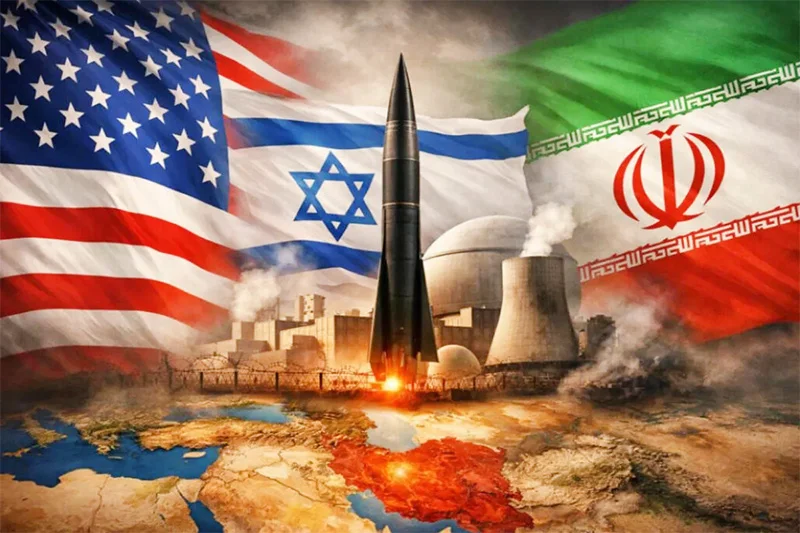
The world’s most theatrical stage
Welcome to the Grand Circus
 If global geopolitics were a TV show, it would be cancelled after the first season for being too unbelievable. Consider the plot: the world’s largest arms exporter lectures others about peace; a government that executed over 500 people in a single year tells its citizens it governs by divine law; and international bodies created to enforce rules seem to apply those rules with remarkable … flexibility. Welcome to the real world of international relations, where the rules are made up and the principles don’t matter.
This analysis examines two of the most consequential actors shaping global instability today: the United States of America, a democracy that can’t quite decide whether it believes in democracy, and the Islamic Republic of Iran, a theocracy that has perfected the art of punishing its own people for simply existing.
Episode I: The United States, ‘Do as I Say, Not as I Do’
The Democracy Export Business
The United States has, for decades, positioned itself as the global guardian of democracy, freedom, and human rights. It is a noble brand. The marketing budget alone, in the form of military expenditure at $886 billion in 2023, is staggering. And yet, the product being sold and the product being delivered have often been … different things.
The CIA-backed coup of 1953, codenamed Operation Ajax, removed Iran’s democratically elected Prime Minister Mohammad Mosaddegh and reinstated the autocratic Shah Mohammad Reza Pahlavi, primarily to protect Anglo-American oil interests.
Nuclear Exceptionalism: The World’s Worst-Kept Secret
The United States currently holds approximately 5,044–5,177 nuclear warheads (depending on the source and year), while Russia being the largest with a stockpile estimated at approximately 5,580 warheads. yet it leads international campaigns demanding that other nations not develop nuclear weapons. This is a bit like the world’s most heavily armed person standing at the door of a gun shop, telling customers they cannot purchase firearms.
Furthermore, Israel is widely believed to possess 80–90 nuclear warheads. The United States has never imposed sanctions on Israel for this. India and Pakistan, both outside the NPT, were rewarded with nuclear cooperation deals after the tested nuclear weapons.
The Saudi Arabia Paradox
Perhaps, no relationship illustrates U.S. foreign policy hypocrisy more vividly than Washington’s alliance with Saudi Arabia. The Kingdom is an absolute monarchy with no elections, no free press, where women were legally barred from driving until 2018, and where the murder of journalist Jamal Khashoggi, carried out, according to U.S. intelligence, on orders from Crown Prince Mohammed bin Salman, resulted in … arms sales continuing and diplomatic ties intact.
The United States sold Saudi Arabia over $37 billion in arms between 2015 and 2020, weapons used in a Yemen war that the United Nations described as one of the world’s worst humanitarian catastrophes. Yet the U.S. simultaneously held press conferences about human rights. The cognitive dissonance is not a bug. It is the feature.
Iraq: The Weapons of Mass Distraction
In 2003, the United States invaded Iraq on the basis of alleged weapons of mass destruction (WMD) that did not exist. The invasion resulted in an estimated 150,000–1,000,000 Iraqi civilian deaths depending on methodology, the displacement of millions, the destabilization of an entire region, and the rise of the Islamic State, none of which appeared in the original brochure. The officials responsible for this foreign policy catastrophe faced no international tribunal. No sanctions were imposed on the United States. Several architects of the war are today respected media commentators.
Meanwhile, the International Criminal Court (ICC), an institution the United States has never ratified, is expected to hold others to account for far lesser offenses. As of 2024, the U.S. has actively sanctioned ICC officials who attempted to investigate American personnel for potential war crimes in Afghanistan.
Episode II: Iran, The People’s Nightmare
Iran’s political system is built on the concept of Velayat-e Faqih, the Guardianship of the Islamic Jurist, a political-theological doctrine holding that a senior Islamic cleric should govern society. In practice, this means that Supreme Leader Ali Khamenei, unelected by the general public, holds veto power over all branches of government, controls the military, the judiciary, state media, and the powerful Islamic Revolutionary Guard Corps (IRGC).
The elected president, whether ‘moderate’ or ‘hardliner’, operates within a system where real power resides with the Supreme Leader and an unelected Guardian Council that vets all candidates and can disqualify anyone it deems insufficiently Islamic. In the 2021 presidential election, the Guardian Council disqualified over 590 candidates out of 592 who applied. The word ‘election’ is being used loosely here.
Women’s Rights: A Systematic Dismantling
Since the 1979 Islamic Revolution, Iranian women have endured one of the most comprehensive rollbacks of rights in modern history. Within weeks of the revolution, mandatory hijab laws were imposed, women were barred from serving as judges, and the minimum marriage age for girls was reduced to 9 years (later revised to 13 in 1982). This was not incidental policy; it was ideological architecture.
Today, Iranian women face legal discrimination across virtually every domain. Under the Iranian Civil Code, a woman’s testimony in court counts as half that of a man’s. Women cannot travel abroad without the written permission of their husband or male guardian. Married women cannot work without spousal consent in many circumstances. The diyeh (blood money) for a woman’s life is legally valued at half that of a man.
In September 2022, 22-year-old Mahsa (Zhina) Amini died in the custody of Iran’s Morality Police, after being arrested for allegedly wearing her hijab improperly. Her death triggered the Woman, Life, Freedom uprising, one of the largest protest movements in Iranian history. The government’s response was to kill over 500 protesters, arrest more than 19,000, and execute at least four people in connection with the protests by early 2023.
The IRGC and State-Sponsored Repression
The Islamic Revolutionary Guard Corps is a military-economic-political entity unlike any other in the region. It controls an estimated 20–40% of Iran’s economy through businesses, construction contracts, and import monopolies. It commands proxy militias across Iraq, Syria, Lebanon, and Yemen. And it suppresses domestic dissent with a ruthlessness that has drawn consistent condemnation from United Nations human rights bodies.
Amnesty International’s 2022-2023 annual report documented the IRGC and security forces using live ammunition, birdshot, and metal pellets against protesters, deliberately targeting eyes, resulting in hundreds being blinded. The UN Special Rapporteur on Iran documented ‘serious, widespread and systematic human rights violations’ constituting potential crimes against humanity.
Episode III: Where the Two Hypocrisies Meet
The relationship between the United States and Iran is, in many ways, a story of two entities who deserve each other in the sense that the behavUior of each government has fed the domestic narrative of the other for decades.
Washington uses Iran as justification for its military presence in the Gulf, its arms sales to autocratic Gulf states, and its general posture as indispensable regional hegemon. Tehran uses American hostility and sanctions as justification for economic failure, political repression, and nuclear advancement. Both governments’ hard-liners need each other to remain in power.
The Iranian people, 85 million of them, majority under 35, highly educated, and overwhelmingly wanting engagement with the world, are trapped between a government that treats them as subjects and an international sanctions regime that punishes them for their government’s choices. The American people, meanwhile, continue paying for a foreign policy architecture that serves arms manufacturers, defense contractors, and geopolitical abstractions more than it serves democratic values or human security.
Some Uncomfortable Truths
The United States is not the villain of every story, nor is Iran irredeemably authoritarian in the hearts of its people. What is consistent, and what this analysis has documented, is that both governments operate by standards they refuse to apply to themselves.
Tehran’s theocratic governance has failed its population economically, politically, and most visibly in its treatment of women and dissidents. The Woman, Life, Freedom movement showed the world what Iranian society wants. The government’s violent response showed the world what the Islamic Republic fears.
The lesson, uncomfortable as it is, is that powerful states, whether wielding aircraft carriers or theology, tend to exempt themselves from the rules they want others to follow. The only antidote is an informed public that refuses to accept these double standards as the natural order of things. Read critically. Follow the money. And remember: when a government tells you it acts in the name of God or democracy.
(The writer, a senior Chartered Accountant and professional banker, is Professor at SLIIT, Malabe. The views and opinions expressed in this article are personal.)

China approves ‘ethnic unity’ law requiring minorities to learn Mandarin

Nasa spacecraft weighing 1,300lb due to re-enter Earth’s atmosphere

Chinese national arrested over attempt to smuggle 2,000 queen ants from Kenya

Attacks reported on three more cargo ships in Gulf, with oil price back near $100

PM Visits the International Rice Research Institute (IRRI)

Heat Index at ‘Caution level’ at some places in the Western, Sabaragamuwa, Southern and North-western provinces and in Monaragala and Mannar districts

‘Dates have the highest sugar content to fight Coronavirus’

Sunday Island 27 December – Headlines

#SundayIsland 17th December – Headlines

Sunday Island – 28th March

Sunday Island Headlines – 21 March

Sunday Island – 21st February – Headlines
-
 News7 days ago
University of Wolverhampton confirms Ranil was officially invited
-

 News6 days ago
Peradeniya Uni issues alert over leopards in its premises
-

 News7 days ago
Female lawyer given 12 years RI for preparing forged deeds for Borella land
-

 News4 days ago
Repatriation of Iranian naval personnel Sri Lanka’s call: Washington
-
 News7 days ago
Library crisis hits Pera university
-

 News6 days ago
Wife raises alarm over Sallay’s detention under PTA
-

 News7 days ago
‘IRIS Dena was Indian Navy guest, hit without warning’, Iran warns US of bitter regret
-
 Latest News7 days ago
Sri Lanka evacuates crew of second Iranian vessel after US sunk IRIS Dena