
Business
Sri Lanka’s macroeconomic policy setting: Cohesion or confusion?

By Dushni Weerakoon
The hike in policy interest rates by the Central Bank of Sri Lanka (CBSL) in August 2021 marks a shift from stimulus to exit strategies in the pandemic era. Such recalibrations globally are focused on how to tackle the historically large debt-to-GDP ratios that the COVID-19 pandemic leaves in its wake. At end 2020, advanced economies (AEs) on average had amassed debt to the tune of 120% of their GDP with emerging markets economies (EMEs) trailing some distance at 65% of GDP. As the spotlight moves, the full impacts of the macroeconomic policy measures, hitherto obscured by the urgency to deal with the health crisis, are now coming under greater scrutiny.
Sri Lanka’s debt metrics make an orderly exit more difficult
Many countries, especially AEs, exercised their ‘monetary sovereignty’ to create and print their own money to support stimulus efforts. They have done so through coordinated monetary/fiscal policies – i.e. using monetary policy to keeping borrowing costs low while fiscal authorities provide back-stop assurance. Some are better positioned to manage the inherent risks and conflicts of interest that are involved in this exercise. AEs have an advantage as issuers of reserve currencies with global demand and historically low interest rates; EMEs with limited exposure to foreign currency-denominated debt and holding comfortable stockpiles of reserves are less exposed to disruptive tail events.
Such countries can bring down their debt ratios if they are able to maintain nominal GDP growth persistently above the average interest rates that they pay on their debt – i.e. the growth-corrected interest rate (r-g) whereby countries can run modest primary deficits and still have a stable or falling debt-to-GDP ratio.
Sri Lanka is not similarly positioned. Its debt metrics point to high vulnerabilities – a high debt-to-GDP ratio of 101% of GDP, large exposure to foreign currency-denominated debt, and a hefty foreign debt repayment schedule. Under these conditions, the threat from exercising monetary sovereignty was always self-evident. A depreciating currency, notwithstanding distortionary controls on imports and capital flows, worsens the debt vulnerabilities.
Domestic and foreign debts are hardly similar. Given Sri Lanka’s debt metrics and the fundamental economic imbalances that have generated them, simple accounting identities do not always offer very plausible solutions. If the exchange rate depreciates, it adds to the real value of outstanding debt, relative to the size of the economy, even if interest rates remain modest. Further, shocks like COVID-19 raise risk premia, and marginal borrowing costs can rise suddenly and sharply, cutting countries abruptly out of financial markets.
Crucial to instill and retain macroeconomic policy credibility
 Short of distortionary measures such as inflating debt away or maintaining an overvalued currency, a primary surplus is needed to stop the public debt-to-GDP ratio from rising and an even larger surplus is needed to reduce it. Improving the primary budget balance calls for tax increases or public spending cuts that are unpopular and have upfront costs. Given the government’s unwillingness to go down this path, households and firms will be required instead to bear the cost through higher interest rates that will affect their consumption and investments.
Higher interest rates in this instance will also not ‘pull in’ foreign capital to firm up the exchange rate given the risk premia on the currency front as depreciating pressure deepens. With reserves in hand to cover barely two months of imports, the forex market will continue to face volatility and instability until a steady stream of capital inflows, beyond short-term swaps, emerge. Until such time, a depreciating domestic currency will increase the interest burden as calculated in that currency. If debt servicing interest rate costs are pushed persistently above the economic growth rate, Sri Lanka’s debt burden will grow steadily even in the absence of new borrowing – a context sometimes called a ‘debt spiral’.
Without a clearly spelt-out debt sustainability path, Sri Lanka seems to be placing all its bets on foreign direct investment (FDI) to ease external pressures and revive economic growth. For a successful outcome – i.e. productivity gains to drive long-term growth – the type of FDI matters. The more desirable is efficiency-seeking FDI, but this is also harder to attract. For now, a policy environment of import curbs and capital controls is more likely to see strategic-seeking infrastructure-led FDI. The latter runs the risk of switching resources to non-tradable sectors – reducing the availability of external financing over the longer term – and the prospect of a short-lived growth burst as before in the post-war years. Crucially too, the sole reliance on FDI leaves Sri Lanka at the mercy of developments beyond its control.
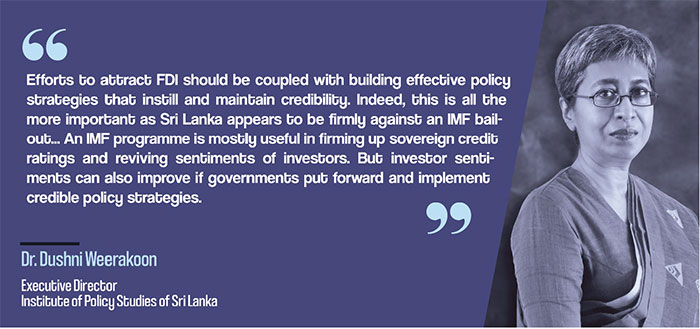
Rather, efforts to attract FDI should be coupled with building effective policy strategies that instill and maintain credibility. Indeed, this is all the more important as Sri Lanka appears to be firmly against an International Monetary Fund (IMF) bailout. IMF loan amounts are small and it no longer has much sway on debt relief with much of EME foreign debt held by private institutional investors and China. An IMF programme is mostly useful in firming up sovereign credit ratings and reviving the sentiments of investors. But investor sentiments can also improve if governments put forward and implement credible policy strategies. By contrast, the CBSL’s policy rate adjustment to anchor expectations, for instance, will not stick if direct financing of fiscal spending is to continue under yield control measures. Instead, market convictions on the credibility of the policy mix will drive economic fundamentals. As Sri Lanka readies to transition out of pandemic-related emergency support, some notion of fiscal and debt sustainability to anchor confidence should be the priority in Budget 2022 preparations.
* This blog is based on the comprehensive chapter on “Economic Performance and Outlook: Managing the Crisis and Promoting Recovery” in IPS’ forthcoming annual flagship publication ‘Sri Lanka: The State of Economy 2021’
.
Link to blog: https://www.ips.lk/talkingeconomics/2021/08/30/sri-lankas-macroeconomic-policy-setting-cohesion-or-confusion/
Dushni Weerakoon is the Executive Director of the Institute of Policy Studies of Sri Lanka (IPS) and Head of its Macroeconomic Policy research. She joined IPS in 1994 after obtaining her PhD, and has written and published widely on macroeconomic policy, regional trade integration and international economics. She has extensive experience working in policy development committees and official delegations of the Government of Sri Lanka. Dushni Weerakoon holds a BSc in Economics with First Class Honours from the Queen’s University of Belfast, U.K., and an MA and PhD in Economics from the University of Manchester, U.K.


The Securities and Exchange Commission of Sri Lanka (SEC) successfully hosted a series of high-level meetings of the International Organization of Securities Commissions (IOSCO), bringing together leading securities regulators and enforcement officials from around the world to discuss emerging regulatory challenges, strengthen international cooperation, and enhance collective efforts to combat cross-border securities market misconduct.
The meetings, held at the Hilton Colombo from 13 to 16 October 2026, included sessions of the IOSCO Enforcement and Cooperation Committee and its Screening Group (Committee 4/SG), as well as meetings of the Monitoring Group and the Steering Committee. The event attracted approximately 50 senior representatives from securities regulators and exchanges across several jurisdictions, including Australia, Japan, the United States, the United Kingdom, France, Italy, Canada, New Zealand, India, Germany, Belgium, Singapore, China and Spain, reflecting the global significance of the discussions and the growing importance of international regulatory collaboration.
Welcoming delegates to Sri Lanka, Senior Professor D.B.P.H. Dissabandara, Chairman of the SEC, emphasized the critical role of international cooperation in safeguarding market integrity and investor confidence in an increasingly interconnected financial landscape.
“No regulator can effectively address cross-border misconduct in isolation. The speed with which information, transactions and illicit activities can move across borders requires an equally coordinated and timely regulatory response. Strong international cooperation, effective information sharing and mutual trust among regulators are essential to maintaining fair, transparent and resilient capital markets,” he stated.
The discussions focused on a range of enforcement and cooperation matters, including mechanisms for enhancing cross-border information exchange, strengthening investigative collaboration among regulators, addressing increasingly sophisticated forms of securities fraud and market abuse, and promoting the effective implementation of international standards and best practices. Participants also exchanged experiences and insights on emerging enforcement challenges arising from technological developments, digitalization of financial services, and increasingly interconnected global markets.
IOSCO is recognized as the leading international body that brings together the world’s securities regulators and serves as the global standard setter for securities regulation. Through its policy work and cooperative initiatives, IOSCO plays a central role in promoting investor protection, ensuring that markets are fair, efficient and transparent, reducing systemic risk, and strengthening confidence in capital markets worldwide.
Sri Lanka has maintained a strong and active relationship with IOSCO for more than three decades. The SEC became an Ordinary Member of IOSCO in 1993 and has been a signatory to the IOSCO Multilateral Memorandum of Understanding (MMoU) since 2004. The MMoU is the internationally recognised benchmark for cooperation and information sharing among securities regulators and serves as a critical tool in facilitating cross-border investigations and enforcement actions.

Pan Asia Bank recently entered into a one-year Memorandum of Understanding (MOU) with Ideal Motors (Pvt) Ltd, creating a new financing avenue for customers purchasing vehicles from the authorised Mahindra dealer. The strategic partnership will enable customers of Ideal Motors to access leasing facilities from Pan Asia Bank, making vehicle financing more convenient while supporting their mobility and business requirements. The agreement also provides an opportunity for the Bank to expand its leasing portfolio and strengthen its presence in Sri Lanka’s vehicle financing market.
Ideal Motors is the authorised dealer for the Mahindra vehicle range in Sri Lanka, including the Mahindra Bolero CPU Truck and Scorpio Jeep/Pickup. The vehicles cater to a range of requirements, from commercial and business applications to personal mobility, making accessible financing an important part of the purchasing decision.
The Bank’s vehicle leasing facilities are designed to simplify the financing process, with convenient repayment options and professional support to help customers select a solution suited to their requirements. For customers, the arrangement brings vehicle selection and financing closer together, reducing the need to navigate the two processes separately.
“Our partnership with Ideal Motors enables us to bring financing closer to customers at the point of vehicle purchase. We remain focused on providing convenient and flexible leasing solutions that support both personal mobility and the needs of businesses,” said Naleen Edirisinghe, Director/CEO of Pan Asia Bank.
Pan Asia Bank and Ideal Motors will work closely during the one-year partnership to maximise business opportunities and deliver a seamless financing experience to customers. The collaboration is expected to strengthen both organisations’ ability to respond to demand for commercial and personal vehicles while creating greater value for customers.
Yohan Ebell, Head of Retail Credit, Pan Asia Bank, said: “Through this partnership, we aim to make vehicle financing simpler and more accessible, with leasing solutions designed to meet the varied requirements of Ideal Motors’ customers.”
The collaboration also reflects Pan Asia Bank’s commitment to building partnerships that make financial services more accessible and responsive to the needs of individuals and businesses.
Pan Asia Bank has established a growing presence in vehicle financing, offering leasing solutions designed around customer convenience and flexibility. Its leasing proposition is supported by a nationwide branch network and a customer-focused approach, enabling customers to obtain guidance on financing options while completing their vehicle purchase.

Heritance Hotels and Resorts has secured four distinguished titles at the World Travel Awards 2026, with three national awards recognising its Sri Lankan properties and an international title for Heritance Aarah in the Maldives.
The three Sri Lankan titles recognise Heritance Tea Factory as Sri Lanka’s Leading Heritage Hotel 2026, Heritance Ahungalla as Sri Lanka’s Leading Luxury Hotel 2026, and Heritance Kandalama as Sri Lanka’s Leading Wedding Hotel 2026. Heritance Aarah was named the Indian Ocean’s Leading All-Inclusive Resort 2026.
Internationally recognised within the global travel and tourism industry, the World Travel Awards celebrate excellence across hotels, resorts, and destinations. Recognition at this level affirms the quality, distinctiveness, and consistency of the experiences delivered by Heritance Hotels and Resorts.

Import and Export (Control) Regulations No. 08 of 2026
Draft Bill of the Public Private Partnership Enterprises Act to be gazzetted
Amendment of the Ayurvedha Act No. 31 of 1961

Cabinet nod to amend the Sri Lanka Development Administration Institute Act No. 9 of 1982
Establishment of the National Higher Performance Centre
State patronage for the cremation ceremony of the late deputy prelate (Anu Nayaka Thero) of the Sri Laka Ramangya Maha Nikaya, Gatambe Rajopawanramadhipatha, Siri Chandawimala Wanshalankara, Chandrakeerthi Sri Amarawansha, Sadhdharmawageeshwara, Shasanashobhanna Most Venerable Keppetiyagoda Siriwimalabhidhana Thero

‘Dates have the highest sugar content to fight Coronavirus’

Sunday Island 27 December – Headlines

#SundayIsland 17th December – Headlines

Sunday Island – 28th March

Sunday Island Headlines – 21 March

Sunday Island – 21st February – Headlines
-

 Features3 days ago
Kotahena:A Small Enclave, An Extraordinary Legacy
-

 News7 days ago
Sri Lanka, India caught in US-Iran ship crisis
-

 News4 days ago
Asgiri Mahanayake calls for immediate release of Gnanasara Thera
-

 Latest News7 days ago
Missiles intercepted near Riyadh after Saudi coalition hits Yemen fuel depot
-

 Latest News7 days ago
Kusal Mendis’ unbeaten 87 hands Sri Lanka consolation win
-

 News2 days ago
Record 1,600 students take Russian Classical Ballet examination in Sri Lanka
-

 News6 days ago
AC President recuses himself from hearing prison attire case pertaining to Gnanasara Thera
-
 News5 days ago
Naval officer testifies Yoshitha received Rs. 5.15 mn in salaries during SLN service