
Business
Sri Lanka’s first fashion movie ‘Yaaluwoda Yaaluida’ premieres


The official red-carpet premiere of ‘Yaaluwoda Yaaluida’, Sri Lanka’s first fashion movie written & directed by Dilshara Jayamanna & produced by Rasitha JInasena, was held recently at the Colombo City Centre Scope Cinemas. The movie, a Netflix flavoured Sinhala romantic comedy for the TikTok age, is due to be released in cinemas islandwide on 3rd March 2023.
Starring newcomers Shereen Willis as Steffi and Eraj Gunewardane as Mithun in the two lead roles, Yaaluwoda Yaaluida aims to create a cultural shift in Sri Lankan cinema by exploring several themes that appeal to today’s young audiences such as the ups and downs of falling in love, the difficult bridge between friendship and love, today’s world of high-end fashion, and the almost inevitable impact of social media on young lives. An ensemble of some of Sri Lanka’s most loved actors and actresses including Saranga Disasekara, Yureni Noshika, Dinakshie Priyasad, Danu Innasithamby, Mass Ramli, Romaine Willis, Sarah Illyas and many others, combine to elevate the performances of the young duo on their big screen debut.
The inspiration behind the movie is Director Dilshara Jayamanna’s desire to shine the spotlight on a significant cultural shift in the way today’s young Sri Lankans approach, see and feel part of pop culture be it fashion, music, career choices, and even their attitudes towards the international community. Jayamanna and his creative team have been able to perfectly capture the essence of this cultural shift and bring it to life on the big screen for audiences of all ages to enjoy and appreciate. Aligning to today’s world that increasingly understands and appreciates the immense impact of strong females on every aspect of modern society, the movie changes the game by putting the female as the lead and building the storyline around her dynamic screen presence and performance.
The back-story of the movie is bound to inspire today’s younger generation, notably the female audiences. Lead actress Shereen was discovered on TikTok by Executive Producer Harshini Kithulagoda and provided a platform to reveal her acting prowess which she does so with tremendous success. Lead actor Eraj, who comes from a background of acting in plays, also impresses as the male friend of young Steffi and their on-screen chemistry will leave audiences wondering as to whether they end up remaining friends or become more than friends as the title of the movie suggests.
The movie also lands a couple of firsts in Sri Lanka’s film industry. The song ‘Tharunai’ by DJ Mass and Romaine Willis is the first EDM (Electronic Dance Music) track in a Sinhala movie while the movie is also the first Sinhala movie to have an Anime sequence, created by young designer Sejini Ratnayake.
Produced by veteran producer Rasitha Jinasena, the studio behind Yaaluwoda Yaaluida is Starfish Neuro, a bold new Sri Lankan content studio making premium content for cinemas and online audiences. Other key members of the production team include Rangana S. Bandara and Hasitha Warnasuriya (Directors of Photography), Kavinda Mudalige (Editor), Jude Gayantha (Costumes), and Nuwan Sanuranke (Production Design). The movie has an outstanding soundtrack with music by Nishan Daniel and songs performed by Dinesh Gamage, DJ Mass, and Romaine Willis.

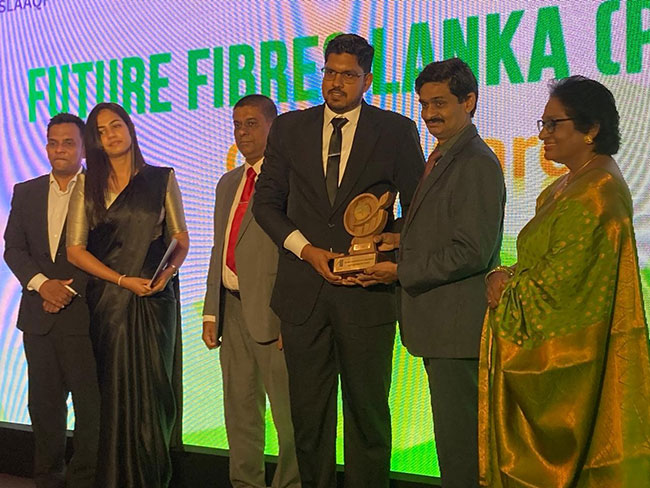
While the corporate world celebrates the merger of efficiency and ecology, a leading academic last week issued a sobering warning: the very technology driving the next “Green Revolution” may leave the human workforce behind.
Speaking at the recently concluded Green Productivity Awards, organised by the Sri Lanka Association for the Advancement of Quality and Productivity (SLAAQP), Professor Hiran Amarasekera of the University of Sri Jayewardenepura characterised Artificial Intelligence (AI) as a “godsend” for environmental sustainability – but one that carries profound social risks.
Professor Amarasekera’s keynote address cut through the celebratory atmosphere, targeting a perceived complacency among top-tier management.
“Managers are already using AI, but many CEOs, directors and managing directors remain sceptical,” he observed. “They think AI will come in another five years. No, it is already here.”
According to the Professor, AI is no longer a futuristic concept but a functional tool currently revolutionising green metrics. He highlighted how the technology is already replacing manual monitoring for energy optimisation, using predictive algorithms to drastically reduce industrial waste, and automating sustainability reporting – turning months of consumption data analysis into a task of mere seconds.
While these advancements provide a massive boost to the “bottom line” and help organisations meet the national Net Zero pledge, Prof. Amarasekera warned of a looming “danger”: the displacement of human workers.
“AI is boosting productivity while cutting back the need for human resources. What will happen to the jobs and the wider society? Not even the USA or other advanced economies have an answer to this,” he noted.
In a moment that elicited both laughter and reflection from the audience, he touched upon the irony of modern higher education: “Students produce their work through AI and we detect plagiarism through AI. So, with AI around, hardly anyone does any real work!”
The technological warning was balanced by the moral urgency of Senior Professor Ajith de Alwis from the University of Moratuwa. Invoking the words of David Attenborough, Prof. de Alwis asked the audience how they would look into the eyes of their grandchildren if they knew of the world’s collapse and did nothing.
The takeaway message of the evening was clear: While AI provides the tools to save the planet, human leadership remains the only force capable of managing the social consequences of that salvation.
Despite the warnings of future challenges, the SLAAQP awards proved that Sri Lankan industries are currently making notable strides. The event recognised 38 organisations – including 28 Gold Award winners – across sectors ranging from plantation, garments and rubber to poultry and textiles.
These winners were evaluated on four critical pillars: Leadership, Environmental Sustainability, Productivity Enhancement and Social Contribution.
By Sanath Nanayakkare
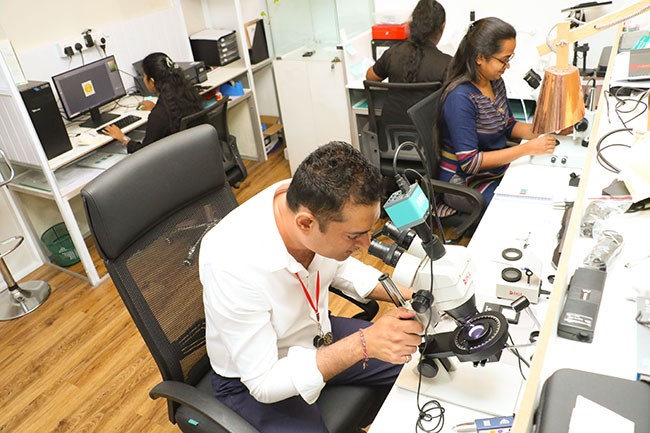
Steps into a critical void to earn recognition in international markets
For decades, Sri Lanka has been globally revered as the “Island of Gems,” yet the industry has long grappled with a paradoxical challenge: while the Sri Lankan soil yields the world’s finest stones, the local certification process has often struggled to command the same recognition in international markets.
Stepping into this critical void is the Gemological Report of Ceylon (GRC). Located at No. 97, Galle Road, Colombo 3, this newly launched laboratory is on a mission to redefine the standards of local gem certification, ensuring that the “fatherhood” of Sri Lankan gemstones remains firmly within its home soil.
Founded by Milinda Edirisinghe, a seasoned gemologist with over 20 years of experience in mining, trading, and geological study, GRC is the result of a lifelong observation of the industry’s “trust gap.”
“I saw a critical disparity,” says Edirisinghe, who received specialised training in Thailand, the global hub for gemstone treatments. “Sri Lankan exporters often face unfair skepticism in markets like Thailand, Hong Kong, and the US. International buyers often view local reports with doubt. I launched GRC to provide a local institute that is on par with the highest-caliber laboratories in the world.”
He made these comments while speaking to media at the new laboratory.
According to him, in its first month of operation, GRC has already seen a surge in demand, processing 30 to 40 stones daily – a success driven largely by its word-of-mouth reputation.
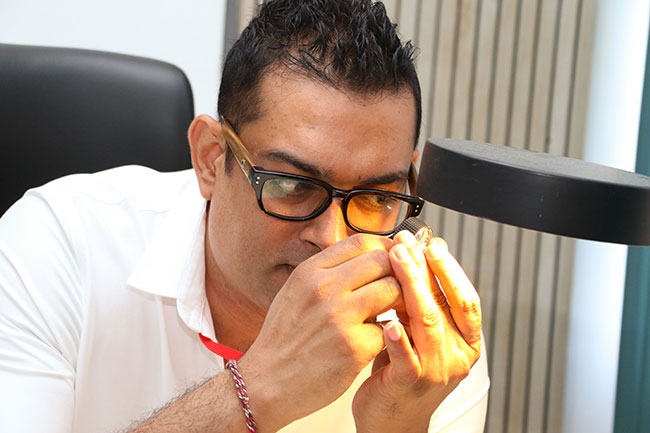
Milinda Edirisinghe performs a sensory inspection of a gemstone using a loupe to assess its initial characteristics
“The lab’s rapid growth is built on a foundation of total transparency. Unlike traditional setups, GRC employs a rigorous triple-blind screening process: three independent gemologists evaluate each specimen – from Sapphires, Ruby and Emeralds to semi-precious stones, polycrystals, rare meteorites, and even organic materials like natural Pearls, and rare coral species etc., used in high-end jewelry. By evaluating the stones without consulting one another, the three gemologists’ independent findings are then synthesised into a final, authoritative and error-free assessment,” he explained.
“As gemstone treatments become increasingly sophisticated – ranging from Beryllium diffusion to evolving heat and irradiation treatments – the need for advanced technology is paramount. GRC’s facility is equipped to identify the full spectrum of enhancements, ensuring the end consumer knows the exact “human intervention” history of their asset,” he further said.
However, Edirisinghe maintains that technology is a tool, not a replacement. When asked if AI could eventually handle the certification job alone, he noted:
“AI already assists our workflow to an extent, but a human gemologist remains an indispensable part of the process. Just as a surgeon uses advanced technology to enhance precision, they must still be present to execute the nuances of a complex operation. AI cannot truly ‘see,’ touch, or feel the soul of a stone.”
He further added, “AI can support our findings, but it cannot replace the gemologist’s ‘eye-view’ and the tactile senses that go a long way in issuing an accurate certification.”
Furthermore, GRC leverages an international expert network. “If we encounter a complex inclusion, we utilize virtual screen-sharing with leading labs in Thailand for real-time peer review,” Edirisinghe explains. “Our conclusions are science-based facts, not just opinions.”
Beyond technical excellence, GRC serves a vital economic purpose. Historically, local dealers spent thousands of dollars obtaining international certificates. GRC offers these world-class reports at a fraction of the cost, with detailed certificates starting from LKR 15,000 for full reports, a medium report at LKR 6,000, “memo cards” at LKR 1,500, and verbal opinions for LKR 500.
“By providing a credible, globally-recognised home-based laboratory, we are stemming the outflow of foreign currency to international labs,” said Edirisinghe.
With plans to participate in upcoming exhibitions in Dubai, Hong Kong, and the USA, GRC is positioning itself as a global contender. As the industry shifts toward “knowledgeable customers” who view jewellery as a liquid asset, GRC stands ready to provide the clarity and integrity the Sri Lankan gem industry deserves.
“If Sri Lanka produces the best stones in the world, it is only right that we also provide the world-class expertise to certify them. Our mission is to ensure that the ‘fatherhood’ of these precious stones remains in Sri Lanka, backed by a certificate that is respected from the USA to the European Union,” Edirisinghe said in conclusion.
By Sanath Nanayakkare

Sri Lanka’s retail landscape will reach a major milestone with the launch of Ministry of Brands (MOB), the country’s first off-price retailer. The flagship store is set to open on 16 February 2026, introducing Sri Lankan consumers to authentic global luxury and premium brands at discounts of up to 90% off original retail prices.
Backed by Akbar Brothers, Ministry of Brands brings the globally established off-price model to South Asia for the first time. The concept allows customers to shop for genuine designer and brand-name products at significantly reduced prices while supporting more sustainable retail practices.
The 10,000 sq. ft. flagship store, located at 28/9, Vajira Road, R.A. De Mel Mawatha, Colombo 4, will feature an extensive range across apparel, footwear, handbags, accessories, homeware, and more. Ministry of Brands will carry over 2,000 international and designer brands spanning womenswear, menswear, childrenswear, home, and accessories, including names such as Gucci, Ferragamo, Valentino, Michael Kors, Ralph Lauren, Burberry, Rag & Bone, Lacoste, Puma, UGG, HOKA, Brooks, Air Jordan, and many more.
Off-price retail is one of the fastest-growing global retail segments, helping fashion houses responsibly manage excess inventory. With the UN Environment Programme estimating 92 million tonnes of textile waste generated annually, sustainable retail models such as off-price are increasingly important.
“Sri Lanka manufactures for many of the world’s leading designer labels, yet these products have often remained out of reach for local consumers,” said Director of Ministry of Brands, Aamir Akbarally. “Through off-price retail, we are proud to make genuine designer brands more accessible to our fellow Sri Lankans, offering premium fashion at affordable prices while delivering a world-class shopping experience built on Akbar Brothers’ longstanding values of integrity, quality, and trust.”
Ministry of Brands Director, Ramzey Hammoud added: “With decades of experience in off-price retail, we see this as an exciting new growth chapter for Sri Lanka’s retail landscape. Our goal is simple: to allow customers to shop global designer brands locally at the best prices, while rediscovering the thrill of the find through a constantly changing, treasure-hunt shopping experience.”
Following the Colombo flagship launch, Ministry of Brands will open a second location at the One Galle Face Mall, with plans to expand across South Asia and Australia.

Winless Afghanistan look to keep slim hopes alive against upbeat UAE

Showers expected in the Central, Western, Sabaragamuwa, Southern and Uva provinces and in Ampara and Batticaloa districts

Patali: Four out of 25 low-quality coal shipments caused Rs. 1,759 mn loss

Cardinal warns of ‘epidemic’ breakdown of family life in Lanka

Three suspects arrested in double murder of lawyer and wife in Thalangama

UK Labour campaigner for sanctions against ex-military chiefs due tomorrow

‘Dates have the highest sugar content to fight Coronavirus’

Sunday Island 27 December – Headlines

#SundayIsland 17th December – Headlines

Sunday Island – 28th March

Sunday Island Headlines – 21 March

Sunday Island – 21st February – Headlines
-
 Life style1 day ago
Marriot new GM Suranga
-

 Midweek Review5 days ago
A question of national pride
-

 Business5 days ago
Autodoc 360 relocates to reinforce commitment to premium auto care
-

 Features1 day ago
Monks’ march, in America and Sri Lanka
-

 Opinion4 days ago
Will computers ever be intelligent?
-

 Features1 day ago
The Rise of Takaichi
-

 Features1 day ago
Wetlands of Sri Lanka:
-
 Midweek Review5 days ago
Theatre and Anthropocentrism in the age of Climate Emergency