
Business
Sri Lanka hits the nail on the head at UN ECOSOC Financing for Development Forum

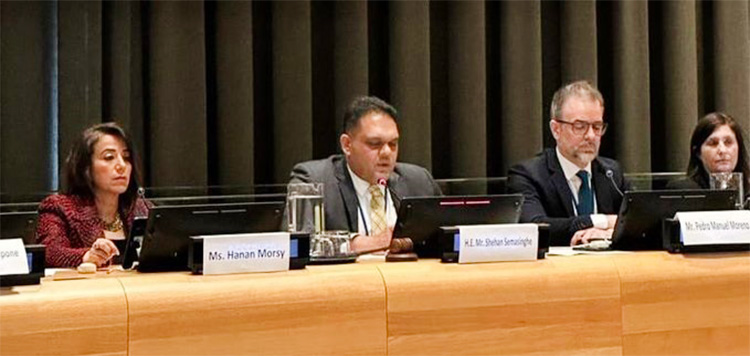
• Says existing system of international debt schemes hinders vulnerable, developing economies
• Urges for political will at global level to reform international financial architecture
• Requests for support in debt restructuring, debt sustainability and adequate climate financing
By Sanath Nanayakkare
Shehan Semasinghe, State Minister of Finance speaking at the UN ECOSOC Financing for Development (FfD) Forum held in New York, on 17 April 2023 said that Sri Lanka’s recent experience has shown the constraints developing countries face in the existing system of the debt architecture, particularly when developing economies are faced with vulnerabilities that are beyond their control.”
Referring to the 54 countries categorized as having severe debt problems given the global outlook of high inflation, low growth and high interest rates, Semasinghe appealed to the high-profile international finance forum that it needs to have a look at the global financial architecture and ensure that the vicious cycle of debt and default does not repeat itself.”
Further speaking he said:
“I came to New York after attending the Spring Sessions of the IMF and the World Bank with whom we have an ongoing dialogue on the reforms being undertaken by Sri Lanka towards economic recovery, and the IMF’s Extended Fund Facility approved last month. As observed by the UN Secretary-General, many developed countries, adopted expansionary fiscal and monetary measures to aid recovery in the aftermath of the pandemic. However, many developing countries could not do so and were burdened with high interest rates and lowered credit ratings. According to the UNDP’s Paper on “Avoiding ‘Too Little Too Late’ on International Debt Relief,” 54 countries are categorized as having severe debt problems given the global outlook of high inflation, low growth and high interest rates. Sri Lanka has had its share of above challenges in recent times,”
“With the successful conclusion of negotiations with the IMF on an Extended Fund Facility, we have reason for optimism and are now engaged in a debt restructuring programme within a framework comprising of a Special Creditor Coordinator Committee comprising of India, France and Japan. Towards this objective, the government of Sri Lanka is committed to making the hard policy decisions needed for the restoration of its economy on sound economic practices.”
“We meet at a time when the development agenda [sustainable development goals of the UN] that we embarked on in 2015 seems to have regressed and is in danger of remaining unachieved in 2030. Even before the pandemic, the development agenda was somewhat constrained due to a multitude of factors. These factors have exacerbated due to a combination of events stemming from the pandemic to the conflict in Ukraine and climate change. Multilateralism and multilateral organizations as well as the process of globalization have today come under threat due to the perception that institutions committed to delivering the Development Agenda have not achieved their milestones. The lack of adequate and sustainable financing remains the primary and key challenge today that many states face in meeting the targets of the 2030 Agenda.”
“The key message in the report on “Financing for Sustainable Development” provides a snapshot of the predicament we are in, the urgency of the action to be taken and the clear recommendations on what needs to be done. What remains to be seen is whether there is political will at the global level to take adequate measures, especially on reform of the international financial architecture, to meet already expressed pledges on Official Development Assistance, assist countries in debt restructuring and debt sustainability and ensure adequate climate financing.
” It is our hope that the SDG Stimulus proposed by the Secretary-General and the deliberations at this Forum will find fruition; stop the back sliding and provide the necessary stimulus to ensure that the Agenda 2030 regains its traction . We cannot be in a state of inertia; we must act with the necessary political will now, if we are to ensure that the global sustainable development prospects will not back slide further and reach a point of irretrievability when we will see an exacerbated finance divide and a yawning sustainable development divide. The time horizons available to scale up SDG financing, investment and development cooperation is short. My government is committed to undertaking national actions to accelerate sustainable industrial transformations. We look forward to forging bilateral and multilateral partnerships to assist this process,” Semasinghe said.

Business
Shinkansen Moment for Sri Lanka: Raghuraman calls for radical export pivot as Japan backs regional value chain


Sri Lanka must engineer a “Shinkansen effect” in its export strategy or risk being left behind in a rapidly reorganising global economy, warned Indo Lanka Chamber of Commerce and Industry President M. Raghuraman, setting the tone for a high-powered policy dialogue at the Japan–Sri Lanka Business Cooperation forum held on Monday at the JAIC Hilton.
Raghuraman’s call for radical reform came amid a broader push by Japan and Sri Lanka to reposition the island as a strategic node in a regional industrial and logistics corridor linking India, Japan and the wider Global South.
The event, organised by Japan External Trade Organization (JETRO) and the Japan-Sri Lanka Business Co-Operation Committee, brought together policymakers, industry leaders and Japanese investors to map out a new export-led growth model.
“Sri Lanka cannot afford incremental change,” Raghuraman said. “We need a Shinkansen effect — a radical transformation in how we plug into regional and global value chains.”
With India projected to expand its middle-income population from 430 million to over 700 million by 2030, Raghuraman described the subcontinent as a “pot of gold just 22 miles away.” Yet Sri Lanka, he cautioned, has failed to fully capitalise on its proximity, particularly through delayed negotiations on upgrading existing trade arrangements into a more comprehensive economic partnership.
Echoing this regional logic, Toyokazu Nagamune, Regional Representative for South Asia at Japan’s Ministry of Economy, Trade and Industry (METI), framed the corridor within Tokyo’s evolving economic security doctrine.
“With rising geopolitical risks and protectionism, Japan is diversifying supply chains,” Nagamune said.
“It is neither realistic nor cost-efficient to localise entire supply chains within a single country. That is why regional cooperation — especially between India and Sri Lanka — is critical.”
Japan is actively encouraging investment in strategic sectors such as semiconductors, batteries, solar panels and rare earth components in India. But Nagamune stressed that Sri Lanka has complementary strengths — from high-purity rubber to skilled electronics assembly — that can integrate into these value chains.
He cited practical examples: Sri Lanka supplying rubber components for compressors manufactured in India; high-purity silicon inputs for solar cell production; and value-added intermediate goods that enhance cost competitiveness across the corridor.
Secretary to the Ministry of Trade, Commerce, Food Security and Co-Operative Development K.A. Vimalenthirajah acknowledged that policy recalibration is overdue.
“We need to create an enabling environment for manufacturers and shift from merely promoting trading entrepreneurship,” he said. “Sri Lanka must position itself as a preferred destination facilitating both investors and exporters.”
Vimalenthirajah identified three priorities: expanding physical connectivity — including ongoing capacity enhancements at the Colombo Port; strengthening “soft enablers” such as comprehensive free trade agreements and mutual recognition of standards; and institutional reforms including result-oriented single-window systems for trade and investment.
Confidence-building through policy consistency, he added, is paramount to attracting long-term capital.
From the Japanese private sector perspective, Takayuki Himeno, Chief Research Manager at Mitsubishi Research Institute, Inc., underscored that infrastructure alone will not secure Sri Lanka’s ambitions as a logistics hub.
“Sri Lanka’s strategic location is an advantage, but it is no longer enough,” Himeno said. “The challenge is fragmentation. Ports, airports and industries operate in silos. Physical infrastructure must be synchronised with data connectivity.”
Drawing on MRI’s two decades of experience managing Japan’s national single window and customs systems, Himeno pointed to digital integration — including port community systems and streamlined customs processes — as essential to reducing lead times and boosting export competitiveness.
Moderating the discussion, Ruvini Fernando, Head of Financial Advisory at Deloitte Sri Lanka, framed the conversation within Sri Lanka’s urgent need to diversify exports and identify new product lines and markets.
“When Sri Lanka is looking at development through export promotion and new market access, this is a very timely discussion,” she observed.
The strategic thrust emerging from the forum was clear: Sri Lanka’s small domestic market — just over 21 million people — should not be seen as a limitation but as a catalyst to integrate outward into regional production networks.
For Japan, the message is about resilience and cost-competitive diversification. For India, it is about scaling manufacturing depth. For Sri Lanka, it is about moving decisively from raw material exports to value-added components — and from policy inertia to execution.
By Ifham Nizam

CSE closed after its broader index hit an intra-day high of 24,000 yesterday due to tensions in US-Iran relations and a dip in investor sentiment.
The All Share Price Index closed at 0.21 percent, or 49.77 points, at 23,870.07 while the S&P SL20 closed down at 0.28 percent, or 19.19 points, at 6,731.31.
Market turnover was Rs 4.9 billion with six crossings. Some of those crossings were reported in Hayleys, where 500,000 shares crossed to the tune of Rs 120 million; its shares traded at Rs 240, Distilleries 2 million shares crossed to the tune of Rs 119 million; its shares sold at Rs 59.50, Dipped Products 1.4 million shares crossed for Rs 80 million; its shares sold at Rs 57, Dialog Axiata 2.25 million shares crossed to the tune of Rs 73.6 million; its shares sold at Rs 32.70, JKH 2.4 million shares crossed to the tune of Rs 55.4 million, its shares traded at Rs 22.80.
Market was driven by interest across diverse sectors with both heavyweights and penny stocks drawing attention, brokers said.
Top negative contributors to the ASPI were Sampath Bank (down Rs 1.75 at 162.25), Colombo Dockyard (down Rs 4.75 at 156.50), Dialog Axiata (down 0.60 cents at Rs 32.70 ), DFCC Bank (down Rs 2 at 157) and Commercial Bank (down Rs 1 at 233). During the day 276.9 million share volumes changed hands in 39867 transactions.
It is said that top contributors to the turnover were Dialog, JKH, Acme, Renuka Hotels, Colombo Dockyard, People’s Leasing and Finance and Asia Siyaka.
Manufacturing sector,especially JKH, performed well. The telecommunications sector, especially Dialog, also performed well.
Yesterday the rupee was quoted at Rs 309.30/35 to the US dollar in the spot market , improving from Rs 309.35/40 the previous day, dealers said, while bond yields edged up slightly.
The telegraphic transfer rates for the American dollar were 305.9000 buying, 312.9000 selling; the British pound was 411.8379 buying, and 423.2855 selling, and the euro was 358.4993 buying, 370.0205 selling.
By Hiran H Senewiratne

Stands with world’s best after receiving ‘Best Life Insurer in Sri Lanka’ title in respect of 2025
Ceylinco Life has once again been recognised as the Best Life Insurer in Sri Lanka by World Finance, securing the prestigious international accolade for an unprecedented 12th consecutive year in respect of 2025.The award positions Ceylinco Life among the world’s most respected life insurance companies, placing it in the distinguished company of global winners such as Sun Life (Canada), Acenda (Australia), China Pacific Insurance (China), CNP Assurances (France), The Talanx Group (Germany), Max Life Insurance (India), Nippon Life Insurance Company (Japan), Swiss Life (Switzerland), Aviva (UK) and MassMutual (USA).
Announcing its 2025 Insurance Industry Awards, World Finance said resilience continues to define the global insurance sector, as firms navigate climate-related claims, rising cyber risks and the rapid evolution of digital underwriting. The magazine noted that this year’s winners exemplify a rare balance between innovation and reliability, earning policyholder confidence while redefining responsible insurance in an increasingly digital age.
Commenting on this latest accolade, Ceylinco Life Executive Chairman R. Renganathan said: “Sustaining this level of international recognition over twelve consecutive years reflects the discipline of our operating culture and the clarity of our long-term strategy. Our focus has always been on building a life insurance business that is resilient across cycles, uncompromising on governance, and deeply aligned with the evolving needs of our policyholders and the communities we serve.”
The World Finance award recognises Ceylinco Life as an organisation that consistently demonstrates operational excellence, financial strength and a strong commitment to customer service. Winners are selected following a rigorous assessment of multiple performance indicators, including underwriting efficiency, policy maintenance processes, exposure to risk, customer retention, claims settlement timelines, new customer acquisition and financial stability measured by premium income, market share, life fund growth and profitability.
The judging process is conducted by a panel representing more than 230 years of combined financial and business journalism expertise, supported by a dedicated research team. Reader insight and experience also play a role in nominations, while the panel is required to avoid bias relating to company size or market depth, enabling a fair evaluation across geographies and business models.
World Finance, established in 2007, is a print and online magazine providing comprehensive coverage and analysis of the global financial industry, international business and the world economy. Its awards programmes are designed to identify and recognise the strongest performers in each market through a structured and transparent evaluation process.
Ceylinco Life has been the market leader in Sri Lanka’s life insurance industry for 21 consecutive years, offering innovative insurance solutions that protect and de-risk the ambitions of policyholders. In 2025, the Company was ranked the most valuable insurance brand in Sri Lanka and the 22nd most valuable brand overall by Brand Finance. It was also voted the People’s Life Insurance Service Provider of the Year for the 19th consecutive year in 2025, reaffirming its position as a brand trusted by millions.
The Company has additionally been adjudged Sri Lanka’s Brand of the Year twice within the past five years and has been recognised among the 10 Most Admired Companies in Sri Lanka by the International Chamber of Commerce Sri Lanka (ICCSL) and the Chartered Institute of Management Accountants (CIMA).

Tariffs ruling is major blow to Trump’s second-term agenda

New Zealand meet familiar opponents Pakistan at spin-friendly Premadasa

Bowlers, Marsh orchestrate consolation Australia win

Development activities in schools within plantation areas should be carried out in coordination with District Coordinating Committees – PM

Asos co-founder dies after Thailand apartment block fall

BCB central contracts: Taskin, Mushfiqur demoted; no player in A+ category

‘Dates have the highest sugar content to fight Coronavirus’

Sunday Island 27 December – Headlines

#SundayIsland 17th December – Headlines

Sunday Island – 28th March

Sunday Island Headlines – 21 March

Sunday Island – 21st February – Headlines
-
 Life style6 days ago
Marriot new GM Suranga
-

 Business5 days ago
Ministry of Brands to launch Sri Lanka’s first off-price retail destination
-

 Features6 days ago
Monks’ march, in America and Sri Lanka
-

 Features6 days ago
The Rise of Takaichi
-

 Features6 days ago
Wetlands of Sri Lanka:
-

 News6 days ago
Thailand to recruit 10,000 Lankans under new labour pact
-

 News6 days ago
Massive Sangha confab to address alleged injustices against monks
-

 Sports2 days ago
Old and new at the SSC, just like Pakistan