
Business
Shinkansen Moment for Sri Lanka: Raghuraman calls for radical export pivot as Japan backs regional value chain


Sri Lanka must engineer a “Shinkansen effect” in its export strategy or risk being left behind in a rapidly reorganising global economy, warned Indo Lanka Chamber of Commerce and Industry President M. Raghuraman, setting the tone for a high-powered policy dialogue at the Japan–Sri Lanka Business Cooperation forum held on Monday at the JAIC Hilton.
Raghuraman’s call for radical reform came amid a broader push by Japan and Sri Lanka to reposition the island as a strategic node in a regional industrial and logistics corridor linking India, Japan and the wider Global South.
The event, organised by Japan External Trade Organization (JETRO) and the Japan-Sri Lanka Business Co-Operation Committee, brought together policymakers, industry leaders and Japanese investors to map out a new export-led growth model.
“Sri Lanka cannot afford incremental change,” Raghuraman said. “We need a Shinkansen effect — a radical transformation in how we plug into regional and global value chains.”
With India projected to expand its middle-income population from 430 million to over 700 million by 2030, Raghuraman described the subcontinent as a “pot of gold just 22 miles away.” Yet Sri Lanka, he cautioned, has failed to fully capitalise on its proximity, particularly through delayed negotiations on upgrading existing trade arrangements into a more comprehensive economic partnership.
Echoing this regional logic, Toyokazu Nagamune, Regional Representative for South Asia at Japan’s Ministry of Economy, Trade and Industry (METI), framed the corridor within Tokyo’s evolving economic security doctrine.
“With rising geopolitical risks and protectionism, Japan is diversifying supply chains,” Nagamune said.
“It is neither realistic nor cost-efficient to localise entire supply chains within a single country. That is why regional cooperation — especially between India and Sri Lanka — is critical.”
Japan is actively encouraging investment in strategic sectors such as semiconductors, batteries, solar panels and rare earth components in India. But Nagamune stressed that Sri Lanka has complementary strengths — from high-purity rubber to skilled electronics assembly — that can integrate into these value chains.
He cited practical examples: Sri Lanka supplying rubber components for compressors manufactured in India; high-purity silicon inputs for solar cell production; and value-added intermediate goods that enhance cost competitiveness across the corridor.
Secretary to the Ministry of Trade, Commerce, Food Security and Co-Operative Development K.A. Vimalenthirajah acknowledged that policy recalibration is overdue.
“We need to create an enabling environment for manufacturers and shift from merely promoting trading entrepreneurship,” he said. “Sri Lanka must position itself as a preferred destination facilitating both investors and exporters.”
Vimalenthirajah identified three priorities: expanding physical connectivity — including ongoing capacity enhancements at the Colombo Port; strengthening “soft enablers” such as comprehensive free trade agreements and mutual recognition of standards; and institutional reforms including result-oriented single-window systems for trade and investment.
Confidence-building through policy consistency, he added, is paramount to attracting long-term capital.
From the Japanese private sector perspective, Takayuki Himeno, Chief Research Manager at Mitsubishi Research Institute, Inc., underscored that infrastructure alone will not secure Sri Lanka’s ambitions as a logistics hub.
“Sri Lanka’s strategic location is an advantage, but it is no longer enough,” Himeno said. “The challenge is fragmentation. Ports, airports and industries operate in silos. Physical infrastructure must be synchronised with data connectivity.”
Drawing on MRI’s two decades of experience managing Japan’s national single window and customs systems, Himeno pointed to digital integration — including port community systems and streamlined customs processes — as essential to reducing lead times and boosting export competitiveness.
Moderating the discussion, Ruvini Fernando, Head of Financial Advisory at Deloitte Sri Lanka, framed the conversation within Sri Lanka’s urgent need to diversify exports and identify new product lines and markets.
“When Sri Lanka is looking at development through export promotion and new market access, this is a very timely discussion,” she observed.
The strategic thrust emerging from the forum was clear: Sri Lanka’s small domestic market — just over 21 million people — should not be seen as a limitation but as a catalyst to integrate outward into regional production networks.
For Japan, the message is about resilience and cost-competitive diversification. For India, it is about scaling manufacturing depth. For Sri Lanka, it is about moving decisively from raw material exports to value-added components — and from policy inertia to execution.
By Ifham Nizam


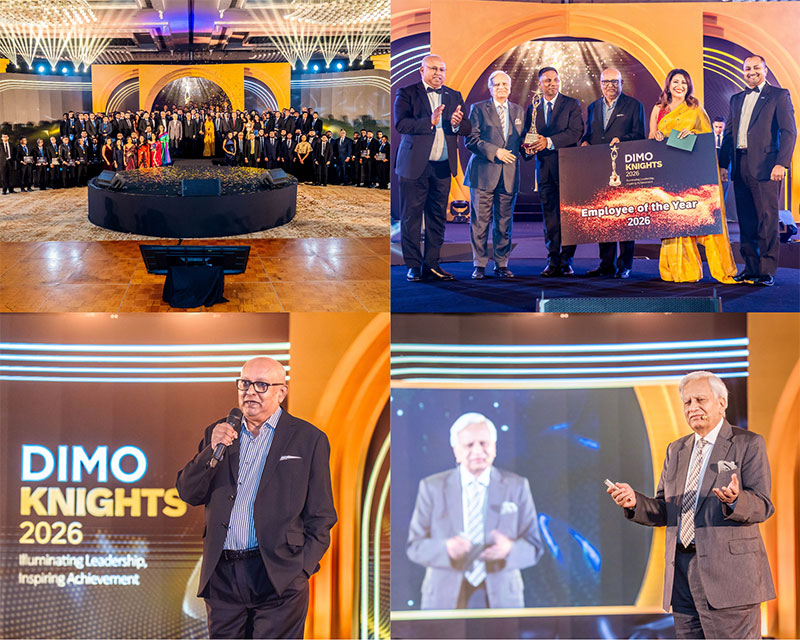
DIMO celebrated DIMO KNIGHTS 2026, recognizing employees whose exceptional dedication, leadership, innovation, and commitment continue to shape the organization’s success. More than an employee recognition event, DIMO KNIGHTS reflects DIMO’s unwavering commitment to cultivating a workplace where people are empowered to thrive, reinforcing the Employee Value Proposition of ‘Making Work Enjoyable and Rewarding’ while bringing its Corporate Purpose of Fuelling Dreams and Aspirations to life.
Held under the theme “Illuminating Leadership, Inspiring Achievement,” the event celebrated individuals who exemplify DIMO’s values and inspire excellence across the organization. By recognizing those who consistently go above and beyond, DIMO continues to foster a high-performance culture where people are empowered to innovate, lead, and create meaningful impact.
A highlight of the evening was the keynote address delivered by Mr. Ravi Kant, former Managing Director and Vice Chairman of Tata Motors India, who shared valuable insights on leadership, organizational transformation, and building resilient organizations capable of sustaining long-term success.
Commenting on the event, Ms. Dilrukshi Kurukulasuriya, Executive Director / Chief Human Resources Officer of DIMO, said: “Our Tribe is the driving force behind DIMO’s continued success. DIMO KNIGHTS is more than a celebration of outstanding performance; it is a reflection of the culture we strive to build every day. By recognizing and empowering our people, we reinforce our Employee Value Proposition of ‘Making Work Enjoyable and Rewarding’ while bringing our Corporate Purpose to life. When our people grow, innovate, and thrive, they create lasting value for our customers, partners, and the communities we serve.”
DIMO KNIGHTS reinforces the organization’s people-first philosophy by fostering a culture of appreciation, continuous learning, and purposeful leadership. The programme reflects DIMO’s conviction that when employees are empowered, recognized, and inspired to excel, they shape the future of the organization through innovation, collaboration, and sustained excellence, strengthening a high-performing culture that delivers lasting value, drives sustainable business success, and reinforces DIMO’s position as an employer of choice.
The evening recognized employees across a wide range of categories, celebrating outstanding performance, innovation, collaboration, customer focus, and leadership. The ceremony culminated with the presentation of the prestigious Innovator of the Year and Employee of the Year awards, with the Employee of the Year accolade presented to Mr. Chathura Gunasekera.
As DIMO continues to invest in developing exceptional talent, initiatives such as DIMO KNIGHTS reaffirm the organization’s belief that sustainable business success begins with its people. By creating an environment where individuals are recognized, empowered, and inspired to achieve their full potential, DIMO continues to cultivate a purpose-driven, high-performing workforce that is equipped to shape the future of the organization while delivering lasting value to all stakeholders.
By Sanath Nanayakkare
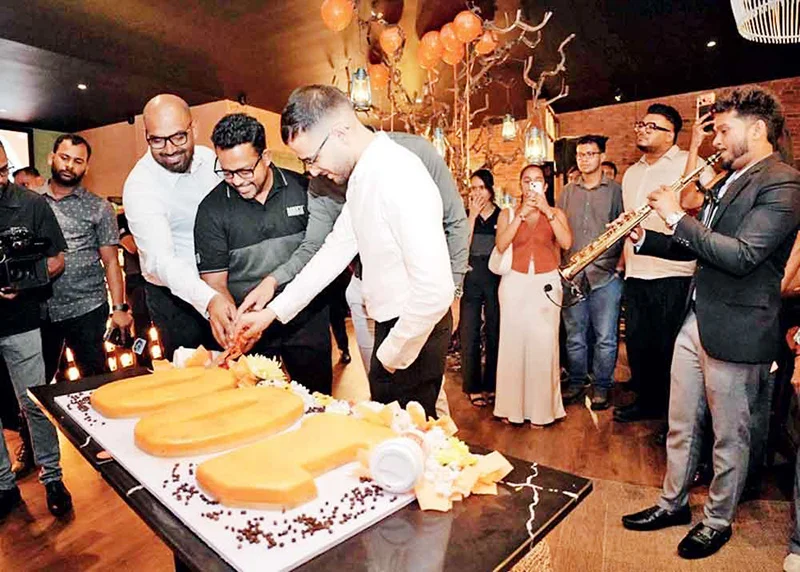
On Baseline Road in Colombo, Barista Coffee recently opened its 100th outlet. For a modern café culture spreading across shopping centers, office districts, and provincial towns, this milestone is a major commercial success. It shows a thriving urban service sector and a growing class of lifestyle consumers who use coffee shops as places to work, socialise, and meet.
This is a curious new picture emerging from Sri Lanka’s post-crisis economic recovery: the coffee cup is getting bigger, even as the household tea cup tells a very different story.
Yet, looking past the espresso machines, a different reality unfolds in the country’s kitchens.
International financial institutions note that while Sri Lanka’s macro-economy is recovering, household welfare and employment remain below pre-crisis levels. Poverty rates sit at roughly double what they were in 2019, and food prices doubled over a three-year span, forcing families to cut back on essentials.
This creates a striking local paradox, especially given Sri Lanka’s proud heritage as a global tea producer. While the world pays top dollar for Ceylon Tea, local market studies and industry reports have long pointed out an unfortunate disparity: many ordinary families find high-quality tea too expensive, often settling for lower-grade alternatives at home.
The growth of a 100-outlet coffee network does not mean prosperity has spread evenly across the island. Instead, it proves that there is a specific, well-resourced segment of consumers with the purchasing power to sustain a premium lifestyle economy, even as many other households carefully calculate the cost of everyday groceries.
Barista’s 100th store is not a bad-news story; it is a testament to acute entrepreneurial grit, shifting consumer behavior, and the vital revival of the nation’s urban service sectors. But it serves as an uncompromising reminder that macroeconomic stabilisation is not synonymous with household recovery.
As Colombo’s coffee culture looks toward its next hundred outlets, the true pulse of the nation’s economic health will not be measured by the espresso machines humming in sleek urban hubs, but by the quiet arithmetic happening in millions of kitchens beyond its doors – where the fundamental question remains whether a family can comfortably afford a better cup of Ceylon Tea.

Aitken Spence Hotel Holdings PLC announced that its maiden listed, rated, unsecured, senior
redeemable debenture issue was oversubscribed on its opening day, 15th September 2026.
The Company sought to raise Rs. 3 billion through an initial issuance of 30 million debentures at Rs.
100 each, with an option to issue a further 20 million debentures in the event of oversubscription of the initial issue, increasing the total issue size to Rs. 5 billion.
The Company said it had received applications for more than 50 million debentures, the full amount on offer, prompting the issue to close at 4:30 p.m. on the opening day (15).
The basis of allotment will be announced to the Colombo Stock Exchange as per regulatory requirements in due course.

Zimbabwean Tavengwa Mukuhlani appointed Deputy Chair of the ICC until November 2027.

DIMO KNIGHTS 2026 Reinforces a Culture of Recognition and Growth

Isle of Man teenage all-rounder Lucy Barnett ICC Women’s Player of the Month for August 2026

Sonal Dinusha named the ICC Men’s Player of the Month for August 2026.

USA midfielder sues doctors after on-pitch cardiac arrest

River home to 500 crocodiles chosen as Olympic rowing venue

‘Dates have the highest sugar content to fight Coronavirus’

Sunday Island 27 December – Headlines

#SundayIsland 17th December – Headlines

Sunday Island – 28th March

Sunday Island Headlines – 21 March

Sunday Island – 21st February – Headlines
-

 Sports7 days ago
DDS set to lose Test captaincy
-

 News7 days ago
Sri Lanka faces new grid challenge as rooftop solar surges: former CEB GM
-

 Latest News7 days ago
Shafali, Deepti power India into sixth T20 Asia Cup final
-

 News5 days ago
Gnanasara Thero absconding after SC ruling
-

 Latest News6 days ago
Sri Lanka thwart Fatima Sana challenge to secure Asia Cup final spot
-

 News6 days ago
Ammunition cache found in old Kandy bungalow
-

 Editorial7 days ago
A flight of fancy
-

 News6 days ago
Green Climate Fund (GCF) Regional Dialogue for East and South Asia will be held from 14 to 17 September 2026 at Cinnamon Life at City of Dreams Hotel, Colombo