
News
Sri Lanka exporters should convert, rupee worth 185 to dollar: Minister Cabraal

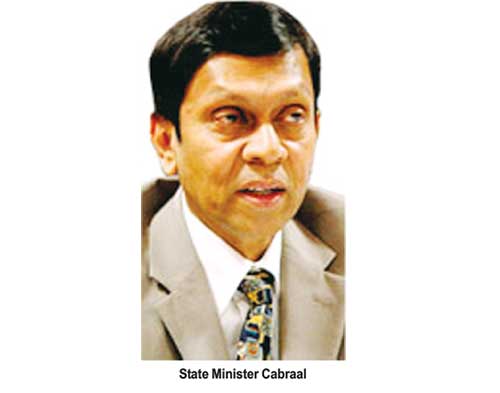
by Imesh Ranasinghe
Sri Lanka’s rupee should be around 185 to the US dollar, State Minister for Money and Capital Markets Nivard Cabraal has said urging exporters to convert dollar inflows without holding them back.
“I think the rupee should be around 185 to the US dollar depending on the macroeconomic factors,” Minister Cabraal said at a conference last week.
Cabraal a former central bank Governor kept the rupee stable for several years, though after a fall in 2012, it was not allowed to appreciate when credit fell in 2013 and the central bank bought billions of dollars for its reserves, for reasons that are not clear.
Sri Lanka’s rupee fell sharply in over January 2021 after the central bank printed money and brought rupee interest rates below local dollar yields over the past year amid a credit downgrade which drove up dollar bond yields, making forward premiums negative and incentivizing importers to cover forward.
As exporters also unwilling to sell forward at a discount, banks bought dollars in the spot and near term market, using the printed money from the central which are sloshing around as excess liquidity to provide forward cover to importers, putting pressure on exchange rate.
Some exporters loaned dollars and were borrowing rupees due to the inverted interest rates.
Due to unprecedented levels of excess liquidity in the overnight market interest rates did not move up in a correction – which would have raised the forward premium – despite interventions by the central bank which reduced some excess liquidity.
Excess liquidity fell from 266 billion rupees at the beginning of the year to around 120 billion rupees amid dollar losses to interventions and debt repayments.
The central bank then closed the forward market, preventing banks from giving forward cover.
“So the central bank took necessary actions about that,” Cabraal said. “And because of those actions taken by the central bank in the past few days, we once again saw the rupee being appreciated.”
Minister Cabraal asked exporters to convert their dollars as soon they receive them, as they may face losses by listening to fear mongers.
“We should keep in mind that it is a tough period for the world, so in such a tough period when we are going forward we all should go forward together,” he said.
“It’s like going in a boat, when that boat is going in a rough sea we should not shake the boat, If one or two tries to shake the boat everyone in the boat will have to face the consequences.”
Cabraal said if some are shaking the boat in that manner will, they will have to take necessary steps in order to stop them from shaking and making the boat unstable,
“It is what the central bank has done now,” he said. “There are other things the central bank can do but our opinion is that it is not necessary to do them now.”
Analysts have blamed a so-called ‘flexible exchange rate’ where a pegged exchange rate is suddenly turned into a floating exchange rate as money printing puts pressure triggering panic and uncertainty forcing importers settle bills immediately taking more credit and exporters to watch and wait.
There have been calls for central bank reform to stop the instability.
The rupee has appreciated in recent days from around 196 to 191 to the US dollar.
Meanwhile Cabraal said in 2014, when Mahinda Rajapaksa administration had left office, the US dollar was 131.5 rupees to the dollar.
At the time the only accusations from the economic experts in the opposition at that time were that the Central Bank is controlling the rupee as it was stable for years and the rupee should be allowed to float.
“But after they came into power the rupee depreciated for 5 years like never before with an annual average depreciation of 6.7 percent,” he said.
There were no global crisis or any other problem during those five years but the rupee depreciated to 181.63 against the US dollar.
“The rupee only depreciated by 2.6 percent in 2020, it is a big achievement when considering the tough period we are going through, meanwhile, the central bank was able to collect 282 million dollar to buttress its reserves,” Cabraal.
Other analysts had also blamed the last administration for giving the central bank independence to target a real effective exchange rate on contested claims that the rupee was more ‘overvalued’ than East Asia while printing money.
The resulting currency crisis then created consumption shocks that lowered growth.
More money was then printed on the basis that there was an output gap, triggering another currency crisis and destroying the economic credential of the United National Party, which was the largest partner of the then ruling coalition.
Analysts had warned of the outcome earlier.
Analysts and economists are now warning that the current monetary framework involving so-called modern monetary theory, with high levels of excess liquidity would also have dangerous consequences as soon as economic activity picks up.
While tourism receipts fell, with no dollar income for tourist sector workers and hotel owners to spend, imports will fall by the same amount, unless money was printed, and credit picked up.
There have been steady losses in foreign reserves, mostly from the financial account despite weak credit lowering imports. (ECONOMYNEXT)



More than 1,600 students sat this year’s Russian Classical Ballet Examination, the largest number ever to take part in the examination in Sri Lanka. Exams were held in Colombo from 5, to 18, October and in Galle on 10 October.
Students aged four and above came from across the island, including Colombo, Galle, Gampaha, Negombo, Matara, Kelaniya, Panadura, Wattala, Kiribathgoda, Ratnapura, Kandy, Kurunegala, Bandarawela and Badulla. They are taught by 15 dedicated teachers trained in the Vaganova method, the renowned Russian system of classical ballet training.
They were examined by Dr. Oxana Karnovich of the Moscow State Academy of Choreography, a distinguished academic and curator.
The Russian School of Ballet and Dancing was established in 2001 by Michael Ustinov, Buddhapriya Ramanayake and Mrs Chandi Aluvihare, with Mrs Galina Pleshakova as its founding instructor. Today the School is led by Director Madam Maria Popova, Counsellor of the Embassy of the Russian Federation in Sri Lanka.


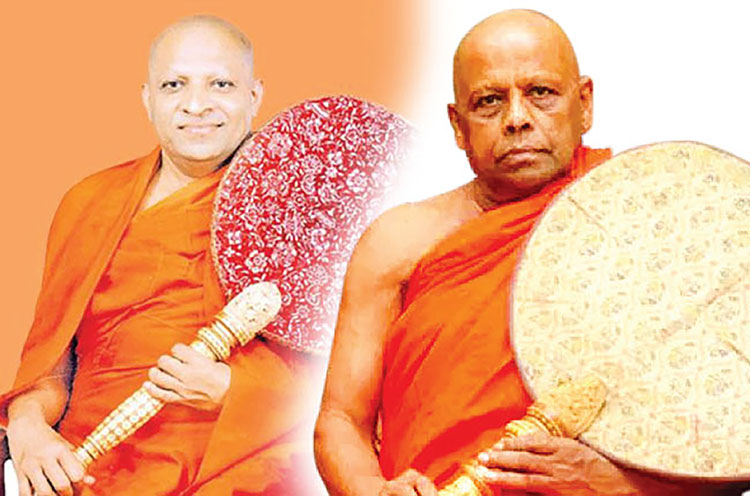
MONETABRIEF– Sri Lanka’s two most senior Buddhist chapters, Malwatte and Asgiriya, demanded special concessions for monks serving prison sentences, following the disrobing of convicted monk Ven. Galagodaatte Gnanasara in line with established procedures.
The chief prelate of the Asgiriya chapter, Most Venerable Warakagoda Sri Gnanarathana, told Prisons Commissioner Senaka Palletenna that Ven. Gnanasara, who is serving a six-year sentence for contempt of court, must be released immediately.
Prison authorities have no power to release or pardon convicts, but Palletenna told the monk in Kandy on Friday that he would convey his request to the relevant government authorities.
“There is no point in talking about this and that… The entire country has been shaken (??????? ) . He must be released,” the Asgiriya chief prelate said.
The Malwatte chief prelate, Most Venerable Thibbatuwawe Sri Siddhartha Sumangala, appeared to accept the court verdict against Ven. Gnanasara, but asked the prisons chief whether a separate section could be established for convicted monks.
Palletenna noted that a special ward for the clergy already existed at Welikada Prison.
At least 63 convicted Buddhist monks are currently incarcerated within Sri Lanka’s criminal justice system.
Meanwhile, a group of 34 Buddhist monks named in a Colombo Fort Magistrate’s Court order to vacate the vicinity of the Presidential Secretariat ended their protest and dispersed after lunch on Friday.The monks are demanding an unconditional pardon for Ven. Gnanasara, who has previously been imprisoned, making him a reconvicted prisoner.
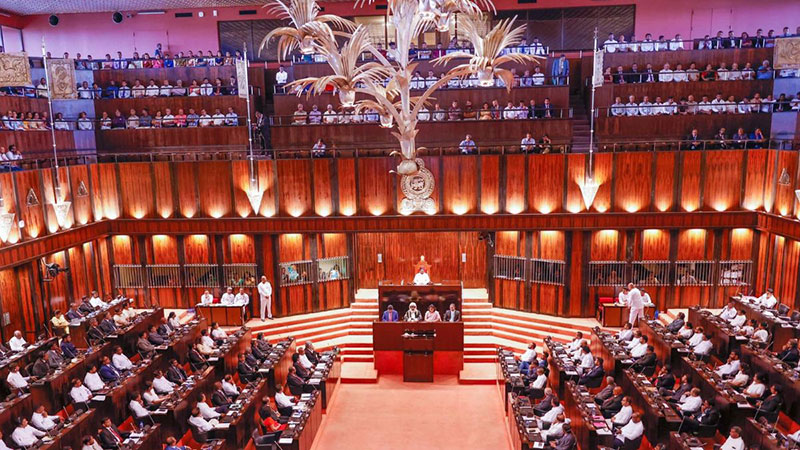
The debate on the no-confidence motion against Speaker Dr. Jagath Wickramaratne, submitted by the Samagi Jana Balawegaya (SJB), has been postponed indefinitely pending the Attorney General’s opinion on certain technical issues in the motion.
Government representatives raised the matter at a meeting of the Committee on Parliamentary Business, pointing out that several provisions of the motion required clarification and that the Attorney General’s advice should be obtained.
As obtaining the opinion would take time, the debate could not be scheduled for the next parliamentary week, parliamentary sources said.
Chief Opposition Whip Gayantha Karunatilaka said a date for the debate would be decided after the Attorney General’s advice was received.
Meanwhile, Parliament is scheduled to meet from October 20 to 23, Secretary General of Parliament Kushani Rohanadeera announced.
The parliamentary business for the week was finalised at a meeting of the Committee on Parliamentary Business held on Friday (16) under the chairmanship of Deputy Speaker Dr. Rizvie Salih.
On each sitting day, the period from 9.30 a.m. to 10 a.m. will be allocated for parliamentary business under Items 1 to 6 of Standing Order 22. Questions for Oral Answers will be taken up from 10 a.m. to 11 a.m., followed by questions under Standing Order 27(2) from 11 a.m. to 11.30 a.m.
On Tuesday, October 20, an Opposition-sponsored Adjournment Motion will be debated from 11.30 a.m. to 5.30 p.m.
On Wednesday, October 21, a resolution under the Public Debt Management Act and a Supplementary Estimate will be taken up for debate and approval from 11.30 a.m. to 5 p.m. The annual reports of five statutory institutions will subsequently be presented for approval without debate, while questions at the Adjournment Time will be taken up from 5 p.m. to 5.30 p.m.
On Thursday, October 22, the Second Reading debates on two Bills to amend the Poisons, Opium and Dangerous Drugs Ordinance (Bills Nos. 79 and 80) will be held from 11.30 a.m. to 5 p.m.
The annual reports of five statutory institutions will then be taken up for approval without debate, followed by an Opposition-sponsored Adjournment Motion from 5 p.m. to 5.30 p.m.
On Friday, October 23, the Second Reading debate on the Elimination of Rabies and Registration of Dogs Bill will be held from 11.30 a.m. to 5 p.m. A Government-sponsored Adjournment Motion will be debated during the final half-hour of the sitting.

Record 1,600 students take Russian Classical Ballet examination in Sri Lanka

Half a million people join protests in France, but some turn violent

Deadly fire breaks out at Canada military base

Showers or thundershowers will occur in most parts of the island after 1.00 p.m.

Buddhist hierarchy demands prison perks for monk convicts

Debate on NCM against Speaker postponed indefinitely

‘Dates have the highest sugar content to fight Coronavirus’

Sunday Island 27 December – Headlines

#SundayIsland 17th December – Headlines

Sunday Island – 28th March

Sunday Island Headlines – 21 March

Sunday Island – 21st February – Headlines
-

 Latest News5 days ago
Nissanka’s return headlines Sri Lanka’s Test squad against Pakistan
-

 Latest News7 days ago
Farhan and Sadaqat help Pakistan seal series in style
-
 Features6 days ago
Intake 16: 45 years of duty and honour
-
 News6 days ago
Malwathu Chapter issues statement on talks with President over Gnanasara Thera’s robes
-
 News6 days ago
CP alleges NPP has taken the blame for illegal US sanctions on Iranian vessels
-

 Opinion6 days ago
How long can Sri Lanka remain silent on its demographic crisis?
-

 News4 days ago
Sri Lanka, India caught in US-Iran ship crisis
-

 Latest News5 days ago
Kusal Mendis’ unbeaten 87 hands Sri Lanka consolation win