
News
Sri Lanka has committed to achieve SDGs and Net Zero by 2040 – President

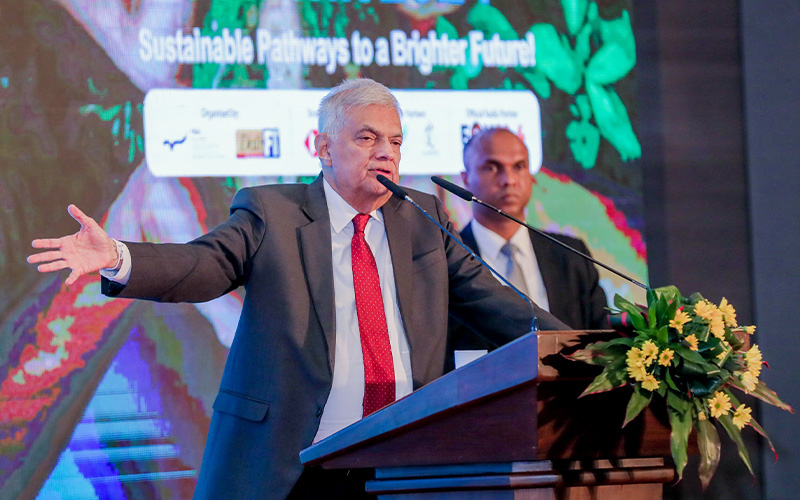
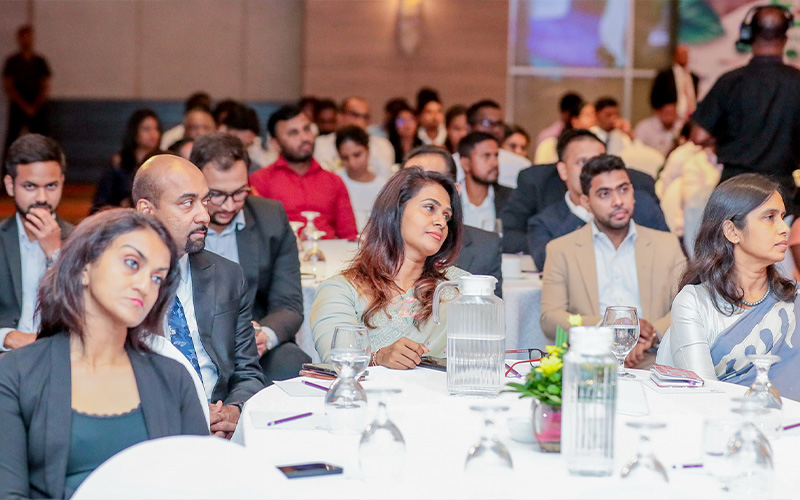
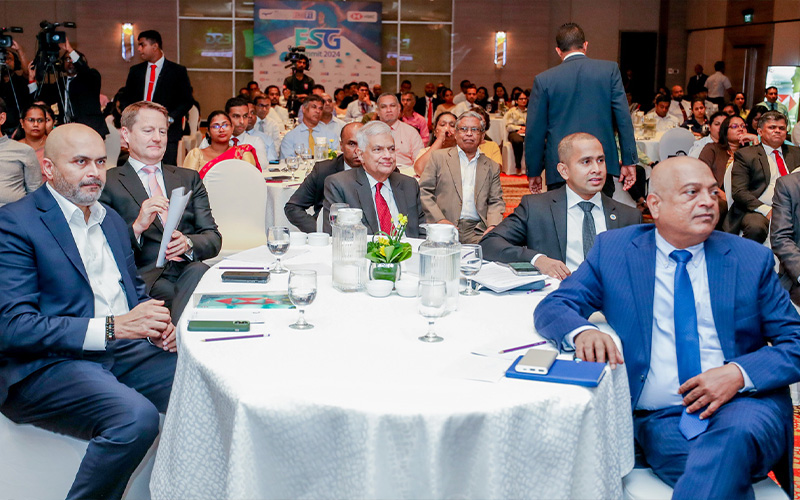
Addressing the Environmental, Social and Governance (ESG) Summit 2024 at the Cinnamon Grand Hotel , Colombo today (06), President Ranil Wickremesinghe outlined Sri Lanka’s commitment to achieving sustainable development goals and reaching net zero carbon emissions by 2040. The president highlighted several rapid methods to achieve these objectives, including harnessing renewable energy, modernizing agriculture, and addressing water shortages.
The president emphasized that attracting global financial facilities through commercial investments is a key part of Sri Lanka’s strategy. He detailed plans to transform the plantation sector into agribusinesses, promote sustainable tourism, and enhance product improvement and digitization.
The conference, held under the theme “Sustainable Pathways for a Brighter Future,” features presentations from approximately 15 experts in environment, society, and governance, who are sharing crucial knowledge and innovative solutions for achieving sustainability.
During the event, President Wickremesinghe presented the ESG Excellence Awards to micro, small, and medium-scale entrepreneurs, recognizing their contributions to environmental, social, and governance initiatives.
Addressing the gathering the President further elaborated:
“I must thank you for taking up the ESG on which you have been holding your conferences for the last three years. It’s good because you have to learn how the world is changing, especially the private sector and commitment to economic, social, and governance. We have to push it further. And I think we are the best of all the countries in South Asia to do so. The Maldives is like us but a bit too small. The rest, I don’t think they are ready. So we must be the first.
But while I commend the private sector globally and here for moving in this direction, you must also remember the geopolitical situation in the world today seems to be coming in the other direction. All the hurrah of the SDGs and of the Paris Climate Summit and even Glasgow have got stuck. We have not made very much progress since then. And the situation also is not good. The world is still recovering from COVID-19, a year or two.
The Chinese economy is not performing at its best. It will take a few more years. Even the US economy, they talked of a boom, but they have talked now that the job market is disappearing. So we should look at the two major economies in the world. You can’t say this very much of Europe either. I mean, they are going ahead, but there are problems. So it’s going to take a few more years. So it’s in this background that we are looking at the Sustainable Development Goals. How do we achieve them? For us, where are the funds? How many countries can spend money on this? And you see a turnaround, well, how ESG will be treated, and the approach if Trump becomes president, is an open question.
But more disturbing was what happened in the UK. Under Boris Johnson, the Glasgow Conference and the Principals were welcomed by everyone. Within two years, his own successor, Rishi Sunak, had gone back on everything just to get the right-wing vote from reform which he failed also. Today we have a new government in the UK who want to turn it back but remember UK no longer has the money.
We have been talking of all the funds that we are to get. We talk at COP 27, 28, 29. This time I am going to wear a hat and go there because each time they mention this, I will raise my hat because it’s like an old friend passing me by. I don’t think there’s anything more you could do but there’ll be a good fight there. How much money are we giving? We went to Paris for the debt meeting, but results are still not out yet. And to make it worse, I don’t know how the Paris assembly would react to it. But where is the money? They are short of money. In the meantime, the US alone has spent more money on Ukraine and Israel.
I think that money could have helped us out. Then take what Europe is now giving on this. And we don’t know how much Russia has spent.
So all that money could have been used. It’s not being done. Secondly, the Middle East situation is such, Iran seems to be wanting to retaliate. To retaliate is going to be bad for everyone, including Sri Lanka. I have just got a paper on the repercussions. I don’t think anyone would like to read it. Just think of the countries that are worse off than us.
Think of a country like Bangladesh, which is in turmoil. I don’t want to speak about the politics of Bangladesh, a friendly country, but it had to erupt at some time. While Sheikh Hasina has left, I still remember her because she gave us $200 million when we were really in need of money. So I think it’s only fair to say some good word about a person who’s really down at the moment. I also welcome the fact that Khalida Zia had been released from jail. If Sheikh Hasina had done it long ago, she would have still been Prime Minister. Let’s hope there’s tranquillity in Bangladesh. I have no doubt there will be tranquillity.
We should not panic. We are the largest investors; we are providing jobs in that country. So having said that, the world situation per se is not good. But that doesn’t mean that Sri Lanka is moving out of it.
In this global context, steps have been taken to establish the International Climate Change University on 600 acres in Sri Lanka, with legislative work planned by early next year. The Tropical Regions Initiative aims to use tropical regions and the Indian Ocean for carbon absorption, focusing on commercial investments. Sri Lanka is striving to meet sustainable development goals and achieve zero emissions by 2040 through renewable energy, modernizing agriculture, and addressing water scarcity issues. To this end, attracting global financial facilities through commercial investments is key. The transformation from plantation businesses to agribusiness, promotion of sustainable tourism, and product improvement and digitization are main objectives. Additionally, four new technical universities are being established to support technical education and innovation.”
Prominent attendees included Professor HD Karunaratne, Vice-Chancellor of the University of Colombo; Mark Surgenor, Chief Executive Officer of HSBC for Sri Lanka and the Maldives; university faculty; businessmen; senior officials from the private business sector; officials of the Colombo University MBA Alumni Association; scholars; and other distinguished guests.


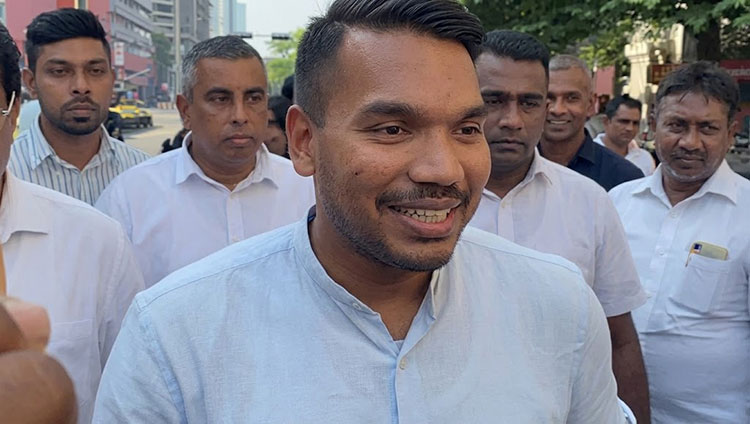
Sri Lanka Podujana Peramuna (SLPP) Member of Parliament Namal Rajapaksa has been arrested by the Commission to Investigate Allegations of Bribery or Corruption (CIABOC).
Namal Rajapaksa had been summoned by CIABOC to provide a statement in connection with investigations into the controversial Airbus deal. He was subsequently arrested by CIABOC after recording his statement for over 5 hours.
Latest News
Sun directly overhead Nittambuwa, Algama, Malwana, Aranayake, Meegahakiula and Panamkadu about 12.09 noon today (04)

The sun is going to be directly over the latitudes of Sri Lanka from 28th of August to 07th of September due to its apparent southward relative motion.
The nearest places of Sri Lanka over which the sun is overhead today (04) are Nittambuwa, Algama, Malwana, Aranayake, Meegahakiula and Panamkadu about 12.09 noon.

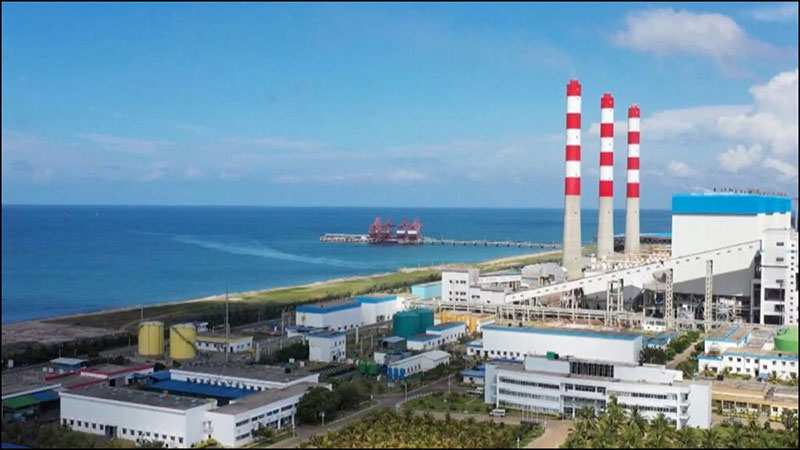
Plant’s output cut from 270 MW to 140 MW amidst dwindling stocks; energy analysts warn system remains “at a razor’s edge”
By Ifham Nizam
The Norochcholai coal-fired power plant is now digging into the last dredges of its coal stock, with two operational units forced to slash generation from around 270 MW to just 140 MW on Sunday as the plant ran critically short of fuel, according to independent energy analysts and sources familiar with the National System Operator (NSO).
The sudden reduction of approximately 130 MW in coal generation has once again exposed the fragile state of the country’s power supply arrangements, with the plant understood to have coal stocks sufficient only until Friday night.
“This is not how a coal plant is expected to operate. They are digging up the last dredges of coal from the plant,” an independent energy analyst told The Island.
The analyst questioned why the units had been allowed to reach this stage without earlier intervention, arguing that at least one unit should have been deloaded around 10 days ago to conserve the remaining coal.
Had that been done, the analyst said, the country could also have reduced its dependence on more expensive diesel-fired generation during the period when
coal stocks were being conserved.
The latest NSO generation figures highlight the continuing pressure on the system.
Around 7 p.m. on Sunday, when the night peak was reached, total demand stood at 2,552.7 MW. Coal contributed only 282 MW, while major hydro accounted for 1,215.8 MW and thermal-oil generation for 791.9 MW.
The night peak of 2,552.7 MW was substantially higher than the daytime peak of 2,246 MW, according to the NSO Generation Summary for August 30.
The most immediate concern is the remaining coal stock at Norochcholai.
Sources said the plant has coal only to Friday night, making the timing of the next shipment critical.
The first shipment under the emergency arrangement is expected to arrive on Friday, September 4, but the coal unloading will have to begin on the same day if
the power plant is to continue operating without further significant deloading.
That creates another potential vulnerability, with rough sea conditions posing an additional challenge to unloading operations.
Energy sector sources said that even the arrival of the September 4 shipment would not completely eliminate the danger.
The next shipment under the new coal tender would need to commence unloading around September 15. Any significant delay beyond that could again force the Norochcholai units to operate at reduced output.
“We are still at a razor’s edge”
The independent energy analyst said the situation should not be viewed merely as a question of whether a particular vessel arrives on time.
The situation also means that any further reduction in coal generation could have a direct impact on the use of oil-fired power generation, potentially increasing the cost of electricity generation.
The latest NSO figures already show the important role being played by thermal-oil generation during the evening peak, when demand rises sharply.
The analyst questioned the rationale behind allowing the coal units to continue operating at higher loading until stocks reached critically low levels instead of taking measures earlier to stretch the available inventory.

SLPP MP Namal Rajapaksa arrested by CIABOC

Devapathiraja clinch U15 Division I title with 33-run win over Royal

Mandhana’s record ton powers India into semi-finals

Sun directly overhead Nittambuwa, Algama, Malwana, Aranayake, Meegahakiula and Panamkadu about 12.09 noon today (04)

Showers expected in the Uva, Central and Eastern provinces and in Polonnaruwa and Mullaittivu districts after 2.00 p.m

Norochcholai digs into dwindling coal stocks, two units slash generation

‘Dates have the highest sugar content to fight Coronavirus’

Sunday Island 27 December – Headlines

#SundayIsland 17th December – Headlines

Sunday Island – 28th March

Sunday Island Headlines – 21 March

Sunday Island – 21st February – Headlines
-

 Features6 days ago
“Wrap Me Up in My Blazer”— A Gentlemanly Bradby Reminiscence
-

 Features5 days ago
When Sri Lankan stories find their own voice
-
 Features6 days ago
JVP/NPP government as seen from outside by Lionel Bopage now domiciled in Australia
-

 News4 days ago
BASL takes exception to Justice Ganepola being denied a place in SC
-

 Editorial7 days ago
Govt. trying to dupe UN Rapporteur?
-

 Features6 days ago
Prof. Savitri Goonesekere: What has she done?
-

 Features5 days ago
World Trade Politics: Canada rebuffs Trump’s tariff blackmail
-

 News1 day ago
Denied of promotion to SC despite vacancies, justice Gurusinghe retires