
News
Sri Lanka and bondholders agree on restructuring deal


Sri Lanka and its creditors have reached agreement on the terms for a 12 billion US dollar bond restructuring, bringing the former closer to completing its debt overhaul two years after a soft default.The deal marks the culmination of more than a year of difficult negotiations between Sri Lanka and its bondholders and the deal will help restore access to international capital markets.
Investors agreed to take a 28% nominal reduction on the bonds as part of the framework, the two sides said in a statement. The ad-hoc bondholder group holds about 50% of the outstanding overseas bonds and includes Amundi Asset Management, BlackRock, Eaton Vance Management, Grantham, Mayo, Van Otterloo & Co., Morgan Stanley Investment Management and T. Rowe Price Associates, among others.
The creditors are represented by White & Case and Rothschild & Co., while Clifford Chance and Lazard Inc. represents the government.
Given below is a statement by the London Stock Exchange: “The Government of the Democratic Socialist Republic of Sri Lanka has announced that it has held restricted discussions between 21 June 2024 and 2 July 2024 (the “Restricted Period”) with nine members of the steering committee who agreed to take part in the restricted discussions (the “Steering Committee”) of the Ad Hoc Group of Bondholders (the “Group”, and together with Sri Lanka, the “Parties”) of its International Sovereign Bonds (“ISBs”).
Sri Lanka was joined by its legal and financial advisors, Clifford Chance LLP and Lazard, respectively, and the restricted members of the Steering Committee were joined by the Group’s legal and financial advisors, White & Case and Rothschild & Co, respectively. The Steering Committee as a whole comprises ten of the largest members of the Group, with the Group controlling approximately 50% of the aggregate outstanding amount of ISBs.
“During the Restricted Period, Sri Lanka, the Steering Committee and its advisors met during a two-day working session in Paris on 27 and 28 June 2024 (the “Meetings”). At the conclusion of the Meetings, Sri Lanka is pleased to report that, following negotiations, the Parties agreed core financial terms of a restructuring of the ISBs, the terms of which are embodied in a joint working debt treatment framework (the “Joint Working Framework”), a copy of which is included in the Annex to this announcement (which is also available as a PDF version through the link at the bottom of this announcement). In addition, the Parties agreed to include Governance-linked Bond features in the terms of one or more series of the plain vanilla bond instruments that form part of the Joint Working Framework.
“As the Joint Working Framework includes a state-contingent feature, it remains to be confirmed by (i) the Secretariat of Sri Lanka’s Official Creditor Committee (the “OCC”) to ensure comparability of treatment with the terms agreed between Sri Lanka and the OCC (“Comparability of Treatment”) and (ii) the IMF staff to ensure consistency with the parameters and debt sustainability objectives of Sri Lanka’s IMF-supported Program. As such, following the Meetings, the advisors to Sri Lanka and the Steering Committee will consult with each of the Secretariat of the OCC, to confirm the consistency of the Joint Working Framework with the principle of Comparability of Treatment, and staff at the IMF, to confirm the consistency of the Joint Working Framework with the parameters and debt sustainability objectives of Sri Lanka’s IMF-supported Program.
“During the restricted discussions, Sri Lanka and the Steering Committee also progressed discussions on certain non-financial provisions.
Sri Lanka would like to thank the Steering Committee, the Group and their advisors for their close collaboration and valuable contribution in the Meetings, and looks forward to further constructive interaction to finalise the ISB restructuring.”

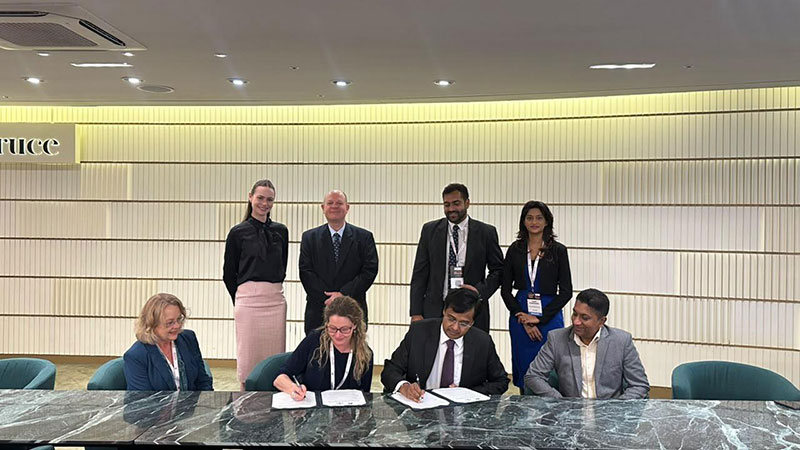
The Bar Association of Sri Lanka (BASL) and the Law Council of Australia entered into a Memorandum of Understanding in Seoul, Republic of Korea, on the sidelines of the 39th LAWASIA Conference. The Memorandum was signed by Tania Wolff, President of the Law Council of Australia and Rajeev Amarasuriya, President of the BASL.
The Law Council of Australia, established in 1933 and based in Canberra, is the apex national body representing the legal profession of Australia. It represents more than 107,000 Australian lawyers through its constituent law societies and bar associations together with ‘Law Firms Australia’. The Law Council of Australia represents the Australian legal profession on national and international issues, and promotes the administration of justice, access to justice and general improvement of the law.
The Memorandum was entered into promote cooperation and exchange between the lawyers of the two countries, and to facilitate the exchange of legal information and materials between the two professions, founded upon the mutual commitment of the Parties to the Rule of Law and to the independence of the legal profession and the judiciary.

The Supreme Court has dismissed three appeals by associations representing judicial officers, ruling that they are liable to pay income tax and that Advance Personal Income Tax (APIT) may lawfully be deducted from their remuneration.
The judgement, delivered on Sept. 15, 2026, concerned appeals filed on behalf of the High Court Judges’ Association, the Judicial Service Association and the Association of Judicial Officers of the Labour Tribunal. The cases challenged a 2023 Court of Appeal decision dismissing applications against the imposition and deduction of APIT from judicial officers.
The five-member bench comprised Chief Justice P. Padman Surasena and Justices A.L. Shiran Gooneratne, Janak de Silva, Mahinda Samayawardhana and Arjuna Obeyesekere.
The judicial officers had argued that they were not employees of the state or any other person, and that treating them as employees for tax purposes was incompatible with the constitutional principle of judicial independence. They sought to halt future APIT deductions and recover amounts already deducted.
Justice Janak De Silva held that the Inland Revenue Act did not create an employer-employee relationship between judicial officers and the respondents in the conventional sense. Instead, it recognised who paid their salaries for the limited purpose of identifying the party responsible for deducting APIT, the court held.
The SC ruled that the application of the Inland Revenue Act to judicial officers did not violate the Constitution, noting that the tax was generally applicable and non-discriminatory and did not amount to a reduction of judicial remuneration that would affect judicial independence.
Answering the key questions of law, the court ruled that High Court Judges, District Judges and Magistrates were liable to pay income tax on their remuneration, and that the authorities were entitled to deduct APIT from that remuneration.
However, the judgment acknowledged the financial difficulties faced by judicial officers following the imposition of income tax. Justice de Silva said the solution was not to exempt judges from a generally applicable tax, but to ensure that judicial officers were adequately remunerated in recognition of their responsibilities and their distinct position within the national wages policy.
The three appeals were dismissed without costs. Chief Justice Surasena and Justices Samayawardhana and Obeyesekere agreed with Justice de Silva’s judgement.

A three-wheeler driver was shot dead in a brazen afternoon shooting beneath the Dematagoda Black Bridge yesterday (17), police said.
The investigators suspected that killing may be linked to notorious underworld figure Mohamed Najim Mohamed Imran, widely known as ‘Kanjipani Imran’ operating from overseas.
The victim, a 50-year-old resident of Udugama, Galle, was killed with a pistol, according to Police Spokesman ASP F.U. Wootler.
The victim was rushed to hospital following the incident. However, police later confirmed that the three-wheeler driver had succumbed to his injuries while undergoing treatment.
Preliminary inquiries have revealed that the deceased had previously served in the Army.
According to police, the gunman is believed to have been travelling in the rear seat of the three-wheeler before opening fire on the driver.
Police suspected that the shooting was carried out by a hireling of Kanjipani Imran – a notorious underworld figure and drug kingpin operating from out of the country.
Police said that weapons and explosives had been supplied by Kanjipani Imran for the recent bomb incident at Dehiwala, where two children were killed in a grenade attack.
According to investigators, the weapons and explosives were supplied to another underworld figure known as ‘Kosmalli’ for the Dehiwala attack. Imran had also supplied narcotics to Kosmalli’s narcotic network, police said.
Further investigations are being conducted by police.

Cholesterol lowering statins: Scope for use widens

BASL inks MoU with Law Council of Australia

SC rules no tax exemption for judges

‘From Galkissa to Tambuttegama’: A response

‘Mortal Causes’ Tales of Mystery and Suspense 20

Beyond the IMF: The jigsaw Puzzle of a production-based economy

‘Dates have the highest sugar content to fight Coronavirus’

Sunday Island 27 December – Headlines

#SundayIsland 17th December – Headlines

Sunday Island – 28th March

Sunday Island Headlines – 21 March

Sunday Island – 21st February – Headlines
-

 News7 days ago
Sri Lanka faces new grid challenge as rooftop solar surges: former CEB GM
-

 Latest News7 days ago
Shafali, Deepti power India into sixth T20 Asia Cup final
-

 Latest News6 days ago
Sri Lanka thwart Fatima Sana challenge to secure Asia Cup final spot
-

 News5 days ago
Gnanasara Thero absconding after SC ruling
-

 News6 days ago
Ammunition cache found in old Kandy bungalow
-

 Editorial7 days ago
A flight of fancy
-

 News6 days ago
Green Climate Fund (GCF) Regional Dialogue for East and South Asia will be held from 14 to 17 September 2026 at Cinnamon Life at City of Dreams Hotel, Colombo
-

 News6 days ago
Prof. Pieris says Buddha Dhamma recognised as source of law under Constitution