
News
Speaker stands firm on ruling, Opposition says he’s undermining constitution

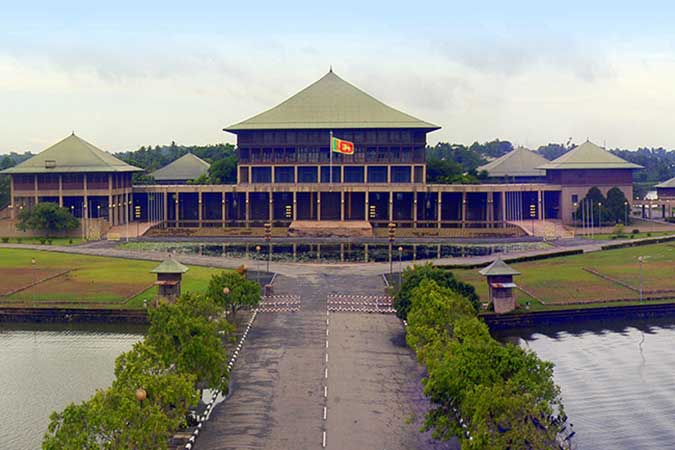
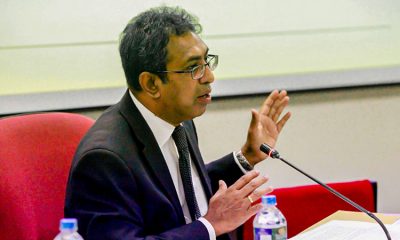
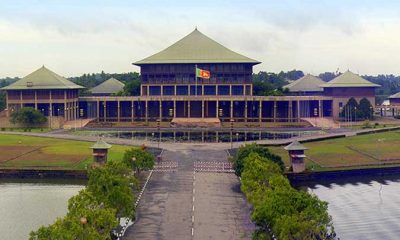
Speaker Mahinda Yapa Abeywardena told Parliament on Friday thaty he would not revoke his ruling given on Wednesday with regard to the Parliament’s supremacy over the Supreme Court.
He said that he had consulted legal experts in preparing his ruling that the Supreme Court is not empowered to issue orders or judgments of any nature against a resolution already passed by the Parliament.The Speaker said so in response to criticisms and demands from the opposition parties that the ruling would set a wrong precedent.
On August 9, the Speaker gave the ruling after Tourism and Lands Minister Harin Fernando raised a privilege issue on petitions filed against the resolution on domestic debt restructuring that had been approved by Parliament.
Opposition MPs urged the Speaker to withdraw this ruling as it violates standing orders, creates tension between the court and parliament and undermines the constitution.
JVP led NPP leader Anura Kumara Dissanayake: “According to standing orders, we can’t question the decisions of the Speaker. However, given that the Speaker’s rulings become a precedent in parliament, we need to have serious discussions about these.
“On August 9 you told parliament that since the parliament has passed a motion on domestic debt restructuring, the court can’t issue orders or judgments of any nature against a resolution already passed by the Parliament.
“The Speaker said that the court was to make a ruling on a case filed against restructuring of EPF funds a few hours later. The Speaker could have made a ruling later, if there was an issue with the court ruling. Also, your ruling is wrong.
“What are motions presented in parliament for? The constitution has named the kind of motions we can have, one is a no confidence motion, the president can also have a motion to seek the opinion of the public on a matter of national importance. These are the two types of motions listed in the constitution.
“When the government presents the budget, we vote on the appropriation bill. This is a law. People have the right to go before the court before it goes to parliament. The bill comes to parliament through the courts. If parliament passes a motion, and in line with the motion tax laws, and financial laws must be amended. The motions therefore fulfill a certain duty.
“I would like to know if the motion to subject EPF funds to domestic debt restructuring, is a law. Is it a draft law? Is it a regulation? Not at all. It was just a motion presented to parliament. What is the standard procedure when we make laws? We come to parliament through the courts.
The court can determine if an act is consistent or inconsistent with the constitution, but it can’t change an act if it is passed in parliament.
“But here it was a resolution, it was not a bill or an act. Tomorrow, a government MP presents a motion saying we must close all courts in the country. All 134 government MPs will approve it. Then what? Can’t the court system examine that? Parliament can impose laws only after the court decides if it’s consistent with the constitution.
“The EPF beneficiaries will suffer because of this. When will this be examined by the court? There are limits to what the parliament can do. If we create a precedent where a government motion, once passed in parliament, can’t be examined by courts, that’s a terrible mistake. So your directive on 09 August sets a bad precedent. What will happen if government starts passing motions that can’t be examined by courts? There is only one thing to do, you must take this directive back. Or you will create a crisis.”
SLFP Kuruengala District MP Dayasiri Jayasekera: “Article 91 of standing orders state that MPs must not talk about court cases that are before courts. If a MP starts talking about such a case, the Speaker or the presiding MP can ask him or her to sit down. These are things that the Speaker has to do. But you, the person in charge of enforcing the above-mentioned standing order, have violated this provision.
“Moreover, as MP Anura Kumara Dissanayake said, the Speaker can give an order if he or she feels the court has made the wrong call. After you said that the court can’t make a call, the Supreme Court dismissed the cases before it. The judges, probably because they wanted to avoid conflict with the legislature, threw out the cases on EPF.”
SJB Kandy District MP Lakshman Kirielle : “You (Speaker) points to a directive given by former Speaker Anura Bandaranaike in your order. However, Bandaranaike made the order after the court gave a verdict. “
Opposition leader Sajith Premadasa: “In recent times, government MPs have raised privilege issues and scared members of independent commissions and the court. They have overlooked directives on holding elections. The president also invited justices to dinner.
“Under the domestic debt restructuring, the workers are suffering when multi-millionaires are untouched. This is a violation of fundamental rights. People have gone before courts and the Speaker has given an order, after an MP raised a privilege issue, undermining the courts.
“You are acting like an agent of the executive. You are interfering with courts. This is a dangerous situation. Separation of powers and a tripartite system is undermined. I urge you to take your order back.”
Freedom People’s Congress (FPC) MP, Prof. G. L. Peiris: “The constitution is clear on this. Parliament passes a motion and that can’t be directly challenge by courts. However, the fundamental rights chapter of the constitution says there should be equality. If the government places the entire burden of domestic debt restructuring on the economically weak and let the rich unaffected, this becomes a problem with equal treatment.
“This is a violation of the constitution. The constitution says that the Supreme Court can hear such cases. If a directive of parliament causes unequal treatment, the court not only has the right to hear such cases, but has the responsibility to do so. Even the Court of Appeal can look at it.
When an FR case is before the Supreme Court, an MP raises a privilege issue and the Speaker gives a directive within a few hours. Parliament and courts must respect each other, this is the glue that holds the constitution. If you destroy that using privilege issues, you are destroying the foundations of the constitution. You must immediately withdraw your directive.”
Speaker Abeywardane: “I will not take my statement back. I have done everything necessary before making the call.”








Parliament:
… sexual harassment claims dismissed
Recommendations made by retired High Court Judge Ms. Sujatha Alahapperuma, following an inquiry into claims by a female employee of the Department of Information Systems and Management of Parliament, regarding sexual harassment, denial of due salary increments and other forms of harassment, were yet to be implemented, sources familiar with the investigation said.
The retired HC Judge handed over the report to Speaker Dr. Jagath Wickramaratne on 24 November, 2025. Secretary General of Parliament Kushani Rohanadeera was also present on that occasion.
The retired judge has recommended that administrative decisions be taken expeditiously to grant her salary increments due for 2024 and 2025, reevaluation of all employees attached to the Department of Information Systems and Management and keep them under close scrutiny and strengthening of the ‘Helpdesk’ to meet the requirements.
Sources said that none of the recommendations have been implemented and the concerned employee in spite of still being the Senior Helpdesk coordinator remained attached to the Supplies and Services Office. She had been ordered to report to the Supplies and Services Office in January 2025 following a continuing dispute with the top management of the Department of Information Systems and Management.
Parliamentary Staff Advisory Committee on 25.07.2025 decided to conduct an external investigation into the issue after the employee refused to accept the outcome of the internal inquiry conducted in the wake of SJB lawmaker Mujibur Rahman raising the issue in Parliament.
The retired judge has emphasised the urgent need to take tangible measures to address administrative issues with a view to enhance discipline and human resources management among other issues.
However, the retired judge has declared that the complainant or any other female employee attached to the of Department of Information Systems and Management hadn’t been subjected to any form of sexual harassment as alleged.
The retired judge further asserted that the complainant had been prejudicially treated by two interview boards when she appeared before them seeking posts of Database Administrator and Parliament Officer.
The retired judge has also asserted that the Supplies and Services Office where the complaint continued to serve even now was not suitable and not in line with her qualifications. Some of those who had appeared before the retired judge during the inquiry claimed that was a temporary transfer. However, the report dismissed that claim declaring that transfer appeared to have been done outside acceptable procedure and her increments stopped without giving any justifiable reason.
The retired judge has stated that for want of proper procedures and systems, the administration seems to be in turmoil.
By Shamindra Ferdinando
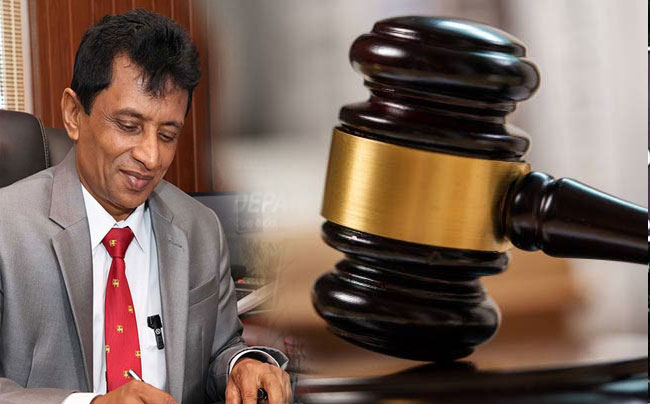
Motor Traffic Commissioner General Kamal Amarasinghe, taken into custody by the CID, was remanded until today (30) following his production before the Kurunegala Magistrate’s Court.
The investigation was launched after the Central Anti-Corruption Task Force received information regarding an illegally assembled taxi, which was later handed over to the CID for further inquiries.
Preliminary findings revealed that the vehicle’s registered chassis number had been altered and documents submitted to obtain a “weight certificate.” These documents were then used to assign a registration number to the taxi, while the chassis modification files were concealed. False declarations were allegedly made to facilitate the fraudulent assembly, with Commissioner General Amarasinghe accused of aiding and abetting the operation.
The suspect was taken into custody on the afternoon of Friday (27) by a CID team at the Hector Kobbekaduwa Road, Colombo 7.
In parallel, the Bribery and Corruption Commission has launched a separate probe into the matter.
The initial investigation was conducted under the direction of SSP Indika Weerasinghe, Head of the Central Anti-Corruption Task Force, along with DIG Rohan Olugala and Senior DIG of CID Kamal Ariyawansa.
BY Norman Palihawadane

A public petition demanding the resignation of Kumara Jayakody, Minister of Power and Energy, over alleged irregularities in coal imports was launched yesterday (29) in Maharagama.
The initiative was organised by the Electricity Consumers’ Association.
Addressing the gathering, the Association’s secretary, Sanjeewa Dhammika, said the Minister was facing allegations related to coal imports, while concerns have also been raised over the poor performance of both the Minister and the Ministry Secretary. He said the petition’s primary demand is the immediate removal of the Minister from office.
Dhammika added that signatures for the petition will also be collected in front of the Colombo Fort Railway Station.
by Anuradha Hiripitiyage

Oil tops $116 a barrel as Iran accuses US of preparing invasion

Iranian attack damages Kuwait power and desalination plant, kills worker

Warm weather conditions prevailing over the island are expected to continue

Inquiry into female employee’s complaint: Retired HC Judge’s recommendations ignored

Motor Traffic CG remanded

Petition launched seeking resignation of Energy Minister Jayakody

‘Dates have the highest sugar content to fight Coronavirus’

Sunday Island 27 December – Headlines

#SundayIsland 17th December – Headlines

Sunday Island – 28th March

Sunday Island Headlines – 21 March

Sunday Island – 21st February – Headlines
-

 News5 days ago
Senior citizens above 70 years to receive March allowances on Thursday (26)
-

 Features2 days ago
A World Order in Crisis: War, Power, and Resistance
-

 News3 days ago
Energy Minister indicted on corruption charges ahead of no-faith motion against him
-

 News4 days ago
US dodges question on AKD’s claim SL denied permission for military aircraft to land
-

 Business4 days ago
Dialog Unveils Dialog Play Mini with Netflix and Apple TV
-

 Sports3 days ago
SLC to hold EGM in April
-

 News5 days ago
CEB Engineers warn public to be prepared for power cuts after New Year
-
 Business6 days ago
Postponement of Sri Lanka Investment Forum 2026