
Sports
South Africa name Wandile Gwavu as white-ball fielding coach

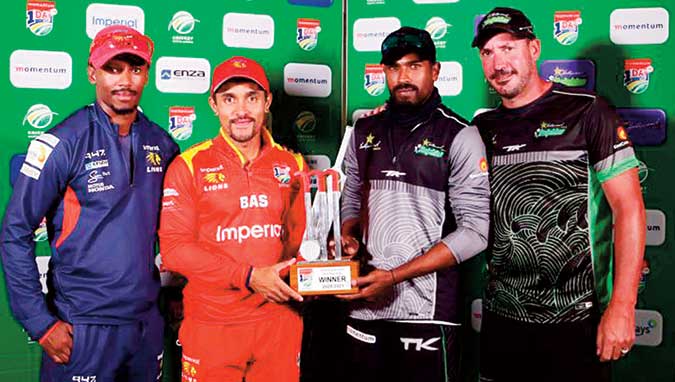
Three days after securing automatic qualification to the 2023 World Cup, South Africa are filling up their backroom staff ahead of the tournament. Wandile Gwavu has been named white-ball fielding coach and will work under Rob Walter, who was appointed earlier in the year, and alongside batting coach JP Duminy.
A permanent bowling coach is yet to be identified after Rory Kleinveldt did the job in an interim capacity last summer.
Gwavu joins the national men’s set-up after four seasons at the Johannesburg-based Lions team, where he won five titles. He has also worked with the Jozi Stars in the now defunct Mzansi Super League and with the Joburg Super Kings in the SA20. In addition, he been involved with South Africa’s Under-19 and A sides.
“He brings a wealth of experience at the highest level in South African cricket with a coaching career that speaks volumes,” Enoch Nkwe, South Africa’s director of cricket said. “With the fine margins and the ever-increasing stakes in 50-over and T20 cricket, fielding has become a critical part of any successful team and we strongly believe Wandile’s expertise will help the Proteas maintain their strong tradition of fielding excellence across both formats.”
Gwavu replaces Justin Ontong, who was part of Mark Boucher’s coaching staff and is understood to have applied for the vacant position at Paarl, where Duminy was head coach. Both Paarl and the Lions are now searching for new head coaches ahead of the 2023/24 season. Gwavu’s first assignment with the team will be the white-ball series against Australia which starts on August 30 and includes three T20Is and five ODIs.
(Cricinfo)










by Rex Clementine
Every cricket fan remembers that Angelo Mathews was Sri Lanka’s captain when Australia were whitewashed 3-0 in the Test series of 2016. Most will also remember Graham Ford, the master tactician, was Head Coach. But hardly anyone remembers the curator.
Perhaps they are not expected to. Curators rarely make headlines. Yet the truth remains that Godfrey Dabare produced the surfaces tailor made for Rangana Herath to weave his magic and the rest, as they say, is history.
Godfrey breathed his last on Tuesday morning after a brief illness. He was 62.
He had no degree in science or agriculture, qualifications that have become almost mandatory for chief curators these days. His university was the cricket field. His knowledge came from countless hours spent under the sun, studying soil, grass, weather and wickets, learning the craft the old fashioned way.
It is a little known fact that Godfrey spent three months in Galle preparing the venue ahead of its inaugural Test in 1998. He did a similar job in Dambulla before it became an international venue in 2001. He was a loyal lieutenant of former board chief Thilanga Sumathipala and both, Galle and Dambulla, were Thilanga’s treasured projects.
I first met Godfrey in 2000 when he was managing Chilaw Marians, then a club playing Division Three cricket. Within two years, the Marians had climbed into First Class cricket and soon became a thorn in the flesh of many fashionable Colombo clubs.
Did Godfrey occasionally use his influence as national curator to prepare pitches that suited his club? Of course he did. He was no paragon of virtue. But neither was he the villain some tried to paint him as.
He would often complain that he would unearth a rare gem from the beaches of Marawila or Wennappuwa, nurture him and give him a platform, only for one of the posh Colombo clubs to come along and pinch the player. Godfrey took those raids personally. And he was determined to teach them a lesson.
Above everything else, he cared deeply about his players.
Without his tireless work, Chilaw Marians would hardly have survived nearly three decades of First Class cricket. Now that he is gone, you cannot help but fear for the future of the club he built with such devotion, a club that has produced many fine cricketers, the latest being fast bowler Asitha Fernando.
Godfrey also had a soft spot for the press.
When England toured Sri Lanka in 2021, Sri Lanka Cricket kept journalists out of the grounds because of COVID restrictions. The press were not prepared to take it lying down, so several reporters climbed Galle Fort and covered the Tests from there.
That did not go down particularly well with SLC. The issue eventually reached Parliament, where there was rare cross party agreement that journalists should be allowed into the venue.
Relations between the cricket establishment and the press were frosty, to put it mildly. What those running the show did not know was that Godfrey was quietly sending food and drinks from inside the ground to the journalists perched on Galle Fort.
That was Godfrey.
His finest hour, however, came during the Asia Cup in 2023.
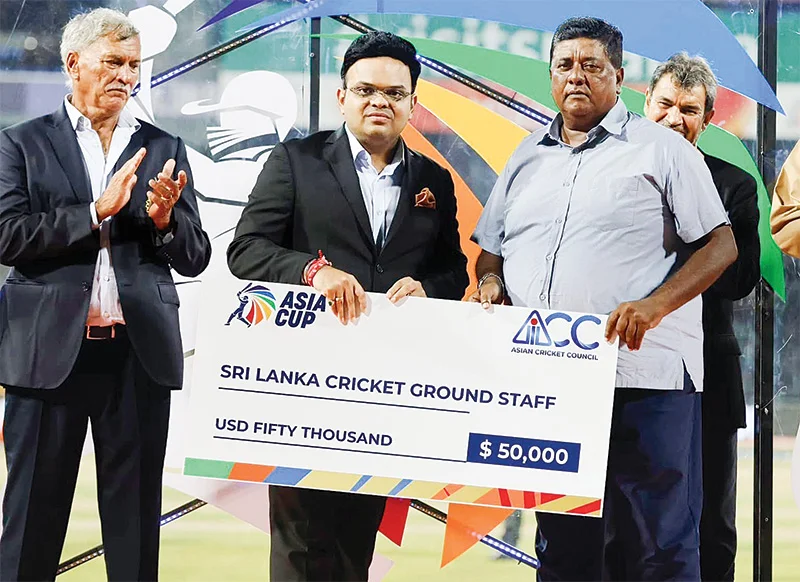
The tournament had been battered by bad weather and the ground staff worked around the clock, often in miserable conditions, to keep it moving. At the end of the tournament, the Asian Cricket Council recognised their extraordinary efforts by awarding the ground staff US$50,000. Godfrey received the cheque from ACC President Jay Shah.
Soon, murmurs began doing the rounds in Colombo. Would all that money actually reach the men who had sweated for it? There were plenty who had their doubts given the questions surrounding SLC’s financial management.
Godfrey made sure there could be no such suspicion.
Every groundsman received an equal share. Godfrey documented the payments, complete with bank and contact details of the recipients, and then, twisting the knife just a little, shared the information with the press.
He was an honest man, although often a misunderstood one.
There was another episode that summed up both Godfrey’s character and the world he occasionally had to navigate.
During a game at the R. Premadasa Stadium, the visiting team’s dressing room door had been smashed with brute force. Nobody quite knew what had happened.
When journalists rang Godfrey, he gave us chapter and verse. Bangladesh star Shakib Al Hasan, furious over an umpiring decision, had taken a bat to the dressing room door. Godfrey said he had CCTV footage and eyewitnesses to back up the claim.
The press went to town.
Shakib was summoned by the Match Referee and a suspension appeared to be looming.
Then, suddenly, Godfrey’s phone went silent.
The following day Shakib escaped with a slap on the wrist. There was apparently insufficient evidence.
A few weeks later, while journalists were watching Sri Lanka train at the R. Premadasa Stadium, Godfrey wandered over, put an arm around me and said: “Sorry, Rex. Bangladesh Cricket Board wanted the matter settled amicably. They agreed to pay for the damage. Board President (go figure who it was), called me and told me to delete the CCTV recording.”
That was Godfrey too.
Loyal to his friends. Loyal to his bosses. Sometimes caught between the two.
Sri Lankan cricket has lost one of those colourful characters who operated away from the television cameras but whose fingerprints were all over the game. Players came and went, administrators fought their battles and coaches collected the applause, but Godfrey was there in the background, preparing the stage on which they performed.
He will be missed.
His remains lie at his residence in Kurukulawa, Ragama. The burial will take place on Thursday in his hometown of Chilaw.

by Reemus Fernando
Since reaching the world number one ranking, javelin thrower Rumesh Tharanga has attained a level no other Sri Lankan athlete has reached. Winning gold at the Asian Games was therefore widely anticipated. What stood out was the way he overcame the wet conditions and, after trailing his rivals for three rounds, showed the composure to come from behind.
Here is why his medal is so special:
Tharanga’s gold at the Asian Games in Japan was Sri Lanka’s 13th in the 75-year history of the Games.
It was the 12th gold won by a Sri Lankan track and field athlete. The only other sport in which the country has won gold is cricket.
He is the first Sri Lankan javelin thrower to win Asian Games gold.
Sri Lanka had won only one previous gold in the field events: Nagalingam Ethirveerasingam’s high jump victory at the 1958 Tokyo Games, the country’s first ever.
Tharanga is also the first Sri Lankan to win gold in any throwing event.
He is the fifth Sri Lankan man to win an individual gold.
Track and Field Athletes who have won gold medals for Sri Lanka are:
Men’s
Nagalingam Ethirveerasingam high jump Tokyo 1958
Lucian Rosa 5,000m and 10,000m in Bangkok 1970
Wickremasinghe Wimaladasa 400m in Tehran 1974
Sugath Thilakarathne 400m in Bangkok 1998
Rumesh Tharanga Javelin Nagoya 2026
Sri Lanka Team inclusive of W. Wimaladasa, Sunil Gunawardana, Kosala Sahabandu and A. Premachandra won 4×400 m relay in Tehran 1974
Women’s
Damayanthi Dharsha 200m, 400m in Bangkok 1998 and 400m in Busan 2002
Susanthika Jayasinghe 100m in Busan 2002
Tharushi Karunaratne 800m in Hangzhou 2023
by Anura Tennekoon
I am baffled as to how our national cricket team can perform brilliantly one day and then, barely a couple of days later, plummet to such depths against the very same opposition.
I will not endeavour to go through the run of play, as most readers would have watched the game on television. Instead, I would like to highlight the areas where we failed and ask those responsible for the national team to explain such an indifferent performance.
Sri Lanka bowled extremely well in the first Powerplay, restricting England to 60 for two and continued to keep the hosts on a tight leash until Tom Banton and Harry Brook became involved in a century partnership that steered England towards safer waters.
However, a cardinal error was made by our captain. Brook was struggling against the wiles of Dunith Wellalage, yet inexplicably the spinner was taken out of the attack and replaced by another bowler. Brook immediately looked far more comfortable and began scoring freely.
Even then, Sri Lanka could have restricted England to somewhere around 300. Instead, the hosts were allowed to gallop past 350 and effectively put the game beyond Sri Lanka’s reach. Those additional 50 runs were largely the result of unimaginative bowling and an inability to respond when England changed gears.
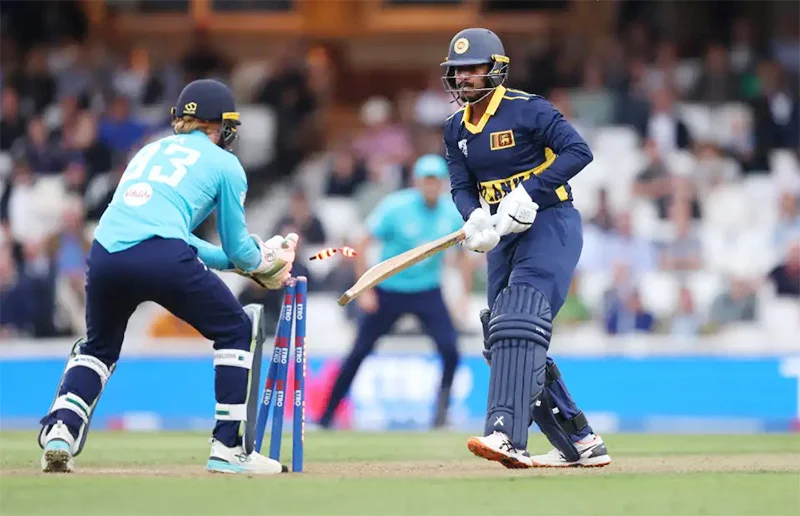
When Sri Lanka batted, England simply ripped through the order. There was precious little resistance as our batting was completely dismantled, leaving Sri Lanka on the receiving end of a crushing defeat.
The question now is not merely how this happened, but what is going to be done about it.
Performing brilliantly one day and capitulating two days later cannot become acceptable. Players representing the country must understand that consistency is not optional. They have to perform consistently to retain their places in the side. If they cannot, others must be given the opportunity.
There comes a point when patience ceases to be a virtue.
Desperate situations call for ruthless measures.

Civil society activist accuses govt. of favouring Ven. Gnanasara

More cops than cones

Sajith accuses govt. of using data selectively in crucial report

75 new inmates sent to Bogambara re-establishing it as a correctional facility

Rs 160 million + diesel discrepancy at Lakvijaya power plant prompts probe

Next Parliament can reverse 22A – GL

‘Dates have the highest sugar content to fight Coronavirus’

Sunday Island 27 December – Headlines

#SundayIsland 17th December – Headlines

Sunday Island – 28th March

Sunday Island Headlines – 21 March

Sunday Island – 21st February – Headlines
-

 Latest News6 days ago
Showers above 100 mm are likely at some places in the Western, Sabaragamuwa, Central and North-western provinces and in Galle and Matara Districts
-

 Editorial6 days ago
Crimes punished and unpunished
-

 Features5 days ago
Beyond traditional jobs: Why Sri Lanka needs to facilitate the gig economy
-

 Editorial4 days ago
Birth of a bad law
-
 Latest News5 days ago
Kusal, Wellalage star as Sri Lanka defend 322 in Headingley thriller
-

 Latest News7 days ago
Ms. P. M. Jayadeera (Engineer) appointed Director General of Irrigation
-

 News2 days ago
Police remove Thileepan statue in Jaffna
-

 News6 days ago
IMF: Sri Lanka on course for 2027 market return