
Sports
Anjelo had to play at his best to shine among other TT stars of his era


By A Special Sports Correspondent
Former table tennis singles champion Michael Anjelo Santiago (71) was in Sri Lanka and met up with some of his close friends (who at one time were also his toughest opponents) at a reunion at Otter Club in Colombo. Two of these close friends who caught up on old times with him were former singles champions Jothipala Samaraweera and Lalith Priyantha.
Anjelo was the champion in the years 1971, 74, 78, 85 and 86 and the break between winning years shows that the competition was tough those days. In fact, that was the ‘golden era of table tennis’ and one scribe-Anto Fernandopulle- described the wonders of the sport magnificently with a banner newspaper headline which went ‘If you want to go abroad play ping pong’. Anjelo remembers this headline very well and in an interview with this writer recalled how the sport rewarded him with 24 opportunities to travel abroad and play competitive table tennis; a sport also known long ago as ping pong.
He still remembers how hard it was to play against Jothipala Samaraweera who was a master at the game holding the racket in a pen holder grip. But Anjelo played the game of his life against Deepak Narendas in the men’s singles final in the 1970s where he went down fighting in a five-setter thriller. He won his fifth singles crown beating Lalith Priyantha in 1986 to equal a record set by Samaraweera in winning the most number of singles crowns (back then). In fact, he gave thought to contesting the 1985 and 1986 nationals after his wife Samadara made a request to continue playing in his pet event, the men’s singles.
The vision players had for the game and the positive frame of mind the players had back then surfaces when players like Anjelo speak to the press. “When I was first selected to represent the country, I was 17 and the tour was going to clash with my O’ Level Exam. But I chose the tour ahead of studies because we saw how talented table tennis players were offered jobs by mercantile companies,” said Anjelo who had completed the missed exam the following year.
By 19 years of age, he was established in the sport and had found employment as an assistant accountant at a footwear company. A job at 19 and as an assistant accountant? “I was good in mathematics,” said a smiling Anjelo.
As much as he trained hard and played ruthlessly at competitions, he also did something vital which must be mentioned here. He was able to read the minds of his opponents. That was the intelligence of players of yesteryear.

Anjelo Santiago stamped his class in the
singles nationals in the years 1971, 74, 78,
85 and 86
His approach to the game changed with an opportunity he got to visit China and undergo residential training. “We saw our game being raised and our fitness levels too shot up due to this exposure at training in another country,” said the former champ who was accompanied to China by three other players.
He changed jobs many times serving in companies like Ceylon Cold Stores, Building Material Corporation and Brown and Company. He also served the Sri Lanka Army; where he said he played his best table tennis. In 1974 he won a triple crown at the sport partnering Narendas in the men’s doubles and Nandini Udeshi in the mixed doubles.
He rates Jothipala Samaraweera as the toughest opponent he had met during his career which continued till 1990. Fans may recall how two sections of spectators cheered for their choice of player in the table tennis singles finals whenever these two met. Spectators never clashed and the only way they released their energies were by vociferous shouting. After the final, regardless of who had won, Samaraweera and Anjelo made a habit of visiting the pub for a quarter of their favourite alcohol. That was the camaraderie among player of that era.
Table tennis was a popular sport back then and the sport’s top players received a lot of recognition. In 1975 there was a voting competition where fans got to choose their favorite sports personality. Cricketer D.H de Silva won the competition with table tennis players Samaraweera and Anjelo finishing fifth and tenth respectively in that competition. That was how popular the sport of table tennis was back then. Jothipala was a household name in the entire sports scene, not only in the racket sport, and we can just imagine the interest table tennis generated with the names of Priyantha, Narendas, Mahinda Dandeniya, N.H Perera, Shabar and Shabeer Hussain thrown into the equation. Each year produced a different champion. And unlike in present times with most sports the winner at table tennis was never a forgone conclusion for those who left home to watch a game of table tennis played at the top level.
By 1990 Anjelo had won all top local titles that were on offer, worked in many companies and raised a family with his beloved. But he was not financially stable and that prompted him to find employment in Canada. He later got his family to immigrate to Canada after establishing himself in the field of insurance.
When asked to name some of the most memorable moments in the sport Anjelo had this to say. “I took a set off world champion Li Chung Kuang at the 1971 Asian Championships in China and a set off Japanese World Champion Ohono at the 1979 Asian Championships. I also got to pose for a photograph with the world best 110 players when I went for the Afro Asian Latin American Tournament” he said with a beaming smile.
He said that he had played club table tennis when he set foot in Canada with that level of table tennis deemed as sport at B Division. He had slowly worked himself up in the ratings and remembers playing in as many as ten games a day. His involvement with club table tennis in Canada shows that Sri Lanka lacks that club culture; something which is so essential for a sport and its players to survive.
Anjelo’s parting words were for the sport to attract more sponsorships, get the services of a foreign coach and for the game’s legends and accomplished players to get involved in coaching and administration.




by Reemus Fernando
World javelin leader Rumesh Tharanga lived up to his billing to win Sri Lanka a highly anticipated gold medal, overcoming wet weather and a slow runway at the Asian Games in Nagoya, Japan, on Monday.
The overwhelming favourite after a string of victories at global level this year, Tharanga made an unlikely start, opening with 73.52m in the first round and trailing his South Asian rivals, including reigning Olympic champion Arshad Nadeem of Pakistan. At the halfway mark he surged ahead with a massive 88.33m, then sealed the contest with 88.55m.
”He rose like a true champion at the most crucial moment. It was an incredible performance in these wet conditions,” veteran coach Susantha Fernando, who watched from the stands, told The Island. “I was blessed to see a Sri Lankan win gold at back-to-back Asian Games.” Fernando’s own charge, Tharushi Karunaratne, won the 800m at the last edition. He was one of the team coaches at the venue yesterday.
The 23-year-old, trained by Tony Prasanna, arrived in Japan as world No. 1 and the season’s leading thrower. In June he became the first Sri Lankan to throw beyond 90m, launching a national-record 92.62m at the Rome Diamond League. In July he beat India’s Neeraj Chopra to take Commonwealth Games gold in Glasgow, and this month he won the inaugural World Athletics Ultimate Championship in Budapest. He also became the first Sri Lankan to win the Diamond League title. He was the only thrower in the field with two throws beyond 92m this season.
With such a reputation to carry, a Games record (89.15m) was widely expected, and Tharanga came close, but nearly every thrower struggled in the wet conditions.
With Chopra absent, India’s Y. Singh and R. Yadav took silver and bronze with 85.72m and 84.35m respectively. Nadeem finished just outside the podium with 80.29m. Former national record holder and Olympian Sumedha Ranasinghe was sixth with 78.08m.
Akalanka impresses in hurdles
Meanwhile, hurdler Ayomal Akalanka produced one of Sri Lanka’s best performances among those who narrowly missed the podium, finishing fifth in the men’s 400m hurdles.
Running from lane two, the 20-year-old clocked 49.37 seconds against an elite continental field. The former Ambagamuwa Central Udubulathgama athlete stayed in contention throughout the final and finished ahead of Japan’s Kazuki Kurokawa, India’s Santhosh Kumar Tamilarasan and Kazakhstan’s Vyacheslav Zems.
Qatar’s Bassem Hemeida won gold in 47.82, with Japan’s Taiju Goto taking silver in a personal best of 47.93. Taiwan’s Chung-wei Lin claimed bronze in a personal best 48.74, and his compatriot Jian-rong Chen was fourth in 49.25.
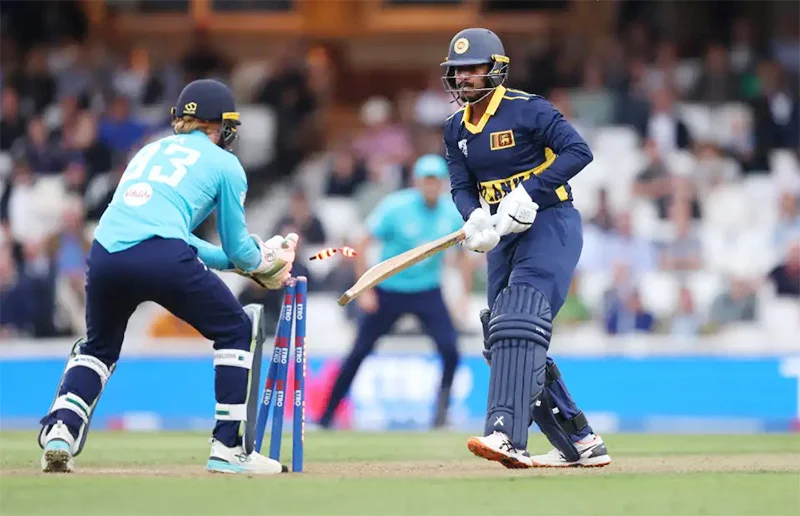
After all the euphoria of Headingley, Sri Lanka’s men’s cricket team came crashing back to earth, suffering an embarrassing defeat in front of a capacity crowd at The Oval on Sunday.
Sri Lanka have been playing ODI cricket for more than 50 years and this was their fifth heaviest defeat in the format and their worst against England.
Defeats hurt, but over the years good teams have used them as motivation to bounce back. With Sri Lanka, however, there appears to be precious little light at the end of the tunnel. They keep persevering with the same set of players and unsurprisingly, keep getting the same old results.
More worrying than the margin of defeat was the lack of fighting spirit. Sri Lanka got their sums horribly wrong and ended up inflicting another dose of humiliation on the once proud brand of Sri Lankan cricket.
Unless the administrators address these issues quickly, Sri Lanka could be heading for yet another disappointing World Cup in South Africa next year. Reaching the semi-finals may be a bridge too far, but the realistic ambition should at least be to reach the last seven stage, with the next World Cup being played under a new format.
On Sunday, Sri Lanka simply conceded far too many runs. The bowlers lacked imagination and discipline, while the fielding was equally shoddy as England piled up 355 for seven, their second highest ODI total against Sri Lanka.
It was a considerable confidence booster for an England side forced to summon replacements following injuries to Jos Buttler and Adil Rashid. Their replacements, Jordan Cox and Liam Dawson, made telling contributions.
Sri Lanka cannot boast of such depth. Like the UNP under Ranil Wickremesinghe, they seem to have been rebuilding for years, yet there is still no sign of the grand comeback everyone keeps waiting for.
When the pressure comes on, the decision making becomes even more alarming. Former captain Charith Asalanka, in particular, has repeatedly made a mockery of running between the wickets. Too often either he finds himself in danger or his partner ends up paying the price.
There was another bizarre episode when Pavan Rathnayake was ruled run out by the on-field umpire. He appeared to earn a reprieve on review, only to eventually be declared out.
Wicketkeeper Cox had initially dislodged the bails while attempting to collect the ball. Most followers of the game know that once the bails have already been removed, a fielder generally needs to uproot a stump while holding the ball to complete a run out. What many perhaps did not realise was that the Laws also provide for a batter to be run out if the ball itself subsequently knocks a stump out of the ground.
It summed up Sri Lanka’s day: even when they thought they had survived, there was another nasty surprise waiting around the corner.
It was yet another bitter lesson on a tour that promised much but delivered precious little. Sri Lanka return home with few positives, plenty of bruises and an uncomfortable pile of questions demanding answers.
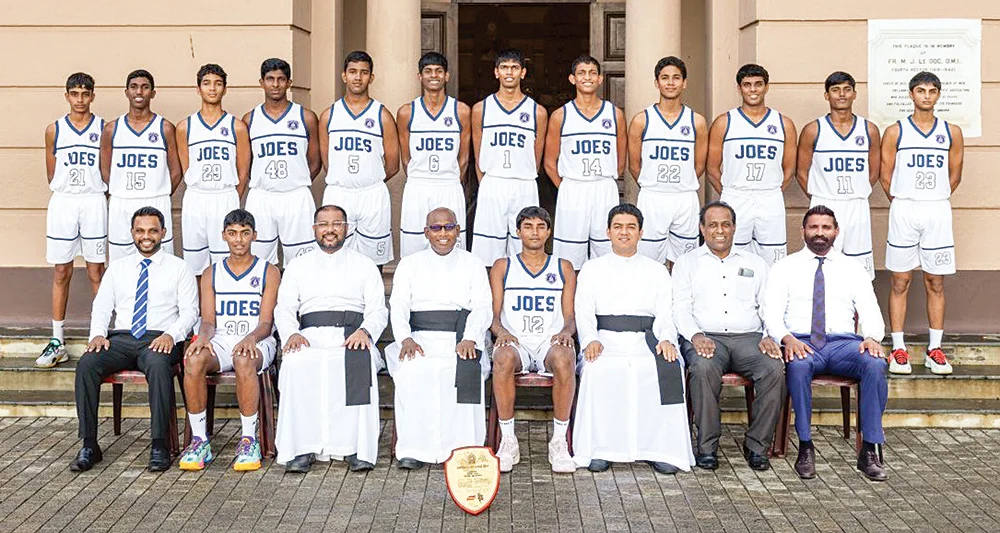
St. Joseph’s College, Colombo 10, has once again etched its name in golden letters within the annals of Sri Lankan school sports. At the conclusion of the 40th All-Island School Games, organized by the Ministry of Education, the Josephians swept the courts with a masterclass performance, capturing both the Under-17 and Under-20 double championships for the third consecutive year (2024, 2025, and 2026).
This occurrence is so rare and never been achieved before and hard to imagine that will be ever matched in the near future.
The U-17 squad put on an exhibition of tactical discipline and relentless energy throughout the competition overcoming every opponent.
In the pre-quarterfinals, the Joes beat St. Anne’s College, Kurunegala in a one-sided game while the quarter-final too proved to be a cake walk as they overcame Jaffna Hindu College. St. Joseph’s beat Trinity College, Kandy in the semis and beat arch-rivals St. Peter’s in the final to secure the title.
The Under-20 team faced fierce competition. Spearheading this phenomenal run was Chamidu Madushan, whose dominant performances on both ends of the floor earned him the prestigious award of Most Valuable Player (MVP).
Joes overcame St. John’s College, Jaffna 42–21 in the pre- quarters while beating Kingswood College, Kandy in the quarter-final, which turned out to be a close contest.
They beat Jaffna Central in the semis and beat Prince of Wales College, Moratuwa 56-49.
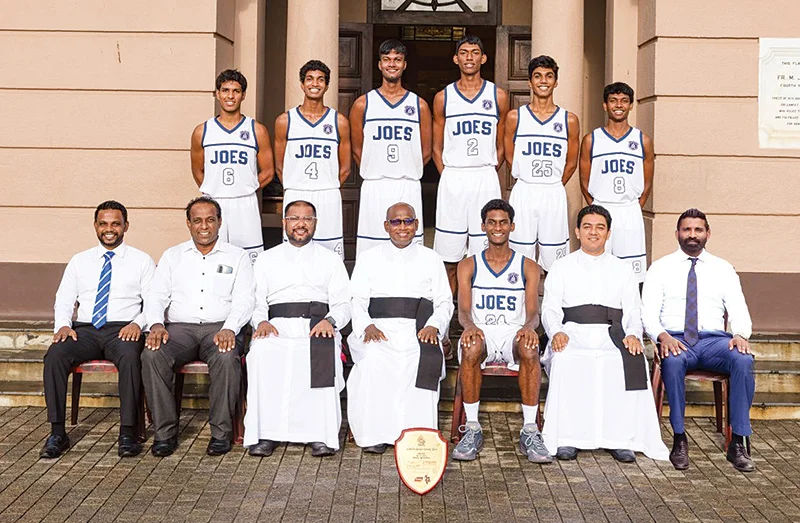
Victorious under 20 Josephian team.

PAFFREL raises concerns over Anti-Corruption (Amendment) Bill

First cases taken up by SC after enactment of 22A dismissed

Now NR named 4th suspect in Krrish case

Sri Lanka Red Cross Society honoured with Friend of Singapore Red Cross Award

Eastern University and the making of a culture of peace

Tharanga seals remarkable season with Asian Games gold

‘Dates have the highest sugar content to fight Coronavirus’

Sunday Island 27 December – Headlines

#SundayIsland 17th December – Headlines

Sunday Island – 28th March

Sunday Island Headlines – 21 March

Sunday Island – 21st February – Headlines
-

 News6 days ago
Mastermind Naufer Moulavi among 15 found guilty
-
 Midweek Review6 days ago
Thileepan’s fast unto death: An authentic narrative that many missed
-

 Latest News5 days ago
Showers above 100 mm are likely at some places in the Western, Sabaragamuwa, Central and North-western provinces and in Galle and Matara Districts
-

 Editorial6 days ago
Big Bad Bills
-
Editorial5 days ago
Crimes punished and unpunished
-

 Features4 days ago
Beyond traditional jobs: Why Sri Lanka needs to facilitate the gig economy
-

 News6 days ago
No referendum needed for passage of 22 A: SC
-
 Latest News6 days ago
Ms. P. M. Jayadeera (Engineer) appointed Director General of Irrigation