
Features
Sound policies a prerequisite for agriculture development –Prof. Marambe

By Ifham Nizam
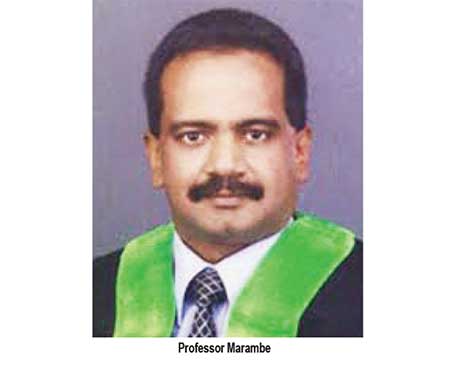
The new Overarching Agriculture Policy (OAP) developed by the Department of National Planning of Sri Lanka (still to be approved by the Cabinet of Ministers) is considered a holistic approach to agriculture development covering eight major segments in the agricultural economy, namely, food crops, plantation crops, export agricultural crops, livestock and poultry, fisheries, agrarian services, irrigation, and Environment, and adequately covers climate change as a cross-cutting issue to support future development of agriculture, says Prof. Buddhi Marambe, Senior Professor-Weed Science, Department of Crop Science, Faculty of Agriculture, University of Peradeniya.
Professor Marambe is the President – Weed Science Society of Sri Lanka (WSSSL), Chairman, National Invasive Species Specialist Group (NISSG), Ministry of Environment and Member. National Experts Committee on Climate Change Adaptation (NECCCA), Ministry of Environment. In an interview with The Island he said that all in all, there were many initiatives by Sri Lanka to tackle issues related to climate change in Agriculture. “Researchers, scientists, academic private sector and practitioners in Sri Lanka have adopted such technologies introduced by the state and private sector agencies, which is encouraging. There is still more to be done. We need to keep the momentum, and review and assess what has been done in the past for the agriculture sector in tackling the dangerous climate change. The efforts that are technologically-sound should continue. With sound policies, all sectors related to agriculture should be in a position to streamline climate change concerns into their respective programmes and projects”.
Excerpts of the interview
The Island: Are you happy with the policy initiatives when it comes to climate change and adaptation on agricultural sector?
Professor: The answer is yes. Sri Lanka has laid a strong foundation to tackle issues related to climate change by adopting the National Climate Change Policy in 2012, which deals with both components in tackling climate change, i.e. adaptation (coping up) and mitigation [reducing greenhouse gas (GHG) emissions]. Before the policy was adopted, we had a National Climate Change Adaptation Strategy 2011-2016 based on the climate vulnerability mapping on the major economic sectors done in 2009-2010 period. Later the level of climate vulnerability was assessed for the agriculture sector at district level in 2013 by the Department of Agriculture in collaboration with the UNDP, with studies now being expanded to divisional secretariat level. Scientists from the Natural resource Management Center (NRMC) of the Department of Agriculture, led by the scientists like Dr. Ranjith Punyawardena, are currently involved in such studies with the support of scientists from the other agencies. The Climate Change Secretariat (CCS) of the Ministry of Environment and Wildlife Resources (MEWR) coordinates activities related to the climate change being the focal point for the United Nations Framework Convention on Climate Change (UNFCCC) and the National Designated Authority (NDA) to the Green Climate Fund. Two National Expert Committees on Climate Change Adaptation and Mitigation have been established by the CCS to advise the MEWR on policy level decision making in climate change related matters, including agriculture. The country has also prepared its National Adaptation Plan (NAP) for climate change for the period 2016-2025, following the adoption of Paris Agreement in mid-2016, where agriculture and food security have been a priority consideration. The country has also developed the Nationally Determined Contributions (NDC) in 2016 and currently in the process of updating the same to identify actions even to minimize GHG emissions from agriculture. The Provincial Adaptation Plans to cover 9 provinces are now in the making. The state and private sector agencies that are responsible for agricultural development of the country have set their targets accordingly, giving due consideration to climate change scenarios. In the field of agriculture, adaptation is a priority to developing countries like Sri Lanka. Accordingly, promotion of climate-smart and precision agricultural technologies focusing mainly on productivity enhancement of crops under changing climate, development of ultra-short age rice varieties (maturating in about 80-85 days) which are drought tolerant or escaping drought, promoting mid-season cultivation of short-age drought tolerant food crops such as mung bean in paddy fields, adopting water saving techniques such as drip irrigation in selected crops, protected agriculture technologies, development of drought-tolerant tea cultivar TRI 5000 series to tackle climate change, crop-animal integrated farming to promote climate resilience in the agriculture systems are some examples to show that we as a country is prepared and moving forward in facing climate challenges. The new Government Policy Framework on “Vistas of Prosperity and Splendor” does not highlight the term climate change, however, adequate attention has been given to promote environmentally-friendly agriculture, which has direct implications on tackling climate change. The new Overarching Agriculture Policy (OAP) developed by the Department of National Planning of Sri Lanka (still to be approved by the Cabinet of Ministers) has considered the holistic approach for agriculture development covering eight major segments in the agricultural economy, namely, food crops, plantation crops, export agricultural crops, livestock and poultry, fisheries, agrarian services, irrigation, and Environment, and adequately covers climate change as a cross cutting issue to support future development of agriculture. All in all, there are many initiatives that have been taken by Sri Lanka to tackle issues related to climate change in Agriculture. Researchers, scientists, academic private sector and practitioners in Sri Lanka as a whole have adopted such technologies introduced by the state and private sector agencies, which is encouraging. There is still more to be done. We need to keep the momentum, and review and assess what has been done in the past for the agriculture sector in tackling the dangerous climate change. The efforts that are technologically-sound should continue. With sound policies, all sectors related to agriculture should be in a position to streamline climate change concerns into their respective programmes and projects.
The Island: About 30 per cent of Sri Lanka’s population are engaged in agriculture, do you think successive governments have done enough for them?
Prof: The labour force in agriculture in Sri Lanka has reduced from 50% in 1980 to 25.5% in 2018. The labour productivity in agriculture has been positive since 1980, which reached LKR 0.3 million in 2017 and LKR 0.33 million in 2018 (per labour unit per year). The labour involvement in agriculture has decreased owing to many reasons, specifically migration to urban and other economic sectors and mechanization in agriculture. Youth moving away from agriculture has been a popularly known reason and modernization of the sector with novel and affordable technology is the key for further improvement of labour productivity in agriculture and retention of the young and skilled labour that is attracted to agriculture. As for doing justice to the farming community by the government of Sri Lanka – I have mixed feelings. Since independence, successive governments have given priority to make Sri Lanka self-sufficient in rice with more investments in research and development. However, other crop sectors and animal production sector have not received the same treatment. Our farming community have been struggling to feed the nation. They need tangible support, not political pledges. More attention need to be paid to infuse new technology and making the technology affordable to those in the sector, to ensure increase in labour productivity and to support the livelihood of the farming community. Provision of subsidies (such as for fertilizer), price controls, and insurance schemes to support the agriculture production and productivity in the country have been key interventions by the government of Sri Lanka, to support livelihood of the practitioners in agriculture. However, timely availability of such inputs, including good quality seeds and planting material, is a must to reap richer harvests without affecting the livelihood of the practitioners. There is no need of rocket science to decide on imports of agricultural inputs depending on the seasonality of crops. What the dedicated farmers in Sri Lanka require is to have timely supply of inputs (seeds, fertilizer, pesticides, and organic matter) and an effective market mechanism. The agricultural practitioners have been flooded with many promises by successive governments, but they have been taken on a ride continuously. Since 1978, the country has been more inclined to import food requirements despite the potential of producing certain food and feed crops such maize, mung bean, green chilli, etc., and dairy cattle in the case of animal production. We have undermined our genetic potential in and biodiversity. In the food crops, with our scientists been able to develop the hybrids and improved production technologies, we are in a position to boost the productivity levels of food crops and animals considering limitations to expand land availability for agriculture. Unfortunately, limited attention have been paid to improve the livestock sector. Private-public partnership is a must to achieve productivity targets with assured local and export markets for the agricultural products. Import restrictions imposed for some food crops in crisis situations would assist in this effort however, will not be a good practice in scenarios where international trade plays a major role.
The Island: Your thoughts on food losses as waste during COVID-19 pandemic, especially in the agricultural sector?
Prof: COVID-19 made many issues that the agriculture sector has faced over many years, to surface at a magnitude that many of us did not even dreamt of. The food supply chain collapsed in the country at least for a shorter time period, not only leaving producers at a precarious position, but leaving many agencies still wondering what to be done. Closure of markets, national and regional lockdowns, issues related to transport, etc. during the COVID-19 pandemic rendered the situation more difficult to handle. The private sector itself, despite their contribution to the agricultural development of the country, was taken by surprise indicating that the so-called “engine of growth” is not prepared in order to face such a crisis. This was true for both crop and animal products, affecting both the industries badly. The government made a valiant attempt to intervene, by means of permitting food transport and agricultural operations amidst islandwide curfew and lockdown, but still failed to cope up with the situation owing to the complexity of the food supply chain, as we learned from many media reports. Panic buying resulting in empty shelves in the markets certainly would have increased food losses due to excess storage of food in homesteads, though scientifically valid analysis on this matter is not available yet. In contrary less food demand at later stages also would have contributed to food losses to a certain extent. When any supply chain collapses, it is natural that both the producers and consumers (not to forget the other players) feel the impact.
The Island: What about the perishables and 20 to 40 per cent harvest losses?
Prof: This has been a long-discussed topic with limited success in terms of practical solutions. The disruption to the food supply chain, as was evident in the COVID-19 pandemic, has only cautioned us further to look into this matter deeper in finding a long-lasting sustainable solution. Unfortunate part is that the whole society speaks of the need for reducing post harvest losses when there is a glut in the market. It is always too late – as the society including the researchers and academia, and the industry, we are not prepared to meet the challenges. We plan our cultivation well, but we do not plan for the post-harvest operations and value addition in the same manner. This is the key issue. Once again, the state and private sector organizations should chip-in at early stages of cultivation and plan for the future to support the agriculture community. Special analysis is not required to conclude that there is a glut of food products in the markets during specific time period of the year such as December, March-April and July-August. This depends on the seasonality of the crops and the way farmers carry out their cultivation aiming at harvests at times when there is a high demand for the crop produce. We cannot start thinking what to do with the excess food at the time when we have a surplus. This can only be addressed through proper planning. Enough lessons are learned from repeated mistakes. Efforts have been made to educate practitioners on the quantities required in the case of different food products during different time periods of the year. The Department of Agriculture has developed a mobile app to educate the farming community in Sri Lanka regarding the requirements and market potential of different vegetable crops, which is upgraded twice a month (every 6th and 21st day of the month). Finally it is a matter of imposing certain rules and regulations to make sure what is required, including for post-harvest processing, being produced. Proper land use planning and directives based on market mechanisms are a must to overcome such problems in the future.
Asking farmers to do value addition for a better export price will not solve the issue at all, unless the mechanism is set to support product marketing at national and global levels.


 The West Asian peace effort continues waveringly amid uncertainties. The world could be considered as having ‘some breathing space’ currently in this tangled situation on account of a dip in oil prices but whether such relief would be of a long term nature is left to be seen.
Meanwhile, some vital ‘details’ in the peace process are continuing to hobble it. One such factor is the nuclear issue. While US President Donald Trump is on record that Iran’s purported nuclear programme from now on will be monitored by the International Atomic Energy Agency (IAEA), this assertion is being denied by the Iranian authorities who indicate that Iran will be coming under no such regime. That is, Iran will be answerable to no one with regard to its legitimate right to defend itself.
Accordingly, an early closure to the nuclear question could not be expected and the furthering of peace in the region hinges on the principal sides being of one mind on the issue. Moreover, toll-free shipping through the Strait of Hormuz is proving to be a bone of contention between the warring sides.
However, perhaps going largely unnoticed in the Middle East region are identity questions of considerable magnitude that have stood in the way of the region making some headway towards a peace settlement and which would continue to undermine such a process going forward. Identity, or a group’s self conception, is by far the most intractable of the factors in the conflict and the main sides would do well to manage it effectively before long.
US Vice President J.D. Vance, as pointed out in this column last week, fired one of the first salvos in this regard in the current peace effort. He reportedly said: ‘Regional peace and stability includes stopping the funding of “terrorist organizations” .’ He probably had in mind the Hezbollah organization which is funded and armed by Iran but, needless to say, the latter would reject this statement out of hand because it does not see the Hezbollah as terroristic in orientation.
Accordingly, the tangled issue of ‘who is a terrorist?’ would recur to hamper the West Asian peace bid. An important corollary to this matter is that Middle Eastern militants would be branding US administrations as terroristic considering the humanly costly military interventions undertaken by the latter over the decades in the world’s war zones.
It is difficult to see the main sides taking up the issue of terror and arriving at a common understanding on the problem over the next couple of months in their peace deliberations but the unresolved question could be expected to be the proverbial ‘elephant in the room’ that could even wear the sides down. Accordingly, ‘quick fixes’ to the Middle East imbroglio would need to be ruled out.
However, paring down terror to its essentials, it needs to be found that in contemporary times it is identity and issues growing out of it that keep the question alive and render it intractable. In fact the problem should be seen as igniting and sustaining a multiplicity of conflicts world wide.
So pervasive are identity questions that they are seen by some as having played a role in leading to the recent resignation of Keir Starmer as UK Prime Minister. Among other things, the latter is seen as having been incapable of managing migration related issues besides falling short in strengthening domestic social cohesion.
Identity issues came to a head in the UK in the form of the recent anti-immigrant riots in Northern Ireland. Clearly, some immigrants continue to be seen as aliens and parasitic in nature in some parts of the UK by jingoistic elements. Thus is ignited anti-foreigner violence.
That said, some of the most laudable measures for the promotion of peaceful race relations are found in the UK today. The latter’s race relations legislation could be seen as constituting a model for the rest of the world and needs to be studied and adopted by particularly the global South where identity conflicts are rampant.
Unfortunately, racial amity is not being considered a priority by the Trump administration. Under the latter immigrants are being seen by supremacist whites as the archetypal ‘Other’ who should be violently shunned. Accordingly, social cohesion in the US too is being steadily undermined and stepped-up race hate in the country shouldn’t come as a surprise.
In the West Asian region, archetypal ‘Othering’ could prove particularly pernicious and destructive. It could lead to the unraveling of the current peace talks between the adversaries and needs to be addressed by them if the negotiations are to prove productive.
For far too long the West and Israel have been viewed as archetypal enemies by Iran and its supporters. On the other hand, Palestinian militants have been habitually seen by the Far Right in the US and by hard line Israelis as sworn enemies who are best eliminated. These seemingly unresolvable divides in the Middle East could bring down the present negotiatory process.
Even if the present round of mediated negotiations between the US and Iran lead to a substantive cessation of hostilities in West Asia, the divisive mindsets of the prime antagonists, that is, the US and its ally Israel on the one side and Iran and its supportive militant groups on the other, would need to be changed for the better if enduring peace is to be given a chance. That is, mindsets would need to be transformed on both sides of the divide from mutual hostility to mutual amicability. No doubt, a long-gestation process.
It cannot be stressed enough that those mediating in this long-running conflict, themselves need to approach peace-making with unbiased minds. It needs to be realized, for example, that Israel too has been ‘hurting’ badly in this conflict over the decades to the degree to which the Palestinian side has been victimized cruelly, dispossessed and divested of dignity.
Any negotiated peaceful settlement should seek to address this persistent mindset malaise as well and turn enmity into amicability. An equitable solution that addresses the lingering grievances of both sides could lay the basis for this process of ‘Turning Spears into Ploughshares.’
‘Land and Bread’ have been at the heart of the Middle East conflict over the decades or even centuries. An equitable solution should provide these assets in equal measure for both sides. There is no getting away from the ‘Two State Solution’.

Long End Street is not a summation of Short End Streets. Eighteen short-term crises and no long-term growth in sight!
For quite some time, there has been no agency of government dealing with long-term economic and social policy questions. Nor have universities been of any help. There has been a National Planning Department in the Ministry of Finance but we have not seen any worthwhile reports from them. M. D. H. Jayawardena, in 1956, presented in Parliament the Six-Year Programme of Investment. Soloman Bandaranaike established a National Planning Council and a Planning Department, with Princy Siriwardena as its Director. They wrote the Ten-Year Plan, better known for its readability than its depth of analysis or policy content. Ten years or so later Dudley Senanayake established a Ministry of Planning and Employment with Gamani Corea (later of high international repute) as its Permanent Secretary. The Ministry was responsible for some useful analytical work and the development of a bureaucracy responsible for plan implementation. The latter was the work of a brilliant member of the Ceylon Civil Service, Godfrey Gunatilleke, who also worked in the Ministry. The major pre-occupation of the Ministry turned out to be the annual government budget and the management of direly scarce foreign exchange, all short term considerations. They set up a bureaucratic mechanism to evaluate capital expenditure in the government budget. The Ministry won plaudits for its Foreign Exchange Budget, some analytical wok on the economy, including population projections as well as education, in both schools and universities. As the 1970s wore on, planning earned a bad press and the new government of 1971 disbanded most of that and created a Department of National Planning in the Ministry of Finance, which survives to date.
A part of the purpose of this narrative has been to bring out that, all along, government has had no outfit of economists and sociologists whose job was to study long term changes in our society and the economy and in the rest of the world and propose solutions for consideration by governments. (A brilliant exception was the work on education, that was directed by Jinapala Alles, who had graduated in chemistry and was a fast learner and was at great ease with numbers. He was also an effortless leader of a small team of self-selected competent and enthusiastic public servants.) The government depended on the Central Bank for advice on long term development of the economy. Princy Siriwardena was seconded for service in the Planning Secretariat; similarly, Gamani Corea was from the Bank. Later, he was replaced with H.A.de S. Gunasekera, likely the most brilliant economics teacher in the University of Ceylon. He taught monetary economics, essentially short term. (His favourite economist Keynes famously wrote, “In the long run we are all dead”.)
When the Ministry of Planning and Employment was established in 1965, government plundered the Central Bank to staff it: Gamani Corea, R. M. Seneviratne, N. Ramachandran, Nihal Kappagoda and G. Usvatte-aratchi. Later, W. M. Tillekeratne and A. S. Jayawardena both long term employees of the Central Bank, were appointed as the chief economist of government. Jayawardena still later became the Governor of the Bank. Several other employees of the Bank, including J. B. Kelegama, P. B. Karandawela, P. B. Jayasundera worked at high levels in successive governments and that practice continued when Mahinda Siriwardena became the Secretary to the Ministry of Finance when Anura Dissanayake became the Minister of Finance. It is mysterious that the government saw no need for specialist advisers who would identify long term economic and social problems and solutions therefor, look out for markets and technology and warn of impending pitfalls, in contrast to our mighty neighbour which had a Planning Commission that handled long term problems and a Central Bank which had learnt to handle masterly, monetary problems.
Pitambar Pant, Montek Singh Ahluwalia, Manmohan Singh, I. G. Patel and Raghu Ram Rajan were most distinguished economics policymakers and central bankers. Japan benefited greatly from the work of MITI. So did Korea from its counterpart. This is not to argue that had there been an outfit of that sort, Sri Lanka would now be rich but to warn that the Central Bank is neither equipped nor fit to fight those battles. If you scan the Central Bank Act of 2023, you will find stabilisation the most frequently recurring theme. Clause 6 reads ‘The primary object (objective?) of the Central Bank shall be to achieve and maintain domestic price stability.’ The most generous reading that the Bank may have anything to do with economic development is in Clause 6 (4) ‘In pursuing the primary object (objective?), the Central Bank shall take into account, inter alia, the stabilisation of output towards its potential level.’ Lawyers may have a field day with that and economists may beg for its meaning.
Amarananda Jayawardena was the last Governor of the Central Bank who had understood that the central bank was equipped to handle short term problems and that not always valiantly, and that it had neither the tools nor the resources to plan and engineer long term development. As Governor, he did not speak for the government on long term economic and social problems, although prior to assuming duties as Governor of the Bank, he had been the chief economist of the government. Jayawardena knew all too well the nature of the tools and the resources he had and how far he could confidently aim and shoot. It was simply silly to produce a Five-year Road Map (no matter how colourful the accompanying graphics), when a central bank mainly used transactions in the short-term financial assets market to move interest rates and the demand for money. The Bank of England, for most of the 20th century, used Commercial Paper with two ‘good names’ at its Discount Window. Short-term and long-term rates of interest, normally, behave in a predictable relationship, although occasionally, and in volatile times, that relationship may become inverted. (I am not well read on recent Fed and the Riks Bank market operations.)
The economists at the Central Bank are experts in monetary policy and are rarely knowledgeable about economic growth. An exception was S. B. D. de Silva and he found writing a half page note to the Centra Bank Bulletin (monthly) stultifying. He left the Bank quite young and continued studying economics until the very end of his life. As undergraduates they may have read on economic growth and development but as professionals in the central bank, it is unlikely that they kept working on problems in that area. They may also have learned, some time, that there has been no central bank credited with spearheading economic development in any country. Therefore, to pretend that they can advise the government on economic planning, is a hobby which they would be wise to desist from.
We did a splendid job of saving our new born children and their mothers as indicated in low infant mortality and maternal mortality rates. We scored an even more resounding victory in educating all our children. If we have any claim to any civilizing missions in the 20th century, these two stand out. Beside them, we have been mostly failures. The economy has advanced only laggardly. It has miserably failed to exploit excellent opportunities to sell in burgeoning markets, output employing a healthy and educated labour force. Japan, South Korea, China, Vietnam, south India, Ethiopia, Rwanda and several other countries, all (except Japan) late comers to the game compared to Sri Lanka, succeeded in doing just that. It is wrong to blame governments alone for poor economic growth, as many do. Most economic activity in this country is run by the private sector and leaders there have made poor use of opportunities.
When ministers of government and its employers collect bribes, private sector persons pay bribes. The markedly rapid economic growth in Andhra Pradesh, Telangana, Karnataka, Tamil Nadu and Keralam and poor growth in Madhya Pradesh, Uttar Pradesh, Bihar and many others in the north east are under the same central government dispensation, sharply pointing to differences in the quality of business leadership in the two groups. ‘Big business’ here run betting shops, supermarkets, hospitals, import and market household equipment, banks and insurance companies and, most ambitiously maintain construction companies. (In the widely watched IPL cricket matches 2026, Sri Lanka advertised regularly a Betting Centre!) Tourism in this country is the business of small-scale enterprises with low productivity. The ubiquitous kade with a stock-in-trade of less than one hundred thousand rupees, borrowed from a relative or a friend, is a sign of rampant unemployment and not of budding entrepreneurship. When you go to consult a doctor in a private hospital in Colombo and wait endless hours, count the number of men and women employees idling, supervised by a proportionately large number of idling supervisors. Where are the large-scale manufacturing and service companies, selling the world over, where economies of scale abound in the 21st century? So far as I recall, there has been no Initial Public Offering (IPO) of shares in the Colombo Stock Market during the last 7 years. Nor have multinational companies established here any large factories or offices.
Is the air we breathe deathly to enterprise?
by Usvatte-aratchi

By the time Sir Keir Rodney Starmer resigned, polls showed that he had become the least popular Labour Prime Minister in living memory. His fall was all the more striking because his political beginnings had once suggested a very different trajectory. As a teenager in the Labour Party Young Socialists, and later as editor of the Marxist journal Socialist Alternatives, he had stood firmly on the radical left. As a human rights lawyer he opposed the illegal invasion of Iraq, earning a reputation for principle and moral clarity.
It was this early radicalism that his supporters later weaponised, presenting him as a unifying leftwing figure in the aftermath of the coup against the Labour Party leader Jeremy Corbyn. The right-wing of Labour, having spent years undermining Corbyn (including through a coordinated campaign that framed him, falsely, as anti-Semitic) found in Starmer a vessel through which they could reclaim the party while reassuring the membership that continuity with the Corbyn surge remained intact.
In his resignation speech, Starmer claimed to have inherited a politically, morally and financially bankrupt Labour Party. Yet the record shows that Corbyn had revived the party’s grassroots, drawing tens of thousands of new members back to a party embodying the tradition of Keir Hardie. The oligarchy closed ranks against this leftist heavyweight, using Starmer and the Labour right wing as their weapon. Starmer’s “Changed Labour” was not a renewal but a repudiation, embracing the very Thatcherite revisionism that had hollowed Labour out in the first place.
A Britain battered by decades of neoliberal restructuring formed the backdrop to Starmer’s rise. The cumulative effects of Maggie “milk-snatcher” Thatcher’s programme, deepened by Blair, Cameron, May, and Johnson, combined with the convulsions of Brexit to produce a profound economic, social, and political crisis. The Conservative Party imploded under the weight of its own contradictions. Starmer, offering managerial calm, an a Corbyn-lite manifesto, rode the wave of Tory collapse to a landslide victory.
But once in office, he revealed himself as a Blairite in sombre tones: a Thatcherite in Labour clothing. Within weeks he slashed winter fuel payments for pensioners, inaugurating a harsh antiworkingclass agenda. He embraced the Israeli government even as it carried out genocide in Gaza. The former human rights lawyer now used antiterror legislation to suppress dissent, particularly protests against the genocide. His immigration rhetoric, invoking an “island of strangers,” echoed the poisonous cadences of Enoch Powell.
Throughout his premiership he remained pofaced, showing little emotion even when forced into humiliating Uturns by public outrage. He displayed no visible sorrow at the mass killing of children in Gaza. Only at the prospect of losing office did he appear moved. He was, in the words of Saki, a man with “the soul of a meringue,” a mediocrity whose obedience to the oligarchic class and to Zionist backers embodied what Hannah Arendt called the banality of evil. His legacy – and that of the Tories who preceded him – is a nation distrustful of politicians of whatever hue, open to the pseudo-anti-elite, deception of the billionaire-backed racist far-right
His resignation leaves Britain at a crossroads – will it follow the fascistic path of Nigel Farage’s Reform Party, or will it go down the green-red road of Zach Polanski and Corbyn? Even replacing Starmer with the newly-elected Andy Burnham will only provide more-of-the-same Tory policies – Burnham went on record saying his first foreign visit as Prime Minister would be to Israel. These are the same policies that created a visceral hatred of Starmer and opened the gates for Reform’s surge.
When news of his resignation broke, a friend told this writer that the one who had engineered the exit of Jeremy Corbyn had been unable to complete two years in office. He added, ‘Rajakam kalath kalakam palade”-– even if you reign, your deeds will bear consequences.
And, so ends the Starmer era, not with the dignity of a statesman, but with the hollow thud of a project built on betrayal, opportunism, and the abandonment of the very principles he once claimed to uphold.
by Vinod Moonesinghe

Sri Lanka seek big win against Scotland to keep semi-final hopes alive

Oil price falls back to pre-Iran war levels

Venezuela earthquakes: At least 164 dead, 971 injured as toll rises

Representatives from the Ceylon Chamber of Commerce meet PM

Progress of Housing Project for Malayagam Community families funded by India reviewed

South Africa stun South Korea to reach World Cup knockouts for the first time

‘Dates have the highest sugar content to fight Coronavirus’

Sunday Island 27 December – Headlines

#SundayIsland 17th December – Headlines

Sunday Island – 28th March

Sunday Island Headlines – 21 March

Sunday Island – 21st February – Headlines
-

 News7 days ago
Creditor receives USD 2.5 mn as Lankan public bears loss from theft of Treasury funds
-

 News6 days ago
Creditor not yet paid
-
 News6 days ago
Consumers bearing 22% tax burden despite 18% VAT claim: Dr. Harsha de Silva
-

 Features5 days ago
Nanda Pethiyagoda Wanasundara as three generations of family saw her
-

 Features4 days ago
Sri Lanka developing independent hydrographic capabilities
-

 Opinion7 days ago
SriLankan Airbus struck by lightning
-

 Editorial5 days ago
Fuel crisis: Beyond price debate
-

 Latest News4 days ago
Sooryavanshi thumps fastest List A fifty as India A win tri-series