
Features
Some interesting court experiences at the Victorian Bar


Excerpted from A Life In The Law by Nimal Wikramanayake
It was the start of 1976. I had been at the Victorian Bar for nearly four years and I now had a small but busy little practice in the Magistrates’ Court with the occasional sojourn into the County Court. I say “small” because the fees in the Magistrates’ Court were not particularly high. I had a large room on the fourth floor of Equity Chambers into which I had moved early in 1974, but in 1975 I moved into a “B”-sized room on the third floor of Owen Dixon Chambers in March 1976.
At that time it was a floor with a number of distinguished barristers, namely Brian Thomson QC, Ted Laurie QC, John Hanlon QC, Len Ostrowski QC, Paul Guest QC, Philip Mandie QC, John Coldrey QC, Con Heliotis and Dinny Barrett (the magistrate who discharged Lindy Chamberlain in her first committal proceeding) and Fred James.
Fred was a shy, self-effacing man with a wicked sense of humour and an old-world charm. He was a man of reasonably substantial girth and he always wore double-breasted suits, which concealed his extra-large stomach. Fred had the room directly opposite me on the third floor of Owen Dixon Chambers. We soon became very close friends and he would either come into my room every morning or I would go into his room and we would smoke cigarettes together. We would spend a pleasant half hour solving the world’s problems and dealing with our little ones.
It was during the 11 years I spent with Freddie that I realized what a “lonely, cruel place” the Victorian Bar could be. Please do not get me wrong, I do not mean to say that Victorian barristers are cruel and mean. But the Bar is, for some members, an extremely lonely place. I will tell you why. Many years before, Freddie had been an acting Crown Prosecutor and was in the process of being confirmed when he was called in for a medical examination. Unfortunately, he did not meet the health requirements so was not confirmed in this position as he did not pass the medical examination.
His practice was almost entirely in the Magistrates’ Court. We were all in awe of his magnificent phraseology and his command of the English language. Freddie was a delightful orator in court. We would sit there listening with great delight to the Dickensian manner in which he put a sentence together.
As the years rolled by, Freddie and I grew much closer. One day early in the year 1986, I knocked on his door and, as was my wont, walked into his room without waiting to be invited. He was seated as his desk with his face in his hands. He had been crying. When he saw me he looked up and burst out sobbing. I was completely taken aback. What was I to do? What could I do?
He said, “Nimal, I have made a terrible mistake in my life. I tried to rise above my station and see what has happened to me. My father was a bricklayer and my mother insisted I receive an education and not have to be a labourer. I should have been a bricklayer.”
I sat there speechless while Freddie continued. “See what happened to me when I tried to rise above my station in life. I became a lawyer and now all is lost. I promised my wife she would never have to work yet we are now completely destitute. Solicitors have stopped briefing me and I have no work. What am I to do? How can I look after my wife?”
Freddie then started apologizing to me for breaking down and behaving the way he did. I looked him in the eye and said, “Freddie, if you did not break down, you would not be human.”
There was nothing I could do to comfort Freddie so I quietly slipped out of the room.
I went down and saw Freddie’s clerk, Kevin Foley. I told him what had happened and that he must do something to help my friend. Foley told me not to waste my time trying to help Freddie as he was past it. Freddie was younger than I, and in his early fifties. I told Foley, “Look, this man has given you over twenty-five years’ loyal service and has been at one time a big money earner for you. Don’t you feel any loyalty towards him?”
Foley laughed and told me not to waste his time.
I then went and saw one of Freddie’s former readers and asked him whether he could help Freddie. He was equally curt with me and told me that Freddie was over the hill and should give the profession away. I told him that he was quite heartless and he owed something to Freddie for reading with him and being helped by Freddie to get a foothold at the Criminal Bar. He laughed at me.
I remembered my two friends, Max Perry and his cousin, Ray Perry. Max had read with Fred in 1977 and I had spent many a happy hour with them. After they heard my plea, Max and Ray set about trying to resuscitate Freddy’s dead practice, and within a few months Freddie was back with regular appearances in court. Thank God for the fact that we have wonderful kind people like Max and Ray Perry at the Victorian Bar. However, my story has a sad ending. Freddie was dead within a year – dead in his early fifties.
I wrote his wife a long gentle letter and received a beautiful letter from his son, thanking me for spending my time with his father. Freddie had often spoken about me to his family and the wonderful mornings we had together settling the world’s problems. Sleep peacefully my dear friend, you never know, we may meet again soon.
Evidence
In 1976 I became quite friendly with two of my neighbours, the late John Barnett – later Judge Barnett of the County Court – and Peter White, who was later appointed a magistrate. They shared chambers directly opposite me. John had a little room with an anteroom and next door to him was Peter’s slightly larger room. One had to enter Peter’s room through John’s ante-room. The three of us had a common interest in life – horse racing. Every Monday morning I would go into Peter White’s room and Peter, John and I would discuss the results of the previous Saturday’s race meeting.
One Monday morning in 1976 I walked into John’s room. There were two men seated in front of his desk with their backs to me. John wasn’t there, he was in the next room chatting to Peter. I walked into Peter’s room and chatted to John and Peter and then left. I was not feeling at all well and was coming down with influenza.
I decided to go home immediately and rest. I went back to my chambers, packed my bag, went to the car park and drove home. I got into bed and was fast asleep when the telephone by my bedside rang. It was John Barnett. I told him, “John, I’m down with the flu. Can’t you leave me alone?”
John said, “Nimal, do you remember seeing two men in my room this morning?”
I looked at my watch and it was 12 noon. I said, “Yes.”
John then said, “Can you come in at 2.15 and give evidence for me that you saw these two men in my room at 9 o’clock this morning?”
I snapped. “Why do you want me to do that?”
John replied, “They have been charged with suborning witnesses in Heidelberg at 8.45 this morning and I want you to give evidence that you saw them at 9 in my rooms to establish that they could not have done this at 9 am.”
I told him that I had the flu and I was feeling pretty woozy. He said, “Please, please come in and do me this favour.”
I reluctantly agreed and went back to bed.
I got up at 1 pm, had my lunch and went to court. When I got there at 2 pm I spoke to John and he said he would call me when he was ready. The court sat at 2.15 and the tipstaff came and called me to give evidence. As I opened the door I found that it was that lovely man, Judge Bernie Shillitoe, sitting on the bench. Many years earlier, Bernie Shillitoe, Judge Bill Martin and I had sung Irish ballads at a party thrown by Des Wheelan QC. Bernie was fond of me and had been very kind to me whenever I appeared before him.
I got into the witness box and I was sworn. Aaron Schwartz got up to lead my evidence-in-chief in place of John, as they were each separately defending the two accused. Aaron barked at me and said,
“You are Nimal Wikrama, aren’t you?”
I replied, “No”.
There was a look of consternation on Aaron’s face. He repeated the question and I repeated my answer. By this time, Bernie Shillitoe was in paroxysms of laughter and kept falling off his chair. I then put Aaron out of his misery by saying, “My name is Presanna Nimal Wikramanayake’
Aaron then pointed to the two accused in the dock and asked, “Have you seen these two men before?”
I said, “I have never set eyes on them in my life”
Shock and horror registered on Aaron’s face. As he was about to sit down, I said, “Relax. If you ask those two gentlemen to turn around, I might able to answer your question.”
Aaron then asked the two men to turn around with their backs to me and I said, “Yes, I saw those two men this morning about 9 am in John Barnett’s chambers”
The Crown Prosecutor was Joe Dixon, later Judge Dixon of the County Court. Bernie looked at me and grinned. He asked Joe Dixon whether he wanted to ask me any questions but Dixon said no, so I went back home to bed.
Around this time I received a brief from Hall and Wilcox to appear in a sharebroker’s contract matter. The case was Mott v. Jagoda. Lindsay Mott, a sharebroker, was suing Jagoda for monies due under a contract of sale of shares which Lindsay had bought for Mott, including his commission. Jagoda had failed to pay these monies.
It was one of the first cases to be heard by Mr Justice Fullaghar. Before the case started, my opponent Graeme Crossley asked me-what my case was and I said I would be running the case on the pleadings. It was a straightforward case of agency.
When I was halfway through my client’s case, I realized that there was an omission in the pleadings, and in addition to agency there was a clear case of ratification of agency by the defendant. I cross-examined the defendant on this point and obtained several damaging admissions from him. At the close of Crossley’s case I moved to amend my statement of claim by pleading ratification.
Crossley nearly had a fit of apoplexy. He told Fullagher that I had undertaken to him that my case was on the pleadings and that I could not now amend my pleadings to plead ratification. I drew the judge’s attention to the fact that I had cross-examined the defendant on ratification, pointed to the passages in the transcript where I had cross-examined him on this point without objection and argued that I was entitled to plead ratification and that there was no such thing as counsel being estopped from this course of conduct.
Justice Fullaghar told us that he was not going to interfere in the dispute between Crossley and me, that this dispute was a matter for another forum and he would allow me to amend the pleadings to plead ratification. I got judgment for a sum in excess of $60,000, which was a large sum of money in those days.
I expected to have a large and lucrative practice after winning such a celebrated case but, lo and behold, I did not get another brief from Hall and Wilcox for another 10 years and, suffice it to say, I won that case too. I have never received another brief from that firm.
One sad outcome from this case was that Crossley reported me to the Bar Council for professional misconduct for the breach of an undertaking. I pointed out to the Ethics Committee of the Bar Council that I certainly had run my case on the pleadings, but I was not estopped from amending my pleadings if I was able to establish ratification. I pointed out to the Ethics Committee that there was nothing improper in what I did and if Crossley had been vigilant he would have objected to my questioning if I had not pleaded ratification.
The upshot of it was that I was exonerated from any professional misconduct by the Ethics Committee. Graeme Crossley, later Judge Crossley, and I remained friends over the next 40 years.
It was now late in the year 1976. I made a calculated decision that I was not going to appear any more in the Magistrates’ Court. I was not going to put up with the boorish behaviour of the magistrates, nor was I going to appear before the justices of the peace. My clerk, Wayne Duncan, was horrified and told me that I would probably starve the following year if I refused to appear in the Magistrates’ Court. I had received a negligible number of briefs from him and if I had relied on him, I would probably have starved for the 16 years that I was on his list.
In December 1976, I was briefed to appear for a man who was accused of fathering a child. Unfortunately, the client was not able to see me before the matter came up for hearing but was able to see me on the day of the case. Despite my misgivings about the Magistrates’ Court, I continued to appear there. I turned up that day and asked Magistrate Moon to delay the matter for an hour so that I could obtain instructions. I duly obtained these instructions and went back into court at 11 am.
My opponent was full of righteous indignation and told me that he was going to fix my client up for the dreadful thing my client had done to his poor lady client. One lesson my father taught me in my early years as an advocate was never to get personally involved in my cases as it would affect my health. My opponent could have done with this advice. He was metaphorically foaming at the mouth.
My client was a married man who had a beautiful home in Frankston and my instructions were that the woman had been sleeping around with other men, and that she was a ‘gold digger.’
When the case was called, my opponent led his evidence. The complainant was an extremely attractive, willowy young lady of Eastern European appearance. After she gave evidence in chief, it was my turn to cross-examine her. I got up, leered at her and said, “Madam, I suggest that you are a common prostitute, and that you would sleep with any man who was available.”
My opponent bounded to his feet with howls of protest. The magistrate started shouting and screaming at me, telling me that I had no business putting such a horrible question to such a lovely young lady. By this stage I had decided that I was not going to put up with any more rudeness from magistrates and I told Magistrate Moon that he was not entitled firstly to raise his voice at me and that he should keep his voice down when addressing me, and secondly, I told him that it was my case that this woman was a loose woman who had slept with many men, including my client. Any one of these men could have fathered the child and I would establish it.
I then cross-examined the lady for about three hours. I began in a fairly gentle manner but it was a rather excruciating experience for her. I suggested to her that on one occasion she was having intercourse with my client in Ballarat late at night in the front seat of his semi-trailer. My client was employed as a truck driver. This act of intercourse was carried out on one of the main streets of Ballarat, the town was sleeping and the street was deserted.
When they heard several cars driving up to the semi-trailer, my client sat up in the driver’s seat while the girl slipped under the dashboard. There were two carloads full of young men who walked up to the truck. One of them asked my client whether he was “fucking the young lady” whom he mentioned by name. Before my client could reply, the young man said, “I would suggest that you get stuck into her because she is no better than a common prostitute.”
When I put this little incident to the complainant, she vehemently denied that the young man had used such words to describe her. I then asked her whether he had used any words to describe her and her response was: “Yes, he told your client to fuck me, as I was the town bike’
After that, I raised my voice and began to attack her. I took her to a number of incidents at a number of parties she had attended where she had walked out of the room where the party was being held and into a bedroom where on different occasions she had intercourse with a number of different men. I mentioned to her that I had several witnesses who were going to testify to these facts. She then readily admitted them and I sat down at 3.45 pm, thoroughly satisfied with myself.
Magistrate Moon enquired from my opponent whether he had any other witnesses, to which my opponent replied “No’
Magistrate Moon then told my opponent, “In that case, I am going to dismiss your complaint as any one of these men could have fathered that child.” My opponent was distraught. I quietly slipped out of court with my client. That was the end of my practice in the Magistrates’ Court.

Features
Counting cats, naming giants: Inside the unofficial science redefining Sri Lanka’s Leopards and Tuskers

For decades, Sri Lanka’s leopard numbers have been debated, estimated, and contested, often based on assumptions few outside academic circles ever questioned.
One of the most fundamental was that a leopard’s spots never change. That belief, long accepted as scientific fact, began to unravel not in a laboratory or lecture hall, but through thousands of photographs taken patiently in the wilds of Yala. At the centre of that quiet disruption stands Milinda Wattegedara.
Sri Lanka’s wilderness has always inspired photographers. Far fewer, however, have transformed photography into a data-driven challenge to established conservation science. Wattegedara—an MBA graduate by training and a wildlife researcher by pursuit—has done precisely that, building one of the most comprehensive independent identification databases of leopards and tuskers in the country.
“I consider myself privileged to have been born and raised in Sri Lanka,” Wattegedara says. “This island is extraordinary in its biodiversity. But admiration alone doesn’t protect wildlife. Accuracy does.”
Raised in Kandy, and educated at Kingswood College, where he captained cricket teams, up to the First XI, Wattegedara’s early years were shaped by discipline and long hours of practice—traits that would later define his approach to field research.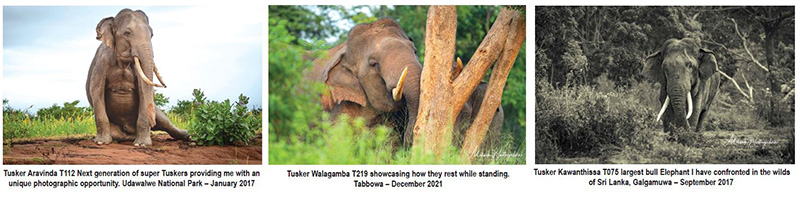
Though his formal education culminated in a Master’s degree in Business Administration from Cardiff Metropolitan University, his professional life gradually shifted toward Sri Lanka’s forests, grasslands, and coastal fringes.
From childhood, two species held his attention: the Sri Lankan leopard and the Asian elephant tusker. Both are icons. Both are elusive. And both, he argues, have been inadequately understood.
His response was methodical. Using high-resolution photography, Wattegedara began documenting individual animals, focusing on repeat sightings, behavioural traits, territorial ranges, and physical markers.
This effort formalised into two platforms—Yala Leopard Diary and Wild Tuskers of Sri Lanka—which function today as tightly moderated research communities rather than casual social media pages.
“My goal was never popularity,” he explains. “It was reliability. Every identification had to stand scrutiny.”
The results are difficult to dismiss. Through collaborative verification and long-term monitoring, his teams have identified over 200 individual leopards across Yala and Kumana National Parks and 280 tuskers across Sri Lanka.
Each animal—whether Jessica YF52 patrolling Mahaseelawa beach or Mahasen T037, the longest tusker bearer recorded in the wild—is catalogued with photographic evidence and movement history.
It was within this growing body of data that a critical inconsistency emerged.
“As injuries accumulated over time, we noticed subtle but consistent changes in rosette and spot patterns,” Wattegedara says. “This directly contradicted the assumption that these markings remain unchanged for life.”
That observation, later corroborated through structured analysis, had serious implications. If leopards were being identified using a limited set of spot references, population estimates risked duplication and inflation.
The findings led to the development of the Multipoint Leopard Identification Method, now internationally published, which uses multiple reference points rather than fixed pattern assumptions. “This wasn’t about academic debate,” Wattegedara notes. “It was about ensuring we weren’t miscounting an endangered species.”
The implications extend beyond Sri Lanka. Overestimated populations can lead to reduced protection, misplaced policy decisions, and weakened conservation urgency.
Yet much of this work has occurred outside formal state institutions.
“There’s a misconception that meaningful research only comes from official channels,” Wattegedara says. “But conservation gaps don’t wait for bureaucracy.”
That philosophy informed his role as co-founder of the Yala Leopard Centre, the world’s first facility dedicated solely to leopard education and identification. The Centre serves as a bridge between researchers, wildlife enthusiasts, and the general public, offering access to verified knowledge rather than speculation.
In a further step toward transparency, Artificial Intelligence has been introduced for automatic leopard identification, freely accessible via the Centre and the Yala Leopard Diary website. “Technology allows consistency,” he explains. “And consistency is everything in long-term studies.”
His work with tuskers mirrors the same precision. From Minneriya to Galgamuwa, Udawalawe to Kala Wewa, Wattegedara has documented generations of bull elephants—Arjuna T008, Kawanthissa T075, Aravinda T112—not merely as photographic subjects, but as individuals with lineage, temperament, and territory.
This depth of observation has also earned him recognition in wildlife photography, including top honours from the Photographic Society of Sri Lanka and accolades from Sanctuary Asia’s Call of the Wild. Still, he is quick to downplay awards.
“Photographs are only valuable if they contribute to understanding,” he says.
Today, Wattegedara’s co-authored identification guides on Yala leopards and Kala Wewa tuskers are increasingly referenced by researchers and field naturalists alike. His work challenges a long-standing divide between citizen science and formal research.
“Wildlife doesn’t care who publishes first,” he reflects. “It only responds to how accurately we observe it.”
In an era when Sri Lanka’s protected areas face mounting pressure—from tourism, infrastructure, and climate stress—the question of who counts wildlife, and how, has never been more urgent.
By insisting on precision, patience, and proof, Milinda Wattegedara has quietly reframed that conversation—one leopard, one tusker, and one verified photograph at a time.
By Ifham Nizam ✍️

This summary document is based on an exemplary webinar conducted by the Bandaranaike Academy for Leadership & Public Policy ((https://www.youtube.com/watch?v=TqZGjlaMC08). I participated in the session, which featured multiple speakers with exceptional knowledge and experience who discussed various aspects of incorporating artificial intelligence (AI) into the education system and other sectors.
There was strong consensus that this issue must be addressed early, before the nation becomes vulnerable to external actors seeking to exploit AI for their own advantage. Given her educational background, the Education Minister—and the Prime Minister—are likely to be fully aware of this need. This article is intended to support ongoing efforts in educational reform, including the introduction of AI education in schools for those institutions willing to adopt it.
Artificial intelligence is no longer a futuristic concept. Today, it processes vast amounts of global data and makes calculated decisions, often to the benefit of its creators. However, most users remain unaware of the information AI gathers or the extent of its influence on decision-making. Experts warn that without informed and responsible use, nations risk becoming increasingly vulnerable to external forces that may exploit AI.
The Need for Immediate Action
AI is evolving rapidly, leaving traditional educational models struggling to keep pace. By the time new curricula are finalised, they risk becoming outdated, leaving both students and teachers behind. Experts advocate immediate government-led initiatives, including pilot AI education programs in willing schools and nationwide teacher training.
“AI is already with us,” experts note. “We must ensure our nation is on this ‘AI bus’—unlike past technological revolutions, such as IT, microchips, and nanotechnology, which we were slow to embrace.”
Training Teachers and Students
Equipping teachers to introduce AI, at least at the secondary school level, is a crucial first step. AI can enhance creativity, summarise materials, generate lesson plans, provide personalised learning experiences, and even support administrative tasks. Our neighbouring country, India, has already begun this process.
Current data show that student use of AI far exceeds that of instructors—a gap that must be addressed to prevent misuse and educational malpractice. Specialists recommend piloting AI courses as electives, gathering feedback, and continuously refining the curriculum to prepare students for an AI-driven future.
Benefits of AI in Education
AI in schools offers numerous advantages:
· Fosters critical thinking, creativity, and problem-solving skills
· Enhances digital literacy and ethical awareness
· Bridges the digital divide by promoting equitable AI literacy
· Supports interdisciplinary learning in medicine, climate science, and linguistics
· Provides personalised feedback and learning experiences
· Assists students with disabilities through adaptive technologies like text-to-speech and visual recognition
AI can also automate administrative tasks, freeing teachers to focus on student engagement and social-emotional development—a key factor in academic success.
Risks and Challenges
Despite its potential, AI presents challenges:
· Data privacy concerns and misuse of personal information
· Over-reliance on technology, reducing teacher-student interactions
· Algorithmic biases affecting educational outcomes
· Increased opportunities for academic dishonesty if assessments rely on rote memorisation
Experts emphasise understanding these risks to ensure the responsible and ethical use of AI.
Global and Local Perspectives
In India, the Central Board of Secondary Education plans to introduce AI and computational thinking from Grades 3 to 12 by 2026. Sri Lanka faces a similar challenge. Many university students and academics already rely on AI, highlighting the urgent need for a structured yet rapidly evolving national curriculum that incorporates AI responsibly.
The Way Forward
Experts urge swift action:
· Launch pilot programs in select schools immediately.
· Provide teacher training and seed funding to participating educational institutions.
· Engage universities to develop short AI and innovation training programs.
“Waiting for others to lead risks leaving us behind,” experts warn. “It’s time to embrace AI thoughtfully, responsibly, and inclusively—ensuring the whole nation benefits from its opportunities.”
As AI reshapes our world, introducing it in schools is not merely an educational initiative—it is a national imperative.
BY Chula Goonasekera ✍️
on behalf of LEADS forum admin@srilankaleads.com

The Trump paradox is easily explained at one level. The US President unleashes American superpower and tariff power abroad with impunity and without contestation. But he cannot exercise unconstitutional executive power including tariff power without checks and challenges within America. No American President after World War II has exercised his authority overseas so brazenly and without any congressional referral as Donald Trump is getting accustomed to doing now. And no American President in history has benefited from a pliant Congress and an equally pliant Supreme Court as has Donald Trump in his second term as president.
Yet he is not having his way in his own country the way he is bullying around the world. People are out on the streets protesting against the wannabe king. This week’s killing of 37 year old Renee Good by immigration agents in Minneapolis has brought the City to its edge five years after the police killing of George Floyd. The lower courts are checking the president relentlessly in spite of the Supreme Court, if not in defiance of it. There are cracks in the Trump’s MAGA world, disillusioned by his neglect of the economy and his costly distractions overseas. His ratings are slowly but surely falling. And in an electoral harbinger, New York has elected as its new mayor, Zoran Mamdani – a wholesale antithesis of Donald Trump you can ever find.
Outside America it is a different picture. The world is too divided and too cautious to stand up to Trump as he recklessly dismantles the very world order that his predecessors have been assiduously imposing on the world for nearly a hundred years. A few recent events dramatically illustrate the Trump paradox – his constraints at home and his freewheeling abroad.
Restive America
Two days before Christmas, the US Supreme Court delivered a rare rebuke to the Trump Administration. After a host of rulings that favoured Trump by putting on hold, without full hearing, lower court strictures against the Administration, the Supreme Court by a 6-3 majority decided to leave in place a Federal Court ruling that barred Trump from deploying National Guard troops in Chicago. Trump quietly raised the white flag and before Christmas withdrew the federal troops he had controversially deployed in Chicago, Portland and Los Angeles – all large cities run by Democrats.
But three days after the New Year, Trump airlifted the might of the US Army to encircle Venezuela’s capital Caracas and spirit away the country’s President Nicolás Maduro, and his wife Celia Flores, all the way to New York to stand trial in an American Court. What is not permissible in any American City was carried out with absolute impunity in a foreign capital. It turns out the Administration has no plan for Venezuela after taking out Maduro, other than Trump’s cavalier assertion, “We’re going to run it, essentially.” Essentially, the Trump Administration has let Maduro’s regime without Maduro to run the country but with the US in total control of Venezuela’s oil.
Next on the brazen list is Greenland, and Secretary of State Marco Rubio who manipulated Maduro’s ouster is off to Copenhagen for discussions with the Danish government over the future of Greenland, a semi-autonomous part of Denmark. Military option is not off the table if a simple real estate purchase or a treaty arrangement were to prove infeasible or too complicated. That is the American position as it is now customarily announced from the White House podium by the Administration’s Press Secretary Karolyn Leavitt, a 28 year old Catholic woman from New Hampshire, who reportedly conducts a team prayer for divine help before appearing at the lectern to lecture.
After the Supreme Court ruling and the Venezuela adventure, the third US development relevant to my argument is the shooting and killing of a 37 year old white American woman by a US Immigration and Customs Enforcement (ICE) officer in Minneapolis, at 9:30 in the morning, Wednesday, January 7th. Immediately, the Administration went into pre-emptive attack mode calling the victim a “deranged leftist” and a “domestic terrorist,” and asserting that the ICE officer was acting in self-defense. That line and the description are contrary to what many people know of the victim, as well as what people saw and captured on their phones and cameras.
The victim, Renee Nicole Good, was a mother of three and a prize-winning poet who self-described herself a “poet, writer, wife and mom.” A newcomer to Minneapolis from Colorado, she was active in the community and was a designated “legal observer of Immigration and Customs Enforcement (ICE) activities,” to monitor interactions between ICE agents and civilian protesters that have become the norm in large immigrant cities in America. Renee Good was at the scene in her vehicle to observe ICE operations and community protesters.
In video postings that last a matter of nine seconds, two ICE officers are seen approaching Good’s vehicle and one of them trying to open her door; a bystander is heard screaming “No” as Good is seen trying to drive away; and a third ICE officer is seen standing in front of her moving vehicle, firing twice in the direction of the driver, moving to a side and firing a third time from the side. Good’s car is seen going out of control, careening and coming to a stop on a snowbank. Yet America is being bombarded with two irreconcilable narratives – one manufactured by Trump’s Administration and the other by those at the scene and everyone opposed to the regime.
It adds to the explosiveness of the situation that Good was shot and killed not far from where George Folyd was killed, also in Minneapolis, on 25th May, 2020, choked under the knee of a heartless policeman. And within 48 hours of Good’s killing, two Americans were shot and injured by two federal immigration agents, in Portland, Oregon, on the Westcoast. Trump’s attack on immigrants and the highhanded methods used by ICE agents have become the biggest flashpoint in the political opposition to the Trump presidency. People are organizing protests in places where ICE agents are apprehending immigrants because those who are being aggressively and violently apprehended have long been neighbours, colleagues, small business owners and students in their communities.
Deportation of illegal immigrants is not something that began under Trump. It has been going on in large numbers under all recent presidents including Obama and Biden. But it has never been so cruel and vicious as it is now under Trump. He has turned it into a television spectacle and hired large number of new ICE agents who are politically prejudiced and deployed them without proper training. They raid private homes and public buildings, including schools, looking for immigrants. When faced with protesters they get into clashes rather than deescalating the situation as professional police are trained to do. There is also the fear that the Administration may want to escalate confrontations with protesters to create a pretext for declaring martial law and disrupt the midterm congressional elections in November this year.
But the momentum that Trump was enjoying when he began his second term and started imposing his executive authority, has all but vanished and all within just one year in office. By the time this piece appears in print, the Supreme Court ruling on Trump’s tariffs (expected on Friday) may be out, and if as expected the ruling goes against Trump that will be a massive body blow to the Administration. Trump will of course use a negative court ruling as the reason for all the economic woes under his presidency, but by then even more Americans would have become tired of his perpetually recycled lies and boasts.
An Obliging World
To get back to my starting argument, it is in this increasingly hostile domestic backdrop that Trump has started looking abroad to assert his power without facing any resistance. And the world is obliging. The western leaders in Europe, Canada and Australia are like the three wise monkeys who will see no evil, hear no evil and speak no evil – of anything that Trump does or fails to do. Their biggest fear is about the Trump tariffs – that if they say anything critical of Trump he will magnify the tariffs against their exports to the US. That is an understandable concern and it would be interesting to see if anything will change if the US Supreme Court were to rule against Trump and reject his tariff powers.
Outside the West, and with the exception of China, there is no other country that can stand up to Trump’s bullying and erratic wielding of power. They are also not in a position to oppose Trump and face increased tariffs on their exports to the US. Putin is in his own space and appears to be assured that Trump will not hurt him for whatever reason – and there are many of them, real and speculative. The case of the Latin American countries is different as they are part of the Western Hemisphere, where Trump believes he is monarch of all he surveys.
After more than a hundred years of despising America, many communities, not just regimes, in the region seem to be warming up to Trump. The timing of Trump’s sequestering of Venezuela is coinciding with a rising right wing wave and regime change in the region. An October opinion poll showed 53% of Latin American respondents reacting positively to a then potential US intervention in Venezuela while only 18% of US respondents were in favour of intervention. While there were condemnations by Latin American left leaders, seven Latin American countries with right wing governments gave full throated support to Trump’s ouster of Maduro.
The reasons are not difficult to see. The spread of crime induced by the commerce of cocaine has become the number one concern for most Latin Americans. The socio-religious backdrop to this is the evangelisation of Christianity at the expense of the traditional Catholic Church throughout Latin America. And taking a leaf from Trump, Latin Americans have also embraced the bogey of immigration, mainly influenced by the influx of Venezuelans fleeing in large numbers to escape the horrors of the Maduro regime.
But the current changes in Latin America are not necessarily indicative of a durable ideological shift. The traditional left’s base in the subcontinent is still robust and the recent regime changes are perhaps more due to incumbency fatigue than shifts in political orientations. The left has been in power for the greater part of this century and has not been able to provide answers to the real questions that preoccupied the people – economic affordability, crime and cocaine. It has not been electorally smart for the left to ignore the basic questions of the people and focus on grand projects for the intelligentsia. Exhibit #1 is the grand constitutional project in Chile under outgoing President Gabriel Borich, but it is not the only one. More romantic than realistic, Boric’s project titillated liberal constitutionalists the world over, but was roundly rejected by Chileans.
More importantly, and sooner than later, Trump’s intervention in Venezuela and his intended takeover of the country’s oil business will produce lasting backlashes, once the initial right wing euphoria starts subsiding. Apart from the bully force of Trump’s personality, the mastermind behind the intervention in Venezuela and policy approach towards Latin America in general, is Secretary of State Marco Rubio, the former Cuban American Senator from Florida and the principal leader of the group of Cuban neocons in the US. His ultimate objective is said to be achieving regime change in Cuba – apparently a psychological settling of scores on behalf Cuban Americans who have been dead set against Castro’s Cuba after the overthrow of their beloved Batista.
Mr. Rubio is American born and his parents had left Cuba years before Fidel Castro displaced Fulgencio Batista, but the family stories he apparently grew up hearing in Florida have been a large part of his self-acknowledged political makeup. Even so, Secretary Rubio could never have foreseen a situation such as an externally uncontested Trump presidency in which he would be able to play an exceptionally influential role in shaping American policy for Latin America. But as the old Burns’ poem rhymes, “The best-laid plans of men and mice often go awry.”
by Rajan Philips ✍️

BCB’s integrity unit finds ‘credible suspicion’ during BPL

Devine’s 95 trumps Lee, Wolvaardt fifties in see-saw thriller

Fairly heavy showers about 75 mm are likely at some places in the Western, North-western and Sabaragamuwa provinces

President proposes; Speaker disposes

Sri Lanka loses Rs.7.5 bn due to coal tender irregularities: FSP

CID summons SJB MP for criticising education reforms

‘Dates have the highest sugar content to fight Coronavirus’

Sunday Island 27 December – Headlines

#SundayIsland 17th December – Headlines

Sunday Island – 28th March

Sunday Island Headlines – 21 March

Sunday Island – 21st February – Headlines
-
 News1 day ago
Sajith: Ashoka Chakra replaces Dharmachakra in Buddhism textbook
-

 Business1 day ago
Dialog and UnionPay International Join Forces to Elevate Sri Lanka’s Digital Payment Landscape
-

 Features1 day ago
The Paradox of Trump Power: Contested Authoritarian at Home, Uncontested Bully Abroad
-

 News6 days ago
Interception of SL fishing craft by Seychelles: Trawler owners demand international investigation
-

 Features1 day ago
Subject:Whatever happened to (my) three million dollars?
-
 News6 days ago
Broad support emerges for Faiszer’s sweeping proposals on long- delayed divorce and personal law reforms
-

 News23 hours ago
Level I landslide early warnings issued to the Districts of Badulla, Kandy, Matale and Nuwara-Eliya extended
-

 News1 day ago
65 withdrawn cases re-filed by Govt, PM tells Parliament