
Features
Sohan Weerasinghe Award-winning, Ever-green Musician


PLACES, PEOPLE & PASSIONS (3Ps)
Part 8
Dr. Chandana () Jayawardena DPhil
President – Chandi J. Associates Inc. Consulting, Canada
chandij@sympatico.ca
Profile
Sohan is a popular singer, entertainer, band leader, song composer, lyrics writer, and showbiz personality. He is an attorney at law but decided to make a career in the entertainment industry. After winning the Observer Talent contest in the mid-seventies, he formed his own band – Sohan & The X’Periments. Sohan did a five-year stint with his band at the Hotel Muscat InterContinental in Oman. His first English original composition – “Whispers in the sand” won the song of the year award at the 1993 Island Music awards. Today, Sohan is one of the most sought-after Sri Lankan singers for performances around the world.
First Meeting in 1972
When I was a first-year student at Ceylon Hotel School in 1972, the idea of celebrating the graduation of the third-year diploma students came up during a booze party at our hostel. We organized Graduation Ball 1972 at the Samudra Hotel with one of the most popular dance bands in Sri Lanka at that time – Gabo & the Breakaways.
That was the first time I met Sohan Weerasinghe, their lead singer. He was friendly and fully focused on entertaining the audience, most of whom were in their late teens and early twenties. With a charming smile, he accommodated a few songs requested by the Australian teenage girl who was my dance partner.
Making Colombo 2000 the # 1 Night Club
When I joined Le Galadari Meridien Hotel in 1986, as the Director of Food & Beverage, I was responsible for hiring musicians and signing their contracts. Just before I joined this five-star 500 room hotel, Sohan had negotiated a good contract with my French predecessor. Sohan & The X’Periments with Estelle performed three days a week at what was then the trendiest night club in Sri Lanka – Le Meridien’s Colombo 2000.
One day I had a business chat with Sohan to renegotiate the contract with a revenue-based payment per night. After a long negotiation, Sohan eventually accepted my proposal. Sohan was shrewd, diplomatic, intelligent, and funny. He also had a good business sense and practical ideas. We quickly became good friends. After that I felt that I should meet all hotel entertainers under contract at the hotel for a brainstorming session, which was productive with some great ideas for the year 1987.
Most of the night clubs in Sri Lanka at that time had a limited operation of three or four nights, focusing on the weekend business. We took a chance on making Colombo 2000 a seven-day operation with live bands every day and opening at the same time (9:30 pm). We used ‘the seven-day’ operation as the unique selling proposition in our ad campaigns.
We found it useful to check night club themes and special effects in Asian countries more advanced than Sri Lanka, such as Singapore (which was around two years ahead of nightclub trends in Sri Lanka). I did a couple of trips to Singapore and Thailand with Sohan to check night club trends. Our two wives joined us on these trips, mainly to keep a close eye on us! We also played lot of 304 card games during our trips. The ladies were annoyed to lose every time and accused Sohan and I of cheating. They never found out how!
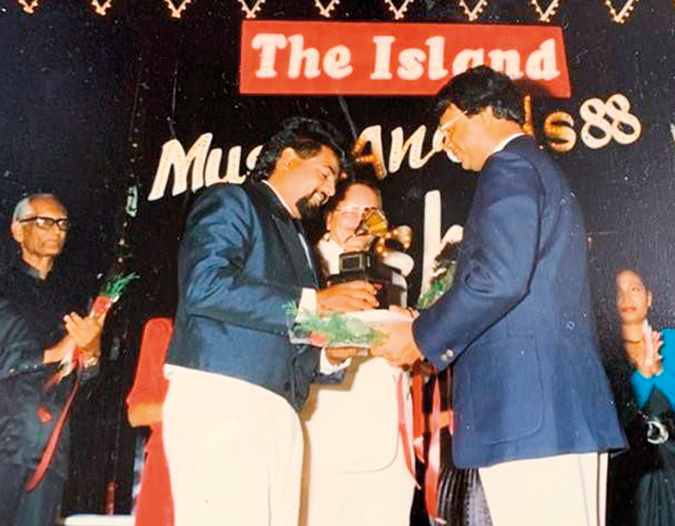
One of the many awards won by Sohan.
Late 1980s were the heyday of the nightclub business in Colombo, and with the support of Sohan and many other leading musicians, my team at Le Meridien made Colombo 2000 the king of nightclubs in Sri Lanka from 1986 for a long time… Thank you Sohan!
Hospitality and Showbiz
I gradually concluded that hospitality and showbusiness which go hand in hand and have many similarities, are really one industry focusing on entertaining customers, while making profits. Entertainment was an essential element of our total food and beverage operation. Usually, in the evening, we had live music in three locations of the hotel. I learnt to treat entertainers as very important members of the hotel family. That orientation proved to be mutually beneficial.
Le Galadari Meridien provided me an opportunity to develop a new hobby, as part of my work. I gradually learnt a lot from Sohan and other hotel entertainers and I became a busy showbiz producer. I regularly used images of Sohan and other leading entertainers to promote events, such as New Year’s Eve dinner dances, which eventually established new records in Sri Lanka.
Mastering Show Biz Productions
During a brainstorming session with musicians, after explaining my objective of improving the ballroom occupancy during the slow months, I encouraged the musicians to suggest solutions. They came with a few great ideas and we decided to organize a series of weekly shows under the theme ‘Musical Stars of 1986’ in the ballroom. A key aim was to promote young musicians who had performed in western bands around the country during the year. All musicians under contract at Le Meridien contributed on an honorary basis as judges for these new, weekly contests and as performers for the gala final show.
I learned to produce music shows with 1,000+ audiences with help from Sohan and other musicians under contract at Le Galadari Meridien. The first three shows I produced in 1987: ‘Musical Stars of 1986’, ‘A Farewell to Priyanthi & Raja’ and ‘Noeline… a Celebration’, all were very successful in terms of production, audience satisfaction, ticket sales, profits, reviews, and publicity. I eventually produced a total of 16 stage music shows, with Sohan as a key member of my team, who provided sound, backing music to all singers and also performing as a leading vocalist.
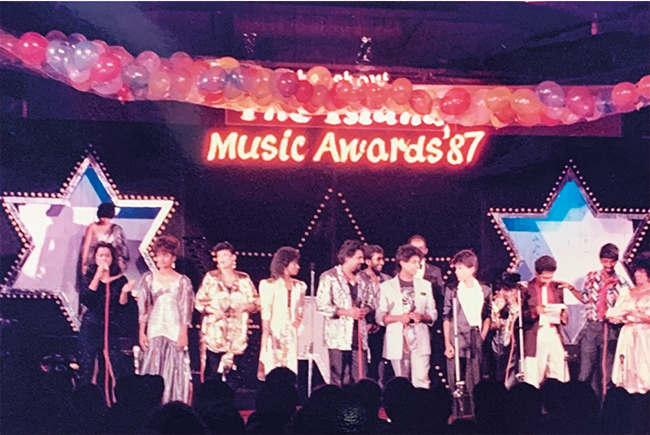
Sohan and other performers at the finale of The Island Music Awards show in 1988.
More Creative Collaborations with Sohan
A Mega Festival in Oman – 1988
The experiences I gained in showbiz productions in Sri Lanka were memorable and useful in the next phase of my career as an expatriate hotelier. I was invited by Oman Sheraton to coordinate and lead the food and entertainment aspects of a mega Sri Lankan festival which included a versatile team of 54 Lankans flown to Oman. Sohan once again was my right-hand man in this initiative. During this trip in 1988, I became more interested and knowledgeable about fashion shows, and the concept of the first-ever ‘Fashion Model of the Year’ competition in Sri Lanka was born
After a short break from Sri Lanka, to work in the Middle East and the United Kingdom, I returned to Sri Lanka by the early 1990s for three years to work as the General Manager of Mount Lavinia Hotel. Although Sohan was not under contract to perform there, he collaborated with me in producing some more stage productions. Sohan always was a great team player.
‘Whispers in the Sand’ – 1991
One day I received a call from Sohan with an unusual request: “Mr. J, Just now I recorded a new English song with the band at my studio. I have themed it: ‘Whispers in the Sand’. If I send you the rough mix, can you kindly give me your comments?” I was surprised with that request. “Sohan, as you know, I am not a singer and have no musical talents. I am not qualified to give you any advice!”, but he sent me the rough mix anyway.
Soon after I listened to it a couple of times, Sohan called me to check what I felt about his composition. “Sohan, congratulations! ‘Whispers in the Sand’ is easily the most beautiful English song recorded in Sri Lanka. You should make a beautiful four and half minute video for it. If you are looking for a director and producer for it, I would love to give it a try.” Sohan immediately agreed to give me 100% free hand with the creation of the video.
Overnight I learnt to create a detailed storyboard for the video. I also consulted movie makers I knew from my acting days. Willie Blake, an award-winning cinematographer, movie director and my friend, was on a holiday in Sri Lanka and was staying at Mount Lavinia hotel at that time. He advice on camera angles and shooting were particularly helpful for me in planning the production. Mount Lavinia hotel was the location and sponsor of the production. ITN network provided the technical support and an excellent crew. We spent a whole day for the shoot and a full night in the editing rooms of ITN to create a video which was nominated for the Best Music Video of the Year award.
‘Fleeting Moments’ – 1992
During the night I spent with Sohan and the editing team at ITN, I learnt about song composing. I was surprised that Sohan created the tune for ‘Whispers in the Sand’ first, then wrote the lyrics, and finally allowed me to write a story for the video. I felt that the better process should be in the reverse: story – lyrics – music. Following that conceptual process, I created my first song composition that night, based on a personal experience I had at Bentota Beach Hotel in 1974.
Sohan did the arrangement for ‘Fleeting Moments’ and sang it. I wrote the story board and directed the video at Mount Lavinia Hotel during the 1992 New Year’s Eve dinner dance at the Empire Ballroom. It was an instant hit on the charts and motivated me to compose lyrics for more songs.
‘The Show’ – 1992
Having produced, annually, The Island Music Awards shows on three occasions, I did my largest show in Sri Lanka in 1992. It was The Island Music Awards 1991, staged at the largest hall in Sri Lanka – BMICH National Convention Centre. At that time, I was also the General Manager of Mount Lavinia Hotel Catering Services at BMICH. This was my last major production before I left Sri Lanka for good, and I was keen to do something spectacular and memorable. We called it ‘The Show.’
On that occasion, I came with my vision for the show and then requested input from the musicians in the organizing team. It worked well. I accepted most of their suggestions and fine-tuned the concept. With that, we were able to take this show to a much higher level, in terms of production, than all the previous shows that I had produced in Sri Lanka.
In addition to employees of the hotel and BMICH, our production team for that show consisted of 153 professionals: musicians, dancers, choreographers, set designers, sound engineers, lighting engineers, special effects professionals, make-up artists, photographers, video recorders and my favourite stage manager – Kenneth Honter.
We added two new features to this show – a complete dress rehearsal the day before the show, and the show video launched on TV a week after the show. We commenced the show exactly at 7:00 pm with a full attendance of 1,506.
As written on my concept document and the detailed production plan, we had two segments with contrasting sub-themes. For each segment, we used contrasting music, choreographed dance acts, special effects, lighting, and sound. It had two major ‘ambitious’ set changes with unprecedented special effects, to enhance the two segments of the show.
‘Nature’ – 1992
The first half of ‘The Show’ was themed: ‘Nature’ with waterfalls, large trees, mist and 34 little ballerinas performing as butterflies, birds, blossoming flowers in a rainforest waking up early in the morning. A gentle ray of the morning sun gradually made the lead singer of the first song (Noeline) visible to the audience. It was slow moving and misty, using greens and blues in the backdrops with subtle lighting. It was a gentle and happy celebration of our beautiful nature.
‘Future’ – 1992
The second half was themed ‘Future’ depicting humankind advancing with science and flying rockets, but destroying our planet with short sighted policies, human greed, unwanted wars, and disruptions. It was fast moving, with sounds of explosions and smoke, using red and orange in the backdrops with flashing lighting. In one scene a rocket landed on the stage, militants came out of the rocket and took a performing singer (Sohan) as a prisoner before flying away from the BMICH stage. It was a warning that we are selfishly destroying our planet.
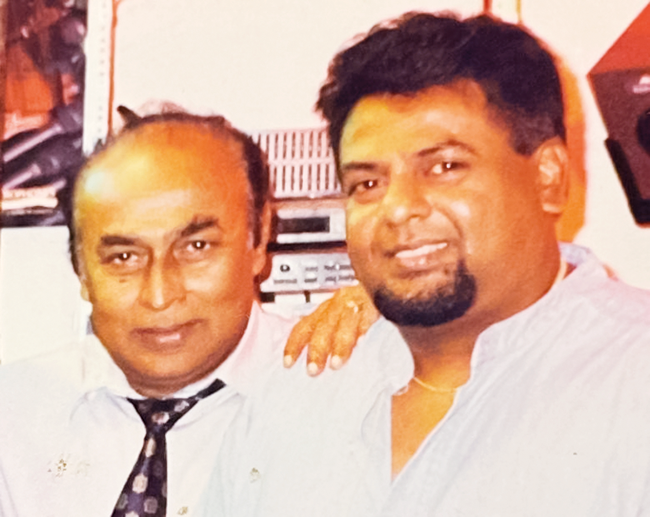
Sohan, after recording the song ‘Dream Woman’ composed by Gamini Fonseka in 1998.
With Noeline and Sohan, I co-wrote two new songs aligned with the two segment themes of the show (they did most of the work!). The song, ‘Nature’ dominated the top of the pop charts in Sri Lanka for several weeks, and a year later, Noeline and I jointly won The Island Music Award for the ‘Composer of the Year.’
‘Am I guilty?’ – 1993
My next song was the most popular. I followed my process of ‘story – lyrics – music’ and Sohan became my co-composer and did the arrangements. I chose Dalrene Suby for vocals with Sohan for supporting vocals. We filmed the music video at the Colombo Airport and Airport Garden Hotel. “Am I guilty?” dominated the pop charts for eight weeks at the most popular English song in Sri Lanka. Concurrently I composed another song titled ‘Faithful’ which was arranged by Chandralal Fonseka, who also did vocals with Crystal Williams. I did not make a video for it.
‘Fitness Fever’ – 1993
My sixth and the last song composition was ‘Fitness Fever’. With 20 top Sri Lankan western musicians providing vocals and 16 semi-professional actors appearing in the video, it was my most ambitious song and music video undertaking. We filmed it over a day at the Ramada Renaissance Hotel. It dominated the pop charts for three weeks as the most popular English song in Sri Lanka. Later I produced a cassette with the same name and included four of the songs I was involved in creating. All the participating singers, actors and technicians worked free of charge and we donated all proceeds to Ranvirusevana (fund to rehabilitate soldiers wounded in the civil war). We held a grand launch of the cassette at the Little Hut night club of Mount Lavinia Hotel.
Re-connecting in 2023
After meeting Sohan in January 2020 on the day he paid last respects to his dear wife, Lali, we did not see each other for three years mainly due to the global pandemic. I was happy to re-connect with Sohan in Colombo in 2023, when he sang at my elder son Marlon’s wedding. In the groom’s speech, Sohan’s family was identified as Marlon’s extended family.
Recently, for the first time in my life I sang. I recorded five video covers of old popular Sinhala songs and posted those on social media over five weeks. I was happy to receive thousands of positive reactions but did not see any comments from my friend Sohan. Finally, I heard from him. “Chandi I was not impressed at all! Singing in not your forte. Don’t believe these people who just praise your singing. Your sense of rhythm was bad and your pitching was way out. Please stick to many other things you are extremely good at. This is from the heart of a genuine friend.”
“That’s what friends are for…” I never sang again.
Questions & Answers
Q: Out of all the places you have visited in Sri Lanka and overseas, what is your favourite and most interesting place?
A: My favourite place is Australia. There are so many Lankans who have migrated to Australia, but they still have a special place in their hearts for Sri Lanka. Whenever I perform there, I do get a very warm reception and tremendous crowd support especially in Melbourne. Most musicians will agree with me that Australia is the place for us!
Q: Out of all the inspiring people you have met, who inspired you most to do well in the entertainment industry?
A: I have been inspired by many including Elvis, Humperdinck, Tom Jones, the Beatles, and Bee Gees. In the local music scene by people like Desmond De Silva, Raj Seneviratne, Mignonne Fernando, Dalrene Suby, Victor Ratnayake, Pandith Amaradeva, and Clarence Wijewardena.
Q: At the present time, apart from music, what is your key passion in life?
A: I love spending a lot of time with my only granddaughter Sienna who means the world to me. I also keep in touch with my son Darshan (fitness trainer) and my daughter Erandika who lives and works in New York. I am also an avid filmgoer and love going out for movies.
Q: After dreaming of practising as an attorney, what made you change your mind about a career in music?
A:Music was my passion, as I come from a very musical family. Although I passed out from Law College with first class honours, when I had to decide between law and music, I opted to make music my full-time career. I have no regrets. I have met so many interesting people and loved doing overseas tours entertaining friends and fans abroad.
Q: You also worked for few years as the General Manager of Finco Group of Companies. At that time, how did you balance your work, hobbies, and family?
A:Yes, it was tough, as I had to spend time with my family, with my band the “X’Periments” and try to pursue my career as a legal officer. The best thing I did was to quit my office job and then concentrate on my music and my family and try to balance it out. Initially it was difficult but eventually it turned out OK.
Q: Before forming Sohan & The X’Periments, what key lessons did you learn from bands you served as the lead singer?
A:I worked with the Moonstones with Annesley Malewana, with Esquire set with Ralph Menezies and with Gabo & the Breakaways with Priyanthi. I realized you had to put in a lot of effort to get to the top. Learn a nice repertoire of songs that were catchy and current at the time. Desist from drinking and smoking and breaking too much rest. Also, I learnt a lot about being a good band leader from both Annesley Malewana and Gabo Pieries.
Q: How successful was your first English original – ‘Whispers in the Sand’ in terms of popularity?
A: ‘Whispers in the Sand’ was an amazing hit for me. It ended up getting the award for the song of the year and was the most popular song in the top of the pops list for a few weeks based on votes to the ‘Teen Page’ of The Island newspaper. Thanks to Chandana Jayawardena who was the General Manager of Mount Lavinia hotel and the ITN network I was able to put out a nice video of the song with Brian Kerkoven and Shani J, playing the lead roles in the music video. That was nominated for the 1992 Best Music Video of the Year award by Sunday Observer newspaper.
Q: Out of many awards you have won during your long career in music, which single award made you most proud ?
A: Yes, I have won many awards during my musical journey but the award I liked most was winning the ‘Showbiz personality of the Year’ at The Island Music Awards show at the BMICH, produced by Chandana Jayawardena of Mount Lavinia Hotel.
Q: You are certainly an ever-green musician, who continues to grow in popularity among Sri Lankans in many countries, resulting in a hectic global travel schedule. What is your secret of success?
A: I have made it a point to “read” the crowd and have constant eye contact with my audience. Do the songs they like and not do advanced stuff just to show them one’s high class. Bringing in humour wherever possible helps you to get the audience on your side. Also being simple, flexible, and down to earth has helped my career immensely.
Q: What is your advice to aspiring young western musicians?
A: My message to young musicians is simple – There is no short cut to success. Hard work pays off in the end. If you choose music as your career, make sure you have the “passion” for it. You also need an element of luck. There will be many ups and downs in your career, but you have to put it aside and have a positive attitude. At least have one or two originals to your credit so that you have your own identity. Be focused and give it your 100 percent and eventually you will succeed. Most importantly, try to get on with your fellow musicians and treat them with a bit of love, respect and understanding.
Next week, 3Ps will feature a doctor turned award-winning portrait artist.


The world’s oldest constitutional democracy turned 250 on the Fourth of July, two weeks ago. It is a rather quirky coincidence that in the 250th year of its largely successful existence, America should be having as its president the most unfitting person in history, and that in keeping with the American trait for mixing serious purposes with fun and play, it should also be hosting perhaps the largest edition of the World Cup Football Tournament. The triple coincidence – the anniversary, Trump presidency and the World Cup – is not without some meaning.
The essence of the Trump presidency has been to recast America in the mould of Trump’s own vulgar and outlandish presuppositions about who belongs in America and what the rest of the world owes to America. Internal exclusions and external isolation have always been a part of American history, but Trump’s project has been to make them America’s sole and permanent purpose. Make America great again by making it more intolerant and more imperfect, as opposed to pursuing the country’s founding purpose of striving towards a “more perfect union.”
Trump is also giving a new meaning to America’s exceptional isolationism by slashing immigration, deporting American residents whom he and his Maga cabal don’t like for the vilest of reasons, withdrawing from global agencies that America created and closing down American agencies providing global services, imposing tariffs on every country and deeming them as payment for America’s past generosity under weak presidents, and threatening neighbours with annexation while militarily attacking others.

2007: Lionel Messi holding baby Lamine Yamal
He got his nose bloodied after listening to Netanyahu and starting a fight with Iran, made a fool of himself by first announcing that he will provide safe passage to ships through the Strait of Hormuz and charge them 20% of their cargo value, and immediately withdrawing it after being told that it was a lamebrained and impractical idea. The Iranian Foreign Minister tweeted that it is a good approach but 20% is too high! The reality is that Iran has effectively closed the strait again, after Trump said his ceasefire with Iran is over, and there is nothing the might of America can do about it – thanks solely to Trump.
The world, not to mention America, are back to where it was soon after February 28. And Trump is back to February 28, with more attacks on Iran while telling Israel to keep out of it and hoping that Iran will soon come to the table. The Iranian regime is insisting that it is Trump and not Iran who will have to blink first again. For the rest of the world and the people of America, fuel and fertilizer prices are again rising along with the prices of goods and services that depend on them.
Meanwhile, the Fourth of July marking America’s 250th Anniversary of American independence has come and gone. Every year, Americans cheer and celebrate the Fourth of July as a civic festival in their local communities. Families take their children to Washington, Philadelphia, Gettysburg and other historical sites to learn and appreciate their history. The state hardly gets involved and there are no military parades or flights of fighter jets. Trump changed it last year by holding a military parade in Washington but it did not excite anyone. The army had to go to extraordinary lengths to protect the city roads from cracking up while parading its massive tanks. This year Trump’s efforts to turn the 250th anniversary celebration into a personal vanity affair spectacularly backfired and what was becoming a national damp squib. Not so ironically, it was rescued by the 2026 World Cup tournament that began on Thursday, June 11 and will end on Sunday, July 19.
World Cup Down to the Wire
The 23rd FIFA World Cup hosted by America, Mexico and Canada with matches played in 16 cities – 11 in the US, three in Mexico and two in Canada – became a significant occasion for the US. It provided an antidote to Trump’s vain and unsuccessful usurpation of the country’s 250th anniversary, even as it became an occasion to show the world that there is still much more likeable about America in spite of all the ugly MAGA makeover that Trump has been giving it from the White House.
What is unique about America is that it is the first and the only immigrant country to become a superpower in world history. An open door country with a melting pot ethos, America has consistently struggled at every stage of its evolution to defy the homogeneity of the privileged, and to celebrate across-the-board heterogeneity in every aspect of the human condition. If the purpose of Trump’s presidency has been to break this arc of American history, the World Cup became an occasion to demonstrate that the arc will continue in spite of Trump.
The World Cup was an eye opener to both resident Americans and visiting football worshippers. Except for the Olympics sporting events, competitive sports in America are dominated by (American) Football, Baseball, Basketball and (Ice) Hockey, and the competitions are all limited to American teams along with some Canadian teams especially in Hockey. The extent of any international connection is limited to allowing players from Central America and Japan for Baseball, and from Canada and Eastern Europe for Hockey. In other words, American notions of exclusivity and self-sufficiency seamlessly extend to the world of sports from the universe of politics and economics.
The arrival of the World Cup, 32 years after America hosted its first and only World Cup in 1994, was an eye opener to American sports fans and the general public. This was international sports at their doorstep and an occasion to live through the experience of witnessing the world’s best exponents of the game fiercely displaying their talents in friendly competitions. The visiting fans who thronged the games brought life and diversity and retail spin offs to the cities where the games were played. The visitors to a person, both players and fans, were enthralled by the magnificence of America’s sporting facilities and the range of amusement and entertainment the host cities offered.
The tournament also became a smorgasbord of different nationalisms from around the world but manifesting pride and passion in support of national football teams and not boastful belligerence about national militaries. The teams were also more equal on the pitch than their governments are at the UN podium. The better teams of the day won in the end but every team made each game as competitive as it could. Small countries from West Asia, Africa and little Atlantic islands went boot-to-boot with European and South American giants and kept everyone guessing until the final whistle. The really big Asian countries – China, India, Indonesia etc. – could not qualify for admission, while Asia’s two industrial giants – Japan and South Korea – acquitted themselves well even though they were unlucky not to go beyond the group stage.
The team that America fielded should not have been allowed to represent the country based on Trump’s executive negation of all DEI (Diversity, Equity and Inclusion) programs in government and in federal hiring. But it did and the US team would have made the 1960s promoters of cross-racial ‘rainbow’ alliances proud. Similar rainbow teams have become the norm of almost all West European countries and England.
Players of colour have become superstars in western football teams and have quite clearly internalized natal nationalism as opposed to being assimilated by them. They are all descendants of birthright citizens of the old empires, a legal tradition that is more universal and anterior to the abolition of slavery and the 14th Amendment in the US, as Chief Justice John Roberts reminded the Trump Administration in overturning its executive order to end the recognition of birthright citizenship in America. A practice that is shared by three dozen countries.
The US Team at the World Cup began as a promising outfit playing with flair and freewheeling style and could have gone as far as the Quarter Finals to play Spain. The team was undone prematurely by Trump’s sleazy intervention with FIFA bosses to suspend the Red Card penalty ban of a US player, Folarin Balogun, for a foul he had committed in an earlier match. Trump’s role and the penalty suspension created a public uproar and in the upshot an inspired Belgium trounced the US whose players performed very poorly perhaps under the weight of the embarrassment that their President had inflicted on them.
The World Cup tournament itself is now down to the final match, the 104th of the tournament, on Sunday, July 19th, between the reigning World Cup champions, Argentina, and Spain, the current Euro Cup holders. The match for the Third Place will be played on Saturday (July 18), between France who lost 0-2 to Spain in a surprisingly one-sided game, and England who went down in a heartbreaking 1-2 defeat to Argentina after leading 1-0 up till five minutes before the final whistle.
The French were the tournament’s cracking team till they came up against Spain who had been belabouring until then. The English team had bestirred all of England back home with their gritty win against Mexico in its national stadium full of 85,000 spectators, but once again came up short in the penultimate game.
The final between Argentina and Spain will feature the 39 year old Argentinian maestro, Lionel Messi, looking to win his second World Cup, and the 19 year old Spanish prodigy, Lamine Yamal. The football internet is abuzz with a 2007 photograph showing then 20 year old Messi carrying Yamal as an infant during a photo session in Barcelona, Spain, where Messi played club football. On Sunday, in New York/New Jersey, they will face each other in a spirited encounter for the biggest prize in sports.
by Rajan Philips
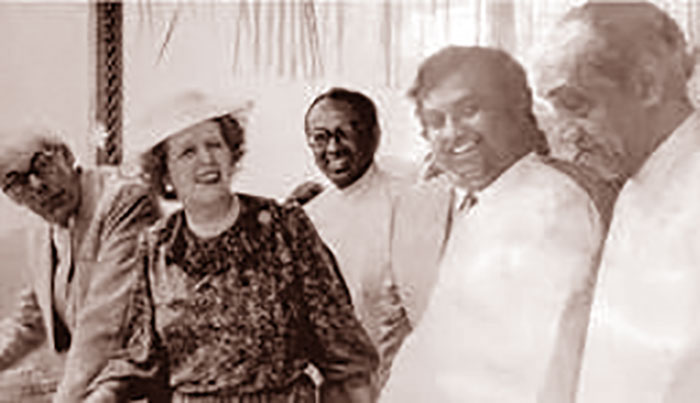
These two excerpts from the forthcoming book, To Survive As One Nation, One People by Air Chief Marshal Oliver Ranasinghe. A Retired Commander of the Sri Lanka Airforce makes interesting reading. The first is of a sudden demand on the SLAF for emergency air support for the besieged Jaffna Fort when the only available helicopters were being prepared for a VVIP flight for UK PM Margaret Thatcher and her husband, Mark.
The second deals with ferying PM Rajiv Gandhi and his wife Sonia to Katunayake after a naval rating had hit Gandhi with a rifle butt.
In April 1985, the UK’s first female prime minister visited Sri Lanka to ceremonially declare open the Victoria Dam and Power Station built with aid under the patronage of Queen Elizabeth II. The completion of the project was a significant milestone for the Accelerated Mahaweli Development Programme, with the power station having an installed capacity of 210 MW. Two helicopters were stationed at Air Force Headquarters premises to fly the VVIPs at 6:30 a.m. on 12 April to Victoria Dam. I was Commanding Officer of the Helicopter Wing and assigned to fly Prime Minister Margaret Thatcher and her husband.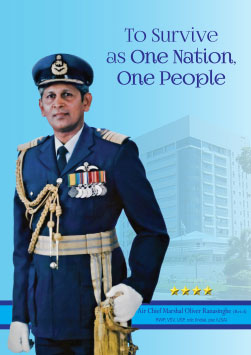
However, at around noon on the day before the flight, I got a desperate call from the Joint Operations Command (JOC) requesting that 250 troops be airlifted to the Jaffna Fort immediately, since “hot intelligence” had informed that the enemy had planned to attack the fort that night.
I did not have any helis in the Wing as all had been deployed throughout the North and East. The only other two serviceable helis were in the VVIP security cordon, standing by to fly Prime Minister Thatcher and the other VVIPs the next morning. According to VVIP flying procedures, the helis are kept for 48 hours before the flight within a security cordon which is well-guarded by guards and air dogs. No one is allowed to go witin the security cordon without the Commanding Officer’s approval.
I had to take a quick decision about whether to drop the troops using the two helis from the cordon and run the risk of having no heli to fly Prime Minister Thatcher the next morning. The alternative was to say “No,” to the Army and take the risk of losing hundreds of soldiers at the front, facing a humiliating defeat, loss of prestige, morale and losing the Jaffna Fort, which was the Army’s pride.
If the latter happened, our conscience would be inconsolable even today. When we were fighting the battle, we were one unit: Army, Navy, Air Force and Police. The Air Force was always there. We never said no. So, I took the decision to fly immediately to Jaffna to carry out the task using the two VVIP helis. I was taking a huge risk, jeopardizing my career in the Air Force, by disregarding the standing orders and removing the two helis from the VVIP cordon.
By 1:00 p.m., we took off from Katunayake for Jaffna, using the two VVIP helis without Air Force Headquarters approval. I was captaining one heli with Flight Lieutenant Lasantha Waidyaratne as my co-pilot. (He was the pilot who, a long time later on, landed a heli at Jaffna Fort in the impossible task code-named Operation Eagle.) Flight Lieutenant Tennyson Gunawardena was flying the other heli as captain. I had to fly as we did not have any pilots to spare.
From the Palaly airport, we flew with twenty-two passengers without seats, keeping within the maximum all-up weight, and headed into the Jaffna Fort, approaching with the wind and not headwind as usual, avoiding enemy guns.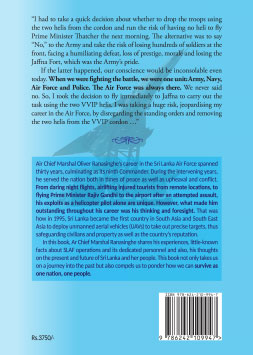
By 5:30 p.m., Tennyson called me on the receiver transmitter unit and said, “Sir, it is raining heavily in Katunayake, and we have to go in bad weather in the night back to Katunayake. So can I leave now?” I said, “Okay,” and ensured the heli was made ready for the VVIP the next morning. In the meantime, I kept flying the balance troops.
I did not get down at all from the heli and refuelling, too, was done whilst I was sitting in the pilot’s seat. The Brigadier-in-Charge in Jaffna came up to the heli very late in the evening and told me that, if I couldn’t drop all troops that night, to do the balance first thing in the morning. I said, “No, I will drop all tonight as I have to fly back to Katunayake for a very important task.”
We dropped all 250 troops into the Jaffna Fort and, after refuelling at Palaly, left at around 10:00 p.m. to fly back to Katunayake. However, we got caught to heavy rain on the stretch from North of Mannar to Katunayake. The weather was so bad that we had to request radar assistance to steer to Katunayake. However, I decided to disregard radar advice and told my co-pilot to follow the coastline, just to be clear of obstacles such as high-tension wires. Helicopters do not fly in rainy weather, let alone bad weather, and definitely not at night, but we had no choice.
Lasantha, my co-pilot, swears that he has not done a bad weather flight of that nature, either before or since, in his flying career. In fact, he says that he matured as a pilot during the last hours of that flight!
At around midnight, we landed at Katunayake where the crew was ready to take the heli and clean it to VVIP standard, which they did throughout the night. I was relieved and happy that I could return to Katunayake the same night.
The next morning, we positioned the two helis by 6:30 a.m. at Air Force Headquarters premises to fly the VVIP. Prime Minister Margaret Thatcher and her husband, Mr.Denis Thatcher, had a safe and comfortable flight to Victoria and back. In fact, Mrs.Thatcher was fast asleep when we touched down in Colombo!
As the Commanding Officer of the No.4 Helicopter Squadron, I risked my life and career because I did not want the Jaffna Fort to fall into the enemy’s hands and lose Army lives. Also, I did not want to let down the VVIP and spoil the image of the Sri Lanka Air Force. If anything had gone wrong, obviously I would have been “thrown” in the sea. I believe such life and death situations reveal the inborn/emerging leadership potential of individuals.
This excerpt deals with flying Prime Minister Rajiv Gandhi and his wife, Sonia, to Katunayake after a naval rating on ab honour guard struck Gandhi with rifle butt.
In July 1987, I was out of the Helicopter Squadron and serving as Base Commander—Anuradhapura. The Commander of the Air Force called me one day and asked me whether I was still current on helis, and I said, “Yes.” He said, “I am sending a Bell 214 for you to do some flying training.” The next day, the heli arrived at Anuradhapura, and I got back into swing doing some flying training.
After two days, I was told to come to Katunayake to do a flight. I was told that I had to fly the visiting Indian Prime Minister, Rajiv Gandhi, from the Bandaranaike International Airport (BIA) to Galle Face and back. He was coming to sign the much-talked about “peace accord.” The Indian Prime Minister arrived at the BIA, and he was ferried to the Galle Face green, from where he was taken in a motorcade to President’s House to sign the Indo-Lanka Peace Accord.
Without taking much time, the motorcade returned to the Galle Face green. There was no panic. Rajiv Gandhi was smiling, but Sonia Gandhi helped Rajiv get in first, to the inner seat of the helicopter, and Sonia sat next to the window. If not for that, everything was normal.
I started up, switched on the VHF radio and contacted the Air Force Operations Room for take-off clearance. They told me that at the Navy’s Guard of Honour parade, there had been an incident targeting Rajiv Gandhi. That played havoc in my mind. I had to think that whoever planned and failed would have a “plan B,” and that would be to target the helicopter. Then I realized that, if so, both Rajiv Gandhi’s life and mine would be destroyed by “plan B.” That was my thinking. I had to save this VVIP, our state visitor. To do that, I had to make decisions on my own.
There was no one to tell me what to do. So, I took off in the most unexpected direction and avoided the usual route and followed a different route to BIA, whilst all the time being alert. Coming over BIA, I disregarded the usual approach procedure to the surprise of the Air Traffic Controllers and approached from the wrong direction and landed, but not in the designated landing place, to avoid a possible sniper or RPG attack.
The VVIP got off and walked away to the awaiting Indian Air Force aircraft. That relieved me of the tension of delivering the “precious cargo” in one piece.
(The book is distributed by the Vijitha Yapa Bookshop)
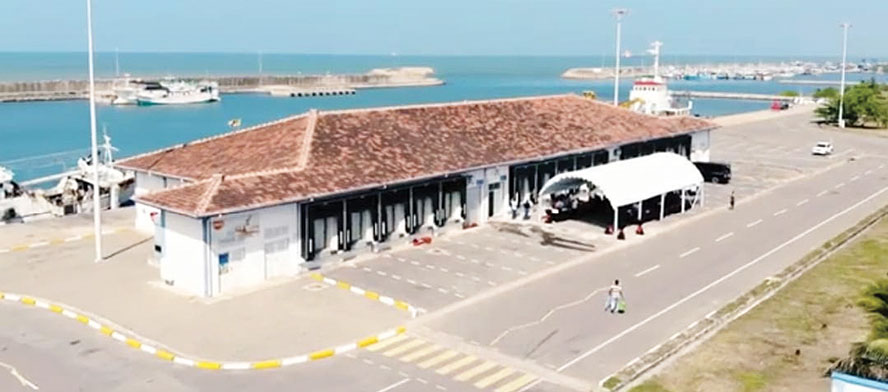
Spanish Israeli entrepreneur Simon Max Astandoust, a fourth-generation member of the renowned Astan fishing family, has endured years of legal battles, business setbacks and the loss of millions of dollars after investing in Sri Lanka’s fishing industry. Yet, despite the challenges, he has chosen to stay and rebuild.
In an interview with the Sunday Island, the founder and CEO of Seamax Ceylon (Pvt) Ltd speaks about his struggle, the restoration of his state-of-the-art factory vessel Astan II, and his plans to introduce cutting-edge seafood technology to Sri Lanka.
Q: You began operations in Sri Lanka in 2018. What was your original vision and investment?
A: We started operations in 2018 with an initial investment of around US$1 million. Over time, that investment grew into several million dollars because we believed Sri Lanka had enormous potential in the fishing industry.
My original intention was to develop a project through the Board of Investment (BOI) and introduce new technology to the country. However, the Government at the time encouraged us to work directly with it instead. We believed that this partnership would help us move forward faster and create something unique for Sri Lanka.
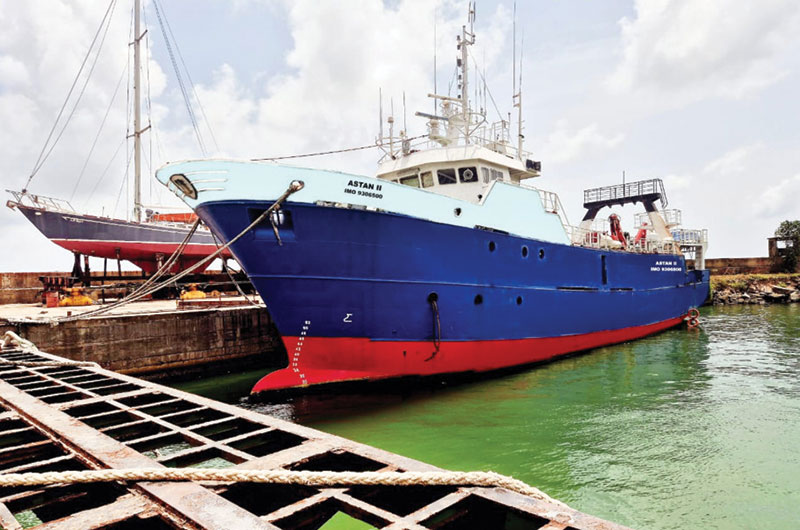
Overhauled Astan II
Our goal was to operate within the harbour and establish a modern fishing operation centred around advanced technology and sustainable seafood processing.
Q: What challenges did you face after starting operations?
A: Around eight to 18 months after we began our investment, COVID-19 hit. The pandemic created enormous difficulties. In countries such as Spain and the United States, governments provided financial support to help businesses survive. Here, the Government itself was facing a difficult economic situation and was unable to provide similar assistance.
Initially, we were told that there would be a grace period and that we would not be pressured for payments as long as we maintained our workforce and kept the operation alive. But later, that understanding changed, and demands for payments began despite the fact that we had a 15-year agreement.
That was the beginning of the major conflict.
Q: How did the change of Government affect your operations?
A: When a new Government came into power, the 15-year agreement signed with the previous administration was not recognized. The factory was closed and legal action was initiated against us.
This was extremely difficult because we had invested heavily based on a long-term agreement. We had built infrastructure, brought in technology and created employment opportunities.
During this period, while the vessel was caught up in legal disputes, a group of people attempted to take control of the ship. One of the most painful experiences was that some lawyers who had been working for us changed sides and supported those attempting to take the vessel.
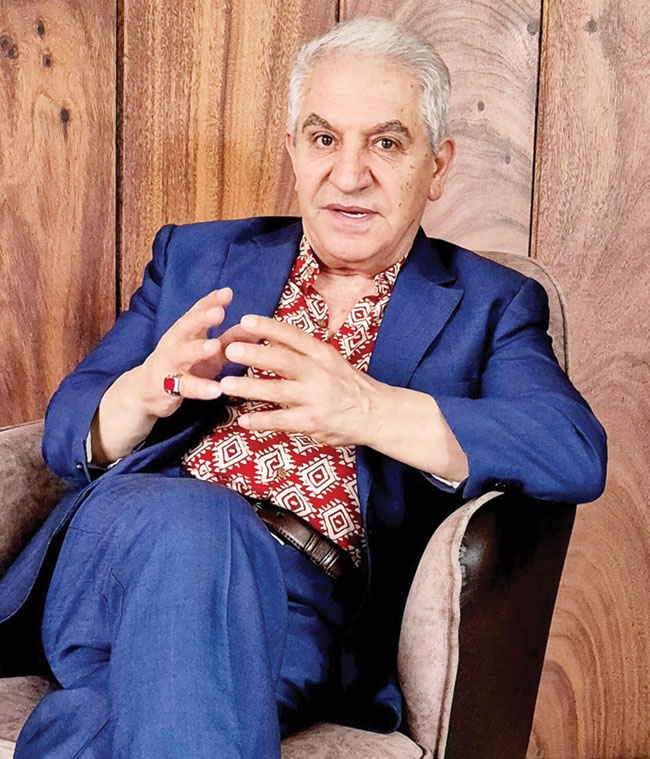
Simon Max Astandoust
The legal battle continued for years and only concluded in 2025.
Q: Your vessel, Astan II, is central to your investment. What happened to it during this period?
A: Astan II is not just a fishing vessel. It is a huge factory vessel with a complete processing facility inside. It was designed to bring a completely new level of technology to Sri Lanka’s fishing industry.
Unfortunately, because it remained idle during the legal proceedings, it suffered significant damage. Ships cannot simply sit in a harbour for months or years without proper operation and maintenance. The Sri Lankan weather conditions are particularly harsh on vessels.
The vessel deteriorated badly, but after we regained control, we decided to completely restore it. It was overhauled.
Q: How much did the restoration cost and what work was involved?
A: The restoration cost approximately US$1.5 million and took about one year, beginning in 2025. The vessel was almost a complete rebuild. One of the biggest technical challenges was repairing the three generators. Because the harbour did not provide electricity, these generators had been running continuously to maintain the vessel. Over time, this caused significant wear and tear.
Finding replacement parts was another major challenge. Many of these parts are not imported into Sri Lanka, so every component had to be sourced from different countries and brought in individually.
A team of around 14 to 20 people worked on the restoration, including a Sri Lankan chief engineer and local professional deck crew. Their expertise and dedication were extremely important.
Today, the vessel is in brand-new condition.
Q: You mentioned that the absence of diplomatic representation made your struggle more difficult. Why?
A: I hold Spanish and Israeli citizenship, and neither Spain nor Israel has an embassy in Sri Lanka. Normally, when a foreign investor faces serious difficulties, an ambassador can engage with authorities and help protect the investor’s interests.
In my case, I had to face everything alone. I had to deal directly with government institutions and the legal system through my lawyers. Having diplomatic support would have made a significant difference. But ultimately, I had to rely on the courts and the legal process.
Fortunately, the maritime judges understood the complexity of the situation and the importance of maritime law. Their fair approach restored some of my confidence.
Q: Your vessel uses unique -70°C “Ultra-Fresh” technology. Can you explain how it works?
A: This is one of the most exciting parts of our project. The technology comes from Japan and is only about two years old. Traditional freezing methods often affect the quality of fish because the freezing process is slower and damages the texture. This technology works differently. It uses a glazing process where the fish is frozen from the outside, creating a protective layer.
Within approximately two hours, the fish is completely frozen. This process eliminates bacteria and preserves the quality of the fish.
When the fish is later defrosted using the correct method, it is almost exactly like fresh-caught fish from the ocean. The taste, texture and quality are preserved. At present, nobody else in Sri Lanka is carrying out this type of ultra-fresh freezing technology onboard a fishing vessel.
Q: What advantage will this technology give Sri Lanka?
A: Sri Lanka has excellent fishing resources, but we need to move beyond simply catching fish. The future is about value addition, quality control and accessing premium international markets.
With this technology, Sri Lanka can export seafood at a much higher value because customers will receive a product that maintains the quality of freshly caught fish.
This is not just about one company. It is about introducing a new concept to the country’s fishing industry.
Q: After everything you have experienced, why did you decide to continue investing in Sri Lanka?
A: I come from a family of fishermen. This is my fourth generation, and my son represents the fifth generation. Fishermen are not people who give up easily. The sea teaches you resilience. You face storms, difficulties and uncertainty, but you continue. Of course, there were moments when I lost faith. Losing millions of dollars and spending years in court is not easy for anyone.
But eventually, the justice system gave me confidence again. The maritime judges understood the situation and treated the case fairly. That showed me that there are people in Sri Lanka who understand the importance of protecting investment and respecting the law. That is why I decided to continue.
Many people told me that, despite the difficulties, the Sri Lankan judiciary would ultimately deliver justice. At the time, after years of uncertainty, it was difficult to know what the outcome would be. But in the end, that is exactly what happened. The courts examined the facts and delivered a fair judgment.
The maritime judges understood the complexity of the situation and the importance of maritime law. Their fair approach restored my confidence—not only in the legal system but also in Sri Lanka itself.
Q: What are your future plans for Seamax Ceylon?
A: Our plan is to expand significantly. We intend to bring two or three more large factory vessels to Sri Lanka, along with five local fishing vessels. We also plan to establish a new processing factory near the beach. However, this time we will work through the Board of Investment rather than entering into a direct agreement with the Government.
The BOI provides a structured framework for investors, and we believe this is the right way forward. My son Sam, who is the CEO of our US-based company, will also return to Sri Lanka to help introduce successful business concepts and support the next stage of development.
Q: What keeps you motivated after such a difficult journey?
A:The answer is simple: we do not give up. I come from a family of fishermen. This is my fourth generation, and my son represents the fifth generation. Fishermen understand struggle. You cannot control the ocean, but you learn how to survive. You face storms, difficulties and uncertainty, but you continue moving forward.
I have lost money, faced difficult times and experienced moments of disappointment. But I never stopped believing in the potential of Sri Lanka. One thing that gave me strength was the faith many people placed in the country’s judiciary. I was repeatedly told that the courts in Sri Lanka would deliver justice, and ultimately that belief was proven right. The maritime judges understood the situation and gave a fair decision based on the law.
That experience reminded me that, despite challenges, Sri Lanka has institutions and people who respect justice. That is why I decided not only to stay but also to invest again.
For me, this is not merely a business project. It is about resilience, trust and proving that when you believe in something, you continue fighting until you succeed.
by Saman Indrajith ✍️

Akif Javeed and Sam Harper star in Galle Gallants five wicket win

Dambull Sixers down Kandy Royals by 18 runs

World Cup final tickets near $2.3m mark on FIFA’s resale platform

Saka hat-trick helps England down France to win World Cup 2026 Bronze Final

US military says two service members killed in Iranian strike in Jordan

Showers will occur in the Western, Sabaragamuwa and North-western provinces and in Kandy, Nuwara-Eliya, Galle and Matara districts

‘Dates have the highest sugar content to fight Coronavirus’

Sunday Island 27 December – Headlines

#SundayIsland 17th December – Headlines

Sunday Island – 28th March

Sunday Island Headlines – 21 March

Sunday Island – 21st February – Headlines
-
 Latest News1 day ago
Davis cup Asia/Oceania Group IV 2026 to be held in Colombo from 20th to 25th July
-
 Features4 days ago
Dirty Money
-

 News1 day ago
Dengue outbreak gallops ahead: Infections surpasses 73,455, leaving 50 dead
-
 News1 day ago
Evidence recorded in money laundering case against Yoshitha Rajapaksa
-

 News2 days ago
Money laundering case against Yoshitha, fixed for pre-trial conference
-
 Midweek Review4 days ago
The sordid tale of theft and tragedy at Finance Ministry
-

 Latest News5 days ago
Oil prices hit 1-month high as US-Iran attacks dim Strait of Hormuz outlook
-

 Editorial2 days ago
Overwhelming fire power and stubborn resilience