
Business
SLT Mobitel awarded prestigious ‘Project Management Excellence Award – 2020’ by PMI


SLT Mobitel, achieved yet another significant milestone by bagging the most esteemed Project Excellence Award (PMI) 2020, by the Project Management Institute (PMI) for its Stage VIII Project themed “Project Rural MPowerment”.
Conceptualized to empower every Sri Lankan with digital inclusivity, the project facilitated rural areas by providing 4G technology across the country. Having embarked on the project in 2018 with two leading strategic partners, namely, Huawei and ZTE, the Mobitel team concluded the project 5 months ahead of its planned schedule. This multi-million-dollar endeavor involved establishing 5400+ base stations including over 3000 4G LTE nodes. As a result, people in and around the rural areas were provided with supreme connectivity and extended broadband coverage.
In 2019 alone, Mobitel made an investment of over USD 100 million in expanding its network and will invest another USD 25 million in 2020 to provide superior connectivity and broadband experience to every Sri Lankan. Having completed just before the COVID-19 outbreak, the project enabled school children to continue their education through e-Learning platforms and helped the corporate sector to adopt to the WFH concept with no interruptions. Further, the project not only enabled people in rural areas to connect with the world but also empowered the SME sector by facilitating them with broadband accessibility thus increasing their contribution to the national economy.
Commenting on the achievement, Lalith Seneviratne, Group CEO, Sri Lanka Telecom Group said “Being recognized internationally for a national level project by the Project Management Institute is a tremendous honor, and I would like to thank the Team Mobitel for their untiring commitment, dedication and loyalty to complete this project in record time. This high level of achievement has not only brought glory to Sri Lanka but has also shown that the skills and capabilities of local professionals to compete in the international market as well. I would like to thank our valued stakeholders, government officials and the PMI Sri Lanka Colombo Division, who went above and beyond duty extending their invaluable support in helping us to secure this coveted accolade”.
(SLT)

Sri Lanka’s apparel exports recorded a softer performance in April 2026, with total exports declining by 4.72% to US$ 328.15 million, compared to US$ 344.40 million in April 2025. The decline was mainly seen across key traditional markets, with exports to the UK down 16.91%, the EU down 8.78%, and the USA down 3.46%. However, the 12.61% growth in other markets during April shows that there is still room to build momentum through greater market diversification.
For the period from January to April 2026, total apparel exports declined by 7.47% to US$ 1.53 billion, reflecting continued pressure across major export destinations. While this performance reflects challenging global demand conditions, it also reinforces the need for Sri Lanka to sharpen its competitiveness, improve cost structures, strengthen market access, and move faster into higher-value opportunities.
JAAF believes the industry’s long-term strength remains intact, but the path forward requires a more focused national effort. To move beyond current export levels and work towards breaking the US$ 5 billion barrier, Sri Lanka must support the sector with policy consistency, energy cost reforms, trade facilitation, skills development, and stronger positioning in both traditional and emerging markets. The apparel industry continues to be one of Sri Lanka’s most important foreign exchange earners, and its ability to recover and grow will be critical to the country’s broader export economy.

Recurring revenues reach 74% of total; Normalized EBITDA margin expands 17 percentage points
hSenid Business Solutions PLC (hSenidBiz) announced its financial results for the fourth quarter and full year ended 31 March 2026, delivering a significant turnaround in operational profitability, materially improving earnings quality, and achieving a key strategic milestone.
In the fourth quarter, total revenue reached LKR 522.2 million, up 5 percent year-on-year (YoY). The PeoplesHR Cloud segment delivered LKR 380 million, representing 20 percent YoY growth in LKR terms and 12 percent growth in USD constant currency terms, with subscription revenues comprising 87 percent of segment revenue. New deal closures recovered strongly to USD 843,395. The Company sustained profitability at the Profit Before Tax (PBT) level with LKR 7 million and a normalized EBITDA margin of 11 percent, while continuing to generate positive free cash flow.
For the full year, the Company delivered a substantial financial turnaround. Revenue grew 13 percent YoY to LKR 2.1 billion. Normalized EBITDA turned positive at LKR 200 million, with the margin expanding 17 percentage points to 10 percent. Profit Before Tax improved by LKR 313 million year-on-year, significantly reducing the loss from LKR 321 million in FY2025 to LKR 8 million. The Company also generated positive free cash flow for the year, a sharp reversal from negative free cash flow in the prior year and an annual improvement of over LKR 350 million. Exit Annualized Recurring Revenue (ARR) reached USD 5.5 million, growing 32 percent YoY, while recurring revenues strengthened to 77 percent of total revenue in the fourth quarter, underscoring the quality and resilience of the Company’s SaaS-led business model.
Dinesh Saparamadu, Founder and Chairman of hSenidBiz, commented: “FY2026 marks a clear inflection point for hSenidBiz. We have materially strengthened the quality and predictability of our revenue base while delivering meaningful operating leverage. These outcomes validate the scalability of our SaaS-led model and position the Company well for the next phase of disciplined, high-quality growth.”
Sampath Jayasundara, Chief Executive Officer, added: “The operational momentum achieved in FY2026 provides a strong foundation as we enter the next phase of growth. Our priorities for FY2027 are to accelerate customer acquisition in key markets, drive execution excellence across the sales organisation, and rapidly advance our AI-driven capabilities, particularly through Lexi Insights to deliver even greater value to enterprise customers across our markets.”
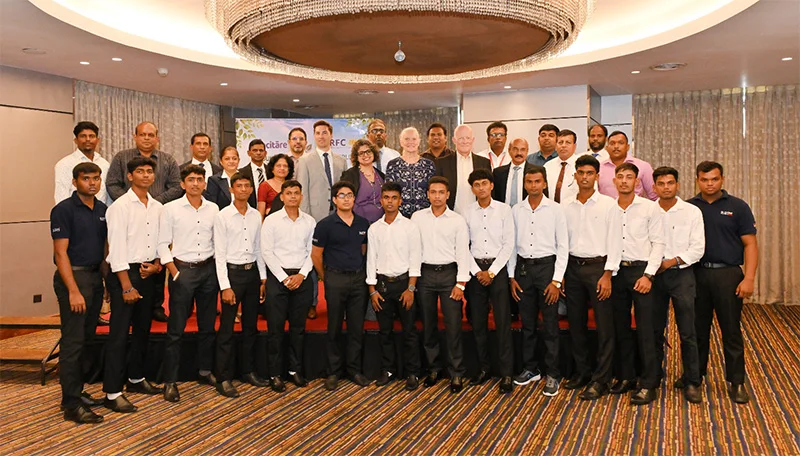
Sri Lanka became the first country in South Asia to unveil a solar hybrid bakery oven, designed with both solar and biogas energy sources to ensure uninterrupted operation despite unpredictable weather conditions.
The event, held on 22 May at Cinnamon Lakeside Colombo, was hosted by Incitare Sri Lanka and the Global Rethinking Finance Collaborative (GRFC), in strategic collaboration with German Tech Kilinochchi, and was graced by Olivier Praz, Deputy Head of Mission at the Embassy of Switzerland to Sri Lanka and Maldives, and Fabio Germano, Representative of GIZ Sri Lanka.
The initiative marks South Asia’s first deployment of this European clean technology, replacing fossil-fuel baking with solar and biogas-powered alternatives while supporting sustainable livelihoods and multiple UN Sustainable Development Goals.
Ms. Beris Gwynne, Founder and CEO of Incitare International and GRFC, whose personal conviction and relentless drive brought this initiative from a bold idea to a functioning reality on Sri Lankan soil, delivered a passionate welcome address: “We are ready to present a hybrid solar oven that we believe has serious potential not only for communities, bakeries, eco-tourism establishments, but also for training institutions, to be able to reduce the carbon footprint, producing products that reduce imports reliance and potentially establish a new field of export industry.”

Ban on animal slaughter to remain in Kandy MC limits

Back home … for a special occasion

JAAF reaffirms confidence in long-term strength of Sri Lanka’s apparel industry

hSenidBiz delivers major FY2026 turnaround with USD 5.5M ARR

Constitutional Council approves Justice Yasantha Kodagoda for Judicial Service Commission

Deep Seek Matters: Education and its divides

‘Dates have the highest sugar content to fight Coronavirus’

Sunday Island 27 December – Headlines

#SundayIsland 17th December – Headlines

Sunday Island – 28th March

Sunday Island Headlines – 21 March

Sunday Island – 21st February – Headlines
-

 Features6 days ago
Octopus, Leech, and Snake: How Sri Lanka’s banks feast while the nation starves
-
 Sports6 days ago
Sri Lanka women’s volleyball team ready for Central Asian challenge
-
 Opinion5 days ago
Murder of Ehelepola family, Bogambara Wewa and Sightings of Wangediya
-
 News5 days ago
Steps underway to safeguard Sri Lanka’s maritime heritage
-

 Business4 days ago
Historic launch of CCWE Fashion Week & International Summit 2026
-

 Features2 days ago
The NPP’s pivot to the past
-
 News24 hours ago
Police probe underway to ascertain links between criminals deported from UAE and local politicians
-

 Editorial5 days ago
A play without its protagonist