
News
SLSI has flouted rules like nobody’s business!

There have been instances where the Sri Lanka Standards Institution (SLSI) allowed the release of imported goods to the market prior to the issuance of test reports during the inspection of imported goods, the Auditor General has said in a report on the Role of Sri Lanka Standards Institution on Quality Product Sales in the Local Market.
There were also deficiencies in the issuance of the Certificate of Standards, management deficiencies, delay in conducting laboratory tests, minimum level of market inspections, reduction of awareness on the use- of pre-standards, and test reports, the Auditor General has said.
The Auditor General has recommended that “informing the relevant parties of the importance of obtaining the Product Certificate logo of the Sri Lanka Standards Institution to minimise the problems that may arise in connection with the above observations, further strengthening the mechanism for awarding the logo, strengthening coordination with other relevant affiliates and issuing product certification logos and this report makes recommendations on how to provide the necessary resources institutionally for conducting and laboratory testing and thereby expedite those processes.”
The report says the SLSI has been given the powers to inspect the quality of imported goods and that it is mandatory for imported goods to obtain the Sri Lanka Standards Certificate. SLSI has prepared a guideline on imported goods, it said.
According to these guidelines when a company imports a consignment of goods they will be allowed to be sold or used without inspection if there is a Certificate of Conformity obtained by that manufacturing company from a government agency, laboratory or testing institute registered with the SLSI in that country.
“However, only two foreign certification agencies for brown sugar were registered and certification agencies for canned fish were not registered,” the report has pointed out.
Moreover, the guideline says if the manufacturing company is registered with the Sri Lanka Standards Institution and obtains a Certificate of Conformity when importing goods, it will be allowed to sell or use without a sample test.
From January 2019 to June 2021, brown sugar was imported on 1014 occasions by 89 companies but no manufacturer was registered with the SLSI and obtained a Certificate of Conformity.
“From January 2019 to June 2021, canned fish was imported from 36 manufacturing companies on 1,522 occasions under 48 brand names. However, only five manufacturers and 20 brand names have been registered. 4,395,416 containers valued at US $ 92,205,253.54 were imported from 31 unregistered manufacturers.
Brown sugar has been imported on 31 occasions without adhering to any of the SLSI guidelines. However, they were allowed to be sold or used without inspection, the report has said. 6323.3 metric tons of brown sugar valued at US $ 2,391,388.95 has been released without testing, the report said.
“As imported goods are released to the market with the approval of the Sri Lanka Standards Institution, it is observed that the company does not have a proper guideline or methodology to ensure that the imported goods are not released to the market until the inspection report of the Standards Institution is received.”
Although a computer database was established in 2018 to keep tabs on imported goods, so far only the data up to the point of sampling has been included in the database.
The Auditor General’s Department has observed that after the sample test, approvals based on the test results, re-sampling, refusal of goods and recommendation for re-export are not made through the relevant database till the audit date of May 2021.
“It was observed that although there should be a good interaction between the Sri Lanka Standards Institution, the Consumer Protection Authority and the Sri Lanka Customs on all imported goods, but there is no such system in place. As a result, there is a high risk of substandard goods being released into the market and instances of such substandard goods being released into the market were observed during the inspection of Sri Lanka Custom’s files. The Standards Institution had not developed a suitable methodology for follow-up in this regard.”
The SLSI has Product Certification (SLS) to assure the hygienic quality of imported foods, however, this certification is not mandatory to import goods, the report says.
The report says, “As of December 2019, the number of SLS branded items was approximately 1105, but the number of market trials was relatively low and the estimated number of inspections carried out in 2016, 2017 and 2018 are 19, 39, and 35 respectively. Furthermore, market inspections were not planned for 2019 and as a result, the audit observes that low quality products are more likely to be released into the market.”

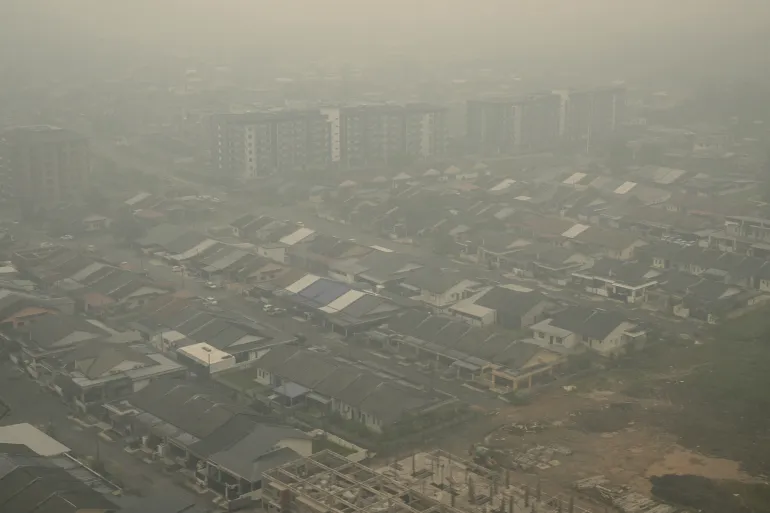
Malaysia has declared a state of emergency in a district in Sarawak state after haze caused by wildfires in neighbouring Indonesia increased air pollution to “hazardous” levels.
King Sultan Ibrahim “has consented to the declaration of emergency throughout Serian Division, Sarawak, following haze conditions that have reached air pollution levels hazardous to public health and safety”, Prime Minister Anwar Ibrahim’s office said in a statement on Thursday.
The declaration followed a formal request from the Sarawak Disaster Management Committee after the region’s Air Pollutant Index reached levels warranting consideration of a local emergency.
Under the order, 647 schools in Serian will close from Monday until at least the end of next week, alongside government and private offices, plantations, construction sites and quarries, with only essential services continuing to operate.
The state’s disaster management authorities said a three-day cloud-seeding operation launched on Thursday would be extended to at least Monday, citing forecasts of “more conducive cloud formations” during that period.
Sarawak State Disaster Management Committee chairman Douglas Uggah Embas, speaking at a news conference in Kuching, stressed that the emergency applied only to Serian, not the entire state, but urged residents there to take the situation seriously.
“Please minimise outdoor activities and avoid strenuous activities outdoors,” he said.
Sarawak, in the northern part of Borneo island, has been heavily affected by haze for weeks, as have the neighbouring states of Sabah and Peninsular Malaysia.
(Aljazeera)
Latest News
Sun directly overhead Moratuwa, Kesbewa, Handapangoda, Idalgashinna, Yudhaganawa, Kotiyagala and Panama about 12.08 noon today (05)


The sun is going to be directly over the latitudes of Sri Lanka from 28th of August to 07th of September due to its apparent southward relative motion.
The nearest places of Sri Lanka over which the sun is
overhead today (05) are Moratuwa, Kesbewa, Handapangoda, Idalgashinna, Yudhaganawa, Kotiyagala and Panama about 12.08 noon
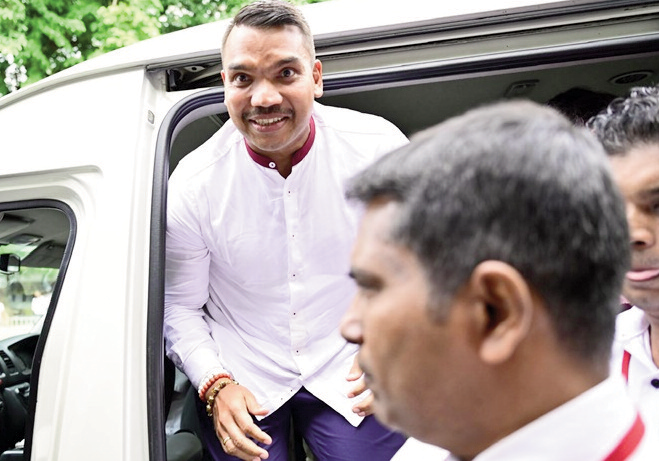
Sri Lanka Podujana Peramuna (SLPP) National Organiser and Parliamentarian Namal Rajapaksa was yesterday remanded until September 18 by the Colombo Chief Magistrate’s Court following his arrest by the Commission to Investigate Allegations of Bribery or Corruption (CIABOC) in connection with an investigation into the controversial SriLankan Airlines Airbus aircraft transaction.
Rajapaksa appeared before the CIABOC at around 9.15 am yesterday to record a statement after being summoned over the transaction. He was taken into custody following several hours of questioning and subsequently produced before the Colombo Chief Magistrate.
The investigation centres on allegations surrounding the acquisition of six Airbus A330 and eight A350 aircraft by SriLankan Airlines in 2013, in connection with an alleged USD 2 million bribe.
Former SriLankan Airlines Chief Executive Officer Kapila Chandrasena and his wife, Priyanka Niyomali Wijenayake, had previously been named in connection with the alleged bribery.
Chandrasena was arrested on March 12 as part of an investigation launched by the CIABOC under the Anti-Corruption Act and was subsequently released on bail. He was later found dead on May 8 while on bail, with police suspecting that his death was a suicide.
Open warrants have been issued for the arrest of Wijenayake, who is named as the second suspect, and Shamindra Rajapaksa, named as the third suspect, in the case pending before the Fort Magistrate’s Court in connection with the Airbus transaction.
The investigation has also received assistance from Airbus, with a delegation from the company’s parent group in France visiting Sri Lanka during the first week of August. The delegation provided statements and other assistance to the CIABOC as part of the ongoing inquiry.
Rajapaksa’s arrest and remand yesterday mark a further development in the widening investigation into the controversial aircraft deal.

Malaysia declares emergency in Sarawak as haze from Indonesia worsens

UAE keep semi-final hopes alive after convincing win over Indonesia

Sun directly overhead Moratuwa, Kesbewa, Handapangoda, Idalgashinna, Yudhaganawa, Kotiyagala and Panama about 12.08 noon today (05)

Showers above 75 mm are likely at some places in the Uva, Central and Eastern provinces and in Polonnaruwa and Mullaittivu districts after 2.00 p.m

Namal remanded until Sept. 18 over Airbus deal investigation

Dengue cases surpass 96,000 this year

‘Dates have the highest sugar content to fight Coronavirus’

Sunday Island 27 December – Headlines

#SundayIsland 17th December – Headlines

Sunday Island – 28th March

Sunday Island Headlines – 21 March

Sunday Island – 21st February – Headlines
-

 Features7 days ago
“Wrap Me Up in My Blazer”— A Gentlemanly Bradby Reminiscence
-

 Features6 days ago
When Sri Lankan stories find their own voice
-

 Features7 days ago
JVP/NPP government as seen from outside by Lionel Bopage now domiciled in Australia
-

 News6 days ago
BASL takes exception to Justice Ganepola being denied a place in SC
-

 Features7 days ago
Prof. Savitri Goonesekere: What has she done?
-

 News3 days ago
Denied of promotion to SC despite vacancies, justice Gurusinghe retires
-

 Latest News3 days ago
Grade 5 scholarship exam results released
-

 News3 days ago
22A: SC urged to suspend hearing, appoint full bench