
Business
SL gearing up to be a ‘FinTech powerhouse’; landmark summit in September


Sri Lanka is gearing up to position itself as a global FinTech powerhouse with the launch of the Sri Lanka FinTech Summit 2025, set to take place on September 24 and 25 at the BMICH, Colombo. Driven by an ambitious national vision and powered by key financial institutions like Hatton National Bank (HNB), the summit is set to be a turning point for the country’s digital economy, with expectations of attracting over USD 100 million in immediate investments and laying the groundwork for USD 500 million by 2030.
Damith Pallewatte, CEO and Managing Director of HNB and chair of the summit, emphasized that the event is more than just a gathering of thought leaders—it is the catalyst for a long-overdue digital revolution.
“We speak digital, we invest in digital, but are we solving the real problems? This summit aims to realign our fragmented efforts, bring all ecosystem players to one platform, and build a practical, methodical roadmap to transform Sri Lanka’s financial landscape, Pallewatte declared.
With over 2,000 participants from 25+ countries and 30 world-class speakers expected, the summit aims to go beyond inspiration—it seeks concrete outcomes. One key goal: increasing financial inclusion to 95% and boosting the Fintech sector’s GDP contribution to 3% by 2030.
Deputy Minister of Digital Economy, Engineer Eranga Weeraratne, outlined the government’s commitment to expanding the current USD 3.5 billion digital economy to USD15 billion by 2030. But to get there, the government acknowledges that deep structural shifts are needed.
“We have Rs. 1.3 trillion in cash circulating outside the formal financial system. If we digitize even one-third of that, nearly Rs. 450 billion could enter the financial ecosystem. That’s a game-changer for lending, public sector financing, and private investment, Weeraratne said.
He noted that while Sri Lanka boasts a strong traditional banking network, it has lagged behind in FinTech adoption, with countries like India, Nepal and even smaller economies rapidly advancing.
“This is not just about QR codes. It’s about building a full ecosystem—public education, interoperability, transport payments, digital credit ratings and above all, stakeholder collaboration, he said.
Weeraratne pledged his ministry’s full coordination with all stakeholders, including the Central Bank, commercial banks, startups, academia and the general public.
Channa De Silva, chairman, FinTech Forum, pointed out that Sri Lanka’s digital banking infrastructure is already mature, handling over Rs. 34 trillion in digital transactions and Rs. 17 trillion in real-time payments in 2024 alone—figures that surpass the country’s GDP.
“The adoption is there—but it’s urban and corporate. The missing link is the last-mile: the retail sector, rural SMEs and informal economy. That’s where FinTechs come in, De Silva noted.
He emphasized that while banks have laid the digital railroads, FinTech companies—agile, innovative, and deeply connected to local challenges—are needed to reach the grassroots.
The spirit of the summit, said Dr. Kumudu Megasuriya, CEO of Texas International and summit co-chair, is about catalyzing a generational transformation.
“This isn’t a summit—it’s a national movement. Every word in our mission statement—empowerment, innovation, inclusion, growth—carries the weight of 22 million aspirations. We’re not chasing regional status. We’re claiming the global FinTech crown, she said in a rousing address.
By Ifham Nizam ✍️


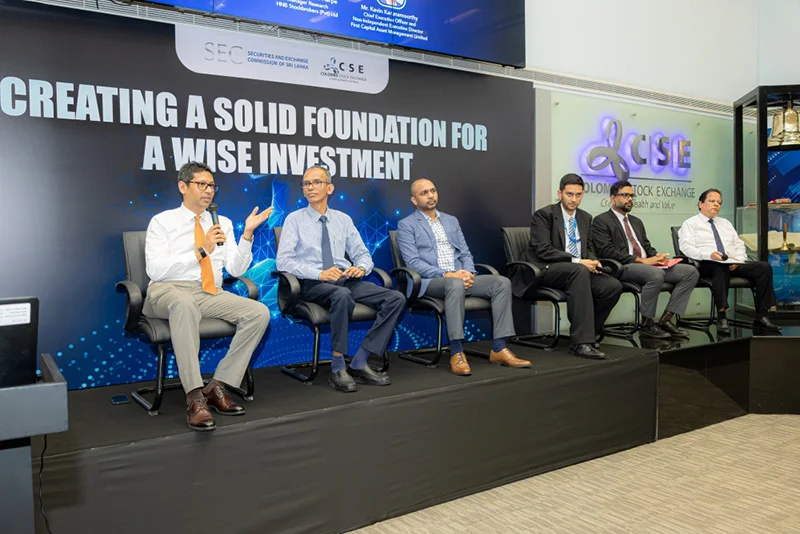
The Colombo Stock Exchange (CSE) in collaboration with the Securities and Exchange Commission of Sri Lanka (SEC) hosted the first of a new series of country-wide investor forums on the iconic CSE trading floor on 25th June and 9th July in Sinhala and English respectively.
The investor forums collectively attracted over 180 participants, with many first-time investors taking the opportunity to speak to members of the SEC, CSE, Unit Trust Associations and Stockbrokers from 5:00 PM onwards.
The forums opened with presentations from senior economists of the Central Bank of Sri Lanka, including Mrs. Lasantha Wijerathne and Chathura Kulawardena, who provided a high-level overview of the country’s macroeconomic landscape. The session also featured presentations by members of leading stockbroking firms, including Tharaka Peiris, Senior Research Analyst at NDB Securities (Pvt) Ltd, and . Cheran de la Harpe, Manager – Research at HNB Stockbrokers (Pvt) Ltd, who provided participants with an overview of the capital market. In addition, representatives from the unit trust industry, including Asanka Herath, Secretary of the Unit Trust Association and CEO and Head of Equity at Lynear Wealth Management (Pvt) Ltd, and Surath Perera, Chief Investment Officer of Senfin Asset Management Pvt Ltd, introduced participants to investing in unit trusts.
The presentations were followed by an interactive panel discussion featuring the speakers as well as Vice President of the Unit Trust Association, Director and CEO of First Capital Asset Management (Pvt) Ltd Kavin Karunamoorthy, Acting Director General of the SEC Tushara Jayaratne and Executive Vice President – Marketing of the CSE Niroshan Wijesundere.
Following the panel discussions attendees enjoyed the opportunity to meet with stockbrokers and unit trust associations to open new investment accounts. All new investors who opened an account on the days of the forum were entitled to receive an investment coupon.
The forum was conducted amidst a remarkable six-year growth in the capital market which saw the All-Share Price Index (ASPI) rise from 4,846 points in May 2020 to 22,310.80 points by the end of May 2026. This represents a growth of 360% and a compound annual growth rate (CAGR) of approximately 28.98% – with capital gains remaining tax-free prospective investors can be notified of through the CSE website and mobile app.
The Bar Association of Sri Lanka (BASL) will host the Inaugural National Sustainable Development Law Symposium on 21 July at The Hilton Colombo, bringing together legal practitioners, policymakers, judges, academics, corporate leaders, financial sector professionals and development stakeholders for a full-day forum on the growing role of law in advancing sustainable development, climate resilience and responsible economic growth.
Held under the theme From Global Trade, Finance and Investment to a National Imperative on Resilience: Integrating a Sustainability Lens in Legal Careers, the programme is structured around several thematic sessions examining the legal dimensions of sustainability in trade, finance, investment, climate governance and national policymaking.
The sessions will cover areas such as Strengthening Domestic Capacity to Succeed and Thrive Amidst a Changing Climate, Sustainability Due Diligence in Global Trade and Positioning Sri Lanka as a Trade Hub in the Region, Sustainable Finance and ESG Due Diligence in Investments: Sri Lanka and CIFC as a Hub for the Region, and Creating the
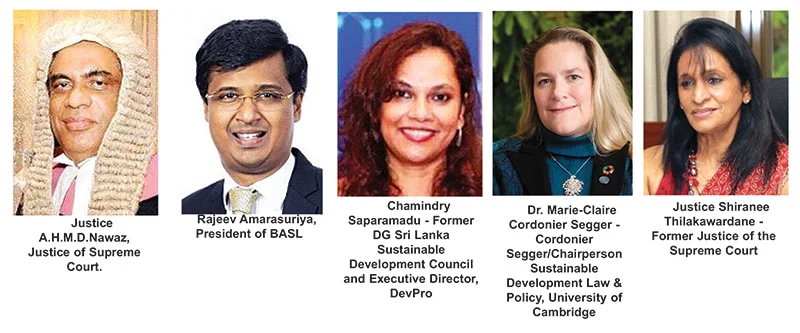
The keynote address will be delivered by His Lordship Justice A.H.M.D.Nawaz, Justice of Supreme Court.
The programme will also feature distinguished speakers including Justice Shiranee Thilakawardane – Former Justice of the Supreme Court, Prof. Dr. Marie-Claire Cordonier Segger /Chairperson Sustainable Development Law & Policy, University of Cambridge, Simon Tribelhorn – CEO – Liechtenstein Bankers Association, Ravi Algama, Dr. Asanga Gunawansa, PC, Prof. (Dr.) Kokila Konasinghe – Professor in Law University of Colombo, Dr. Ravindranath Dabare, Centre for Environmental Justice, Neshan Gunasekera, CEO – World Future Council, Ms. Chamindry Saparamadu – Former DG Sri Lanka Sustainable Development Council and Executive Director, DevPro, Prof. Dominic Coppens – International Economic Law Maastricht University Netherlands, Deputy Solicitor General Nirmalan Wigneswaran, Deputy Solicitor General, Dr. Avanthi Perera, Senith Abeyanayake – Research Associate Centre for Smart Future, Ms. Prashani Illangasekera – General Manager Group ESG, Hayleys PLC, Shiran Fernando – SG/ CEO The Ceylon Chamber of Commerce, , Dr. Priyantha Thilakaweera – Director Macroprudential Surveillance, Central Bank of Sri Lanka, Mr. Thilan Wijesinghe – Managing Director TWC Holdings, Mr. Adheesha Perera – Core Group Member Sri Lanka Banks’ Association’s Sustainable Banking Initiative, Mr. Leel Randeni – Director Climate Change Secretariat from Ministry of Environment, Dr. Ananda Mallawatantri – Co-Chair, Climate Action Steering Committee, The Ceylon Chamber of Commerce and Ms. Punyamali Saparamadu – Senior Vice President -Commercial Colombo Stock Exchange.
For further details, please contact the BASL Program Office at 077 588 8781 or
b.jayasinghe@basl.lk.

The Employers’ Federation of Ceylon (EFC), Sri Lanka’s premier employers’ organisation, has appointed Yashoravi Bakmiwewa as its 14th Director General, marking a historic milestone in the Federation’s 97-year history. She is the first female to serve as Director General of the EFC and also the first female Director General to head an Employers’ Business Member Organisation (EBMO) in South Asia. The appointment heralds a significant era for leadership within the region’s employer representative bodies.
Bakmiwewa succeeds Vajira Ellepola, under whose leadership the Federation further strengthened its position as the country’s leading voice for employers. Her appointment is a further reflection of the Federation’s commitment to continuity, professional excellence, and inclusive leadership as it continues to support employers in navigating the evolving world of work.
An Attorney-at-Law with over 16 years of distinguished service at the EFC, Bakmiwewa, is a graduate of the University of Colombo with a Bachelor of Laws (LL.B.) and a Masters in Labour Relations and Human Resources Management. She was admitted as an Attorney-at-Law of the Supreme Court of Sri Lanka in 2007 and commenced her legal career at the Attorney General’s Department before joining the EFC in 2010.
Since joining the EFC, Bakmiwewa has been instrumental in providing strategic legal and industrial relations advisory services to member organisations representing diverse industries. In 2019, Bakmiwewa was appointed as the Head of the EFC’s training division and under her leadership and guidance, the EFC training division reached several important milestones which was instrumental in strengthening workplace compliance and productive employment relations. Apart from representing members before legal forums, throughout her tenure, Bakmiwewa has contributed significantly to national policy discussions by representing employer interests at key tripartite forums, including Wages Boards and national steering committees.
Following her appointment as the Director General, Bakmiwewa noted that amidst ever evolving socio-economic challenges the world of business has to brave, the EFC is well positioned to navigate them with confidence and excellence. “Our history is one of resilience, having successfully weathered many periods of uncertainty and transformation during its nearly century-long journey. Drawing on that legacy, we are confident that we will continue to adapt, innovate and extend support for private sector businesses to thrive in an increasingly complex and dynamic business environment”
Bakmiwewa also remarks that, in the present AI-driven business environment, the Federation is conscious of adapting to support business transformation while being mindful of the unprecedented environmental and sustainability challenges that are reshaping businesses and economies worldwide.

Oil prices hit 1-month high as US-Iran attacks dim Strait of Hormuz outlook

A few showers may occur in the Western, Sabaragamuwa and North-western provinces and in Kandy, Nuwara-Eliya, Galle and Matara districts

‘Sarasavi Diriya Abhiman’ programme launched under PM’s patronage

England to make late call on Declan Rice for World Cup semi-final

GEF-UNDP backs USD 38 mn drive to curb mercury, hazardous waste

Govt. bans import of goods made with forced labour

‘Dates have the highest sugar content to fight Coronavirus’

Sunday Island 27 December – Headlines

#SundayIsland 17th December – Headlines

Sunday Island – 28th March

Sunday Island Headlines – 21 March

Sunday Island – 21st February – Headlines
-
 News5 days ago
Herath warns prospective migrant workers not to get fleeced by racketeers
-

 Midweek Review7 days ago
Unexpected focus on ‘pieces of tin’ worn by military men
-

 Features3 days ago
Prison riots and politics: NPP’s biggest challenge and Sri Lanka’s biggest opportunity
-

 Editorial4 days ago
What’s the world coming to?
-
 Foreign News5 days ago
Tensions erupt in Indian state after 11-year-old raped and murdered
-

 Features5 days ago
Devanesan Annan – in Memoriam
-

 News6 days ago
Negombo Prison riot: Ensuring protection of prisoners fundamental responsibility of the state – UN
-

 Editorial7 days ago
Prison riots and political battles