
News
SL facing just beginning of Delta crisis – expert

By Rathindra Kuruwita
COVID-19 had reached the community spread stage in the Western Province, some parts of the Northern Province and in the Galle and Matara districts, Prof. Manuj C. Weerasinghe, Head, Department of Community Medicine said on Thursday. He is also involved in the ‘904’ SMS-based system to manage home quarantined Covid-19 patients.
Prof. Weerasinghe said that naming clusters, i.e. Avurudu Pokura, Malu Market Pokura, etc., no longer made any sense as the country was only at the beginning of the crisis created by the Delta variant
“We are only seeing the beginning. We must not dupe ourselves into thinking that we are near the end of the crisis created by Delta,” he said,
Prof. Weerasinghe said that there was no point in talking about the official figures, or planning based on the numbers at their disposal. Making assumptions based on these numbers will only lead to trouble, he said.
“We have to look beyond the numbers and understand the dynamics of the real world. We can safely assume that if there is one COVID positive person in the house, most of the other members too are infected. Given that it’s not easy to get tested, other family members won’t be in the official statistics. This is not only a health crisis but also the beginninf of a social crisis,” he said.
Moreover, in most Sri Lankan households, young people of 18 liveed among senior citizens and thus, the medical attention they need differed, he said, adding that no one had thought of what happened after the travel restrictions were lifted. “Given that we have not imposed a curfew to ensure that people remain in their homes, the effectiveness of the current lockdown is questionabl,” he said.
“Is there a way to enforce effective travel restrictions short of a curfew? It’s good if there is such a method. It’s even better if people stay home when they are asked to do so. However, we know this is not how things happen in the real world. There is a segment of people who will try to do the opposite of what they are advised to do. We have to take severe action because there are such people,” he said.
The extension of the lockdown for another week had given the government and health officials time to decide what they want to achieve during the lockdown, he said. Having objectives and benchmarks were important because it showed what the government wanted to achieve with the lockdown and gave everyone an opportunity to think beyond the lockdown, the Professor said.
“The lockdown has given us breathing space. We must think whether we should revitalize inactive systems or to create new systems to ensure that most people don’t need to travel after the lockdown is lifted. Now people are home and we expect things are going well. There is no planning and when restrictions are lifted, there will be a bit of normalcy for a few days. Then the cases will go up again and we will have to lockdown. This is not a sustainable system,” he said.
The government and most of its detractors were focused on the pros and cons of locking down the country. However, what mattered more was what the country had done to prepare itself to post lockdown context, he said.
“What have we done in the last seven days? Do we have systems in place for people to work and live without coming into contact with each other? At this rate, the social crisis created by COVID-19 will grow rapidly and once we hit a critical point, we will have no options left,” he warned.
MePrimary Health Services Director Dr. Priyantha Atapattu said that the real cases were at least five times more than the reported cases and whether Sri Lanka could return to some sort of normalcy would depend on whether the society could be mobilized to fight the pandemic.
“People are the vector and we have to find a way to keep them home,” he said.


Convenor of the Samagi Joint Trade Union Alliance affiliated with the Samagi Jana Balawegaya, Ananda Palitha, yesterday (16) said that the Ceylon Electricity Board was seeking to raise electricity tariffs by 13.56% percent although it had earned a profit of more than Rs 22,000 mn.
The CEB recently submitted its proposal to the Public Utilities Commission of Sri Lanka (PUCSL) for an electricity tariff revision for the second quarter of this year – the period effective from April 1 to June 30.
Palitha alleged that the PUCSL, in spite of knowing the massive profit earned by the CEB, at the expense of the hapless public, had chosen to allow the state enterprise to propose an additional burden.
The economic, technical and safety regulator of the electricity industry, and the designated regulator for petroleum and water services industries, should exercise its powers in terms of the PUCSL Act No. 35 of 2002 and the Sri Lanka Electricity Act No. 20 of 2009 to provide relief, the veteran trade unionist said.
Palitha emphasised that the PUCSL had the right to intervene on behalf of electricity consumers but, unfortunately, chose to facilitate the CEB’s despicable strategy. “The proposal to increase tariffs by 13.56% was meant to divert attention. The real issue at hand is the percentage of electricity tariff reduction,” Palitha said. The former UNPer found fault with the Opposition for failing to expose the CEB.
Taking into consideration the Rs 22,000 millionplus profit, the PUCSL could order the CEB to grant relief to consumers, Palitha said, adding that the CEB and PUCSL, together, deprived electricity consumers tariff reduction in the first quarter of this year, too.
In January this year, the CEB asked for a 11.59% tariff increase though it was enjoying Rs 22,000 mn profit at that time, the trade unionist said.
Palitha said that as the PUCSL received all data available to the CEB it was fully aware of the finances of the state enterprise.
In January, 2025, regardless of the NPP government floating the idea regarding as much as a 37% tariff increase, the PUCSL granted a 20% tariff reduction (25% of Rs 22,000 mn profit), Palitha said.
According to him, as a result of relief granted to the consumers, the profits had been reduced to Rs 16,000 mn but by June 2025 profits had increased to Rs 18,000 mn and there was a need to grant tariff reduction. But, the NPP, having always lashed out at the International Monetary Fund (IMF) in the run up to the presidential election, held in September 2024, started playing a different tune.
Responding to The Island queries, Palitha said that contrary to claims that the CEB proposed a 13.56% tariff increase to cover up losses caused by the importation of low-quality coal for the Norochcholai Lakvijaya coal-fired power plant, the current strategy seemed to have been adopted at the behest of the IMF.
Instead of granting tariff reduction for the third quarter in 2025, the PUCSL ordered an 18% increase, Palitha said. The trade unionist claimed that the Finance Ministry, at the behest of the IMF, directed both the CEB and the PUCSL to increase electricity tariffs by 20% in violation of the relevant Acts, he said.
Then in Oct, 2025, the CEB proposed a 6.8 % tariff increase at a time its profits were around Rs 22,000 mn. The CEB and PUCSL staged a drama over that proposal and finally, on the false pretext of the CEB’s failure to furnish its proposal on time, the revision was dropped, Palitha said. The SJB activist pointed out that the Opposition failed to highlight that consumers had been deprived of downward revision in spite of massive profits earned by the Board. “In fact, when Energy Minister Kumara Jayakody met trade unions, he very clearly declared that they were considering electricity power reduction, perhaps by 10%, 12% or 15%. But in the end nothing happened.”
Now the same drama is being enacted by the government, the CEB and the PUCSL, Palitha said.
By Shamindra Ferdinando
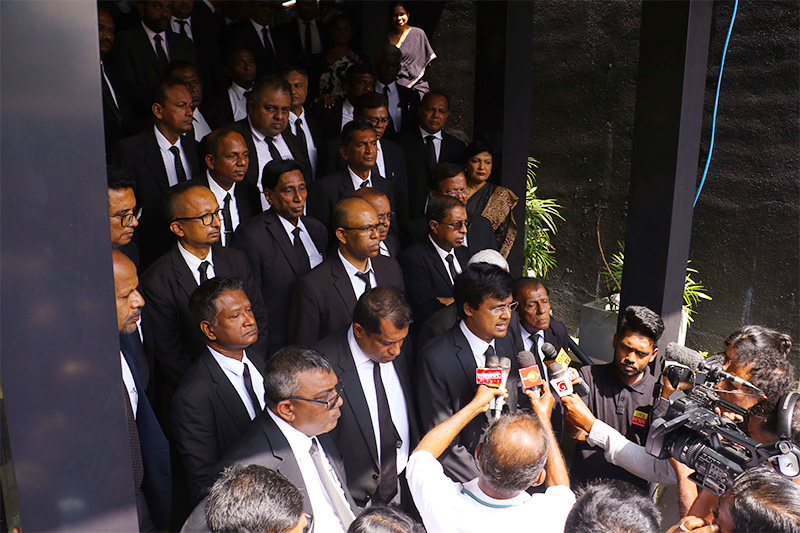
Members of the BASL yesterday (16) staged a protest march over the murder of a lawyer and his wife in Akuregoda, Thalangama, last week. The BASL staged a protest march from the Supreme Court Complex to the BASL Head Office.
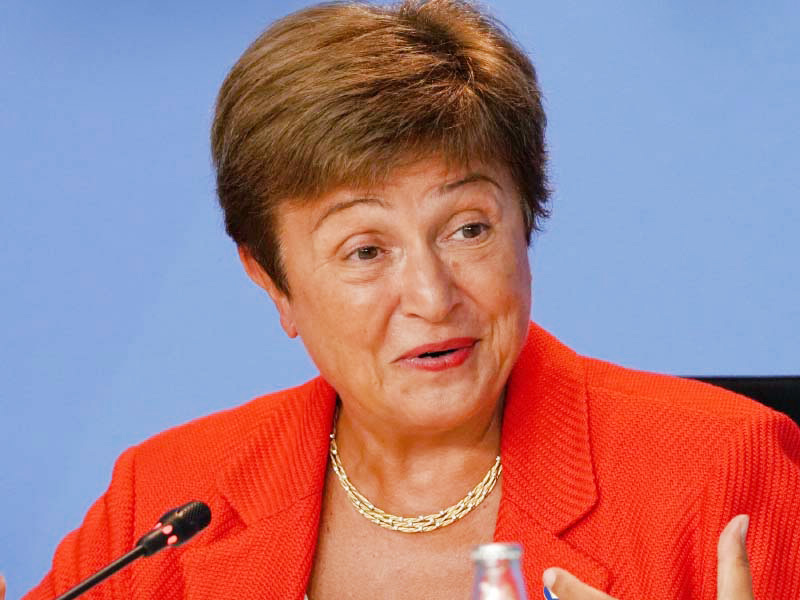
Managing Director of the International Monetary Fund (IMF) Kristalina Georgieva arrived in Colombo yesterday (16) for top level discussions with the government. She is scheduled to leave tomorrow (18) after meeting government authorities and key stakeholders, observing firsthand the impact of Cyclone Ditwah, and discussing ways in which the IMF could support recovery efforts and contribute to building a more resilient future for all Sri Lankans, sources said.

Ancient bone may prove legendary war elephant crossing of Alps

Nepal, Scotland chase win to close out what-if tournament

How dark web agent spotted bedroom wall clue to rescue girl from years of harm

US build-up of warships and fighter jets tracked near Iran

Showers above 75 mm are likely at some places in the Central, Uva and Eastern provinces and in Polonnaruwa district

Zimbabwe take on Ireland with clarity about Super Eights path

‘Dates have the highest sugar content to fight Coronavirus’

Sunday Island 27 December – Headlines

#SundayIsland 17th December – Headlines

Sunday Island – 28th March

Sunday Island Headlines – 21 March

Sunday Island – 21st February – Headlines
-
 Life style2 days ago
Marriot new GM Suranga
-

 Business1 day ago
Ministry of Brands to launch Sri Lanka’s first off-price retail destination
-

 Features2 days ago
Monks’ march, in America and Sri Lanka
-

 Midweek Review6 days ago
A question of national pride
-
 Business6 days ago
Autodoc 360 relocates to reinforce commitment to premium auto care
-
 Opinion5 days ago
Will computers ever be intelligent?
-
 Features2 days ago
The Rise of Takaichi
-

 Features2 days ago
Wetlands of Sri Lanka: