
News
SJB promises digital public infrastructure and targeted subsidies within 90 days of coming to power


Within 90-days of coming to power, the Samagi Jana Balawegaya (SJB) will usher in digital public infrastructure which will determine how much a person should pay for fuel based on their economic capacity, Dr. Harsha de Silva, Chairman, Committee on Public Finance (COPF) and SJB MP said.
“Essentially this is a QR code. You go to the shed, present the QR code and make the payment. Let’s say the price of fuel is 400 rupees a litre, the computer system will calculate the subsidy you deserve because of your economic status and transfer that subsidy to your bank account immediately,” he said.
Dr. de Silva said this is one example of targeted subsidies under an SJB administration and they have already prepared the necessary technical infrastructure to implement these complex projects.
“This is a way to reduce prices of goods to selected groups of people. Within three to six months, the SJB government will usher in reforms that will benefit people directly,” he said.
He added that SJB leader Sajith Premadasa told Peter Breuer, Senior IMF Mission Chief for Sri Lanka, that economic reforms must run parallel with significant relief for the people.
He said that the IMF delegation met Premadasa in late July when they visited Sri Lanka.
“We need social justice. Reform with relief is our framework. I also explained, in length, to the IMF delegation what we need to change the current agenda,” he said.
Dr. de Silva said that SJB was never opposed to IMF reforms and that it was he who urged the Gotabaya Rajapaksa administration to start discussions with the IMF in 2020.
“However, we do not think Sri Lanka should implement everything the IMF says. There is a lot that needs to change, and we need to talk to the people to get them on board the proposed reforms,” he said.
The SJB MP said they also stood for the independence of the Central Bank and supported the government’s reforms to minimise political influence on bank officials. Sri Lanka will hold presidential elections on 21 September and whoever comes to power will need to decide whether they would continue the IMF programme, he said.
“The next president will have to decide what changes need to be carried out, if the IMF programme is to continue. Some changes will be non-negotiable for the IMF and can lead to a collapse in the negotiation process,” he said.
Dr. de Silva said any attempts to repeal the independence given to the Central Bank would lead to a collapse in the agreement with the IMF.
“We spoke with the IMF delegation about that too. They asked how long it would take us to form a cabinet, if we win the 21 September election. We spoke about the short-term fixes that are needed to uplift the people. The IMF has two types of agreements. One is called the standby agreement, which provides short-term financial assistance to countries facing balance of payment problems. The other is the Extended Fund Facility (EFF). This provides financial assistance to countries facing serious medium-term balance of payments problems because of structural weaknesses that require time to address. To help countries implement medium-term structural reforms, the EFF offers longer programme engagement and a longer repayment period,” he said.
The EFF in Sri Lanka proposed to stabilise the economy by increasing taxes. The SJB MP said that this is an unfair demand because a democratically elected new government needs space to carry out its economic policies.
“If that policy is in conflict with the IMF and how we can solve that is a political issue. We have the right. Secondly, even if we agree with the IMF policies, we can agree with the short term economic objectives. We need to ensure that the economy blossoms in the medium and long term, to increase it to 10 percent. We can’t achieve these with these restrictive measures,” he said.
The SJB MP said not all debt is the same. There is a difference between local debt and dollar debt. “In the same way growth is achieved by shielding local industries from global competition and the other way to achieve growth is by exporting globally competitive products. For example, under Mahinda Rajapaksa the economy grew by 9 percent, due to the massive construction that took place in Hambantota. However, this was not sustainable and didn’t lead to any competitiveness in the economy,” he said.
Dr. de Silva said most Sri Lankans do not consume adequate quantities of food. SJB wants to ensure that the price of food drops, so people can eat. “About 40 percent of our produce is wasted before they enter the retail market. If we can reduce this, this will be a solution itself. We can build climate-controlled warehouses across the country,” he said.
Commenting on the debt restructuring with commercial debt holders, the SJB MP said that any agreement with the private bond holders must be just and must not come at the expense of the Sri Lankan people.
“I told the IMF that the Employment Provident Fund (EPF) was heavily targeted during domestic debt restructuring. The government, until the very end, said they will not touch EPF funds. This was done at the behest of commercial debt holders. Now the government is going to agree to issue a Macro Linked Bond (MLB). In reality, only in 2028 will we decide how much of a haircut on international debt we will receive. Right now, the government says the haircut will be 28 percent, but 90 percent of commercial debt holders believe that the haircut will be less than 15 percent. They think that the way things are going, the economy will develop, and they will profit from that,” he said.
Dr. de Silva said that bi-lateral creditors have told the government that if they are giving significant concessions to commercial debt holders, they too will take back some of the concessions given to Sri Lanka, i.e., introduce a claw back clause. A clawback clause is a way for a company to reclaim compensation payments based on preset criteria. Bilateral creditors have not asked for such a clawback clause in the history of debt restructuring, he said.
“We told the IMF that we will bring a clawback clause for the EPF too. The IMF didn’t ask us to restructure domestic debt. Sri Lanka is also the only country that placed the onus of debt restructuring on workers pensions. Sri Lankans have suffered and if we make progress, the benefits of the hard work must not only go to bilateral and commercial creditors. (RK)



The Navy has apprehended 55 people in separate operations targeting illegal fishing and suspected narcotics smuggling in coastal areas this month.
According to the Navy, 50 people were arrested for engaging in illegal fishing during operations conducted between October 2 and 17 in coastal areas of Trincomalee, Jaffna and Puttalam.
The operations, conducted by the Eastern, Northern and Northwestern Naval Commands, also resulted in the seizure of 33 dinghies, a canoe and a quantity of unauthorised fishing equipment.
The suspects, boats and equipment were handed over to officials of the Department of Fisheries and Aquatic Resources for further legal action.
Meanwhile, five suspects were arrested along with a multi-day fishing trawler during a separate naval operation in the southern seas on October 13 over suspected narcotics smuggling.
The suspects and the trawler were handed over to the Police Narcotics Bureau for further investigations and legal action.
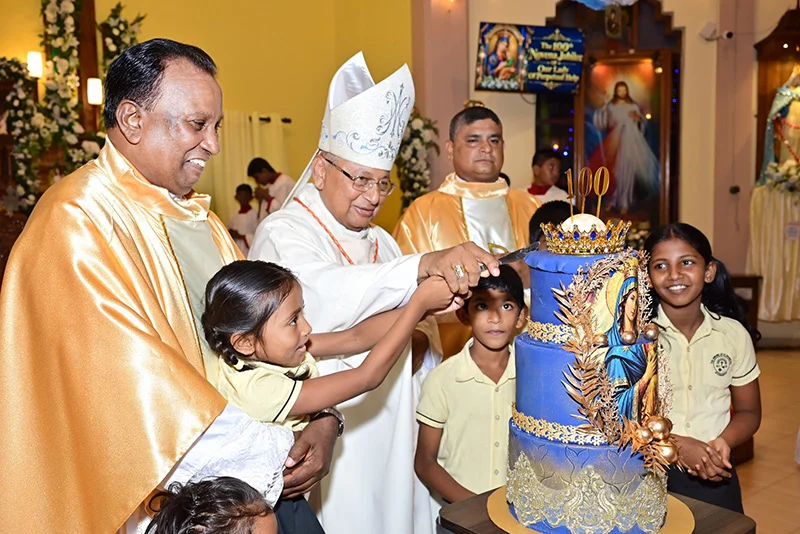
by J. Stanislas Pius
The centenary Perpetual Novena Holy Mass at the Shrine of St. Padre Pio in Athurugiriya was held on Sunday (18), presided over by Archbishop of Colombo Malcolm Cardinal Ranjith.
The Mass, marking the 100th Perpetual Novena, was held at 6 p.m. with the participation of Colombo Regional Vicar Very Rev. Fr. Robinson Wijesinghe, Ven. Sevwanagala Samadhi Thero of the Athurugiriya Seewali Hermitage and members of the Catholic community.
The event was organised under the leadership of the priest in charge of the shrine, Rev. Fr. Harsha Rajakaruna.
Following the Mass, the Grotto of Our Lady of Perpetual Help within the shrine was blessed and opened.

Opposition and SJB Leader Sajith Premadasa yesterday called for the establishment of a special task force to protect Sri Lanka’s remaining tuskers, together with a dedicated wildlife hospital, and a rapid-response mechanism to treat injured elephants.
Speaking in Parliament, Premadasa said stronger wildlife protection and emergency treatment systems were needed to prevent further losses of the country’s iconic tuskers following the death of Kavanthissa.
He proposed that the task force include experienced Wildlife officers, including Chathura Gunaratne and the investigation team, led by ASP Rohan Olugala, who were involved in an arrest connected to the Kavanthissa incident.
Their expertise should be used to strengthen efforts to protect endangered elephants and combat crimes against them, he said.
Premadasa also proposed establishing a dedicated wildlife hospital, equipped to treat seriously injured wild animals, particularly elephants requiring specialised medical care. Modern diagnostic equipment, mobile laboratories, emergency treatment units and a rapid-response system should be provided, he said.
He pledged the Opposition’s support for securing foreign funding and other resources for such facilities and proposed bringing in foreign veterinary specialists for complex cases. He also called for greater cooperation between Wildlife authorities, universities and other relevant institutions.
Noting shortages of wildlife veterinarians and other trained personnel, Premadasa urged the government to strengthen staffing and medical facilities at the Department of Wildlife Conservation.
He further proposed that environmental organisations and civil society representatives be included in the expert committee appointed to investigate Kavanthissa’s death, saying their participation would enhance transparency and accountability.
The deaths of Kavanthissa, Bhathiya and Thekka Raja should be used to improve treatment protocols and emergency response systems, the Opposition Leader said.
Protecting Sri Lanka’s remaining tuskers required practical reforms, stronger veterinary capacity and coordinated action, rather than responding only after an elephant had died, Premadasa said.

Heshara, Shashen, Dilini among top performers

Molineux, Dunkley enter WPL 2027 auction with top base price of INR 50 lakh

JXG’s Wasanthi Stephen makes history as the first female recipient of the CIPM Sri Lanka Lifetime Gold Award

Lessons from the collapse of Colombo’s US$ 392 mn logistics Hub

The role of economic science in an era of global power dynamics

Dinemore joins the Dialog Pay Merchant ecosystem

‘Dates have the highest sugar content to fight Coronavirus’

Sunday Island 27 December – Headlines

#SundayIsland 17th December – Headlines

Sunday Island – 28th March

Sunday Island Headlines – 21 March

Sunday Island – 21st February – Headlines
-

 Features3 days ago
Kotahena:A Small Enclave, An Extraordinary Legacy
-

 News7 days ago
Sri Lanka, India caught in US-Iran ship crisis
-

 News4 days ago
Asgiri Mahanayake calls for immediate release of Gnanasara Thera
-

 News3 days ago
Record 1,600 students take Russian Classical Ballet examination in Sri Lanka
-
 News6 days ago
AC President recuses himself from hearing prison attire case pertaining to Gnanasara Thera
-
 News5 days ago
Naval officer testifies Yoshitha received Rs. 5.15 mn in salaries during SLN service
-

 Latest News7 days ago
Heavy showers above 100 mm are likely at some places in the Western, Sabaragamuwa, Southern, Central, and North-western provinces and in Anuradhapura district.
-
 News3 days ago
Karannagoda pushed for £24,536 for Yoshitha’s UK training, Court told