
News
SJB, FSP agree on common agenda


Focus on abolition of Executive Presidency
BY SHMAINDRA FERNANDO
SJB MP Kabir Hashim, MP, says the main Opposition party and the Frontline Socialist Party (FSP) have recently agreed on the abolition of the Executive Presidency.Hashim yesterday (20) told The Island that they agreed on empowering Parliament at the expense of the Executive President.The SJB and FSP delegations met at the Opposition Leader’s Office at , Sir Marcus Fernando Mawatha this week. The SJB delegation consisted of lawmakers, General Secretary Ranjith Madduma Bandara, Kabir Hashim, Eran Wickremaratne and Mujubur Rahuman whereas the FSP was represented by Central Committee members, Pubudu Jagoda and Duminda Nagamuwa.The SJB, offshoot of the UNP, secured the recognition of the Election Commission in Feb 2020 while the FSP is yet to be registered as a political party.
Lawmaker Hashim said that the SJB was keen to discuss the current situation with all political parties represented in Parliament and out as part of the overall efforts to reach agreement on a common programme.Referring to the proposals made by the Bar Association of Sri Lanka (BASL) to resolve the political crisis that would be a prerequisite for addressing the economic downturn, lawmaker Hashim said that the SJB and the FSP agreed on the need for President Gotabaya Rajapaksa to agree on a timeline for him to step-down.Responding to The Island queries, one-time UNP Chairman said that the SJB could work together with the FSP on both political and economic issues. The talks took place amidst the FSP, the breakaway faction of the JVP, was consolidating its position as the spearhead of the ongoing protest campaign meant to force President Gotabaya Rajapaksa to step down.
MP Hashim said that they agreed to prepare a document meant for future cooperation. Asked whether they have scheduled another meeting with the FSP, the Kegalle District MP said that they were keen to prepare a working document before they next meet for talks.The top SJB spokesperson said that in spite of swearing in UNP leader Ranil Wickremesinghe as the Prime Minister, the President was on a difficult wicket.Lawmaker Hashim said the SJB was also engaged in talks with the JVP though the deliberations weren’t at official level. “We are proceeding with efforts to finalize a common agenda meant to restore normalcy. We had talks with the BASL, industry leaders as well as civil society,” MP Hashim said.Asked whether the SJB had met Premier Wickremesinghe or sought a meeting with him, MP Hashim said that when Dr. Harsha de Silva raised a spate of issues at hand, especially the recent hard default, the Premier assured the Parliament that party leaders would be fully briefed pertaining to the current situation.Lawmaker Hashim was referring to the first occasion Sri Lanka experienced a hard default as the grace period for the International Sovereign Bonds (ISB) Coupon payment lapsed on May 18. Last month Sri Lanka announced a pre-emptive negotiated default ofall outstanding debt as at April 12.On April 18 the ISB Coupon worth $ 78 million fell due and those had 30 days to obtain “Consent Solicitation” from all ISB holders for payment suspension by May 18.
FSP spokesperson Pubudu Jagoda told The Island that the party discussed the developing situation with some political parties, including the SJB and ’43 Brigade’ led by SJB MP Patali Champika Ranawaka. The FSP delegation comprised Central Committee members, Pubudu Jagoda, Duminda Nagamuwa and Sanjeewa Bandara. MP Patali Champika Ranawaka and Attorney-at-Law Shiral Lakthilake represented the ‘43 Brigade.’Jagoda said that the ’43 Brigade’ was of the view the executive presidential system should be retained with necessary amendments.According to Jagoda, the Eksath Samajawadi Pakshaya and the Tamil National Alliance (TNA) agreed that the executive presidency should be abolished. FSP leader Kumar Gunaratnam and Pubudu Jagoda had represented the party whereas Jaffna District MP M.A. Sumanthiran, PC, and Shanakiyan Rasamanickam represented the TNA.
Jagoda said that the current environment was conducive for building a common agenda that could accommodate the vast majority of political parties represented in Parliament and other groups bent on abolishing the executive presidency.He emphasized the pivotal importance of a common response to what Jagoda termed the government crackdown in Colombo, its suburbs and the provinces where over 1,000 persons had been arrested by the police in connection with the ongoing investigations into mob assaults ignited following unprovoked attacks on those demanding the resignation of the President and the Premier.

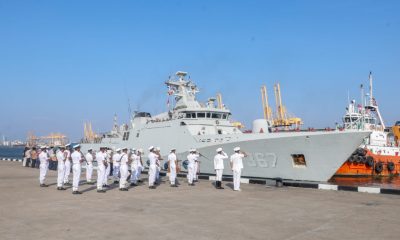



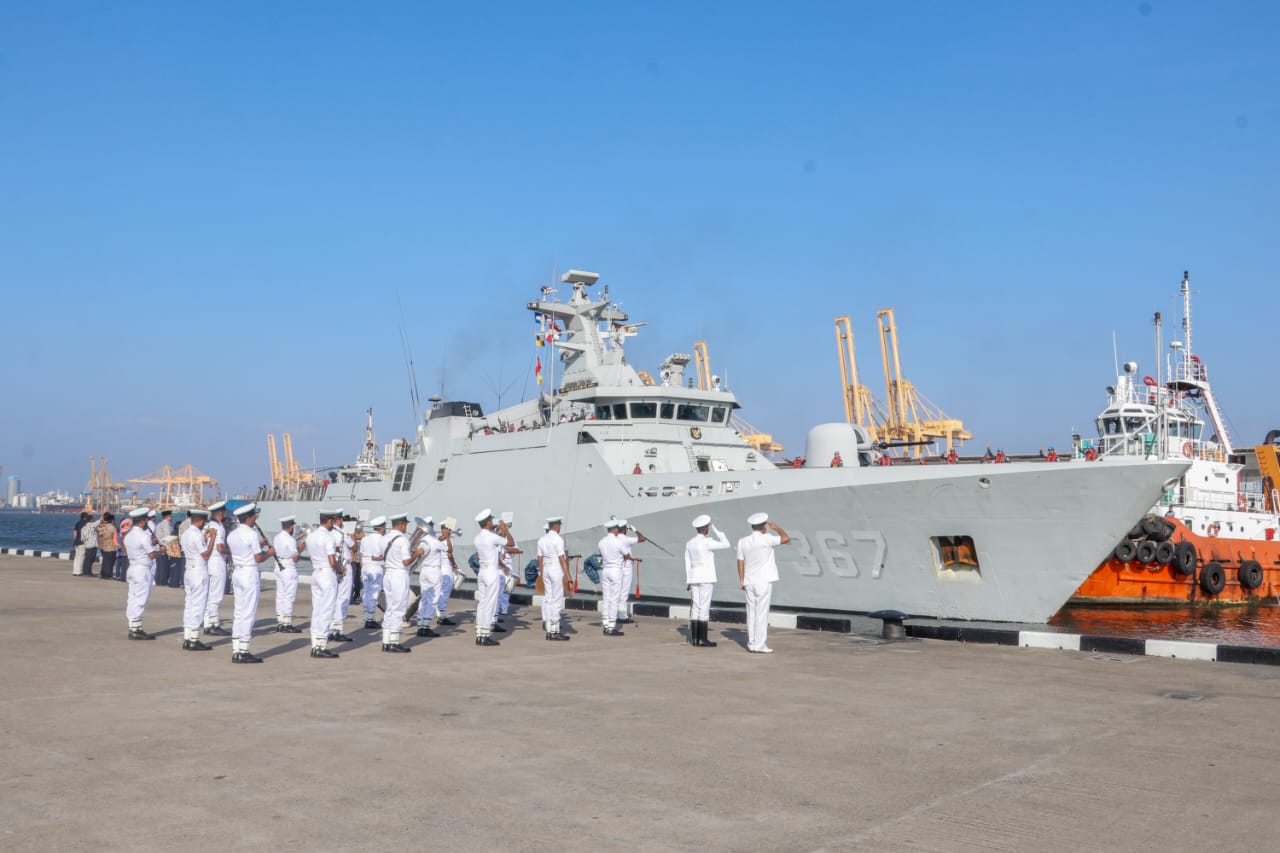
The Royal Navy of Oman Ship ‘AL SEEB’ concluded a logistics replenishment visit to Sri Lanka and departed the Port of Colombo on 24 Jan 26.
In accordance with naval tradition, the Sri Lanka Navy extended a customary farewell to the departing ship.

The price of gold has risen above $5,000 (£3,659) an ounce for the first time, extending a historic rally that saw the precious metal jump by more than 60% in 2025.
It comes as tensions between the US and NATO over Greenland have added to growing concerns about financial and geopolitical uncertainty.
US President Donald Trump’s trade policies have also worried markets. On Saturday he threatened to impose a 100% tariff on Canada if it strikes a trade deal with China.
Gold and other precious metals are seen as a so-called safe-haven assets that investors buy in times of uncertainty.
Demand for gold has also been driven by a range of other factors including higher-than-usual inflation, the weak US dollar, buying by central banks around the world and as the US Federal Reserve is expected to cut interest rates again this year.
Wars in Ukraine and Gaza, as well as Washington seizing Venezuelan President Nicolás Maduro, have also helped push up the price of gold.
On Friday, silver topped $100 an ounce for the first time, building on its almost 150% rise last year.
[BBC]

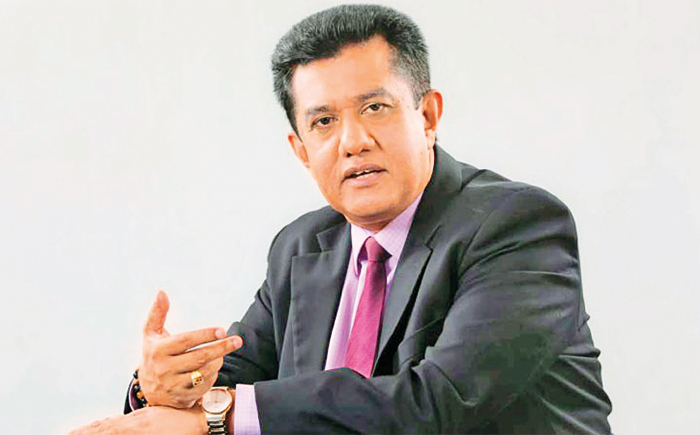
SJB Working Committee member and ex-SLPP lawmaker Charitha Herath says that all eyes are on the newly constituted Constitutional Council (CC) as to how it will handle the dispute between President Anura Kumara Dissanayake, and the previous CC, over the appointment of Auditor General (AG).
The former parliamentarian said so in response to The Island query yesterday (25). In terms of the Constitution, Prime Minister Dr. Harini Amarasuriya and Opposition Leader Sajith Premadasa last week agreed on the appointment of former civil servant Austin Fernando, Professor Wasantha Seneviratne and Ranjith Ariyaratne as non-MP members of the CC.
They replaced former Ministry Secretary Dr. Prathap Ramanujam, former Chairperson of the Sri Lanka Medical Association Dr. Dilkushi Anula Wijesundere and Dr. Dinesha Samararatne of the University of Colombo. Pointing out that they rejected the President’s nominees for the AG’s post on several occasions, Herath emphasised the pivotal importance of the appointment of a person with impeccable credentials.
The other CC members are the Prime Minister, Speaker Dr. Jagath Wickremaratne (Chairman), the Opposition Leader, the President’s nominee Bimal Rathnayake and five persons appointed by the President, upon being nominated as follows: one MP nominated by agreement of the majority of the MPs representing the Government (Aboobucker Athambawa, MP), one MP nominated by agreement of the majority of the Members of Parliament of the political party, or independent group, to which the Leader of the Opposition belongs (Ajith P. Perera, MP), and one MP nominated by agreement of the Members of Parliament other than those representing the Government and those belonging to the political party or independent group to which the Leader of the Opposition belongs, and appointed by the President ( Sivagnanam Shritharan, MP.)
The present CC was established on October 31, 2022 in terms of the 21st Amendment to the Constitution. The Attorney General heads the National Audit Office (NAO). One-time COPE Chief said that it would be the responsibility of the government to ensure the integrity of the NAO.
Chulantha Wickramaratne, who served as AG for a period of six years, retired in April 2025. Following his retirement, President Dissanayake nominated H.T.P. Chandana, an audit officer at the Ceylon Petroleum Corporation as the AG. The CC rejected that nomination. Subsequently, President Dissanayake appointed the next senior-most official at the NAO Dharmapala Gammanpila as Acting Auditor General for a period of six months. Then, the President nominated Senior Deputy Auditor General L.S.I. Jayarathne to serve in an acting capacity, but her nomination, too, was also rejected. Many an eyebrow was raised when the President nominated O.R. Rajasinghe, the Internal Audit Director of the Sri Lanka Army for the top post. That nomination too was rejected. As a result, the vital position remains vacant since 07 December, 2025.
Herath said that the government was in a bind over the Auditor General’s appointment and the disgraceful campaign launched against Attorney General Parinda Ranasinghe, Jr, PC.
The ex-lawmaker said that JVP/NPP loyalists masquerading as journalists and civil activists had launched the protest against the Attorney General. Herath said that the decision to send Deputy Secretary General of Parliament Chaminda Kularatne, on compulsory leave, too, was a matter of serious concern.
Herath said: “This is the same government that campaigned strongly on non-interference, institutional independence, and respect for the rule of law—principles they used to criticise every previous administration. Now, they appear to be doing exactly what they once opposed, only more openly. If this pattern continues, these undemocratic actions will eventually lead to their own downfall.”
BASL in late December, 2025 urged President Dissanayake and others, including the Opposition Leader, to consult civil society and professional bodies, including them, before the appointment of civil society representatives.
Herath said that the newly constituted CC would face its first acid test when it addressed the Auditor General issue.
by Shamindra Ferdinando

Royal Navy of Oman Ship ‘AL SEEB’ leaves island

Gold tops $5,000 for first time ever, adding to historic rally

Showers will occur in the Northern, North-central, Eastern, North-western, Western, Sabaragamuwa and Uva provinces and in Matale, Matara, Galle and Nuwara-Eliya districts

U – 19 World Cup: Andrew, McKenzie deliver West Indies comfortable win

U – 19 World Cup: Bowlers, Hogan help Australia breeze past South Africa

Abhishek blasts 14-ball fifty to hand India unassailable 3-0 lead against New Zealand

‘Dates have the highest sugar content to fight Coronavirus’

Sunday Island 27 December – Headlines

#SundayIsland 17th December – Headlines

Sunday Island – 28th March

Sunday Island Headlines – 21 March

Sunday Island – 21st February – Headlines
-
 Business21 hours ago
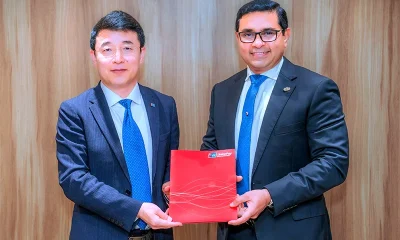
ComBank, UnionPay launch SplendorPlus Card for travelers to China
-
 Business2 days ago
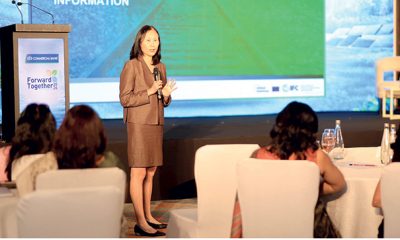
ComBank advances ForwardTogether agenda with event on sustainable business transformation
-

 Opinion7 days ago
American rulers’ hatred for Venezuela and its leaders
-
 Opinion5 days ago
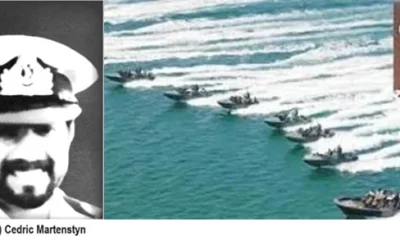
Remembering Cedric, who helped neutralise LTTE terrorism
-
 Business5 days ago
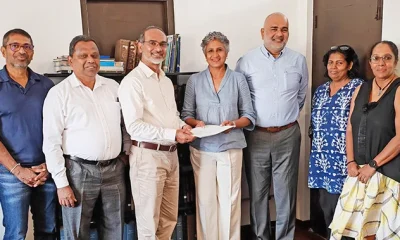
CORALL Conservation Trust Fund – a historic first for SL
-

 Opinion4 days ago
A puppet show?
-
 Opinion2 days ago
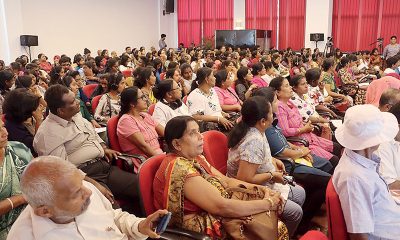
Conference “Microfinance and Credit Regulatory Authority Bill: Neither Here, Nor There”
-
 Opinion7 days ago
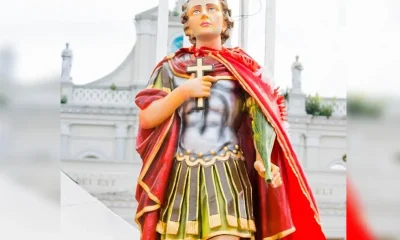
History of St. Sebastian’s National Shrine Kandana