
Business
Significance of repatriation and conversion of export proceeds for external sector stability and overall financial system stability


Sri Lanka’s merchandise export sector has shown a notable improvement in 2021 compared to the pandemic-affected 2020. As per the latest Customs data, export earnings have averaged US dollars 985 million during the eight months ending August 2021 compared to a monthly average of US dollars 837 million in 2020, while the average earnings have amounted to US dollars 1,064 million during June-August 2021. This is an appreciable development as the merchandise export sector (comprising diverse products) is the largest foreign exchange earner in most countries, including Sri Lanka.
Sri Lanka has had a trade deficit each year since 1977, and the gap between merchandise imports and exports is typically financed by other inflows to the external current account (such as tourism and other services inflows as well as workers’ remittances), and financial inflows (such as investments and borrowing).
In this background, some recent developments in the foreign exchange market have raised several concerns, particularly as some of these typical avenues of foreign exchange inflows have been affected due to pandemic-related pressures, as explained below:
a) Compared to the monthly average exports as reported by Customs (goods flow) of US dollars 985 million during the eight months ending August 2021, the monthly average repatriation of export proceeds during July/August 2021 has been US dollars 640 million as reported by banks (financial flow). Accordingly, there has been a significant gap of US dollars 345 million between these two figures. This observation therefore, raises the serious question as to whether exporters comply with the regulation on 100 per cent repatriation of export proceeds.
b) It also appears that due to an undue speculation on exchange rate movements, there has been a reluctance to convert export earnings during the period from January 2020 to July 2021, thereby limiting inflows to the domestic foreign exchange market, which situation has then resulted in a buildup of foreign currency deposit balances with the banking sector by a significant US dollars 1.9 billion. In addition, with low rupee interest rates, some exporters have found it more lucrative to borrow and import to meet their input requirements, leading to further tension in the domestic market.
c) As per the data available, it would also be noted that if there had been a 100 per cent repatriation and 100 per cent conversion of export proceeds, the monthly export foreign exchange flow into the domestic market would have been US dollars 985 million, and with the average expenditure on imports of US dollars 1,670 million, that would have resulted in a monthly average gap of US dollars 685 million. This could have been easily financed using other foreign exchange inflows into the country.
d) Based on the above past statistics in general, and the experience during July/August 2021 in particular, the monthly average gap between the conversions of export proceeds with an incomplete repatriation and expenditure on imports has been quite alarming.
It would also be fair to state that there is a necessity for a country to ensure that the foreign exchange generated through export activities are duly repatriated into the country and converted into its currency. In fact, many emerging market economies have repatriation and conversion requirements imposed on merchandise and services exports. Country experiences vary, and over time, with the buildup of a country’s foreign exchange reserves through such non-debt inflows, countries have also gradually relaxed these requirements. Regional economies such as Bangladesh, India, Indonesia, Malaysia, Nepal, Pakistan, and Thailand have export proceeds repatriation requirements currently in place varying from 3 months to 2 years of the export. Bangladesh, India, Pakistan and Thailand have repatriation requirements on both goods and services export proceeds, while in Nepal, Malaysia and Indonesia, the repatriation requirement is only applicable on goods exports. Bangladesh, India, Pakistan and Thailand have rules on conversion to respective local currencies in different percentages based on nature and the amount of repatriated export proceeds and their utilisation. Such repatriation and conversion requirements ensure the fulfillment of the demand for foreign currency, including intermediate and investment goods imports directly required by the export sector, as well as essential fuel and medical requirements of the country, which are indirect inputs to all sectors including the export sector.
Therefore, it would be reasonable for the Government (which supports the export sector through lower taxes and numerous other incentives) and the Central Bank (which is expected to deliver price and economic stability as well as financial system stability) to take steps to ensure the complete repatriation of export proceeds within a reasonable period and the conversion of inflows of export proceeds into the local currency, including the proceeds already accumulated in exporters’ accounts, so that the true purpose of exports is realised.
As would be well appreciated, an export would realise its objective only when it finally culminates in the flow of foreign exchange that is generated by the export into the country’s financial system in its local currency. That objective would obviously not be fulfilled if the final conversion of export proceeds into local currency does not take place. Accordingly, steps must be taken to strengthen the systems to ensure monitoring and to implement measures that lead to this objective. It is only then that the gap between the foreign exchange liquidity provided through exports and the foreign exchange liquidity demand for imports would reduce to the level as published in the Central Bank’s own reports.



In response to the devastating impact of Cyclone Ditwah, The Ceylon Chamber of Commerce has been actively supporting national relief and recovery operations in collaboration with the Government of Sri Lanka, key partners, and its members.
As a co-chair of the Sri Lanka Preparedness Partnership (SLPP) alongside the Disaster Management Centre (DMC), the Ceylon Chamber together with Janathakshan, played a central role in coordinating emergency response efforts, ensuring rapid and efficient assistance to affected communities. From 28 November to 6 December 2025, the Chamber mobilised volunteers across the Chamber Secretariat, member companies MAS Capital Pvt. Ltd – Intimates Division, Aitken Spence PLC, and university student groups, contributing more than 190 hours of service and answering over 40,000 emergency assistance requests to support the DMC’s 24-hour Emergency Operations Center.
The Chamber also provided support to the DMC for the Rapid Disaster Needs Assessment (RDNA), assisting with data analysis of calls received and the development of the direct community needs component of the RDNA, which informed government planning and coordination of relief distribution.
With the generous support of its member companies, the Ceylon Chamber facilitated the collection and handing over of financial aid and essential relief items to affected areas. The Chamber is deeply appreciative of Aitken Spence PLC, BASF Lanka (Pvt) Ltd.. CDK Philip Hospital, Central Finance Company PLC, Cinnamon Hotels & Resorts, Devi Trading Company, Eastern Merchants PLC, Emar Pharma Pvt. Ltd., Finagle Lanka Pvt.Ltd., H Connect International Pvt. Ltd., Hemas Manufacturing (Pvt) Ltd., John Keells-Cinnamon Life, John Keells Holdings, John Keells Properties, Lakdhanavi, Lauke Shipping, Oxford College of Business, Perera & Sons, Shanthi Textile, Union Assurance PLC, Union Bank of Colombo PLC, Walkers Tours, Wealthtrust Securities Ltd., and a large number of private donors, both individuals and companies, for heeding the nation’s call, supporting communities and industries hardest hit by Cyclone Ditwah, and contributing to ongoing recovery and rebuilding efforts across the country.
Beyond immediate relief, the Chamber continues to support preparedness initiatives ahead of the North East Monsoon Season 2025, reinforcing resilience and readiness across the country.
“We are deeply grateful to our member companies and volunteers for stepping up in this critical time – demonstrating once again that the private sector has and will continue to play a strong and supportive role in ensuring stability and sustainability for Sri Lanka at all times’, said Krishan Balendra, Chairperson of the Ceylon Chamber.

The CSE kicked off yesterday on a bullish sentiment, but by the middle of the session it turned negative due to heavy selling pressure. Later, though, it returned to positive territory, market analysts said.
There was satisfactory buying pressure latterly, both in retail and institutional entities, following the return to normalcy of economic activities driven by international support for rebuilding the country.
Amid those developments both indices moved upwards. The All Share Price Index went up by 60.33 points while S and P SL20 was up by 11.67 points. Turnover stood at Rs 5.55 billion with nine crossings.
Top seven crossings were: Sunshine Holdings 13.6 million shares crossed to the tune of Rs 462 million and its shares traded at Rs 35, JKH 9.5 million shares crossed for Rs 198 million; its shares traded at Rs 21, Laugfs Gas (Non-Voting) 1.2 million shares crossed for Rs 73.2 million; its shares traded at Rs 61 Tokyo Cement (Non-Voting) 730,000 shares crossed tfor Rs 66.1 million; its shares traded at Rs 87, Commercial Bank 185,000 shares crossed for Rs 37 million and its shares sold at Rs 200, Access Engineering 300,000 shares crossed for Rs 23.1 million; its shares sold at Rs 77 and Laugfs Gas 300,000 shares crossed to the tune of Rs 22.4 million; its shares sold at Rs 73.90.
In the retail market top seven companies that mainly contributed to the turnover were; Colombo Dockyard Rs 485 million (two million shares traded), JKH Rs 468 million (22.4 million shares traded), Dialog Axiata Rs 245 million (8.4 million shares traded), Sunshine Holdings Rs 198 million (5.7 million shares traded), ACL Cables Rs 122 million (481,000 shares traded) and Lanka Credit Business and Finance Rs 108.5 million (11.4 million shares traded). During the day 171 million shares volumes changed hands in 34388 transactions.
It is said that manufacturing sector counters, especially JKH and Sunshine Holdings, led the market while the banking sector also fared reasonably well, especially Commercial Bank. The telecommunication sector, mainly Dialog Axiata, also performed well.
Meanwhile, Cargills Bank is looking to raise Rs 2.5 billion through a rights issue of shares at Rs 8.50 each to support lending activities.
It also will issue 294,200,000 ordinary voting shares at a ratio of 14 new ordinary shares for every 45 existing ordinary shares. The issue is expected to raise Rs 2,500,700,000 in capital, CSE sources said.
Yesterday, the rupee was quoted at Rs 308.95/309/05 to the US dollar in the spot market, weaker from Rs 308.80/90 the previous day, dealers said, while bond yields dropped significantly.
A bond maturing on 15.02.2028 was quoted at 9.05/15 percent, down from 9.15/20 percent.
A bond maturing on 15.09.2029 was quoted at 9.50/52 percent.
A bond maturing on 01.07.2030 was quoted at 9.55/65 percent.
A bond maturing on 15.12.2032 was quoted at 10.20/30 percent, down from 10.25/30 percent.
A bond maturing on 15.06.2035 closed at 10.63/70 percent.
By Hiran H Senewiratne
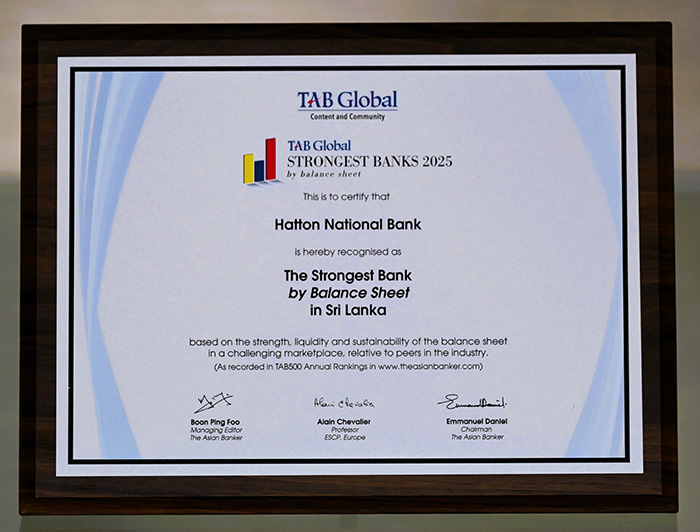
HNB PLC, the leading private bank in Sri Lanka, has been awarded the title of Strongest Bank in Sri Lanka for 2025 by TAB Global. The recognition was confirmed following the release of the TAB Global World’s 1000 Largest and Strongest Banks Rankings, with the announcement made recently
HNB’s Managing Director / CEO, Damith Pallewatte, stated that the accolade underscores the bank’s unwavering commitment to sustained financial strength and strategic resilience. “This honour shows the resilience and clarity of purpose that guide our institution. Our teams advanced through demanding cycles with discipline and accountability. The recognition confirms the trust placed in us by customers, investors and partners and it reinforces the duty we carry as a leading private bank. We remain fully committed to safeguarding long-term strength while contributing to Sri Lanka’s economic advancement with integrity and resolve.”
HNB achieves a landmark distinction in the 2025 rankings, establishing itself as Sri Lanka’s strongest bank. The assessment highlights HNB’s balance sheet quality, prudent risk discipline and the bank’s consistent ability to maintain stability through varied economic conditions. The ranking places HNB alongside leading global financial institutions acknowledged for sustained strength, institutional reliability and capacity to absorb external shocks.
Foo Boon Ping, President and Managing Editor at TAB Global, stated: “HNB demonstrated strong fundamentals and consistent delivery across multiple stress indicators. The bank’s performance placed it ahead of its domestic peers and aligned it with institutions recognised for structural strength. The ranking reflects measurable outcomes drawn from transparent criteria.”

Showers or thundershowers will occur at times in the Northern, North-Central, Eastern and Uva provinces and in Puttalam, Matale and Kurunegala districts

Rs 1. 3 bn yahapalana building deal under investigation

SL Railways suffers staggering losses; more than 2/3 of rail tracks out of service

US, SL advancing free, open, and resilient Indo-Pacific region: Embassy

Vetaran lankan artistes domiciled in UK felicitated in London ceremony

Forced disappearances, a contentious issue warranting NPP’s attention – FSP

‘Dates have the highest sugar content to fight Coronavirus’

Sunday Island 27 December – Headlines

#SundayIsland 17th December – Headlines

Sunday Island – 28th March

Sunday Island Headlines – 21 March

Sunday Island – 21st February – Headlines
-

 News4 days ago
Over 35,000 drug offenders nabbed in 36 days
-

 Features2 days ago
Finally, Mahinda Yapa sets the record straight
-

 News3 days ago
Cyclone Ditwah leaves Sri Lanka’s biodiversity in ruins: Top scientist warns of unseen ecological disaster
-

 Business6 days ago
LOLC Finance Factoring powers business growth
-

 News6 days ago
CPC delegation meets JVP for talks on disaster response
-

 News6 days ago
A 6th Year Accolade: The Eternal Opulence of My Fair Lady
-

 News4 days ago
Rising water level in Malwathu Oya triggers alert in Thanthirimale
-

 Features5 days ago
The Catastrophic Impact of Tropical Cyclone Ditwah on Sri Lanka: