
News
Shared Values and Democracy in Asia

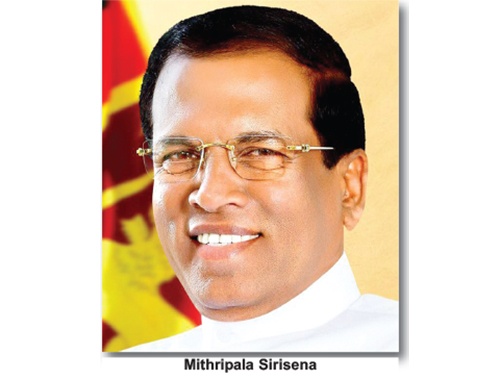
Ex-Prez Sirisena on “Shared Values and Democracy in Asia,”
Excellencies, Distinguished Participants, Ladies, and Gentlemen, Good afternoon Let me at the outset congratulate Excellency Suga Yoshihide, the Prime Minister of our cherished friend-Japan. I am extremely happy to address the Symposium on “Shared Values and Democracy in Asia,” following him, and Excellency Shree Narendra Modi, the Prime Minister of India- our great neighbour and friend.
I am reminded of the San Francisco Conference after the Second World War, where Excellency J R Jayewardene, our then Finance Minister, staunchly stood for Japan. Quoting from Dhammapada, he said, “We extend to Japan a hand of friendship, and trust… her people and ours may march together to enjoy the full dignity of human life in peace and prosperity.” Japan has achieved that wish. I consider the invitation to me echoes that friendship and trust.
Since Buddhist teachings mentor governance in Sri Lanka, I will initially touch upon how democratic and Buddhist values tally. Lord Buddha, emphasized the Sathara Sangraha Vasthu on treating the subjects. They were: dana (attached to giving-up and sharing), Priya Vachana (kind speech leading to mutual understanding), arthacharya (frugality and spirituality), and of samanatmatha (equality in dispensing justice without fear or favor). They are compatible with democratic governance principles.
Additionally, the Dasa Raja Dharma explains the virtues of the Buddhist ideal of Kingship. Democratic governance qualities are symbolized in them. For example, Dana projects to welfare, seela to morality, avihimsa to non-hatred, Shanthi to patience.
The Constitution of Sri Lanka ends with the following invocation:
‘Devo Vassatukalena
Sassasampatthi hetu cha
Phito bhavatu loko cha
Raja bhavatu dhammiko’
It meant: “May the rains be on time, may the farmers have a plentiful harvest, may the people prosper, and may the King be just.” The understanding is that as a consequence, the prosperity our governments wish is embedded in nature and the principles of good governance. This is how the Buddhist criteria bind with Sri Lankan governance
In my long political career, I successfully achieved peace, equality, freedom of expression, justice, etc., which are shared common values of democracy and Buddhism. In the first year in office of President itself, I shed the extraordinary powers of the presidency through a constitutional amendment. Appointments were made to the Superior Judiciary, membership of Human Rights, Public Service, Elections, and Police Commissions, etc., in a depoliticized and democratic manner.
Politics, when viewed from a lens of Machiavellian angle, one may comprehend that shedding unlimited power is foolish. Since a true democrat represents people he should follow his vision, not for his empowerment. I shed power knowing the potential personal loss. It was believing from the bottom of my heart the value of victorious democratic values.
During my presidency, a strong Right to Information Act was legalized. It was a victory for democratic values and human freedom.
As a father, I cannot imagine grief for a parent in a life that surpasses, seeing, hearing, the death or disappearance of a child. Respecting reconciliation, the establishment of the Office on Missing Persons and Office for Reparations was evidence for our shared democratic and humanitarian values. These echoed as positive democratic signals. Though I lost politically by deep rooting such democratic, humanitarian pillars, by fertilizing humanity I enjoyed incessant satisfaction.
In global politics, parallelly there are selfish efforts to exterminate these values. Some countries retreat from democracy to semi-authoritarianism, and even authoritarianism. Some leaders have withdrawn from humanitarian stances to the chagrin of champions of democracy. Sometimes it is despicable to observe how some democratic governments treat their minority communities, denying welfare and fundamental rights, behaving abusively, with hatred-in words and deeds. These are negative signals.
If we inquire into the root-causes for positive and negative signals, it transpires that they are symmetrically related to sharing or not-sharing democratic values. Even today these differentiations happen everywhere. Though this Symposium is Asia-centric, due to this universal spread, it transforms into an exercise of global value, validity, and appropriateness.
What is the clientele group affected by these values? One may say they belong to the politicians’ category. As President Barack Obama once stated in a democracy it is the citizen who is most important. I also believe that the citizen should be the owner and recipient of democratic values.
Therefore, citizens’ demands are the most important. What could be enjoyed by the citizen is the most important. It could be a multitude of challenges like upgrading the basic physical facilities, alleviating poverty, offering mental peace, erasing threats of wars and conflicts, enhancing humanitarianism and friendship with internationals, supporting the affected by disasters, saving the climate and environment for future generations, etc.
Most Symposium participants represent citizens. Since citizens are the most important factor, vigilance, constant monitoring, tending, etc become extremely important. In performing these, questioning, and scrutinizing the actions of citizens and their representatives become essential.
The checks and balances are provided in parliamentary institutions and Constitutions. The Public Accounts Committees, Petitions Committees, Standing Committees, etc., are our experiences. They are tools securing democratic values and independence.
As mentioned in the Constitution, the three pillars – the Executive, Legislature, and Judiciary- can perform decent democratic balancing. If one pillar steamrolls power over the other two, it will signify the death knell of democracy.
While we discuss democratic values, it is observed that other forces act to negate democratic values.
It is observed that some world powers increasingly project authoritarian influence beyond their borders by manipulation, through global propagandizing, using third-party proxies, lavishly throwing resources, or using military alliances. The battlefields of the First World are not located on their motherlands, but lands of less powerful nations. Remote controllers of war are in faraway powerful countries, away from the war fronts. Complaints are heard that some political leaders are bought-over by powerful nations. These are threats to democratic values.
Even in the developed world in firmly established democracies, we woefully observe appeals to populism, nationalism, chauvinism, and racism attracting social attention, raising their heads above democratic values, such as transparency, cooperation, rule of law, equality, etc.
Additionally, unfortunate challenges are observed emerging under the poisonous fangs and flags of organized terrorism. They carry out unsympathetic attacks. These events exhibit that democracy is open to the challenges of extremists and they are aware of how to pierce through to destabilize democracy. Therefore, the Region needs to be prepared and be on alert.
Our borders have become unrealistic with new technological development. A situation has arisen where we cannot escape cybercrimes, terrorist attacks, atomic radiation, etc. These do not care about borders.
The economic issues created especially by forcible encroachment of borders by COVID-19 has confirmed the fear of economic destabilization. This domestic and international deprivation created by it cannot be avoided in isolation. Therefore, we require the integrated cooperation of democratic countries.
Technology has effectively increased productivity, but divorced labour. In developed countries, this can result in retrenching labour or making them poor or exploited. It skews income distribution; reduces their purchasing power. It diminishes the demand for our products in their markets. It results in unemployment in our country. When it becomes acute, and no solutions are found for their problems from democracy or globalization, people degrade both and suspect them. The consequences are dangerous.
American President-elect Joe Biden once declared “Globalization has not been an unalloyed good. It has deepened the rift between those racing ahead at the top and those struggling to hang on in the middle or falling to the bottom.” With COVID 19, the status has worsened. As the new American President, we look forward to him and other developed nations for responses to us in Asia to escape from globalization impacts and the stresses of COVID-19.
If the common man does not receive positive responses, demagogues, cunning saviours, and charlatans will get opportunities to rouse people’s fear, win their vote and manipulate to divorce them from democratic values, instead of sharing democratic values.
They will attack democratic values. They will rouse emotional sentiments, deceive poverty-stricken, innocent, naïve people, and manipulate to gain political power. The powerful States, having trapped poor governments financially, may finally attempt to coerce those governments to execute anti-democratic procedures.
They will belittle freedom of expression; hack communication networks; delegitimize the independent judiciary, hamstring civil society by disparaging them as spies; use the internet and social media to disseminate misinformation and exacerbate internal divisions, etc. These deteriorate democratic values.
What we require is to develop democratic values to face future situations.
I may exemplify influences on one democratic value. The foundation of democracy lies in election systems. Having supported various political groups and elevating them to power we repent when we find them oriented to authoritarianism, and fail in solving peoples’ problems. The correct choice is the voters’ responsibility. Hence, it is important to educate the voters’ democratic social responsibility, their power, rights, obligations, and organizational processes.
Some developed countries complain of foreign interventions to electoral processes. This could be faced by any country. To counter, it is necessary to establish transparent monitoring systems on election functions and financing, money laundering processes, strengthening election-related institutions, the establishment of anti-corruption institutions, etc.
To achieve optimal results, steps should be taken to assist through democratic processes. Multilateral organizations such as the United Nations should motivate the weak parties. It is necessary to support the pulse-racing institutions in our societies such as the rule of law, protection from poverty, good governance, invasions, and pandemics, etc.
Our commitment should truly exhibit our acceptance of values such as equality, dignity, respect to the rule of law, honouring the independence of the Judiciary, balancing of separation of powers and freedoms of expression and demonstration, etc. Their outputs must reflect active democratic participation, success in democratic operations, and reduction of nasty ant- democratic violations in the society. The progress of democratic innovations and creativity are respected when everyone in the society is heard and weighed equally, citizens are empowered to hold their leaders to account through democratic institutions, no one is above the law. These processes must be our values and expectations.
Joe Biden, the American President-Elect once said that when Benjamin Franklin was exiting the Constitutional Convention, a group of citizens inquired “What kind of government the delegates had decided on?”. Benjamin Franklin had responded: “A Republic. If you can keep it.” What he meant was that there was a huge responsibility on the people to safeguard the democratic values.
Joe Biden later said: “Democracy demands diligence. Democracy demands engagement. And sometimes, democracy demands the sacrifice of its citizens.” Like for Franklin’s Republic, ‘maintaining’ a democracy is also a heavy challenge.
I believe that the participants at this symposium will commit to fulfilling the demands of diligence, engagement, and sacrifice. If we commit thus, we are certain of victory.
The nuclear disarmament and global peace champion, former Mayor of Nagasaki Ikko Itho San appealed in the Nagasaki Peace Declaration to join hands with the world’s citizens for disarmament and peace. He wished that “the bells of peace will ring loud and clear in the sky over Nagasaki.” I pray from the bottom of my heart that the ideas, recommendations, solutions, invigorating democratic values, generating from this Symposium, will one day ring loud and clear in the sky over Asia.
I wish the Symposium success.
I wish all a peaceful, happy, prosperous, and healthy New Year-2021.
Thank you very much for listening to me patiently.

Latest News
Sun directly overhead Dodanduwa, Rathgama, Yakkalamulla, Akuressa, Mulgirigala, Ranna, Kalamatiya and Ussangoda at about 12:13 noon today (05th April)


On the apparent northward relative motion of the sun, it is going to be directly over the latitudes of Sri Lanka during 05th to 15th of April in this year.
The nearest areas of Sri Lanka over which the sun is overhead today (05th) are Dodanduwa, Rathgama, Yakkalamulla, Akuressa, Mulgirigala, Ranna, Kalamatiya and Ussangoda at about 12:13 noon
Latest News
Heat Index at Caution Level in the Western, Sabaragamuwa, Southern, Eastern, North-western, Northern and North-central provinces and in Monaragala district

Warm Weather Advisory
Issued by the Natural Hazards Early Warning Centre
Issued at 3.30 p.m. on 04 April 2026, valid for 05 April 2026
The Heat index, the temperature felt on human body is likely to increase up to ‘Caution level’ at some places in the Western, Sabaragamuwa, Southern, Eastern, North-western, Northern and North-central provinces and in Monaragala district.
The Heat Index Forecast is calculated by using relative humidity and maximum temperature and this is the condition that is felt on your body. This is not the forecast of maximum temperature. It is generated by the Department of Meteorology for the next day period and prepared by using global numerical weather prediction model data.

Effect of the heat index on human body is mentioned in the above table and it is prepared on the advice of the Ministry of Health and Indigenous Medical Services.
ACTION REQUIRED
Job sites: Stay hydrated and takes breaks in the shade as often as possible.
Indoors: Check up on the elderly and the sick.
Vehicles: Never leave children unattended.
Outdoors: Limit strenuous outdoor activities, find shade and stay hydrated.
Dress: Wear lightweight and white or light-colored clothing.
Note:
In addition, please refer to advisories issued by the Disaster Preparedness & Response Division, Ministry of Health in this regard as well. For further clarifications please contact 011-7446491.


The internationally recognized “Walk for Peace,” originating from the United States, is set to take place in Sri Lanka starting April 21, 2026, led by the Most Venerable Paññakara Thero and a delegation of twelve monks from the Maha Sangha, President’s Media Division said.
Spanning seven days across the island, this pilgrimage’s purpose and concept are guided by the Buddha’s teaching, “Caratha bhikkhave carikam bahujana hitaya bahujana sukhaya lokanukampaya” (Wander forth, O Monks, for the welfare and happiness of the many, out of compassion for the world).
This program aims to promote peace and lovingkindness within society. It serves as a practical demonstration that peace cannot be attained by force, but must be cultivated step-by-step through mindfulness.
The inaugural event of this program is scheduled to be held in Anuradhapura on April 21, 2026. A ceremony to receive the sacred sapling of the Jaya Sri Maha Bodhi will take place at 4:00 PM, followed by special religious observances at the sacred Ruwanweliseya premises at 5:00 PM.
Thereafter, the walk will commence from the ancient Dambulla Royal Cave Temple and proceed towards Kandy. Upon reaching Kandy, the Maha Sangha will pay their respects to the Chief Prelates (Maha Nayaka Theros) of the Malwatta and Asgiriya Chapters, before visiting the Sri Dalada Maligawa (Temple of the Sacred Tooth Relic) to receive blessings.
Throughout the journey, the procession will carry the sacred sapling of the Jaya Sri Maha Bodhi, along with venerated relics from the historic Nilagiri Cetiya, Madanwala Raja Maha Viharaya in Hanguranketa, Mahiyangana Raja Maha Viharaya, and the Hunupitiya Gangaramaya.
The walk will conclude at Independence Square in Colombo on April 28, 2026. Subsequently, the venerated relics and the sacred sapling of the Jaya Sri Maha Bodhi are to be carried from Independence Square to Gangaramaya Temple, Hunupitiya, Colombo by a procession.
The Sri Lankan coordination of the event is spearheaded by Venerable Melpitiye Wimalakirti Thera. The Government of Sri Lanka’s flagship national program, “Clean Sri Lanka,” serves as the principal state partner.
Additionally, the event receives extensive support from various state institutions, including the National Design Centre, the Tri-Forces, and the Department of Information.
At the conclusion of the seven-day walk, a special State Ceremony will be held at Independence Square in Colombo on April 28, 2026. Concurrently, a special exhibition showcasing Sri Lanka’s Buddhist heritage and traditional handicrafts will be organized by the National Design Centre at the Gangaramaya premises on April 28 and 29, 2026.
This exhibition will feature brass items (ceremonial fans, flags, statues, bowls, and pinnacles), lacquerwork (caskets and boxes), clay crafts (bowls and statues), palm leaf crafts (fans and sesath), natural dyeing of robes, Dumbara wall hangings, traditional drums, and traditional paintings.
The primary objective of this cultural program is to contribute Sri Lanka’s Buddhist and cultural heritage to a project in Texas, USA, where the Tripitaka is being inscribed in 10 languages and enshrined within 840 stupas to create a centre for Buddhist education.

Sameer Rizvi aces another tricky chase as Delhi Capitals floor Mumbai Indians

Sun directly overhead Dodanduwa, Rathgama, Yakkalamulla, Akuressa, Mulgirigala, Ranna, Kalamatiya and Ussangoda at about 12:13 noon today (05th April)

Showers expected in the Western, Sabaragamuwa, Central, Southern, Uva, Eastern and Northcentral provinces after 2.00 p.m.

Heat Index at Caution Level in the Western, Sabaragamuwa, Southern, Eastern, North-western, Northern and North-central provinces and in Monaragala district

Global ‘Walk for Peace’ to be held in Lanka

World Bank launches new 5-year partnership framework with Lanka

‘Dates have the highest sugar content to fight Coronavirus’

Sunday Island 27 December – Headlines

#SundayIsland 17th December – Headlines

Sunday Island – 28th March

Sunday Island Headlines – 21 March

Sunday Island – 21st February – Headlines
-

 News3 days ago
2025 GCE AL: 62% qualify for Uni entrance; results of 111 suspended
-
 News5 days ago
Tariff shock from 01 April as power costs climb across the board
-
 News6 days ago
Inquiry into female employee’s complaint: Retired HC Judge’s recommendations ignored
-
 Features6 days ago
New arithmetic of conflict: How the drone revolution is inverting economics of war
-

 Editorial3 days ago
Search for Easter Sunday terror mastermind
-

 Business4 days ago
Hour of reckoning comes for SL’s power sector
-

 Sports6 days ago
Sri Lanka’s 1996 World Cup heroes to play exhibition match in Kuala Lumpur
-
 Features5 days ago
Seychelles … here we come